In Contention

Tag: Reviews

  • SHORT TAKE: “The Illusionist” (****)

    The IllusionistBerlin International Film Festival

    It took six days and an awful lot of films, but the Berlinale has finally turned up a masterpiece. Moreover, it’s a rare case of one of the fest’s most eagerly awaited titles managing to meet, and even subvert, expectations.

    “The Illusionist,” French animator Sylvain Chomet long-gestating follow-up the 2003 Oscar nominee “The Triplets of Belleville,” confirms a truly singular auteur sensibility, while revealing a more disciplined artist and storyteller within. A streamlined character study, less deliriously eccentric in tone and structure than his debut feature, “The Illusionist” nonetheless boasts an emotional heft that handsomely repays its creator’s restraint.

    Those who have been following the project will already know the reason for the newfound calm in Chomet’s quirk. “The Illusionist” is based on a previously unfilmed script by the late comic master Jacques Tati, and the film plays as a fascinating across-the-decades collaboration between two distinct voices (though given their shared preference for amusingly garbled dialogue, perhaps “distinct” isn’t the word) of French comedy: the tangling of Tati’s genial situational humor with Chomet’s more extravagant flights of fancy proves mutually enhancing.

    (more…)

  • BERLIN: ‘Please Give,’ ‘Red Hill,’ ‘Submarino’

    Ryan Kwanten in Red HillFilm festivals have a curious way of either dulling one’s critical faculties or provoking them to an impolite degree. I almost never walk out of a screening under normal circumstances; at a festival, while compressing five-odd films into one day, it’s almost life-affirming to do so.

    Such was the case yesterday, halfway through “Caterpillar,” a Competition entry from widely admired Japanese veteran Koji Wakamatsu. An apparent Oshima knockoff combining catatonic narrative inertia with visual dinginess, it centers on a mute, limbless Sino-Japanese War vet rebuilding his relationship with his wife: “rebuilding his relationship” being a euphemism for working his way through the paraplegic Kama Sutra.

    After a sufficient number of po-faced sex scenes, interspersed with shots of cherry-blossom to indicate the passing of seasons — the film, it seems, was edited with a blunt axe — Tim turned to me and whimpered, “I can’t take it anymore.” We bailed and headed for “Gentlemen Broncos” instead; and you know now how that worked out.

    The film has its champions, mind. And I’m now convinced it will win something on Saturday just to spite me. After the cut, however, are three films I happily sat through in their entirety.

    (more…)

  • BERLIN: ‘Winter’s Bone,’ ‘Greenberg,’ ‘Exit Through the Gift Shop’

    Jennifer Lawrence in Winter's BoneYesterday’s viewing roster just about had me double-checking whether I was at the right festival, as I was treated to a pair of Sundance hits, in addition to a brand-new Amerindie feature from a Sundance alumnus. The copious snow still smothering the sidewalks of Berlin only aided the comparison.

    Perhaps it was Valentine’s Day spirit making me more benign – apparently against the current of critical opinion, in the case of Noah Baumbach’s “Greenberg” – but all three films, moreover, afforded me pleasures of varying degrees. (And definitions: “pleasure” is not the most appropriate term for a film as severe as “Winter’s Bone.”)

    “WINTER’S BONE” (***1/2)

    In 2004, NYU film grad Debra Granik spun a student short into a ragged but confident debut feature, “Down to the Bone,” that landed her a Sundance award and kick-started the career of a sensational actress named Vera Farmiga. Perhaps you’ve heard of her.

    (more…)

  • REVIEW: “Invictus” (**)

    InvictusThere’s really no arguing the fact that South Africa’s victory in the 1995 Rugby World Cup was an inspirational moment of collaborative triumph for a country healing the wounds of the past.  The occasion was an against-all-odds statement of progress and togetherness.  It announced to the world that a nation had chosen to look to the future, not to the past.  And the echoes undeniably reverberate in the crossroads the United States finds itself in this very day.

    These themes are apparent in Clint Eastwood’s “Invictus,” but they do not have the elevating quality that might have rendered them truly affecting.  A flat narrative and tedious structure ironically hold the audience at arm’s length from a story of inclusion and camaraderie.  A confused central relationship is done no favors by a lack of true conflict and dramatic tension (the latter due largely to swift third act resolution).  The film simply chugs along at a capable but unremarkable pace, and given the subject matter, it’s staggering how arbitrary the proceedings ultimately feel.

    This might be seen as par for the course when it comes to Eastwood.  He is an unfussy director concerned with streamlined, no-frills visual story telling, and at times, refreshingly so.  But “Invictus” doesn’t feel like the work of a man invigorated by his focused process.  It almost feels like the work of an exhausted artist, letting any number of elements slide on the way to completing a toothless, benign depiction of a momentous occasion.

    (more…)

  • SHORT TAKE: “Nowhere Boy” (**1/2)

    Nowhere BoyLondon Film Festival

    A bright, slight, mostly enjoyable portrait of the formative years of John Lennon, artist-turned-filmmaker Sam Taylor-Wood’s “Nowhere Boy” opens with a nudge-nudge tease, as the singular opening chord of “A Hard Day’s Night” reverberates through the theater over a shot of the 18 year-old Lennon running to school.

    That single-second strum, however, is all we get of the ubiquitous Beatles songbook, as Taylor-Wood and screenwriter Matt Greenhalgh (“Control”) go out of their way to distance their story from Fab Four iconography, even coyly dancing around any mention of the “B” word. “What do you call yourselves now?” Lennon’s weary Aunt Mimi (Kristin Scott Thomas) asks her nephew over breakfast, after he announces the band’s plans to travel to Hamburg. “Do you care?” is his tart reply.

    Even if this is a little too cute, it’s cause for commendation that the film largely avoids the contrived “inspiration” cues that usually plague the musical-biopic genre. A fleeting glimpse of the original Strawberry Fields house in Liverpool is about as on-the-nose as things get; we’re spared the mandatory montages of the artist scribbling lyrics in a battered notebook, and even the Beatles cuts performed towards the film’s end are authentic fledgling efforts. (Over-familiar 1950s rock n’ roll standards comprise the bulk of the soundtrack, while Goldfrapp’s incidental score hardly registers.)

    (more…)

  • REVIEW: “The White Ribbon” (***1/2)

    The White RibbonLondon Film Festival

    With apologies to Pete Townshend, the kids are most certainly not alright.

    Such is the message we seem to be gleaning from the cinema of 2009, as a vast range of unrelated titles – “Precious,” “Coraline,” “Dogtooth,” “Antichrist,” “Fish Tank,” even “An Education” – appear united in visiting the physical and/or psychological damage wrought upon children by either obliviously or maliciously neglectful parents, in some cases planting the seeds of trauma for further generations.

    No film this year, however, addresses the matter with more thematic exactitude and near-scientific scrutiny than Michael Haneke’s grimly riveting “The White Ribbon,” a film which differs from the ones previously mentioned by taking an entire community, as opposed to a solitary family, as its allegorical subject. More expansive in its focus than any previous Haneke work, it nonetheless surprises with the intimacy of its gaze and the social responsibility of its treatise.

    Eternally fascinated by human behaviour, yet never a director much associated with the humane – his trademark chilliness reaching new heights (or depths, if you prefer) with last year’s “Funny Games” remake, which treated its papery characters with even more diagrammatic dispassion than the 1997 original – Haneke finally marries these two approaches here, empathizing with its considerable ensemble of characters even as it dissects them.

    (more…)

  • LONDON: ‘Micmacs,’ ‘The Time That Remains’

    Dany Boon in MicmacsI am presently seeing films at the London Film Festival at a greater pace than I can write them up — expect a round-up of curt (by my standards, at least) capsule reviews either later today or tomorrow.

    Some films, however, demand to be reviewed in pairs, as is the case with Jean-Pierre Jeunet’s latest, the frothy action caper “Micmacs,” and Elia Suleiman’s rather more subdued Cannes entry “The Time That Remains,” which I saw this afternoon and yesterday respectively — two polar-opposite films that nonetheless both blend naive physical comedy with a political agenda, to very different tonal effect.

    “Micmacs” (**)

    As a filmgoer, few things are as dispiriting as the sensation that everyone on screen is having more fun than you — and not being able to join in. Such, I regret to inform, was my experience watching the latest eccentricity from Jean-Pierre Jeunet (“Amélie,” “Delicatessen”), which floods the screen with inventiveness, enthusiasm and his trademark sepia-stylized visuals — special kudos to Aline Bonetto’s production design — but is so claustrophobic, and so convinced of its own charms, that the narrative is lost somewhere in the bustle.

    (more…)

  • LONDON: ‘Enter the Void,’ ‘Wolfy’

    Paz de la Huerta in Enter the VoidAs if sympathetic to the fact that I’d have a pounding hangover from Wednesday’s swish opening party in Chelsea, festival organizers were kind enough to schedule a film I’d already seen, “The Men Who Stare at Goats,” for the next morning, affording me a much-needed lie-in.

    Still, George Clooney’s second go-round on the LFF red carpet in as many days was the day’s major event. I already weighed in on the film at Venice, though from conversations I’ve had with others, I’m not finding many supporters for my view that the film is big, silly fun.

    Anyway, missing this stop on the Clooney-London express afforded me the chance to catch up with two artier prospects that had been high on my festival priority list, one big (Gaspar Noé’s latest Cannes-endorsed provocation “Enter the Void”) and one small (Russian playwright Vassily Sigarev’s filmmaking debut “Wolfy”). Guess which one was the keeper.

    “Enter the Void” (**)

    Back in 2002, more column inches were spent on two isolated scenes — an agonizing rape sequence and that fire-extinguisher bludgeoning — than the whole of Gaspar Noé’s “Irréversible,” but amid the shrill cries of the moral police, the film arguably received insufficient credit for its thoughtfulness (and structural verve) in probing and evaluating the way we respond to onscreen violence. An astonishing technical feat by any measure, it was that rare film that revealed something of the viewer to himself, albeit in an unpleasant fashion.

    (more…)

  • REVIEW: “Fantastic Mr. Fox” (***)

    Fantastic Mr. FoxLondon Film Festival

    Rather like two well-matched friends that one sets up on a failed blind date, Roald Dahl and Hollywood really ought to have got along better over the years. Taken at face value, Dahl’s rightly beloved children’s books should be a cinch to film: the concepts are high, the imagery vivid, the storytelling swift and snappy.

    Yet for all these virtues, and for no lack of trying on Hollywood’s part, a stone-cold classic filmization of one of his novels still awaits us. Some stand by Mel Stuart’s irony-deficient “Willy Wonka and the Chocolate Factory”; others will put in a word for Henry Selick’s vividly textured but emotionally inert take on “James and the Giant Peach.” No filmmaker has exhibited more understanding of Dahl’s cruel streak than Nicolas Roeg, but his largely dazzling “The Witches” still loses its nerve in the final reel with a facile ending.

    Though the men share a broad eccentricity, Wes Anderson’s fey, faintly solipsistic creative touch once more seems a less-than-perfect match for the nastier, more arch sensibility of Dahl – and there are a few glib missteps in his otherwise appealingly ragged riff on “Fantastic Mr. Fox” that show up the disconnect.

    But Anderson has at least been savvy in picking one of Dahl’s youngest-skewing, most sweet-natured narratives for his first ever adaptation. The brevity and elemental simplicity of the book’s survival-themed tale provides a lot more room for Anderson’s trademark affectations and diversions – be it the familiar 1970s-style duds or a jangly nonsense ditty from Jarvis Cocker – than Dahl’s later, darker work would.

    (more…)

  • REVIEW: “The Messenger” (***1/2)

    The MessengerThere is a film that succeeds as a cerebral drama, concerned with the impact of war on the individual, free of the genre’s typical tropes and remarkably fresh as a result.  And believe it or not, I’m not talking about “The Hurt Locker.”
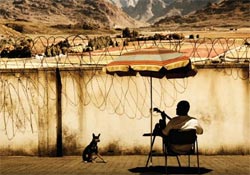
    Of course, it is unfair to Oren Moverman’s “The Messenger” to so quickly evoke the name of one of the year’s most critically acclaimed films by way of comparison.  And Kathryn Bigelow’s sterling 2009 gem doesn’t deserve to be jerked down a peg by showcasing the merits of another, more under-the-radar film.

    But the fact remains, these two efforts are departures from the status quo in a dramatic subset that is perhaps more artistically important now than it has been in 60 years.  And Moverman’s film has settled, for this viewer, much more completely than Bigelow’s.  It instantly stands out as one of the year’s most powerful dramas.

    The nuts and bolts of the story concern a pair of military officers charged with the heavy burden of notifying next of kin in the event of a combat casualty.  Woody Harrelson’s Anthony “Tony” Stone has been wading through the waters of this “sacred” task for some time and has come to identify its importance with a strict regimen followed each time out.

    Ben Foster’s Will Montgomery, meanwhile, has been relegated to Tony’s charge in the wake of a heavy combat experience.  He is neither comfortable with the emotional workload of the job nor, seemingly, convinced of its importance over his battlefield duties.

    The narrative isn’t focused in any traditional manner.  It serves up what is, essentially, a series of vignettes, Tony and Will notifying next of kin in a variety of atmospheres.  These are powerfully acted by supporting, basically cameo players such as Peter Friedman, Halley Feiffer, Steve Buscemi and Angel Caban, among others.

    (more…)

  • SHORT TAKE: “Disgrace” (***1/2)

    John Malkovich in Disgrace“As long as one is alive, one is all right.”

    These words, spoken with pithy irony by John Malkovich halfway through Steve Jacobs’s brilliant, bruising adaptation of J.M. Coetzee’s novel “Disgrace” — which opens Stateside tomorrow — encapsulate a post-apartheid South Africa more riven by crime and inequality than the bandages of democracy can cover. It’s a world where survivor’s grief is constantly chased by the threat of a more fatal occurrence; where, with no commodity more valuable than security, ugly human compromises must be made.

    Published in 1999, Coetzee’s novel was a well-aimed bullet to the heart of a nation still negotiating its social and racial prejudices, laying them bare with few pointers towards reconciliation. Denounced as racist in some quarters of the ruling African National Congress, it doesn’t cast any social group in a particularly flattering light. Rather, it focuses on individuals, and the very different ways they manage their escalating mistrust of the other.

    The story’s dependence on the country’s multi-splintered cultural differentiations makes the outside-in achievement of Australian director Jacobs (and his wife Anna Maria Monticelli, who wrote the screenplay) all the more miraculous. I can’t recall another feature film that so tangibly evokes the country that I grew up in, from its point-on account of lingering (and shifting) master-servant acrimony to minute details of production design.

    (more…)

  • SHORT TAKE: “A Single Man” (***1/2)

    Colin Firth and Julianne Moore in A Single ManVenice Film Festival

    In a curious way, revered fashion designer Tom Ford had a defined auteur’s stamp before he ever so much as shot a frame of his debut film: from his louche advertising campaigns to his infamous curation of Vanity Fair’s 2007 Hollywood issue to the forms and textures of his designs themselves, Ford has constructed a highly idiosyncratic brand identity fusing burnished retro cool and chilly modern eroticism.

    No surprise then, that the handsome, eggshell-delicate character study “A Single Man” is very much an extension of that identity: trading in polished surfaces and swoonily aestheticized desire, the film looks on occasion like an animated GQ shoot. (And yes, Ford provides the leading man’s wardrobe.)

    But just as you’re tempted to dismiss the film as a gorgeous vanity exercise, it reveals a keen beating heart beneath the decor — and the match of Ford’s precise sensibility to Christopher Isherwood’s 1964 literary examination of the effect of grief on an overly compartmentalized life begins to make perfect sense.

    (more…)

  • VENICE: ‘Mr. Nobody,’ ‘Lola’

    Jared Leto in Mr. NobodyThe Lido finish line beckons, as this morning saw the press screening of the final film in Competition, Tom Ford’s “A Single Man.”

    Ford’s debut (which I’ll deal with in a separate Short Take) surpassed my expectations, completing a slight upswing in the standard of films on display that began with yesterday’s second Surprise Film selection: Brillante Mendoza’s “Lola,” which proved surprising in more than just a programming sense.

    Jaco van Dormael’s elaborate fantasy “Mr. Nobody” never quite gelled for me — and still, none of these titles touch “White Material” — but it’s been a pleasant day’s viewing nonetheless.

    Now the process begins of sorting the wheat from the chaff — with not a whole lot of wheat to go around, in my eyes — and playing the futile guessing-game of who will take home the gold. I’ll have a post with my predictions and preferences tomorrow, but for now, the last bundle of Competition reviews:

    “Mr. Nobody” (**½)

    Jaco van Dormael’s first film in 13 years betrays the formal rustiness and structural indiscipline that such a hiatus can cause in an artist, but there’s enough unique visual artistry and demented storytelling bravery on display here to make one glad he’s back.

    (more…)

  • VENICE: ‘Soul Kitchen,’ ‘The Double Hour’

    Soul KitchenHappily, the bug that kept me down yesterday seems to have flown on the wings of Nurofen and a night’s sleep, so I’m ready to face the Lido madness again.  As if sympathetic to my state, the Competition served up two relatively untaxing titles.

    Festival director Marco Müller made it clear that he was experimenting with a more mainstream-friendly approach in this year’s Venice programme — hence the inclusion of “Bad Lieutenant” and “Survival of the Dead,” among others, in the lineup — so the overt genre leanings of Italian psycho-thriller “The Double Hour” came as no surprise, particularly given its hometown advantage. Far less expected was that heavyweight German-Turkish auteur Fatih Akin would arrive with the fluffiest Competition entry to date.

    This afternoon brings a second “surprise film” in the Competition (here’s hoping it’s a more pleasant surprise than “My Son, My Son, What Have Ye Done?”), as well as Jaco van Dormael’s “Mr. Nobody.” As eagerly as I’m awaiting the latter, I might have to postpone it to tomorrow, as a producer friend of mine unveils a short film next door. Onto this morning’s films …

    “Soul Kitchen” (**)

    Fatih Akin’s candyfloss-light character comedy will come as a major shock to those familiar with the 36 year-old director via his solemn arthouse works “Head-On” and “The Edge of Heaven.”

    (more…)

  • SHORT TAKE: “The Men Who Stare at Goats” (***)

    George Clooney and Ewan McGregor in The Men Who Stare at Goats

    Venice Film Festival

    A trim, lively comedy powered by a winning quartet of personality performances and an endearingly naff drive-time rock soundtrack, Grant Heslov’s helming debut “The Men Who Stare at Goats” doesn’t make too many demands of its audience. In return, we shouldn’t make too many demands of the film.

    Anyone looking for a skewering satire of U.S. military practice might come away disappointed, even as the film opens with the cute semi-disclaimer, “More of this is true than you might imagine.”

    Based on British journalist-humorist Jon Ronson’s book of the same title, which investigated the development of outlandish psychological warfare techniques in the U.S. army and their application in the Iraq war, Heslov’s film (from a script by Peter Straughan) jettisons most of Ronson’s dark gallows humor in favor of a sunnier, sillier sort of absurdity.

    Not much has been retained but the idea of crazy psychic soldiers with telekinetic powers (the title is to be taken literally), but given the indifference of film audiences to anything remotely Iraq-related, you can hardly blame the “Goats” team for playing down the political currency of their source material.

    (more…)

  • VENICE: ‘White Material,’ ‘Around a Small Mountain,’ ‘Lebanon’

    White MaterialVenice Film Festival

    The big deal on the Lido today was Oliver Stone rolling into town for his Hugo Chavez documentary “South of the Border” — I did my level best to catch the screening this afternoon, but demand greatly exceeded seat supply on this particular occasion. Tomorrow, perhaps.

    Otherwise, the search continues at the festival for a talk-of-the-town critical hit: I had hoped that the extraordinary “White Material” might be it, but the reception so far seems to be warm rather ecstatic. Still, given the general goodwill towards Claire Denis (who has surprisingly never claimed major festival gold) and the undeniable quality of the film, it has to be regarded as one of the frontrunners.

    The title that keeps resurfacing in conversation, interestingly enough, is Todd Solondz’s “Life During Wartime”: people really like the film, it seems, and the fact that an extra screening has been arranged for it may or may not be significant. If I were a betting man, this is where I’d place my chips. Anyway, onto some short takes of the great, the good and the befuddling.

    “White Material” (****)

    I’ve been chided elsewhere for not being direct enough in my reviews, so let’s just get this out of the way: Claire Denis is one of the greatest filmmakers alive, and “White Material” is one of her greatest films.

    (more…)

  • TELLURIDE: ‘Red Riding,’ ‘A Prophet’

    Tamar Rahim in A ProphetThings are winding down in Telluride.  I saw the last film I’ll see here last night (Jacques Audiard’s “A Prophet”) and have a few things to square away before I hop the shuttle for Montrose and, finally, the flight back to Los Angeles.

    The fest has been a low key delight.  An IFC-sponsored dinner Saturday night brought out a number of the principals from films on display (where I had fun throwing back a few and discussing “that moment” when you decide film will be your life with “Red Riding” producer Andrew Eaton).  Nicolas Cage was strolling the streets last night with his kid, free of the usual adoring mob.  Jason Reitman, Viggo Mortensen, Paul Schneider, Carey Mulligan, etc. have made themselves available for interviews, priming the pump for Oscar season.  Good times all around.

    The big winners of the fest, from what I can gather from conversations with a number of attendees, are Michael Hoffman’s “The Last Station,” Todd Solondz’s “Life During Wartime” and, of course, Jason Reitman’s “Up in the Air,” among others.  Unfortunately, I missed (again) Michael Haneke’s “The White Ribbon” and a number of the once-in-a-lifetime screenings from Alexander Payne’s program, but I had a full, enjoyable time regardless.  I have a few more interviews to get to today, but I thought I’d rattle off the last pair of capsule reviews before I head off into town for some meet-and-greets.

    (more…)

  • SHORT TAKE: “The Informant!” (***)

    The Informant!

    Venice Film Festival

    That jaunty exclamation mark handily sets the tone for Steven Soderbergh’s “The Informant!,” a flip, frisky entertainment that may well represent the year’s most audacious feat of adaptation.

    Of course, the trailer already (and unavoidably) pulled the covers from the film’s biggest trick: that writer Scott Z. Burns (“The Bourne Ultimatum”) has reimagined Kurt Eichenwald’s dense non-fiction thriller about a mid-1990s agribusiness price-fixing scandal as a rapid-fire corporate comedy of errors, like “The Insider” as filtered through the dry whimsy of Preston Sturges.

    It’s a double or nothing strategy that merrily pays off, offering rich comic dividends as the true-life nature of the material elevates its absurdity, but — far more surprisingly — not sacrificing the sense of consequence and complexity in the events at hand.

    Critically touching on both the antisocial nature of corporate American greed and the inefficiency of the government in curbing it, the film actually makes an elegant companion piece to its its festival compatriot, Michael Moore’s “Capitalism: A Love Story” (reviewed here).

    (more…)