In Contention

Tag: Reviews

  • Alfredon’s ‘Tinker, Tailor’ smolders on screen

    I don’t want to write too much about “Tinker, Tailor, Soldier, Spy” right now because, point blank, I want to see it again and digest and — gasp! — consider.

    For now, though, I’ll start with this: It’s an impeccably made, satisfyingly dense piece of work from director Tomas Alfredson. It’s the rare film that is a slow burn but nevertheless moves along at a clip, with a very well-honed editorial sense, I might add.

    The thing is, I saddled up to the film this afternoon without knowing the source material or bothering to investigate it much. I’ve never read John le Carre’s novel (I will) and I haven’t seen the 1979 British mini-series starring Alec Guiness (I will). And the vibe I get is it would be helpful to come to the new film with a modicum of knowledge on that, but it’s no less satisfying. It just means a second look is in order, and I’m all for it, because you come away with an extreme reverence for craft here.

    (more…)

  • VENICE: Delicious ‘Damsels’ breaks the Closing Night curse

    “Oh, Christ, that means it’s going to be shit,” wailed a friend of mine, an ardent devotee of long-dormant American auteur Whit Stillman, when the director’s new film, “Damsels in Distress,” was announced as the Closing Night film of this year’s Venice Film Festival.

    I consoled him that it needn’t be the case, but only half-heartedly. It’s an unwritten rule of major festival programming that the closing film should be, if not shit, at least aggressively mediocre — particularly at Venice, so as not to antagonize the hordes of journalists who have already departed for Toronto. God forbid they should be given a reason to stay.

    Last year’s selection was certainly the kind that benefited from being seen by as few eyeballs as possible: Julie Taymor’s ghastly adaptation of “The Tempest” was both the nadir and epitome of festival closers, its ill fortunes seemingly cast in stone even before the critics stuck the boot in. The unfailingly literate, stylish Stillman couldn’t have made a film that bad, could he? Surely not. And yet why was Venice director Marco Mueller burying it at the end? And why was the first film in 13 years from this critics’ darling not in  Competition?

    (more…)

  • VENICE: ‘Texas Killing Fields,’ ‘Faust,’ competition stragglers

    After a ten-day, 23-film Venice Competition that started slowly but respectably, hit a healthy stride midway through and began wheezing with exhaustion in its closing stages, things have finally ground to a permanent halt with “Texas Killing Fields” (**), the sophomore feature from Ami Canaan Mann — daughter of Michael,  who predictably takes a producer credit here. Mann fille arrived on the Lido a mostly unknown quantity — her debut feature dropped 10 years ago, and appears to have been by precisely nobody in that time — and I’d love to say she proved to be something of a secret weapon up festival director Marco Mueller’s sleeve.

    Alas, the only weapons brandished by this color-by-numbers tumbleweed policier are those belonging to the dutifully scowling small-town cops played by Sam Worthington, Jeffrey Dean Morgan and one of Jessica Chastain’s recently minted clones — the ones to whom she now hands the second-string scripts that don’t quite merit her personal attention.

    (more…)

  • VENICE: ‘Killer Joe,’ ‘The Exchange,’ ‘4:44: Last Day on Earth’

    With two days to go until wrap-up, and a host of journalists having defected to Toronto, one can feel the air not-so-slowly hissing out of the Venice balloon. And while this certainly has its upsides — it no longer takes half an hour to get an espresso as the festival café, for example — it’s difficult to escape the sense that we’re drinking the dregs of the film programme. (If I had a euro for every time I’ve heard the term “front-loaded” uttered around the Lido…)
    Or perhaps not — the festival didn’t start to a tune of critical consensus, and it’s not ending that way, either. Last night, the last of the heavyweight Euro auteurs in competition, Aleksandr Sokurov, unveiled his take on Goethe’s “Faust” — and while I thought it a mostly agonizing misstep for the Russian formalist (with a bevy of walkouts suggesting others agreed), ecstatic applause all the way through the closing credits didn’t bode well for critical consensus. Sure enough, Sight & Sound’s Kieron Corless tweeted this morning that the film is “flawless,” and online bookies appear to be knocking down its Golden Lion odds. To each his own cinema, and all that — but I’ll happily let others have mine, in this case.

    (more…)

  • REVIEW: “Wuthering Heights” (***1/2)

    Venice Film Festival

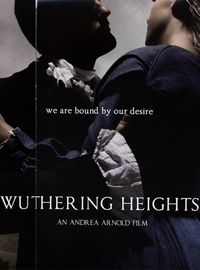
    British filmmaker Andrea Arnold would have been 16 years old when Kate Bush topped the UK pop charts with “Wuthering Heights,” a swirling art-rock ballad that stripped the Emily Brontë novel for which it is named down to a few key lines and narrative details, but evoked its grand-scale tragic romance in more intuitive terms. In its wake, a new generation of schoolgirls clutched Brontë’s words tightly to their chests.

    We can only speculate how Arnold came to the novel, but her bold, forbidding and impressively reconceptualized “Wuthering Heights” appears to take the Kate Bush course of adaptation: gutted of most of its words, with some choice ones added (I haven’t read it in some time, but I’m pretty sure Brontë didn’t write the line, “Fuck you all, cunts”), the novel serves as a theoretical starting point for an artwork that redraws the story with the most immediate sensory tools of its medium. This is a “Wuthering Heights” of weather and flesh and grass and locked eyes, one that has the simple common sense and staggering cinematic wherewithal to know that great adaptations don’t beat great writers at their own game; they play a new game entirely.

    (more…)

  • REVIEW: “Tinker, Tailor, Soldier, Spy” (***1/2)

    Venice Film Festival

    An uncharacteristically dark Venetian downpour greeted this morning’s premiere screening of “Tinker, Tailor, Soldier, Spy,” and if some flashbulbs of lightning last night hadn’t already previewed the turn in weather, I’d suspect the pervasively, necessarily drab atmospherics of Tomas Alfredson’s artful John le Carré adaptation of bleeding out from the screen and into the beyond.

    Looking for all the world as if the print has been stewed in black tea before being left to gather a few months’ worth of dust in the projection room — and that’s a good thing, I hasten to add — the film proves a happy marriage between two very different brands of understated precision: the British scholarliness of le Carré’s dense espionage lore and the icier Scandinavian calm that Alfredson brought to his breakout vampire drama, “Let the Right One In.”

    In many ways, Alfredson directs le Carré’s self-described “little gray men” of Britain’s MI6 intelligence service as they are themselves vampires of the Cold War: lurking in irremovable half-light, striking efficiently and selectively, and only notionally acquainted with the concept of sunlight, these thickly-tweeded spies appear to bear the burden of their profession as a lifelong alibi for the avoidance of intimacy, social functionality and even standard-issue conversation.

    (more…)

  • VENICE: ‘Dark Horse,’ ‘Chicken With Plums,’ ‘Sal’

    (Review of “Tinker, Tailor, Soldier, Spy” landing later this morning. Hang tight.)

    Todd Solondz has forged a loyal friendship with the Venice Film Festival across the second half of his career: all three of his last features have premiered here. Their mutual devotion somewhat surprises me, given that both Solondz screenings I’ve now attended on the Lido have seemingly been received with a measure of polite confusion by the home crowd, like an awkward cocktail party guest joining in the laughter at a joke he didn’t quite hear. Perhaps other high-end festivals simply lost their taste for his casual misanthropy; after the 1998 career peak of “Happiness,” most arthouse audiences seemed to do the same.

    They could potentially be lured back by “Dark Horse” (***), a more streamlined character comedy that, while neither as probing nor as acidly funny as 2009’s “Life During Wartime,” might just represent the warmest film Solondz is capable of making.

    (more…)

  • REVIEW: “Shame” (***1/2)

    Venice Film Festival

    If “Hunger,” artist-turned-filmmaker Steve McQueen’s remarkable debut feature, was a study of a body strenuously denied its fundamental needs, his satisfyingly rigorous, explicit follow-up, “Shame,” traces the very different damage done by a body over-gifted with wants.

    A sternly formalist parable on the pruning and stunting of relationships both familial and carnal in modern-day urban society, “Shame” is only for the purposes of swift summary a story of sex addiction — specifically that endured by Brandon, Michael Fassbender’s dourly handsome New York advertising hotshot. Sex, and the pursuit thereof, is what needles Brandon first and foremost, but it doesn’t take Freud (or indeed Fassbender’s own Jung from “A Dangerous Method”) to tell that it’s a displaced urge in a life whose most crippling vacancies take longer to fill than a Friday night fuck.

    “Hunger” was a film that dismantled known history and re-presented it in highly sensual, imagistic terms. The new film might be a foray into fiction for its director — working from an original screenplay by British playwright and television scribe Abi Morgan — but it performs a similar trick with psychology so embedded in the popular consciousness it would appear to offer little room for surprise.

    (more…)

  • VENICE: ‘Alps’ and other drugs

    The first few days of the Venice Film Festival were so jam-packed with the big-name premieres you’ve been most restless to hear about that, between thrashing out full-length individual reviews of those and negotiating the braided Venice obstacles of crippling humidity and crippled wi-fi facilities, my usual roundups of less flashy fare got a bit shunted. As did anything in the way of an introduction: we may have already reached the close of Day Four, but hey, welcome to this year’s Venice coverage! Hope you’re enjoying it at least as much as I am. More, hopefully.

    As you’ve probably gathered from the reviews I have written, it’s been a quiet festival so far: perhaps I’m more down than most on such titles as “A Dangerous Method” and “The Ides of March,” but even accounting for the more encouraging reviews, no big film has yet set the Lido alight the way last year’s opener, “Black Swan,” did. Indeed, the buzz film of the festival so far may well be Madonna’s “W.E.,” if only because critics, when bored, thrive on schadenfreude.

    (more…)

  • TELLURIDE: Close’s passion for ‘Nobbs’ unmistakable, though maybe blinds to flaws

    Hats off to Glenn Close. Really. When you’ve lived with and loved a role and a story for as long as she’s hung on to “Albert Nobbs” (which she first performed as a play way back in 1982), you deserve a pat on the back.

    She’s been trying to get this made as a film ever since she stumbled onto the George Moore short story, and even saw things fall apart 10 years ago when she was oh so close (no pun intended). Finally, it’s a reality, thanks to filmmaker Rodrigo Garcia. But with great passion can come, often, blinders to the flaws of a story.

    The film tells the tale of Albert Nobbs, who appears to merely be a “kind little man,” a hotel waiter in 19th-century Ireland. Or so it would seem. In reality, Nobbs is an older woman posing as a man in a male-dominated society, glacially putting together the funds to live her dream: purchasing a small shop and selling, oh, tobacco will do.

    (more…)

  • TELLURIDE: ‘The Artist,’ ‘Pina’

    Today began, as already conveyed, with the first-ever screening of Alexander Payne’s “The Descendants.” I managed two more films, one of them capsuled here. I’ll get to “Albert Nobbs” separately, but just to clean my plate a little…

    Hazanavicius’s ‘Artist’ doesn’t quite reach the hype

    There is very little doubt in my mind that we’ll all be talking about Michel Hazanavicius’s Cannes sensation “The Artist” over the next six months. The film will generate a lot of respect from Academy members who understand that getting a silent film made in this day and age, let alone a popular one, is an amazing feat. As is well-documented, the film speaks to the industry’s history with reverence and passion, is impeccably crafted (which will generate support across the branches) and features a lead performance that is easy to root for.

    (more…)

  • ‘Contagion’ keeps you at arm’s length — by design

    Spinning off of comments made in the podcast this morning, I liked Steven Soderbergh’s “Contagion” quite a bit. It doesn’t reinvent the outbreak movie wheel per se, but it manifests a unique cross-section of characters and dissects them clinically, perhaps the film’s (and screenplay’s) biggest stroke of genius.

    There isn’t a lot of heart to be found in the film, though when it peeks through, it counts. And even then, Soderbergh and screenwriter Scott Z. Burns aren’t concerned with lingering on it. They’re more interested in depicting a global community in crisis, dropping the players onto a Petri dish to observe — coldly — societal breakdown and human frailty.

    The film pulses along (driven by precise editing by Stephen Mirrione and thumping electronic interludes by composer Cliff Martinez), rarely taking time to burrow into a character before pushing on to the next. Indeed, some threads are left dangling, handled in closing by mere suggestion. And it’s all of a piece with a film that seems determined to keep you at arm’s length — and for good reason.

    (more…)

  • TELLURIDE: Payne’s ‘Descendants’ plays, but doesn’t quite reach the bar he’s set for himself

    Over the years Alexander Payne has been invited to Telluride to debut various films, but conflicts with other festivals have always kept that from becoming a reality. He finally attended his first SHOW here two years ago as a Guest Director for the festival. And today, he finally brought a film with him, debuting “The Descendants” to the first audience ever as part of the press and patrons special screening at the Chuck Jones Cinema.

    “It’s funny how long it can sometimes take to realize your destiny, to be a part of this festival,” he told the audience while introducing the film. And indeed, Payne fits right in here with the cineastes.

    The film, however, I found to be a bit Payne-lite. There’s a wonderful subtlety to the effort that certainly isn’t present in his past work. There’s an effortlessness here, where something akin to straining would frequently pop up in his breed of dramedy. And the level of cynicism in most of his work, including his still-best “Sideways,” was refreshingly absent here. But it doesn’t have the density of his past work, and I missed that.

    (more…)

  • REVIEW: “A Dangerous Method” (**1/2)

    Venice Film Festival

    “Do you think they know we’re on our way, bringing them the plague?” So asks Viggo Mortensen’s Sigmund Freud of his younger colleague Carl Jung (Michael Fassbender), as the two approach New York City to gift the untreated denizens of America with their equally grueling brands of psychoanalysis, in the closing stretch of “A Dangerous Method,” David Cronenberg’s thoughtfully embroidered account of their professional rivalry.

    It’s the sharpest line in corset-prestige specialist Christopher Hampton’s script, adapted none-too-cinematically from his 2002 play “The Talking Cure.” It is also, as most Freudophiles will recognize, one he didn’t write himself — like so many of a writer’s best moments, it was gifted to him by legend. Freud, luckily enough, had a pretty dry line in irony; drier, perhaps, than that of Hampton, who tackles his historical subjects’ rich battle of wills and philosophies with the requisite scholarly enthusiasm, but is oddly cautious,  even a little po-faced, about the way he fashions intellectual debate into drama.

    (more…)

  • REVIEW: “W.E.” (*1/2)

    Venice Film Festival

    There’s such a bounty of ripe absurdities in Madonna’s sophomore directorial effort “W.E.” — an over-the-spectacles glance at the supposedly for-the-ages romance of Wallis Simpson and Edward VIII, blending the story of “The King’s Speech,” the structure of “Julie & Julia,” the styling of “A Single Man” and the collected smarts of none of those films — that it seems positively ascetic to begin with the closing credits, but so I shall. Nestled in the final minute of a decidedly over-generous 120 comes the list of “Thank Yous,” upon which you may or may not be surprised to encounter the names John Galliano and Leni Reifenstahl (sic).

    The names may be there for perfectly fair reasons. Galliano is a genius fashion designer, and Madonna’s film is nothing if not well-dressed. Riefenstahl was a genius metteur en scène, and Madonna’s film is nothing if not — well, perhaps she just likes Riefenstahl’s films, even if any claim of creative influence would be on the tenuous side. The irony of thanking two prominent alleged Nazi sympathizers, mere minutes after “W.E.” goes to manful if unconvincing lengths to discredit any suggestions that the Duke and Duchess of Windsor had similar leanings, is incidental, and perhaps a little cheap to pick on, but merely one small symptom of Madonna the Auteur’s astonishing lack of self-awareness.

    (more…)

  • REVIEW: “The Ides of March” (***)

    Venice Film Festival

    “I’m not a Christian. I’m not an atheist. I’m not a Muslim. I’m not Jewish. I believe in the American constitution,” intones a spiffily-suited and even fresher-faced-than-usual Ryan Gosling as the opening line of “The Ides of March,” George Clooney’s crisp, diverting and typically (even overly) studious political thriller.

    Standing at the podium, he hesitates a moment — teasing us with the tantalizing possibility that he might launch into an even less rhythmic rendition of the rap interlude from Madonna’s “American Life” — before the camera pulls back to reveal the context of the rhetoric: he’s merely timing an address that his boss, a Brylkreem-slick presidential candidate played by Clooney himself, will deliver later.

    It’s the first of several occasions where the film strips political speech down to its mere machinations, and where the mind of one character is filtered through the voice of another. It’ll come as no surprise to anyone familiar with Clooney’s work as a filmmaker and as an activist that “The Ides of March” takes a wearily disapproving stance on the manipulations and (mostly bad) manners of US politics, prizing the candid idealism of Stevie Meyers, Gosling’s gifted 30 year-old press secretary, over the more urbane truth-parsing of Clooney’s Democratic hopeful Mike Morris — loosely inspired, as in the play, “Farragut North,” from which the film is adapted, on failed 2004 campaigner Howard Dean.

    (more…)

  • ‘Martha Marcy,’ my, my, my

    After the film caused a major splash at Sundance in January and continued the discussion at Cannes in May, it’s safe to say I’ve been champing at the bit to see what Sean Durkin’s “Martha Marcy May Marlene” had in store. I expected an above average indie experience with highlights of talent to likely be scattered across projects in the future, sure. But I didn’t expect such a complete, layered, visionary construction.

    I share Guy’s feelings out of Cannes pretty much word for word. It’s an elegantly structured film that not only finds a unique way of telling backstory but bleeds it into the present in such a way as to put the viewer right in the paranoid perspective of the troubled Martha (Elizabeth Olsen). And it’s not just writerly chops on display from the first-time feature filmmaker. Durkin weaves this menagerie of slow-boiling intrigue while getting quality work out of his actors.

    (more…)

  • Nants ingonyama bagithi Baba

    Disney held it’s big premiere for “The Lion King 3D” today at The El Capitan Theatre in Hollywood, fit with live African bongo music, a green carpet (made of fake grass) and a “Hakuna Matata” dress code. Not a bad way to spend an early Saturday afternoon, and I’ve been looking forward to this for a little while now, I must say.

    First thing’s first: the 3D. It’s actually quite wonderful. I was struck by how much the conversion had to work with, as there is a lot of depth built into the film as is. Whether it’s the foreground/background of the ants and zebras in the prologue, the use of Red-billed Hornbill Zazu in flight or just the opportunity to lend striking separation in sequences like the pulp Nazi-inspired “Be Prepared” number, there was just a lot of opportunity to make the 3D effective. That’s always helpful.

    The movie, for me, is a perfect one, and my favorite animated film ever. I’ve always been taken by it’s story, taking cues from Shakespeare and painting one of the studio’s most indelible, thematically potent gems. I haven’t seen it in a theater since the summer of 1994, and I was choking up five minutes in.

    (more…)