In Contention

Tag: Reviews

  • SHORT TAKE: “It’s Kind of a Funny Story” (**)

    BFI London Film Festival

    (LFF coverage will begin in earnest when the fest itself kicks off next Wednesday. However, given that this film is opening Stateside on Friday, it made sense to yank the review forward.)

    Hitherto a pair of the brightest lights on the American indie-film scene, writing-directing duo Anna Boden and Ryan Fleck share an apparent interest in rerouting classic Hollywood story patterns to a sharper, sadder place. Their first two superb features both took on genres largely characterized by inspirational narratives, only to find compromised hope in irregular resolutions: “Half Nelson” is an idealistic-teacher movie where the educator in question needs as much repair as his students, while “Sugar” is a sports drama whose gifted baseballer hero winds up pursuing the American Dream off the pitch.

    If anyone, then, could breathe new life into the well-fed subgenre of the mental-asylum drama, you’d think it would be these two. Alas, Boden and Fleck have come a cropper with “It’s Kind of a Funny Story,” a terminally precious and timing-deficient youth comedy that sees the filmmakers trading in their quiet, observational character shooting style for an artificial attempt to emulate the tricked-out, capital-Q Quirkiness of early Wes Anderson.

    (more…)

  • REVIEW: “The Tempest” (*)

    Venice Film Festival

    If any one title in the Shakespeare library has been sufficiently fiddled about with on screen, it’s “The Tempest,” among the most tonally malleable of his comedies, and a fantasy that gifts filmmakers with obvious opportunities for spectacle.

    “Forbidden Planet,” a terrific 1956 sci-fi riff on the play, perhaps took this adaptability furthest, but it only set the ball rolling for assorted free interpretations: Derek Jarman gave it a homoerotic spin in 1979, Paul Mazursky rewrote it as a neurotic modern-day sex comedy in 1982 and Peter Greenaway played all manner of metatextual games in 1991’s “Prospero’s Books.” At this point, about the most radical thing a filmmaker could do with “The Tempest” on screen is play it straight.

    That is evidently not a view shared by one Julie Taymor, whose murky, lunk-headed and signally boring new film tricks out Shakespeare’s text with gaudy CGI saturation, a wardrobe from “Zoolander”‘s Derelicte collection and a key sex change in the lead, as sorcerer and doting father Prospero here morphs into Helen Mirren’s Prospera, a highbrow voodoo priestess of sorts with a permanent Patty Hewes-style scowl.

    (more…)

  • SHORT TAKE: “Barney’s Version” (***)

    Venice Film Festival

    Too few film reviews open with the wisdom of Feargal Sharkey, so it brings me great pleasure to begin this one by saying that a good heart these days is, indeed, hard to find. That’s the chief conclusion to be taken from not just the narrative but the execution of “Barney’s Version,” a measured, thoughtful and agreeably down-the-middle adult romance that makes up in mature sincerity for what it lacks in style.

    I am, I admit, unfamiliar with the popular 1997 novel by Mordecai Richler from which Canadian TV director Richard J. Lewis’s film is adapted; it is, by all accounts, a dense, inventive and stingingly satirical work that has been substantially pared back and ironed out for the screen. This is not surprising: even without knowledge of the material, it’s easy to see where corners have been either cut or sanded smooth in the adaptation of a decades-spanning life study.

    Charting the fortunes and (mostly) misfortunes of Paul Giamatti’s eponymous anti-hero, principally his three failed marriages, Lewis and novice screenwriter Michael Konyves have fashioned a busy, baggy flashback structure that races through some key plot points as it leaves others dangling, and never makes good on its literary opening gambit to tell the story as Barney’s autobiography.

    (more…)

  • VENICE: ‘Black Venus,’ ’13 Assassins,’ ‘Attenberg,’ ‘A Sad Trumpet Ballad’

    On my way to Tom Tykwer’s latest, so no time for an intro. Further rounding up highlights (and lowlights) of the Venice competition lineup:
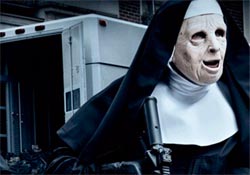
    Expectations were appreciably high, and the press screening queue consequently doubled back on itself, for Abdellatif Kechiche’s historical drama “Black Venus” (**1/2) – after all, Kechiche had a hit on the Lido three years ago with the excellent “The Secret of the Grain,” and for those who know it, the story he’s working with here seemed overdue for screen treatment. By the time the credits rolled on this hard, dense, 165-minute slap of a movie, however, applause was more scattered than one might have expected for a display of such voluminous craft and ambition; the silence, one suspects, was that of an audience assessing which lines had and hadn’t been crossed.

    For my part, I remain stuck in a halfway house between immense appreciation that Kechiche has brought the extraordinary story of Saartjie Baartman, the black South African maid whose unusual physique (and genitalia) briefly made her the toast of the European vaudeville circuit in the 19th century, to the screen; and regret that he’s chosen to tell it in such a way that the film becomes complicit in the objectification it claims to decry.

    (more…)

  • SHORT TAKE: “The Town” (***)

    Venice Film Festival

    Many actors-turned-directors use their outings behind the camera to express something of themselves that they feel hasn’t been enabled by the filmmakers they’ve worked with thus far: personal passions or preoccupations, social or political responsibilities, alternative thespian workout plans or simply a craven desire for awards they haven’t been able to win on their day job.

    Ben Affleck, however, is not drawn by any of these urges. Ben Affleck just wants to make movies. And with his sophomore feature “The Town” – a crisp, grown-up, tangily written thriller one might call “conventional” if studio entertainments this efficient weren’t so hard to come by these days – he further proves that he can make very good ones indeed.

    Affleck’s directorial debut “Gone Baby Gone,” a solid Dennis Lehane adaptation with a fluffed denouement, arguably received a mite more praise than it warranted due to general surprise at the sheer professionalism on display. “The Town” is a more followed-through genre effort with fewer artsy flourishes, but is perhaps destined to be underrated instead by critics expecting Affleck to develop more of an auteur’s ambition.

    (more…)

  • VENICE: ‘Post Mortem,’ ‘Essential Killing,’ ‘Promises Written in Water’

    One week into the Venice Film Festival, and I don’t mind admitting that I’m feeling a little worse for wear. (Okay, and more than a little hung over on free Prosecco.) Yesterday didn’t exactly soothe matters, serving up as it did two of the festival’s most mortifying Competition films – one of which, Alex de la Iglesia’s abominable psycho-clown melodrama “A Sad Trumpet Ballad,” I haven’t the fortitude to write about right now – and yet more wi-fi trouble in the press room, which explains yesterday’s meagre showing on my end.

    With two-thirds of the festival’s Competition lineup now unwrapped – including the surprise film, which rather anti-climactically turned out to be Wang Bing’s reportedly very nutritious “The Ditch” – some clear critical favorites have emerged.

    It is, of course, anyone’s guess what jury president Quentin Tarantino might take a shine to, but it’d be a surprise if Russian entry “Silent Souls” came away from the Lido empty-handed. Meanwhile, lingering high regard for “Black Swan” and “Meek’s Cutoff,” whether they win awards or not, points to something of a recovery for the stars and stripes after the embarrassment that was this year’s Cannes showing.

    (more…)

  • SHORT TAKE: “I’m Still Here” (**1/2)

    Venice Film Festival

    “This is the moment where the fucking good guy wins,” yells an evidently kite-high Joaquin Phoenix at a hapless member of his entourage, midway through his brother-in-law Casey Affleck’s debatable documentary portrait of the star’s much-publicized career meltdown.

    It’s a little difficult to spot the victory – or, indeed, the good guy – in this and many other such tantrums that pepper “I’m Still Here”: the film can be interpreted in a number of ways, and Phoenix comes off pretty awfully in most of them. Is it all a hoax? More specifically, could Phoenix’s actions – his abrupt 2008 “retirement” from the screen, his intended hip-hop career, his bizarre new American-Apparel-rabbi look – all be an elaborate stunt, and the film somehow not?

    Affleck was predictably unforthcoming in this morning’s press conference: “Elliptical” was his one-word answer when asked how he felt about the allegations of fakery, supported by certain scenes in the film that have obviously been (re)staged. (The closing credits feature a cast list in which not every player is billed as themselves.)

    (more…)

  • VENICE: ‘Potiche,’ ‘A Letter to Elia,’ ‘Robinson in Ruins’

    Hey, did you miss me yesterday? Don’t answer that. Sorry for the radio silence, but Saturday proved to be both my busiest and most rewarding day at Venice, serving up five films — none of them stinkers, and one of them perhaps my favourite of the fest so far.

    After capping the day’s viewing with a delightful pasta dinner in the company of two of Variety’s finest, I took the water-bus back to my San Marco hotel room in a pleasant fog of good feeling and red wine, only to find the wi-fi in my hotel room had taken the night off.

    As it turned out, it was just as well: today’s festival schedule being a lean and mostly unappetizing one, I rewarded myself with my first lie-in of the week (sorry, Tsui Hark) and began afresh in the morning. Late-night reviewing is fraught with hazard, anyway, as I’d learned the night before when I nodded off in the middle of writing up “The Sleeping Beauty.” (Before you say, “How apt,” let me remind you that there is no beauty in waking up at 5 a.m. with keyboard-face.)

    (more…)

  • SHORT TAKE: “Meek’s Cutoff” (****)

    Venice Film Festival

    “But nothing happens,” complained several friends to whom I had (perhaps a little too zealously) recommended Kelly Reichardt’s previous feature “Wendy and Lucy,” her pocket masterpiece about the mental unravelling of a stalled drifter in the great American nowhere.

    It’s hard to say whether such viewers will be appeased or even further dismayed by Reichardt’s subtly muscular and altogether staggering follow-up, “Meek’s Cutoff,” which sees the director taking on a propulsively linear narrative – an ox-wagon road movie driven by the most fundamental of human needs – that nonetheless still finds its greatest dramatic significance in minute human exchanges. This is a film whose story turns on one character’s offer to repair another’s shoe, the implications of this small act weighted so as to hold you in hushed fascination through every stitch.

    If, then, Reichardt remains an astute chronicler of what happens when nothing happens, “Meek’s Cutoff” affords the director her largest canvas yet on which to ruminate. A 19th century-set Western covering the most severe and spectacular stretches of the Oregon Trail to transfixingly beautiful effect, the film expands its focus from the selective character studies of “Old Joy” and “Wendy and Lucy” to ponder the fates of three families and two bookended individuals, miles from a home that does not yet exist.

    (more…)

  • VENICE: ‘The Sleeping Beauty,’ ‘Silent Souls’

    Blame Sofia Coppola. Or at least blame Los Angeles. For immediately after the former’s summery, sun-bleached “Somewhere” kicked off this morning’s activity, the Lido clearly decided to rebel against Coppola’s aesthetic and started gathering its clouds. Shortly before noon, the beachfront was a mere blur under a torrential downpour of rain, robust sponsors’ umbrellas blown heedlessly across the red carpet.
    The storm ended as abruptly as it began, though I couldn’t help wondering if it was an instruction of sorts from the festival gods. “Okay, dilettantes, you’ve had the three name American auteurs,” they seemed to be saying. “Now feel free to hop on over to Telluride or Toronto; you won’t even be missing out on the weather.”

    I was indoors when the gusts began whipping against the windows of the press room, but was affected by the storm nonetheless: largely because a leak in the ceiling necessitated the shutdown of the room’s wi-fi network for over two hours, handily erasing half the “Somewhere” review I’d already written and throwing my day’s screening schedule out of whack. Venice’s slightly bumpy administration can be endearing sometimes; this was not one of those times.

    (more…)

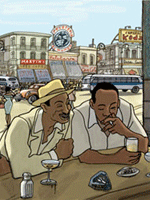
  • TELLURIDE: ‘Inside Job,’ ‘Chico & Rita’

    It’s a bit of a scorcher in Telluride this year.  Relatively speaking, of course.  I’ve got all these long pants in the suitcase but can’t seem to shake the shorts as of late.

    Anyway, tonight brings “Never Let Me Go” and “The Way Back.” I’ll likely hit up the former and catch the latter sometime later in the weekend.  Errol Morris’s “Tabloid” also screens late tonight, and I can’t wait to catch that one.  I’m debating “Tamara Drewe” this early evening.  Guy’s Cannes review doesn’t instill confidence, but I’ve heard from others that it’s quite entertaining.  What to do?

    By the way, there are a bunch of rumors concerning Terrence Malick’s “The Tree of Life” suddenly popping up at Telluride because Brad Pitt is in town. Same as the rumor that “The Descendants” would show up because Alexander Payne is here. Sometimes, people just want to go see movies in a laid-back environment — even celebrities.  That’s all I’m saying.

    Anyway, on to the first set of capsule thoughts…

    (more…)

  • REVIEW: “Somewhere” (***1/2)

    Venice Film Festival

    Who’d be Sofia Coppola? (As an artist, I mean – I’m sure plenty of women would gladly trade for her beauty, wardrobe and Parisian rock-star husband.) No sooner had her bijou, highly personal breakthrough picture netted her an Oscar, atop countless critical valentines, than an acidic chorus of detractors began chiding her for aiming too low. When she shot for postmodern history and swirling visual excess in her strong follow-up, “Marie Antoinette,” the same people gleefully decided she was reaching too high this time.

    So when the pitch surfaced for her fourth feature film, it seemed that Coppola may have been cowed into submission by her critics: another story of a disaffected Hollywood actor adrift in hotel world, its apparent similarities to “Lost in Translation” could scarcely pass without comment. Was Coppola playing it safe, or worse, exposing a limited creative arsenal?

    The answer to both questions, happily, is no. With the wry, shimmery and thoroughly beguiling “Somewhere,” Coppola has perhaps made exactly the film she needed to at this point in her career: one that calmly takes stock of her abilities and interests rather than pushing them too severely.

    (more…)

  • VENICE: ‘Reign of Assassins,’ ‘Happy Few’

    “How many films did you see today?” It’s an innocent-sounding question that you nonetheless feel oddly cautious answering at a festival. Did I see too few? Do they think me a lightweight? Should I squeeze in a midnight screening of that Iranian peasant musical I really have no interest in seeing, just to beef up my score?

    Okay, it’s not as petty and competitive as all that. (And it goes without saying that I’d be totally up for an Iranian peasant musical.) But whereas watching three films at home on a regular day feels like something of an indulgence, at a festival it seems positively neglectful, unappreciative of the spread that has been laid out for you.

    “What am I missing?” you keep asking yourself (and others willing to listen). Then again, a friend of mine who sticks religiously to a six-film-a-day diet at every festival likely asks himself the same thing. It’s best to stop counting.

    (more…)

  • SHORT TAKE: “Miral” (**)

    Venice Film Festival

    Coming as it does from a filmmaker whose previous work has bent over backwards to reclothe and perfume the unglamorous body of the prestige biopic, the opening beats of Julian Schnabel’s latest, “Miral,” couldn’t be more prosaic.

    For a good few minutes, the credit sequence offers the eye little more than a dawdling pan over a fuzzy map of the Israel-Palestine region, ennobling music thrumming away. (The blocky purple credits themselves are hideous, by the way, but that’s already the least of our problems.) Surprises aren’t exactly forthcoming when we the credits wrap and our geography lesson is complete: “My name is Miral,” intones Freida Pinto in a helpful introductory voiceover. “I was born in 1973, but my story really begins in 1947.”

    Except it doesn’t; another woman’s does, however, and it’s the first of several admissions of the film’s own uncertainty as to why it’s here in the first place. The first of Schnabel’s biopics to come with a moderate fictional sheen, it’s scripted by Rula Jebreal — an international political journalist who became conscientized during her teenage years at an embattled Jerusalem orphanage — from her openly autobiographical novel, though it loftily purports to be about three generations of Palestinian women working toward independence.

    (more…)

  • VENICE: ‘Norwegian Wood,’ ‘The Black Sheep’

    Hey, did you get that I kinda liked “Black Swan?”

    I hope you did, because it’s really the only thing to write home (or, indeed, to you) about from my first official day at the Venice Film Festival – a day that looked better on paper than in practice, owing a little each to the films themselves, scheduling overlaps in the programme and my own neglect and/or incompetence. (I willingly sacrificed one screening slot to write my “Black Swan” review, but the next was less sensibly given over to a red-herring panic attack over a missing passport that, as it turned out, was merely out on an errand.)

    Having missed Robert Rodriguez’s “Machete” for the less stupid of those reasons, I attempted to catch up with it at its midnight show an hour ago, but after spending 30 minutes standing in a motionless queue for a screening that was already running significantly late, I concluded that while there are some films I’d be willing to go to bed at 3 a.m. for, one directed by Mr. Rodriguez doesn’t really fit that description, however much fun several critics say it is. Hey, I tried. (Here’s Anne Thompson’s enthusiastic take on it.)

    (more…)

  • REVIEW: “Black Swan” (****)

    Venice Film Festival

    It’s the juvenilization of the term “fairy tale” that has led many people to associate them inextricably with happy endings. At their most literary, fairy tales can be moral and often very unhappy narratives of yearning, obsession and eventual redemption, even if it comes with rather a large sacrifice attached; Hans Christian Andersen specialized in compromised happy endings, notably in “The Little Mermaid” and “The Red Shoes,” that would have made Walt Disney wince.

    If you squint slightly at “Black Swan,” the boldly deranged and beautifully despairing new film from Darren Aronofsky, you can see that it is, when push comes to plié, a contemporary fairy tale of sorts: the story of a little girl, in the fierce grip of controlling adults, who wants nothing more than to dance, and learns that she must exchange part of herself for the opportunity.

    That much I can say without breaking the spell for those who have not seen it. For while “Black Swan” may reveal itself as a fairy tale, that’s only after it has successfully masqueraded as a taut, witty and wickedly kinky thriller that pulls off the tricky double-bluff of following precisely the narrative course one has mapped out for it, yet emerging as all the more surprising for that adherence.

    (more…)

  • REVIEW: “Inception” (***1/2)

    In reviewing 2008’s “The Dark Knight,” I wrote that director Christopher Nolan “has made a brief career of exploring characters built upon their somber, in some instances twisted pasts, however distant or immediate.” The theme continues with “Inception,” a film like nothing you have ever seen before that plays out like a two-hour therapy session, wrapped in the accoutrement of a heist film and bathed in the panache of an entirely immersive cinematic experience.

    The hero is Dom Cobb (Leonardo DiCaprio), a man trying to find his way home, to paraphrase the filmmaker. But is home just a dream, some fantasy trapped in the “what if” corridors of his mind? Or is it possible that maybe through one final job of contrived gobbledygook he might find his way to the life he was forced to flee years before?

    Cobb’s black market profession is “extraction,” a type of mind theft dependent on dream manifestation technology developed by military intelligence for training purposes. If you want someone’s secrets, Cobb’s your man. For a price, he and his crew will go into the individual’s subconscious and bring it to you on a silver platter. But it’s a dangerous job, given the complexities of the process, not to mention the complexities of dealing with the kind of people who’d pay for such a thing.

    (more…)

  • REVIEW: “The Kids Are All Right” (***1/2)

    Annette Bening and Julianne More in The Kids Are All RightBerlin International Film Festival

    A spry, sun-bleached and often rather sexy study of what makes a family in modern America, “The Kids Are All Right” breezes by so pleasurably it’s easy to forget what a daring and very necessary film it is. Gift-wrapping its smart sexual politics with kicky dialogue, bright visuals and a pleasingly messy tangle of relationships, Los Angeles-born auteur Lisa Cholodenko’s fourth (and finest) feature is her most mainstream to date, but makes a virtue of those concessions.

    Since its deservedly buzzy Sundance premiere, you’ve probably already heard “The Kids Are All Right” described ad nauseum as a lesbian – or perhaps more coyly, liberal – drama. With the film having been adopted by Focus Features, who recently had success with “Brokeback Mountain” and “Milk,” it seems likely the tag will stick, particularly if award season beckons.

    But such a label, however well-intentioned, does a disservice to Cholodenko’s admirable avoidance of social tract. Rather than hectoring its audience to accept its characters as normal, this film goes one better by doing just that, and not commenting on the matter any further.

    (more…)