In Contention

Tag: Reviews

  • SHORT TAKE: “King Kong” (***)

    King KongI don’t feel like writing passionately about “King Kong” in the slightest. What I can say with utmost conviction is that the film affords too much of EVERYTHING. The story is bloated, with subplots that could have been fleshed out more succinctly by capable hands (I contend that Peter Jackson is not the most gifted director when it comes to combining the dramatic and the spectacle, even if he is quite gifted at relaying them separately).

    I will, however, say what no one will have the guts to say. 80% of the visual effects in the film are not worth the saliva they will induce. The heart and soul of the budget in this arena was obviously afforded to the Kong close-ups, which, by and large convey one hell of an intimately realized animated creature, but I will stand firm and offer that 12 years later, no filmmaker has flawlessly combined the elements of CGI the way Steven Spielberg’s team did with “Jurassic Park.” These are green screen environments that recall the “Star Wars” prequels – I’m sorry to say.

    Much will be written about a dynamic duel between Kong and a trio of Tyranosaurs. And with good cause. The scene is pulse-racing, and along with the rest of the film’s action sequences, it is exhausting. But for this viewer, not necessarily in a good way. Not all of the time.

    (more…)

  • REVIEW: “The Chronicles of Narnia: The Lion, the Witch and the Wardrobe” (***1/2)

    The Chronicles of Narnia: The Lion, the Witch and the WardrobeJeff Wells is half right when he says “There’s a new Best Supporting Actress contender in town…10 year-old Georgie Henley, the soul and natural light-beam of ‘The Chronicles of Narnia: The Lion, the Witch and the Wardrobe’…came out of nowhere…but she’s Drew Barrymore in “E.T.” without the cloying I-know-I’m-cute-and-you’re-going- to-adore-me attitude.

    “Henley’s serene little-girl aura…her beauty, obvious intelligence, cultured British accent, etc…plus the generosity of feeling from within make for a potent combination.”

    Henley is nowhere near a Best Supporting Actress nomination (especially with co-star Tilda Swinton chewing the scenery), but she is one of the cutest and most talented youthful actor discoveries in a long time.

    “The Chronicles of Narnia: The Lion, the Witch and the Wardrobe” is inevitably going to find itself compared to Peter Jackson’s “The Lord of the Rings” franchise. And in the wake of those films, it will likely come off as old news to an Academy so desperately out of touch with depth of cinema over external labeling.

    (more…)

  • SHORT TAKE: “The Producers” (***)

    The ProducersI never saw the stage production of Mel Brooks’s “The Producers.” It was the certifiable “it” item of the 2001 Tony Awards (taking in a record-breaking 12 wins).

    Now I’m fairly sure the film production is the stage musical on celluloid, with the typical additives that enhance the overall world that inhabits the story. If so, I really wish I had been able to make it out to a theater four years ago to give this thing a look.

    So, that said, if this brief reaction to the film comes off as a rave of the musical production many of you have already seen, forgive me – but this was a fun time at the movies.

    Mel Brooks has established a long lineage of toilet humor as his career has progressed. His stories have gone from Oscar-caliber (Best Original Screenplay winner “The Producers” in 1968 – on which his musical production was based) to irreverent and fun schlock (“Spaceballs,” “Robin Hood: Men in Tights”). But “The Producers,” even from that seed planted so long ago, is about something much, much more. It is a nod to, and a slap in the face of the business of show.

    (more…)

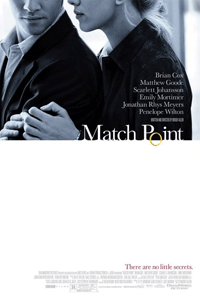
  • REVIEW: “Match Point” (**1/2)

    Match PointThe problem with Woody Allen’s most recent effort, the multi-lauded Cannes favorite “Match Point” is that we’ve seen it all before. The writer/director has approached the exact same territory before albeit on this side of the pond.

    But deeper than that, it seems the extremely positive critical reception has more to do with a longing for the “return to form” we’ve come to expect – or should I say pine for – with each and every new endeavor from the conceiver of such creative works of genius as “Annie Hall” and “The Purple Rose of Cairo.”

    What “Match Point” lacks inherently, however, is just that – creativity.

    One comes to appreciate the cutely conceived, tight little package of a story (fit with hooks and paradigms the level of Syd Field), but what the master filmmakers do in instances such as these is elevate the material that extra inch with a depth of character, a richness of interaction. Who better to offer such aspects than Woody Allen?

    Instead, however, while the audience is set off on the interesting ride that unfolds beat after beat, a disinterest in the people actually living the events in the story keeps one at an uncomfortable observer’s distance.

    (more…)

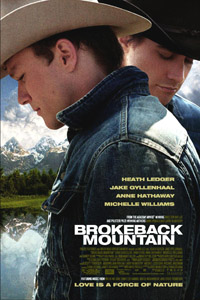
  • REVIEW: “Brokeback Mountain” (***1/2)

    Focus Features' Brokeback MountainIt is the true mark of artistry that guides a hand away from the simplistic and into the complex.

    “Brokeback Mountain” is and has been poised to merely be considered “the gay cowboy movie,” a label I’ve defended it against ever since I first read E. Annie Proulx’s short story (which originally appeared in The New Yorker).

    In the final analysis, however, director Ang Lee strikes so many right chords in the film, which took eight years to find its way to the screen, that one comes to forgive moments of melodrama that creep into an otherwise emotionally raw narrative.

    The story revolves around two ranch hands, Ennis Del Mar (Heath Ledger) and Jack Twist (Jake Gyllenhaal), who come to form a close bond while sheepherding for extra income over the summer of 1963.

    A chance moment of absolute comfort overtakes the two men one night, and that bond becomes a sexual one, but more appropriately, a sensual one. Their lives soon part ways, and years go by before they reunite for the first of a number of getaways to the mountains of Wyoming, both with wife and child at their respective homesteads.

    The story would be a tightrope walk for any seasoned filmmaker. Indeed, as Del Mar notes of the forbidden passion he and Twist share, “there ain’t no reins on this one.” It is an applicable statement to the tale itself, and like Twist’s rodeo cowboy, Lee takes the thunderous implications and bucking ferocity of the story in stride, riding the beast the full eight seconds. In so doing he elevates the chronicle above the physicality which can unfairly precede it.

    What struck this viewer most is that Lee reveals the thin line between love and hate with absolute expertise. Pain is a natural byproduct of intense passion. When Ennis punches the wooden walls of a façade –- after what he presumes to be the last time he’ll ever see Jack –- the reaction is both to the pain of loss and the anger he feels toward something clutching his heart so authoritatively. Let alone any thoughts that he may feel disgust for the act he has committed, surely the last thing he’d expect to have happened. This is quite apparently the first time Ennis Del Mar has ever fallen in love.
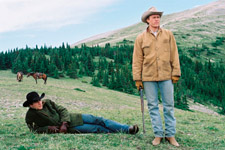
    (from left) Jake Gyllenhaal and Heath Ledger in Brokeback MountainThe performances largely represent the correct emotional cachet across the board.  Ledger’s seedy, love-struck cowboy is the standout. He lurks between his own surface, a character inside an entirely different persona. At once guarded and intense, this has to be seen as the actor’s finest work to date.

    The moment he claims “I’m nothing, I’m nowhere,” it becomes one of the truest depictions of the trappings of desire and ardency we’ve seen on screen.

    Much credit is due to a well-assembled and emotionally investigated screenplay from Diana Ossana and Larry McMurtry, but Ledger’s task was a challenging one regardless of the words provided.

    Suitably boring is Ennis’ wife Alma, played rather succinctly by Ledger’s real-life sweetheart Michelle Williams. The performance gives us another level of understanding when Ennis flees away to the mountains with Jack, as his “real” life becomes a slow, uneventful process lacking any real passion or excitement. Alma’s distress and shock at the knowledge of her predicament plays well through pained eyes.  The difficulty, however, lies on the other side of things.

    Jake Gyllenhaal slips over the top a bit too often as Jack Twist, both in times of joviality and in times of sincerity. He really hits his stride, however, once the character begins to age over the course of the narrative’s 15 or 20 years, as we see the toll longing and idolatry have taken on him.
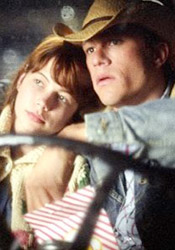
    Michelle Williams and Heath Ledger in Brokeback MountainIt has to at least be said that Gyllenhaal has come into his own this year, both through this performance as well as through his controlled portrayal of an equally emotionally secluded young man in the underwhelming “Jarhead.”

    Anne Hathaway has a presence as Twist’s wife, Lureen, which overrides the function of the character. Her face is so bold and her performance so over-baked that it really clashes with the intent of the role.

    The relationship between Jack and Lureen just isn’t as thematically potent as the relationship between Ennis and Alma, due largely to this, and if there is a weak link in the case, I’d consider Hathaway as such.

    Regardless of imperfection, what we have in Brokeback Mountain is a brutal account of tragic love. It’s one of the oldest stories in the book, but Lee’s conviction and dedication to the core of Proulx’s wonderful story, in every waking aspect of the film’s creation, is what assists it in vaulting quite capably beyond simple-minded nonsense.

    Such a perception could easily have been detrimental to understanding the affecting symphony being composed here.

  • SHORT TAKE: “Transamerica” (*)

    TransamericaIt’s a very rare occasion that I walk out on a film. I tend to give everything a chance, and, especially in my life as a critical mind and writer, I feel I at least have the responsibility of seeing a thing from all sides.

    I did not walk out on “Transamerica,” but boy did I want to.

    Let us not bother with the mountain of issues the film either clobbers with a mallet or otherwise dodges completely.  Let’s leave alone it’s existence in a woefully surface-scratching state unworthy even of the label “sitcom-ish.”  And let’s also set aside the most dreadful character illustration we’ve seen in a film this year (misguided former hooker and wannabe junkie Toby Osbourne).

    Yes, let’s forget all of those elements for a moment and simply ponder what the heck this film is trying to say.

    (more…)

  • SHORT TAKE: “Chicken Little” (***)

    Walt Disney Pictures' Chicken LittleDisney’s first fully computer generated in-house animated feature opens next Friday, and in a Fall season that seemingly brings with it a new disappointment each and every week, I have to consider this little gem a breath of fresh air.

    I won’t dip into hyperbole here. “Chicken Little” is what it is: a swift animated venture aimed at kids with brief attention spans, fit with enough mature giggles thrown into the mix to keep the parents engaged. Though at its heart the film is quite “grown up,” dealing with parental issues of believing in one’s child that make it more pertinent for a family movie-going experience than most animated features.  The film is still a frothy delight that at the very least reaches the bar for which it aims. That’s saying a lot this year.

    Taking the well-known fable of “Chicken Little” and her claims that “the sky was falling” after being conked on the head by an acorn, the screenplay –- from writers Steve Bencich, Ron Friedman and Ron Anderson –- expands on the myth.  It weaves a rather comprehensive moral into the mix that goes far beyond the mere warning against exaggeration and ill-informed conclusions the 300-year-old tale proposes.

    This was an enjoyable experience on many levels –- even in a crowded Westwood theater surrounded by talkative and fidgety youngsters. The voice talent is of considerably high quality, most especially Zach Braff, who pumps a lot of emotion into the title role (the gender of the character was changed to male early in the process), and Gary Marshall as Buck Cluck, Chicken Little’s struggling father who wishes he had the answers his dearly departed wife had in the realm of guidance.

    That’s right, the film even deals with single parenting -– right under your nose.

    I’d prefer not to write too much because analysis of something like this isn’t valuable. You’ll take from it what you will and the themes are easy enough to pick up on without a critic or columnist hammering them home for you. But while it may not be as inspired or as inventive as “Tim Burton’s Corpse Bride,” “Chicken Little” is a very charming addition to the pantheon of 2005 animated film product.

    (I should add that I was not, nor was the crowd, able to experience the “digital 3-D” technology utilized by the film at this screening, but I’m intrigued nonetheless and may just have to give it a shot once the film opens.)

  • REVIEW: “Jarhead” (**1/2)

    JarheadSam Mendes’s “Jarhead” makes no immediate attempt to connect you to its central character. It makes no attempt to pump emotion and empathy into the veins of the audience. It falls in line with Mendes’ penchant for colder, more removed depictions, and it’s potentially the material that most suits this penchant that the director has come across to date.

    I don’t blame the film for any of this. In fact, I rather champion it for it. The thematics come across, even if Mendes doesn’t follow through when he could have REALLY hit it out of the park, but the overall sense one gets from the film is a mish-mash of the offerings we’ve seen from other war film directors.

    Following a protagonist reminiscent of Albert Camus’ central focus in “The Stranger,” Bill Broyles’s screenplay (based on the novel by Anthony Swofford) gets to the point abruptly and hammers it home for the remainder.

    In the eyes of a “jarhead,” as envisioned by Swofford, life is a meaningless existence.  The journey of a soldier is less about defending a nation than it is about defining himself (or herself). In the middle of the desert, miles away from anything that matters in their world, no matter what they’re told by those in positions of power, the lives of freedom fighters are worthless in the eyes of those who live them.

    (more…)

  • SHORT TAKE: “Hustle & Flow” (***1/2)

    Hustle & FlowI was finally able to catch Craig Brewer’s acclaimed “Hustle & Flow” last night at the Pacific Design Center in West Hollywood. The film was the opening installment of this year’s Movie City News Screening Series.
    Much hullabaloo has been made this year of Terrence Howard’s breakout work in both this and Paul Haggis’s “Crash,” and let me just say, in “Hustle & Flow” he puts forth the single greatest performance I’ve witnessed in a number of years. His depiction of DJay, a Memphis pimp with “head in the clouds” dreams of becoming a successful hip-hop artist, boasts an embarrassment of layers that makes one wonder, “Why hasn’t anyone tapped into this guy’s star potential before?”

    His turn in “Crash” was well-developed and largely faithful to the visions of Paul Haggis and Bobby Moresco, but his work in Brewer’s film elevates what could have been a flat, uneven character – one that may have seemed overbearing in an insistence on killing stereotypes – to a whole other, transcendent level.

    (more…)

  • SHORT TAKE: “Kiss Kiss Bang Bang” (***1/2)

    Kiss Kiss Bang BangShane Black’s “Kiss Kiss Bang Bang” is surprisingly fun, excitingly catty and ultimately one of the greatest guilty pleasure film experiences of the year.

    Based in part on Brett Halliday’s novel “Dead Bodies Are Where You Find Them” – about which I must confess I am entirely ignorant and therefore have no basis for commentary – Black’s film serves as a worthy addition to the canon of the American buddy/cop film genre he helped to create with 1987’s “Lethal Weapon.”

    The conglomerate of Walter Hill, Roger Spottiswoode, Larry Gross and the ever genre-immersed Steven E. de Souza really initiated the concept with 1982’s “48 Hours.” Following suit, the trend continued through to the John McTiernans and the Jan De Bonts of the world toward fully crafting the modern American cop actioner. Of course, films like this can find roots in, say, William Friedkin’s “The French Connection” on some level, but in as much as they exist almost as comedies first and foremost, Shane Black has certainly hand a major hand in paving the way, for better or worse.

    (more…)

  • REVIEW: “Good Night, and Good Luck.” (***1/2)

    Good Night, and Good Luck.I see many films each year. I write about most of them. But rarely do I feel the need to rush home and pour my thoughts and perspective into a column immediately.

    Such was the case with “Good Night, and Good Luck.”

    The subject of Edward R. Murrow and his valiant stand against McCarthy Era politics is an obvious obsession for director George Clooney. Newsman father Nick Clooney brought the star up in a lefty household that held men like Murrow in the highest regard – men who invented journalism in its modern existence, found its pulse of potential and utilized its merits for a greater, noble good.

    When Murrow (portrayed to perfection by David Strathairn) is first revealed in the film, it is a backstage moment before giving what would be seen as an indicting speech in acceptance of commendation at a 1958 Radio and Television News Directors Association convention. He takes a few final puffs from his signature cigarette. A plume of smoke steadily escapes his nostrils. The image recalls a dragon blowing smoke before breathing furious fire.

    That’s precisely what Murrow was about to do.

    (more…)

  • SHORT TAKE: “Walk the Line” (***)

    Walk the LineYou’ll soon see Joaquin Phoenix tearing up the screen with a blistering performance in the story of a seminal rock star’s fascinating life in “Walk the Line” – but it ain’t Johnny Cash.

    The film works very well on its own terms, but I have to say – I just don’t like the terms. On performances, the singing in the film is unbelievably on point. Reese Witherspoon is fantastic and it’s perhaps her best work yet – a proud moment for the dearly departed Carter.

    And Phoenix is on fire, even if I felt like I was watching Joaquin Phoenix the whole time. You see, I never once felt like this was Johnny Cash – unlike Jamie Foxx in “Ray.”  And is it really wise to make your main character THIS loathsome for the entire film? Is it even that interesting to do so? Is it very respectful to hold Cash up as a junkie first and foremost? Talk about pillaging a legacy.

    (more…)

  • SHORT TAKE: “In Her Shoes” (**1/2)

    In Her ShoesCurtis Hanson’s “In Her Shoes” is an exercise in sluggish pacing.  It has a lot to say to its target audience, but it ultimately feels as though the filmmaker behind the project isn’t capable of really sparking the conversation.
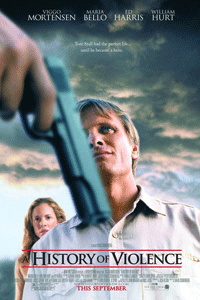
    Cameron Diaz struts about the screen desperately in need of a meal, but fulfilling the empty framework of her character well enough to believably convey a ditz, while Toni Collette capably provides us with yet another brilliant performance in a sub-par film.

    The real question mark for me becomes why anyone would have made a big deal of Shirley MacLaine’s lackluster performance of a flatly conceived character.

    (more…)

  • REVIEW: “A History of Violence” (***1/2)

    A History of Violence“A History of Violence” is going to be David Cronenberg’s crowning glory. It’s the film that has something to say about every cinematic endeavor in his lengthy portfolio. It’s the film that time will remember him by.
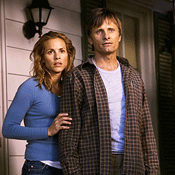
    Based on a gritty graphic novel by John Wagner, the film is a commentary on the nature of violence, the mechanics of its simplicity and the mechanics of its complicity. It’s an account of the effect violence has on a household, on a town, on many different psyches. It’s one of the smartest subtextual films of the year, yet the subtext seems obvious. But it’s not.

    “A History of Violence” is a very intricate film.

    The fascination is that to be so meticulous in its thematics, the story is relayed in a very elementary fashion. No fancy tricks, no overwrought hand-to-mouth relay – just basic, almost painfully simple storytelling. I would say that not only is it Cronenberg’s most accessible film, but it is potentially his most disturbing. And, obviously, that is saying a LOT.

    The events take place in Millbrook, a picturesque small-town setting that stands almost archetypal in the midst of an upcoming storm. The storm comes in the form of two mass murderers waltzing into Tom Stall’s (Viggo Mortensen) downtown diner with evil intentions. After handily disposing of the would-be murderer/rapists, Stall is catapulted into the limelight as an unassuming hero. He soon finds himself at the whims of Philadelphia mobster Carl Fogaty (Ed Harris) and his band of cronies, expressing a vested interest in this small town savior.

    The violence in the film is extensive and at times outrageous, though it retains a level of creativity and relevance that keeps it from becoming gratuitous – shockingly. The gore is stomach-turning, to be sure, but vital to the components of the story Cronenberg is telling. Ultimately, it’s all seemingly a justification for the career he has made in the splatter business, as if it’s all been a long, slow ride to this moment, this declaration, this brand of insightful commentary.

    Furthermore, the film boasts one of the most organic ensemble performances of the year.

    (from left) Maria Bello and Viggo Mortensen in A History of ViolenceMortensen portrays Stall with a particular ease. Rather he inhabits him, giving the kind of performance that true acting is all about. At the same time, it’s the sort of work that gets ignored during awards season in favor of showier turns.

    Ed Harris springs onto the screen as the creepy Fogaty, and I have to say he sculpts the character off the page better than any other actor could have managed. On paper, Fogaty is assuredly a device if anything. Harris breathes him in and out and terrifies accordingly, though I must admit it’s missing a certain something to be considered formidable in the Oscar ring.

    William Hurt’s five minute cameo is one of the best pieces of work this year, a barrel of laughs and yet a swift study in acting perfection. Yes, perfection.

    But the real stand-out is Maria Bello. Bello was passed over by the Academy for a notice in 2003 for her multi-lauded performance in The Cooler, but I don’t expect that to be the case this year. If “A History of Violence” has any real shot at Oscar recognition, it is for her explosive performance. This is fire-breathing, gut-wrenching, head-spinning work. The layers that would be considered missing in a film like this, one that could easily be labeled “surface,” she adds them…in spades.

    A final note, “A History of Violence” also has something to say about passion. I’m not afraid to say that I haven’t quite put my finger on it yet, but it has something to do with two raunchy sex scenes that manage to remain out of the realm of gratuitous – much like the violence – as well as the motivations behind the character of Stall and why he is where he is at the film’s open. There is most definitely a point being made about desire, vehemence and conviction. It’s lurking – much like the film.

    I can’t wait to see this again.

  • SHORT TAKE: “Corpse Bride” (***1/2)

    Tim Burton's Corpse BrideI saw Tim Burton’s “Corpse Bride” in Westwood tonight, and it’s one of the most enjoyable films of the year. Recalling strands of “Beetlejuice” and “The Nightmare Before Christmas,” the film’s witty screenplay combines with a bombastic Danny Elfman score and a heightened level of production value to make for Burton’s best endeavor of any sort since 1999’s Sleepy Hollow, and perhaps since 1994’s Ed Wood.

    The film tells the story of Victor and Victoria (voiced by Johnny Depp and Emily Watson respectfully) and the deceased bride-to-be (Tim Burton’s own bride, Helena Bonham Carter) that comes between them and their arranged marriage.

    Burton draws upon his cast of collaborators for a who’s who of voice talent. Amongst the contributors are Albert Finney, Christopher Lee, Michael Gough, and Elfman, with Tracy Ullman and Joann Lumley to boot.

    (more…)

  • SHORT TAKE: “The Family Stone” (***1/2)

    Fox Searchlight Pictures\' The Family StoneThomas Bezucha’s “The Family Stone” is as refreshingly scripted as one can hope for. His film has magnificent ideas. His characters are thoroughly crafted with a richness unbecoming of the current cinema. His tale brings with it a warmth and a spirit that permeates like the finest emotional experience.

    It should be noted that the film I saw is not in its finalized form. There are touches to be made, score to be filled in, a number of variables to add to the mixture. But in the current state, “The Family Stone” is still something to behold.

    As for performances, you’ll hear many things about Diane Keaton to be sure. Her earthy motherly portrayal is a sincere portrait from an actress at the top of her game yet again. Sarah Jessica Parker sports a showy turn that will leave audiences in stitches. Luke Wilson offers up a chuckler per minute he’s on screen. Rachel McAdams stays on course for assured stardom. Dermot Mulroney keeps an even keel and Claire Danes pops in for a touching if understated, and perhaps under-written, spell.

    But Craig T. Nelson steals my heart, supporting as the father figure that bleeds a warmth you can’t stand to be away from. It’s my favorite performance of the year, and it will likely remain under the radar.

    I won’t yet fully handicap the film’s Oscar potential. We need to see where it goes upon release, though I expect this one to find a significant holiday audience. Speculation for Keaton is warranted, but I’m looking five other directions at the moment.

    Parker’s sparkling irritant could make a play if her category weren’t stuffed to the gills. And Nelson would be a personal hopeful, of course. All things considered I think the writers’ branch ought to see the sure-handedness Bezucha displays in his sophomore effort. If not for Oscar then perhaps his guild can come through, because writing of this caliber deserves distinction.

  • SHORT TAKE: “Grizzly Man” (**1/2)

    Grizzly ManWerner Herzog’s “Grizzly Man” is an amazingly rich film, and an indefinably important one for those who have a vested interest in artistic showcases of man’s position in his natural world.

    That Herzog, a madman in his own right, would be drawn to the life and times of Timothy Treadwell is hardly surprising, but what did catch me off guard watching the film was how much Herzog, even given the controller that he is, allowed the seams of his staging and the melodrama of his subjects to come across on film.

    I don’t really want to dig too deep into the film. Treadwell was a madman, but a beautiful man. And Herzog, a cinematic genius, found a fascination in his fellow filmmaker’s exploits. Hearing Herzog’s view of his basis for nature’s common denominator (chaos) bouncing off of his subject’s basis (balance) was an exercise in exemplary cinema where filmic essays are concerned. But what really bothered me was how out of control the director let his obviously theatrical (in personality) interviewees get.

    (more…)