Forgive us if things have been a little quiet here the past day or two — as Kris has already explained, he’s snowed under with work, while I’ve had my share of distractions too. However, I will be doing my best to pick up the slack, with a new edition of The Lists on the way later today (a little later than usual — apologies) and other bits and bobs to come.
Author: Guy Lodge
-
Chalk one up for ‘WALL-E’
 The Academy has revealed the 14-strong shortlist of films competing in the Best Animated Feature category, and, well, it doesn’t make for very inspiring reading. What’s most significant about the news is that it means the nominees will, as usual, be limited to three films; to accommodate five, more than 15 shortlisted titles are required. That has only happened once before, in 2002. Here’s the list:
“Bolt”; “Delgo”; “Dr. Seuss’ Horton Hears a Who!”; “Dragon Hunters”; “Fly Me to the Moon”; “Igor”; “Kung Fu Panda”; “Madagascar: Escape 2 Africa”; “$9.99”; “The Sky Crawlers”; “Sword of the Stranger”; “The Tale of Despereaux”; “WALL-E”; “Waltz With Bashir”
It’s a nail-biting race. “Madagascar: Escape 2 Africa” may appear to be the locked-in frontrunner, but “Bolt” has Academy veteran Miley Cyrus powering its chances, and watch out for the lovely Australian stop-motion work “$9.99,” which is creeping up on the outside lane, and could take it all…
Okay, okay, forgive me for trying to make it sound a little more exciting. (I am pleased to see “$9.99” in there, though.) I think we can safely eliminate most of the titles on the list from consideration — even if the voters have in the past nominated the odd head-scratching dud. (“Jimmy Neutron: Boy Genius,” anyone?) Anyway, We all know “WALL-E” is winning this by a country mile, so the only thing left to ponder is which two films it will beat.
-
Are the Oscars a popularity contest? Sort of.
 Over at his increasingly active OscarWatch blog, Dave Karger is bringing up the age-old issue of whether or not the Oscars are a popularity contest. The post is in part a response to Tom O’Neil and Pete Hammond’s dismantling of Karger’s predictions in the Best Actor race, where he declared the frontrunners to be Sean Penn, Mickey Rourke and Frank Langella.
Seems sound enough to me — the first two in particular — but O’Neil and Hammond seem to feel that personal likeability issues might get in the way for all three actors. Karger acknowledges their point, but ultimately feels they might be off-base:
I see where they’re coming from: An awards campaign truly is similar to a political campaign at times, and one’s deportment certainly comes into play. I think it’s fair to say that Marion Cotillard’s tirelessness and charm in supporting La Vie en Rose didn’t hurt in her recent eventual Best Actress victory over Julie Christie. And who knows how many nominations Russell Crowe has squandered over the years by shoving awards-show producers or chucking hotel telephones. But then again, I wonder if Penn’s win for Mystic River (after he didn’t even bother to show up for the Golden Globes) proves that conduct doesn’t matter that much.
I have to agree. Yes, the Academy can play favourites — not least within the actors’ branch — but popularity and likeability aren’t always one and the same. Otherwise, someone as universally liked as Kate Winslet would have won approximately four Oscars by now. (Kate Hepburn, meanwhile, might have won substantially fewer.)
-
Is ‘Australia’ really in the Academy’s wheelhouse?
 I haven’t hidden the fact that I’m in the tank for Baz Luhrmann’s “Australia,” or at least I hope to be — when we’re eventually allowed to see it. It is, bar none, my personal most-anticipated title of the next two months, sink or swim.
I am, however, beginning to get nervous about its Oscar chances, as troublesome buzz circulates about its down-to-the-wire editing and last-minute narrative changes. The Academy tends to shy away from anything that might be perceived — deservedly or not — as a grand folly, preferring works that play the publicity game a little safer.
A part of me has thought for some time that, should “Australia” overcome the naysayers, it could be welcomed by voters as a return to the more “traditional” model of Best Picture winner — sweeping, romantic, period-set and controversy-free — after four consecutive years of honouring bleak, un-pretty and (relatively) modern-day works. It’s argument that can also be made in favour of another unseen film widely presumed to be the one to beat: “The Curious Case of Benjamin Button.”
However, over at The Film Experience, Nat Rogers makes an excellent point to the contrary, suggesting that the romantic epic is less of an Oscar ‘gimme’ genre than we tend to presume:
My initial instinct, minus any research, was that Oscar loves to be romanced by beautiful people in period finery, their love story intertwined with famed world events. But is that really true? Perhaps it’s just that early Oscar champion “Gone With the Wind” casts a really long shadow …
Oscar isn’t always in the mood for retro loving. But even when they aren’t, the films can quite often emerge with Best Actress and Costume Design nominations and a stray nomination of some other sort. “Australia”‘s chances in a wide array of categories clearly hinge on how deep audiences fall into reciprocal love with Kidman’s aristocrat and Jackman’s cattle driver.
-
RIP Mama Africa
It may not be strictly movie-related — though she did enjoy a couple of screen appearances, most notably in Darrell James Roodt’s “Sarafina!” — but I can’t let the passing of the great Miriam Makeba go unacknowledged. As a Grammy-winning musician, influential political activist and all-round symbol of a country’s hopes, she was treasured not only by South Africans like myself, but by the world at large.
It is interesting — and not a little fitting — that Makeba died performing for another noble cause: she collapsed on stage after performing at a benefit concert in Italy for Roberto Saviano, the author (and co-screenwriter) of “Gomorrah,” whose work in exposing the workings of the Naples mafia has put his own life in danger. That Makeba, after all she has accomplished for her own people, was prepared to work for this cause too is really a measure of the woman.
The various obits are full of clips of “Pata Pata” and “The Click Song,” but I love the purity of her voice and urgency of the storytelling on this 1966 performance of “Khawuleza.” If you’re not moved by this, something is wrong with you.
-
REVIEW: “Last Chance Harvey” (***)
 Remember “Falling in Love?” I wouldn’t blame you if you don’t. A modest join-the-dots 1984 romantic drama charting the will-they-won’t-they courtship between two married New York commuters, it should never have gone beyond the dimensions of a TV screen…
…but for the fact that the two commuters happened to be played by Robert De Niro and Meryl Streep. So sensitively crafted were their performances, and so effortless and infectious their chemistry, that they alone made the film worthwhile.
Watching “Last Chance Harvey,” the sophomore feature from British writer-director Joel Hopkins, I couldn’t help but be reminded of “Falling in Love.” The comparison isn’t entirely fair — “Harvey” is a bit smarter and more acutely observed — but both films are essentially slender, undemanding constructions designed principally to showcase two great actors riffing off each other.
In the case of “Harvey,” the actors in question are the appealing September-December duo of Dustin Hoffman and Emma Thompson, and the pairing proves immediately irresistible.
The contrivances of Hopkins’ screenplay and his prosaic filmmaking approach are of little consequence once it emerges that this is a star vehicle, plain and simple. On those terms, it’s a bull’s-eye, one that is bound to register strongly with an audience starved of relationship stories concerning anyone over the age of 40.
Following their spring release “The Visitor,” a similarly low-key, mature-audience-skewing success, new outfit Overture Films is cunningly slipping “Last Chance Harvey” into theaters in late December, in the hope of awards success for the stars. Given the strength of the performances and the film’s winning charm, it’s a move that could well pay off.
-
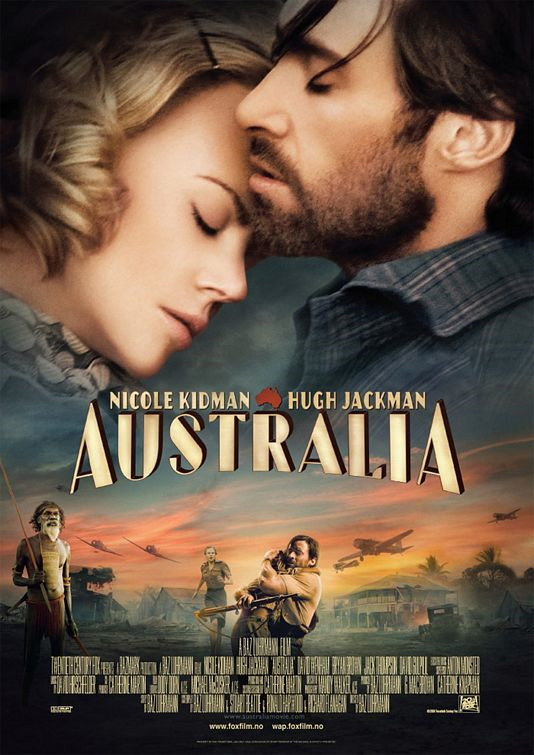
International ‘Australia’ poster
New and slightly improved, if you ask me — though I still think they missed an opportunity to go for an all-out 1940’s throwback design. (Thanks to Stale Popcorn for pointing it out.)

-
Italy leads the charge at European Film Awards
 Proof positive that 2008 is a banner year for Italian cinema: Matteo Garrone’s “Gomorrah” and Paolo Sorrentino’s “Il Divo,” both masterpieces of a very different stylistic ilk, lead all nominees for the European Film Awards, with five nominations apiece.
Joing them in the hunt for Best European Film are “The Class” and “Happy-Go-Lucky,” which makes four of my favourite films of the year in the list. Rounding out the nominees in that category are “Waltz With Bashir” and “The Orphanage,” neither film one to be sniffed at either.
By any standards, that’s one hell of a group — I would be very surprised if the eventual five Oscar nominees for Best Picture match that collective quality. I’d be hard pressed to pick a personal favourite, though my gut says the Italian nominees will split the vote, and the wonderful “The Class” will emerge victorious.
Four of those six reappear in the Best European Director category, with Steve McQueen (“Hunger”) supplanting Mike Leigh as the British nominee in that race. More puzzlingly, Leigh is also absent in the Best European Screenwriter category — curious, since “Happy-Go-Lucky” strikes me as more of a writerly achievement than the nominated “Waltz With Bashir.”
More thoughts, and a full list of nominees, after the cut.
-
WEEKLY WRAP: ‘Doubt,’ Danny Boyle and a bit of politics
 In a week in which there were more important things going on than the movies (an outlandish notion, I know), these were nevertheless some of the highlights:
• Several takes from the AFI Fest, including disappointment in “Doubt” …
• … but hearty cheers for “The Wrestler.”
• We caught up (twice) with the thoroughly delightful Danny Boyle, both in London and in L.A.
• Meanwhile, Dennis Hopper was also feeling chatty.
• In the wake of the reprehensible passing of Proposition 8, we wondered if “Milk” could have made a difference.
• We bade farewell to Mr. Michael Crichton. Rest in peace.
• “Australia” got a new trailer and a new poster. Smashing. Can we see it now, pretty please?
• Listing the greatest English-language directors at work today. Debate, as ever, was heated.
• Tech Support surveyed the horses in the Best Film Editing race.
• Oh, you might have heard that the United States has a new president. The right one, at that.
-
Still nobody knows anything
 At least, that’s the message I get from Pete Hammond’s latest column, in which he somewhat half-heartedly claims that the Best Picture frontrunners at this stage are “WALL-E,” “The Dark Knight” and “Changeling.” In that order, apparently — with “Slumdog Millionaire” creeping up behind.
I realize Hammond has access to more Academy members than I do (not hard, since I know none), but I find that hard to swallow. Of the summer blockbusters, “The Dark Knight” looks to me to have more campaigning momentum than “WALL-E,” though I’m still not predicting it as a nominee. And I can’t see “Changeling” making much headway in the race with such a mixed critical reception. Surely, of the seen contenders, “Slumdog Millionaire” is ahead of all three. What I really learn from this is that Academy members clearly need to see more movies.
More helpful to me is this tidbit Hammond offers on the Best Foreign Language Film race:
From what we’ve been told only Germany, Japan and Russia have made any significant impact, with Italy’s Cannes Grand Prix winner, “Gomorra,” getting predictions that it will be one of the final five, despite mixed response from some who frowned on its generous amount of violence. And the Portuguese film “Our Beloved Month of August” was apparently so poorly received that some members were trying to leave before they could “officially” exit and still receive credit for seeing it.
-
U.K. ‘Che’ teaser
Courtesy of the Telegraph comes this British teaser trailer for “Che,” which makes it look rather more gung-ho and biopic-styled than it really is.
I’ve been struggling with the two films slightly in the week since I saw them. I was more persuaded by Soderbergh’s vision than Kris, but I’m not sure if I was all that moved. The lack of urgency in the filmmaking may just be carrying over to its staying power in my memory — but then, I was suffering from festival fatigue when I saw them. I really need to rewatch both films in a couple of months to see where I stand.
Anyway, enjoy:
-
Dream big
 I think, as of today, Deepa Mehta is officially the bravest woman in movies.
My reason for saying this? Well, she’s only taking on the small task of filming Salman Rushdie’s “Midnight’s Children,” a novel so vast in scope and fanciful in tone that no filmmaker has dared touch it since its publication in 1981. Screen Daily reports:
The film-maker announced the film with Rushdie today, at the eighth annual Mahindra Indo-American Arts Council Film Festival following last night’s New York premiere of her latest film, Heaven On Earth.
The partners will start writing in March and expect to begin production at the end of 2010 on Rushdie’s 1981 allegorical tale about the country of his birth. The story is told through the eyes of Saleem Sinai, one of many characters born at the stroke of midnight on August 15 1947 when India gained independence from the British Empire.
The idea of Rushdie adapting his own work is intriguing — on the one hand, he has no screenwriting experience, but on the other, “Midnight’s Children” is such a dense, idiosyncratic piece of storytelling that perhaps only he can really unpick it.
Mehta, meanwhile, is an interesting choice for the material — someone whose work combines keen social awareness with occasionally dreamy visual impressionism. Her Oscar nomination for “Water” notwithstanding, she’s never quite made a completely great film in my eyes, but this could be her moment. A film of “Midnight’s Children” can only be spectacular, whether in its success or its failure. Good luck to her.
-
What was the debut of the year?
 Chances are it’s not a prize that studios are going to mount furious campaigns for, but the Guardian First Film Award has the classiest slate of nominees I’ve seen all year. Not so much an award as a nice little citation in their year-end Film&Music edition, their critics have drawn up a list of the ten best directorial debuts from the last 12 months, and have invited their readers to vote for the winner.
They’re going by the UK release schedule, which is why you have 2007 fare like “Persepolis” rubbing up against more recent releases on the list. (And why “Waltz With Bashir” or “Synecdoche, New York,” surely the year’s most discussed freshman effort, aren’t on it.)
So the ten are: “Caramel” (Nadine Labaki); “Control” (Anton Corbijn); “Eden Lake” (James Watkins); “In Bruges” (Martin McDonagh); “I’ve Loved You So Long” (Philippe Claudel); “The Orphanage” (Juan Antonio Bayona); “Persepolis” (Vincent Parannaud and Marjane Satrapi); “Shotgun Stories” (Jeff Nichols); “Unrelated” (Joanna Hogg); “Water Lilies” (Céline Sclamma).
Not much American content there, but hey, that’s the kind of year it’s been. I haven’t yet seen “Eden Lake” or “Unrelated,” I’m afraid to say, but besides that fact, I can’t argue too much with any of these inclusions. (Clearly I’m getting too sanguine.) What would you vote for? What have they left out?
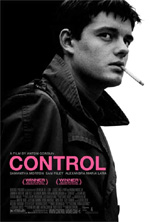
I’m still trying to break a three-way tie in my head between “Control,” “Persepolis” and “I’ve Loved You So Long,” which you may remember I kind of liked. (I’m just happy for an excuse to use the “Control” poster as illustration — seriously, has there been a better one in the last couple of years?) Check out all the details, and vote if you’re so inclined, here.
-
Hang your head, Britain
 It’s at moments like this that I would like to point out that I’m not really British. Yes, I live there. Yes, I have a British passport and a somewhat malformed British accent. But I was born in South Africa and hold those last two items in a South African flavor too. For the moment, at least, I’m calling myself South African.
The reason for the cultural distancing? Well, it has something (okay, everything) to do with the fact that “Mamma Mia!” is on course to become the highest-grossing film of all time in the UK.
It is currently sitting in second place, with £67.4 million — with the record £69 million gross of “Titanic” only a heartbeat away. It will more than likely happen — 16 weeks into its run, recently released “singalong” versions (shudder) are giving it renewed life.
Words fail me. True, I can’t stand “Titanic” either. But at least it was a massive, self-mythologising event of a movie, one that broke some ground in the industry (if not in the artform) and represented a clear ‘moment’ in pop culture history. It was a film, in other words, whose stature and influence befitted such records.
“Mamma Mia!”, on the other hand, has Meryl Streep belting “The Winner Takes It All” on a pastel-hued Greek island, like the floor show at some ghastly Sandals resort. If this is any cultural representation of the current British generation, we’re as confused as we are doomed.
And you thought America was the only country whose credibility was at stake today.
On a side note, it’s interesting to draw a parallel here with “The Dark Knight.” With Christopher Nolan’s film devouring the US box-office this summer, there have been calls for the Academy to fall in line with public tastes and consequently recognise its significant cultural achievement with a Best Picture nomination.
By that rationale, should the Brits start lobbying BAFTA for a “Mamma Mia!” sweep, come February? It only seems fair, complicating factors of crapness aside.
-
Remembering cinema’s Bush years
 As the world prepares to bid farewell to George W. Bush following tomorrow’s election, I came across an apt article in the new edition of Sight and Sound, in which critic Michael Atkinson evaluates how the Bush presidency affected American film, and how the period might be interpreted by future film historians. As always with S&S pieces, it’s not available online, but it’s an insightful (and occasionally contentious) piece worth tracking down if you want to give a cinematic spin to your sense of closure.
As has been noted before, Atkinson believes that the sense of public panic and political insecurity that characterised the presidency has been most clearly manifested in the resurgence of the superhero movie:
It’s easy to imagine that in a decade or two, the Bush years will be viewed as the discouraging ebb in the pop-cult continuum when everyone from eight to 80 was excited about ‘super powers’ … Clearly, a preadolescent bout of night terrors required succour, producing a trend that’s bound to date as badly as the Spielbergian blue light and Rambotics of the 1980s.
This is the kiddie-escapist paradigm tinctured with memories of 9/11; today, the vigilantes in primary-colour tights we hanker for don’t confront the conjectural fears of the Cold War, but the all-too-tangible, falling-bodies verities of the new millennium. In “The Dark Knight,” Christian Bale’s Batman has to wrestle, as the Bush administration didn’t, with the necessity of being perceived as evil for the sake of what’s construed as the common good.
-
Luhrmann: “It’s not naturalism”
 Baz Luhrmann’s massive “Australia” keeps hurtling nearer, with the director apparently in an editing-room frenzy to have it ready in time. A new trailer and poster emerged last week, together with word that the film is hovering around the 170-minute mark. Fine by me — if that’s the scale of the project, then so be it.
However, one thing I’ve noticed about the reaction from many bloggers and commenters is how many people seem to have missed the point of what Luhrmann is aiming to achieve here. People are complaining that the film looks too “old-fashioned,” or that, heaven forbid, it doesn’t look “realistic.”
Apart from the fact that realism has never been on Luhrmann’s agenda, it’s perfectly obvious that he’s working in a throwback vein here. All the footage we’ve seen suggests the film is a homage to the epics of Hollywood’s golden age, with all the heightened performance style and florid visual sensibility that entails. Whether or not it works remains to be seen, but one has to understand the mode he’s working in first.
Luhrmann makes as much clear in an extensive piece in the Guardian, where he explains his epic intentions:
When I make a film, people don’t seem to talk about the film itself. Instead, they say: ‘How can he mix genres and styles like that?’ or ‘How can that cinematic language be credible?’ One expects it with this film, too, because, although I draw the DNA very directly from the epic tradition, this isn’t a carbon copy.
Will I be accused of reinventing the epic? Only if it works. If it doesn’t, I’ll be accused of wasting a lot of time and money. The cinematic language is not like in the Red Curtain trilogy [Strictly Ballroom, Romeo + Juliet and Moulin Rouge!], but it’s not naturalism. I think you’ll see the influences of those movies I’ve loved, but it will also be something of its own. It’s a very difficult thing to achieve.
-
Superb ‘Disgrace’ trailer goes online
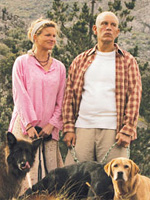 As I’ve said before on these pages, I’ve been looking forward to Aussie filmmaker Steve Jacobs’ film adaptation of J.M. Coetzee’s “Disgrace” for some time.
It’s a novel very close to my heart, John Malkovich seems ideally cast in the lead and, though it’s a South African-set story, its stark, ruminative nature sits comfortably in the groove of great Australian cinema. A warm reception at Toronto (where it won the FIPRESCI award) only amplified my anticipation.
Now a trailer has finally appeared, and from where I’m standing, it looks excellent: spare, understated, with a fine feel for the severe beauty of the Eastern Cape landscape.
Malkovich, who appears in some ways to be channelling Coetzee himself, seems to have captured the character’s balance of affectation and disengagement, and South African newcomer Jessica Haines looks equally promising. This should really be one to watch in 2009.
It’s not available to embed yet, but check out the trailer here. (Thanks to Stale Popcorn for pointing it out.)
-
INTERVIEW: Danny Boyle
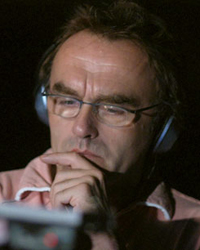 Roughly halfway through my interview with Danny Boyle, the small, rather alarmingly wallpapered room we’ve been seated in is, by some technical error, suddenly flooded with the opening beats of “Orphans,” the first track off Beck’s “Modern Guilt” album.
Boyle immediately leaps to his feet to report the problem, though he can’t help nodding in
time to the music. “That’s the new Beck, isn’t it,” he notes excitedly. “Fantastic stuff. Now’s not the time, but fantastic stuff.” The music vanishes. Boyle flops back onto the couch, straightening out his rumpled plaid shirt.It’s a fittingly surreal interlude for an audience with Boyle, demonstrating both his utterly unflappable personality and his keen interest in every sight and sound around him — whether invited or not. It’s a heightened awareness that is apparent in every one of his films; few directors make films as busy as Boyle’s, films as alive to the possibilities of environment, movement and music. His is a sensation-driven cinema that comes into full fruition in his astonishing new film “Slumdog Millionaire,” a breathless rush of visual and narrative energy that marries fanciful storytelling to a rich, perceptive study of a 21st-century nation.
It’s also his first film with an entirely non-Western context, something which seems to have further fired Boyle’s creative impulses. “India is just … everything at once,” he enthuses, gesticulating wildly to convey the scale of it all. “It’s got these amazing extremes of wealth and poverty and religion and landscape, but in the West we go to a lot of trouble to separate those extremes. Nothing is separate in India. That makes it an incredible place to set a story, particularly one that is so tough and so joyful all at once.”
True to form, “Slumdog Millionaire” tells a pretty incredible story, a rags-to-riches tale in the most literal sense. It’s a story that hinges on the fairytale conceit of destiny, but as Boyle notes, that notion still plays into contemporary Indian society. “There’s a bond between the classes there, however far apart they are in terms of wealth. They get each other because they pretty much come from the same place — destiny makes all the difference.”
Boyle pauses to pour himself a fresh cup of tea, cheerfully dismissing the waitress’s offer of bottled water. (An Englishman through and through, he still resides in Mile End, an unfashionably working-class corner of East London.) It’s late in the day, he’s tired and, he sheepishly admits, a little hung over — the previous night saw “Slumdog” close out the London Film Festival, with all the flashing lights and partying that entails.
While it should be noted that a “tired” Boyle still projects more energy than most of the normal human population, this level of media attention is new to him. For all the acclaim his previous work has garnered, he’s never before made a film that received the awards buzz that “Slumdog Millionaire” is receiving (remarkably for an edgy, foreign-set picture with not a single name star attached).
“It’s brilliant, it’s insane,” he says, shaking his head. “It seems I just came here from L.A., and now I’m off to L.A. tomorrow. But you can’t release a film like this, something so potentially alien to audiences, and not work hard to promote it. Fox Searchlight are working me ragged, which is fantastic.”