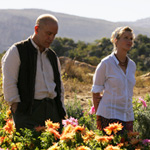
 With the Toronto festival just around the corner, one title set to bow there that isn’t garnering that much attention yet is Australian production ‘Disgrace,’ the long-gestating adaptation of Nobel Prize-winner J.M. Coetzee’s searing 1999 masterpiece.
That’s not exactly surprising, given that it’s a sophomore effort from a director, Steve Jacobs, whose previous credit, the flavourful but slight comedy “La Spagnola,” didn’t make much of an international ripple in 2001. The film is tiny; it also promises to be (if they do it right, at least) intensely bleak. The lone ‘name’ involved, John Malkovich, is something of a niche figure. Suffice to say that there are any number of starrier, sexier prospects in the TIFF lineup.
But in a quarter already boasting its fair share of prestigious literary adaptations (“Revolutionary Road” and “The Road” being just two of the most anticipated), this is the title that has me most intrigued. I admit my South African bias possibly comes into play here. But you don’t have to be from the country to know what an astonishing novel “Disgrace” is – one that picks apart the moral identity of post-apartheid South Africa with a precision and ruthlessness of Dostoyevskian proportions. In 2006, The Observer named it the greatest “British” (cheekily including the Commonwealth) novel of the last 25 years.
Actress-turned-screenwriter Anna-Maria Monticelli, who also wrote “La Spagnola,” faced a pretty daunting task in taking on the novel – though to my mind, Coetzee’s visceral, landscape-oriented prose is more filmic than his academic reputation suggests. The final draft apparently received Coetzee’s blessing, and Monticelli recently won the Australian Writers’ Guild Award for her pains, so there’s every reason to be hopeful that she nailed it.
It should be noted too that the film potentially offers the role of a lifetime for Malkovich, for my money one of the greatest and most under-rewarded thesps of his generation. It’s a rare treat to see him headlining a film these days, and the part of David Lurie, a professor of literature forced to reassess his life when an affair with a student brings about his professional downfall, should provide a striking showcase for the studied elegance that he has, of late, only provided in shorthand (and increasingly self-parodic) form. With “Changeling” and “Burn After Reading” providing more of the latter in the coming months, this looks to be a very good year for Malkovich.
(On a side note, anyone who saw “Lumumba,” Raoul Peck’s thrilling biopic of the slain Congolese politician, will no doubt be pleased to see that film’s excellent lead, Eriq Ebouaney, turning up here in the meaty supporting role of Petrus.)
Right now, it’s impossible to tell which way this one will go. It could easily exit as quietly as it has arrived – the sexually and racially loaded narrative will certainly prove a tough sell for distributors. But if critics latch onto the film and the right parties show some interest, it could prove a tidy, prestigious little specialty item. At the very least, it’s sure to be an interesting picture. I’m keeping an eye on this one.
Comments
4 responses to “Under the radar: ‘Disgrace’”
Disgrace is a great novel, a masterpiece really… but the film has always seemed too low profile for any major awards consideration… but I hope it will turn out to be a good film anyway…
Exactly. Not really thinking of awards here (though you never know), I just want it to fulfil its potential – which is far more important.
[…] a devotee of South African author J.M. Coetzee, I’ve been eagerly tracking the film adaptation of his seminal novel “Disgrace,” which won the FIPRESCI […]
[…] I’ve said before on these pages, I’ve been looking forward to Aussie filmmaker Steve Jacobs’ film […]