In Contention

Author: Guy Lodge

  • Michael Shannon among NYT’s breakthrough picks

    The New York Times has compiled a list of what they deem the five outstanding breakthrough performances of the season. It makes for interesting reading — sure enough, there are some performers from otherwise high-profile Oscar-bait films, but there are some surprises too.

    I’m pleased to see them singling out François Bégaudeau, the star and real-life subject of “The Class,” who projects remarkable warmth and gravitas on screen for someone who has never acted before. Meanwhile, their most under-the-radar selection is Freddy Rodriguez, apparently the standout of an ensemble pic I must confess I hadn’t heard of, called “Nothing Like the Holidays.” As a fan of Rodriguez’ low-key work in the much-missed “Six Feet Under,” I’m intrigued.

    The Times’ other three picks are all in rather more baity titles: Alison Pill in “Milk,” an actress who has been bubbling under for a while now; French ingenue Alexa Davalos in “Defiance,” whom they liken to a young Liz Taylor; and finally, an actor who has long been in my Best Supporting Actor predictions list, Michael Shannon in “Revolutionary Road.”

    In Richard Yates’ novel, the character of John Givings is small but absolutely incendiary: a supposed paranoid schizophrenic who refuses to comply with the rigidly defined etiquette of 1950’s suburbia. Shannon has been an exciting, imposing presence in such films as “Bug” and “Shotgun Stories,” and I always thought his brooding intensity would make him ideal casting here. According to the Times, he makes good on the promise:

    (Shannon) provides some of the movie’s most thrilling fireworks … Playing a man who is mentally ill is an opportunity to chew the scenery, but Mr. Shannon does something else, infusing John with such tormented authority that the character becomes classical: he’s the movie’s Cassandra and Greek chorus at once.

    Well, that’s got my attention. In a lean category seriously wanting for contenders — beyond the slamdunk nomination for Heath Ledger — Shannon looks more and more like a surefire nominee. Read the rest here.

  • ‘The Class’ trailer

    Apple has a shiny new trailer for “The Class,” the Cannes Palme d’Or winner that was my favorite film of the London festival, and is surely one of the frontrunners for Best Foreign Language Film. (In a rather barren Best Adapted Screenplay field, I wouldn’t discount its chances of a nomination there either.)

    For me, the trailer doesn’t quite convey the film’s quickfire conversational energy, but it’s a difficult film to sell in two minutes. Watch it in gorgeous HD here, or YouTubed below:

  • Does ‘Rachel’ have Oscar legs?

    One advantage of the hectic festival environment is that, while seeing more movies in a month than is medically advisable, it offers a pretty ruthless method of separating the wheat from the chaff. If a film still sticks in your mind after seeing a million others in such a compressed timeframe, it clearly has something special. (For me, those would be the films in my London Top Ten list.)
    On the other hand, there are a couple of films that, even if they seem quite impressive in the moment, ultimately get lost in the crush. And so it was with me and Jonathan Demme’s much-vaunted “Rachel Getting Married.”

    One of the first films I saw in the festival press screenings, I enjoyed it for the funky looseness of Demme’s direction and a couple of interestingly barbed performances — even if I didn’t quite get the ecstatic wave of praise that greeted it in the US. A month later, however, with numerous other films jostling for attention in my brain, I find it difficult to remember much about the film at all… and that goes for the actors too.

    Of course, that’s an entirely subjective test, one that is largely irrelevant to awards prognostication — there are still plenty of ardent devotees declaring it the best film of the year (huh?), and they will no doubt continue to do so. Still, something caught my attention yesterday which suggested I might not be alone. In their always-interesting Oscar Futures chart, those wicked guys at Vulture sense a downturn in momentum for Anne Hathaway in the Best Actress race:

    This category is getting pretty competitive — was she really as good as everybody thought two weeks ago?

    (more…)

  • Bond bows, UK critics shrug

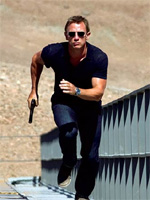
    It was probably inevitable. After “Casino Royale,” the first entry in the retooled, Daniel Craig-led James Bond franchise, garnered unprecedented critical acclaim (and even awards attention, on this side of the Atlantic at least) for a 007 pic, the follow-up, “Quantum of Solace,” is having a more muted reaction. The reviews are in, and they’re respectable at best.

    Peter Bradshaw at The Guardian has the best line (“Bond has gone rogue — like Sarah Palin, only with less expensive clothes”), but his three-star review is pretty typical of the mood:

    I have to confess that this second Bond adventure disappointed me a little: it’s not nearly as smart as Craig’s debut. There is not much storyline or romance … (but) what Quantum of Solace does have is Daniel Craig. No one could deny Craig’s charisma, and the effortless way he has inhabited the role … Quantum of Solace isn’t bad, but from now on, Craig’s Bond has to be a real character with something real at stake, however absurd. Otherwise we’re going to return to the franchise production line. That would be an awful shame.

    Tim Robey at the Telegraph is more enthusiastic, even if he also has some reservations about the narrative:

    Quantum of Solace may hurtle through its own (sketchy) plot as if it’s not quite the point – there have been more satisfying narrative pay-offs than we get here – but its best sequences bring you up short in the best way, adding up to the giddiest straight ride since The Living Daylights … It has the compensation of a rock-solid dramatic idea, and the intelligence to run and run with it.

    (more…)

  • WEEKLY WRAP: ‘Milk’ unveiled, London winds down, Halloween horror

    It’s been a quieter seven days after the upheaval we’ve seen in the race lately, but here’s how things went down:
    • “Milk” and “Frost/Nixon” finally unspooled for the LA crowd…

    • … and boy, some people don’t take kindly to criticism of either flick.

    • Meanwhile, “Doubt” kicked off the AFI Fest…

    • … while the London Film Festival drew to a close, showcasing “Che” and “The Wrestler” along the way. Check out our assorted reviews and “best in show” wrap-up.

    • ‘Tis the season to be scared shitless… the 20 all-time best horror films, as assembled by our team.

    • Christopher Nolan offers pretty much the final word on “The Dark Knight,” while some wonder if he can complete a Batman hat-trick.

    • The British Independent Film Awards revealed their nominees… “Hunger” and “In Bruges” are sitting pretty.

    • Best Sound Editing gets its week in the sun at Tech Support.

    • Looking at some new blood in this year’s tepid Best Original Song race.

  • LONDON: Gongs for ‘Mice,’ ‘Tulpan’ … and my own awards

    My last post on the London Film Festival brings some happy news, as one of my favourite festival titles was justly rewarded last night. The festival is not a competion-based one, but three prestigious awards are still handed out before the final screening.

    One of these is the global festival staple, the FIPRESCI International Critics’ Award. I’m thrilled to see it went to Australian multi-hyphenate Matthew Newton for his superb debut feature “Three Blind Mice,” which I already gushed over here. At only 31 years of age, I predict big things for Newton, both before and behind the camera.

    Meanwhile, the Sutherland Trophy for best debut feature went to “Tulpan,” the Kazakhstani entry for Best Foreign Language Film, beating such heavyweight contenders as “Ballast” and “Hunger.” It’s an auspicious award with a 50-year history: previous winners include “L’Avventura,” “In the Realm of the Senses,” “The Fabulous Baker Boys,” “You Can Count on Me” and “Persepolis.” I was rather taken with “Tulpan,” so I’m pleased to see this underdog come through — it’s a dark horse to crack the Oscar shortlist.

    Other winners included the Italian character drama “Mid-August Lunch,” which took the Satyajit Ray Award for “artistry, compassion and humanity” in a debut film, and “Victoire Terminus,” a study of female boxing in the Congo that took the Grierson Award for best documentary. I’m afraid to say I missed both films, though I particularly wanted to catch the latter.

    And with that, bearing in mind that I couldn’t see everything, I thought I’d hand out my own inaugural (and no doubt much-prized) awards for the best that I saw at the fest, starting with my own personal Top Ten:

    TEN BEST FILMS OF THE FESTIVAL: 1. “The Class”; 2. “Synecdoche, New York”; 3. “Il Divo”; 4. “Slumdog Millionaire”; 5. “Three Blind Mice”; 6. “Wendy and Lucy”; 7. “The Good, The Bad, The Weird”; 8. “The Wrestler”; 9. “Sugar”; 10. “La Belle Personne”

    (more…)

  • What might have been

    It’s James Bond day here in the UK, and to celebrate the opening of “Quantum of Solace,” The Guardian has a nice little feature: a round-up of several Bond themes that never were. Whether submitted on spec, or commissioned by the producers who then changed their minds, it makes for some fascinating listening.

    Can you believe that Ace of Base were the first choice to do a “GoldenEye” theme? That “For Your Eyes Only” was supposed to be sung by Blondie? (Oh, if only.) That Johnny Cash and Dionne Warwick both submitted brilliant tracks for “Thunderball” but were rejected in favour of Tom Jones?

    Suffice to say that this year’s rejected chanteuse, Amy Winehouse, is in some good company. My favourite, much as I love Nancy Sinatra’s theme, is this sharp little Northern Soul number that singer Lorraine Chandler submitted for “You Only Live Twice”:

  • Sticking to the music

    Way back in April, in my very first post for InContention as it happens, I reported that Marketa Irglova — the delightful star of “Once” and the woman responsible for the best speech of this year’s Oscar ceremony — was in talks to further her acting career by appearing in “Darkness,” a new horror film from Czech veteran Juraj Herz.

    Sadly, it’s not to be. Irglova has backed out of the project in order to tour with her personal and professional partner (and, of course, “Once” co-star) Glen Hansard. I shouldn’t complain, since I can’t wait to see them in concert, but it would’ve been interesting to see her on screen again. Here’s hoping something else comes up.

  • LONDON: Filling in the gaps

    Whew. A fortnight and 60-odd films later, I have reached the end of the London Film Festival. It came to a rousing close today with “Slumdog Millionaire,” a film for which I can only echo the enthusiasm that has been expressed nearly everywhere else — a fresh, thrilling, beautiful marriage of classical (even fairytale-style) storytelling and edgy stylistic verve. Plenty will be written about this beguiling work in the months to come, but for now, I’ll just say that it satisfies and surprises on just about every level.

    I’ve tried to keep up with the pace with my review roundups, but inevitably, I’ve wound up with a backlog of films I haven’t mentioned yet. So what follows is a quick catch-up effort, looking over some of the lower-profile hits and misses in 100 words or less.

    I will get into some bigger films in due course — Steve McQueen’s harrowing “Hunger” and Rian Johnson’s undervalued if occasionally precious “The Brothers Bloom” are two titles that merit more detailed discussion. And, as I’ve said before, there’s no need for me to discuss films that are already old news in the US (though I will say I finally caught up with “Frozen River” and was impressed by its tight construction and Melissa Leo’s deeply felt lead turn), or have already been covered on these pages. (I have similar sentiments to Kris on Ari Folman’s exquisite but overly distancing “Waltz With Bashir.”)

    So here’s a rundown of the littler guys, ranging from (to filch from the title of one of my favourite festival pics) the good to the bad to the weird:

    SUGAR (***1/2): One of the strongest American entries in the festival, Ryan Fleck and Anna Boden’s worthy follow-up to “Half Nelson” shares that film’s lyricism and humanism, but paints on a broader social canvas. The story of a young baseball pitcher from the Dominican Republic embarking on his Stateside career, it adds new textures to the sports-movie genre — no other baseball film has conveyed the knife-edge stakes of league politics more effectively. A rare portrait of the American Dream that skirts sentimentality, it benefits from the brooding, vulnerable presence of lead actor Algenis Perez Soto, and the hazy, summery tones of Michael Brooks’s cinematography.

    (more…)

  • Ebert hearts Hawkins

    I happened upon this a week late, so apologies for that, but I still think it bears mentioning. It’s no secret that Roger Ebert is probably one of the few critics who means anything to Academy voters. Whether it’s true or not that his backing of such underdog contenders as “Crash” played into their victories, people thinking you wield that kind of influence is an influence in itself.

    What I’m saying, in a long-winded fashion, is that when Ebert gets truly excited about a film or a performer, the sun often shines a little brighter on their Oscar campaign. And someone whose publicist must be smiling is Sally Hawkins, a well-liked but comparatively low-profile contender who needs passionate support to come through in a crowded Best Actress race. And, in his glowing four-star review of “Happy-Go-Lucky,” passionate support is precisely what Ebert offers:

    Poppy is one of the most difficult roles any actress could be assigned. She must smile and be peppy and optimistic at (almost) all times, and do it naturally and convincingly, as if the sunshine comes from inside. That’s harder than playing Lady Macbeth. Sally Hawkins been in movies before, including Leigh’s “Vera Drake” and Woody Allen’s “Cassandra’s Dream,” but this is her star-making role. She was named best actress at Berlin 2008. I will deliberately employ a cliche: She is a joy to behold.

    (It’s) a role very few women could play. Maybe Meryl Streep could sustain that level of merriness, but then what can’t she do? And now I must ask, what can’t Hawkins do? There are countless ways she might have stepped wrong. But she breezes in on her bicycle and engages our deepest sympathy.

    That’s heady praise there. He is also deeply impressed by Hawkins’s co-star Eddie Marsan, describing his performance as “spellbinding.” I’m not saying Ebert strikes gold every time, but should he continue to champion Hawkins and the film to such an extent, some voters might just be listening.

  • LONDON: A note on ‘Che’

    Since its contentious debut at Cannes in May, Steven Soderbergh’s “Che” has attained a  reputation in certain quarters as some kind of intimidating four-hour monolith, even a grand folly. The 252-minute running time is invariably the first detail given about the film, a figure that seems to awe and repel people in equal measure.

    So it was interesting, at the London Film Festival, to watch “Che” in the format Soderbergh originally intended, and as it will eventually be distributed in wide release: as two separate films screened, in this instance, two days apart.

    I think it’s the right way to go, not from a commercial perspective (though probably that too), but an artistic one. For “Che” is no simple, single sprawl that has been bisected, miniseries-style. We’re talking about two individual, self-standing movies here, each one distinct in rhythm, tone and texture. Watching “Guerrilla” (Part Two) this afternoon, after “The Argentine” (Part One) had been knocking around in my head for 48 hours, gave me the appropriate distance to reflect on the changes that occurred in the man in the gap between the two narratives; I got the sense I was watching a life in progress.

    Both films are fine, muscular feats of storytelling, utterly compelling through their accumulation of military and domestic detail. There’s also a preoccupation with landscape here that recalls the earthy stateliness of 1970’s European art cinema — the Taviani brothers kept coming to mind for some reason, though they never made anything remotely similar. Despite the running time, barely a scene in either film feels wasted — if anyone’s life bears such intense scrutiny, after all, it’s Guevara’s.

    (more…)

  • SHORT TAKE: “The Baader Meinhof Complex” (***)

    The Baader Meinhof ComplexGermany has hit something of a sweet spot with the Academy of late, having won Best Foreign Language Film twice in seven years, and scoring two additional nominations — all with somber, rock-solid takes on aspects of the country’s fascinating 20th-century history. (Last year’s winner, “The Counterfeiters,” may have been from Germany’s neighbor Austria, but it was a clear continuation of the trend.)

    So I’m not at all surprised to hear whispers that this year’s German entry, “The Baader Meinhof Complex,” is going down well at Academy screenings. A weighty, expansive and absorbing study of the war of terror waged against the state by the radical Red Army Faction in 1970s Germany, as well as the personal conflicts raging between its three leaders, it ticks any number of Academy boxes: it feels ‘important’ yet accessible, exotic in subject but familiar in form. Intelligently structured and immaculately crafted, its initially daunting 150-minute running time fairly zips by.

    Yet it isn’t quite a great film. Where Florian Henckel von Donnersmarcks’s stunning “The Lives of Others” managed to filter volumes of political context through a finely wrought personal narrative, “The Baader Meinhof Complex” — admittedly working within the bounds of non-fiction — occasionally struggles to locate the human complexity within the history.

    The three protagonists speechify to rousing effect, but their psychological motivations and vulnerabilities remain frustratingly opaque to the end. Fine actors like Martina Gedeck and Moritz Bleibtreu consequently can’t find enough notes to play in the portrayals of the title characters; more compelling is Johanna Wokalek, who, as Baader’s wife Gudrun, colors her political passions with a fierce sexuality.

    Uli Edel directs with a sure, selfless hand, placing story before style, which makes sense with story material this rich. While his approach borders on the prosaic at points (I could do without such literal music cues as “Blowin’ in the Wind”), this is still robust meat-and-potatoes filmmaking: not as innovative or as challenging as other fare on offer, but nutritious nonetheless. The density of incident and detail crammed into the film’s frame is impressive, but it’s hard not to come away wishing one knew the people at its centre a little better.

  • ‘Hunger,’ ‘Bruges’ lead British Independent nominees

    The British Independent Film Awards are an odd, under-the-radar institution that frequently like to avoid the obvious and champion the underdog. Last year, for example, they bypassed the starrier likes of “Eastern Promises” and “Notes on a Scandal” to award their top prize to Anton Corbijn’s magnificent, under-rewarded “Control.” The previous year, they were even more daring: Best Film justly went to “This Is England” over “The Queen,” while Helen Mirren and Forest Whitaker — gasp — lost to the unknown leads of Andrea Arnold’s “Red Road.”

    So it is this year that the nominations feature one doozy of a snub: while the top prize, Best British Independent Film, features such obvious contenders as “Slumdog Millionaire” and “Hunger,” Mike Leigh’s “Happy-Go-Lucky” is nowhere to be found. Ditto Best Director and Best Screenplay — the omission particularly galling when the likes of (gack) “Son of Rambow” made the cut. Did Leigh run over the voters’ dogs or something? Sanity at least prevailed in the acting categories, where Sally Hawkins, Eddie Marsan and the wonderful Alexis Zegerman all made the cut.

    Zegerman’s category, Best Supporting Actress, is an indication of how slim the pickings were this year: nods for the mediocre likes of Hayley Atwell in “The Duchess” and Sienna Miller in “The Edge of Love” don’t suggest a very deep pool of nominees. Meanwhile, Kristin Scott Thomas’ mention for the fun but flimsy trifle “Easy Virtue,” which I saw this morning at the Festival, is clearly an indirect nomination for her ineligible awards-bound work in “I’ve Loved You So Long.”

    Still, there’s plenty to cheer about here, not least the impressive showing for Martin McDonagh’s superb “In Bruges,” which jointly leads the field with “Hunger,” both films receiving seven nominations. The inevitability of the nominations for “Hunger” and “Slumdog Millionaire” doesn’t make them any less deserving, and “Man on Wire” is a pleasingly left-field choice in the top category.

    (more…)

  • REVIEW: “Wendy and Lucy” (***1/2)

    Wendy and Lucy(BFI London Film Festival)

    Quietly, steadily and with markedly little vanity, Michelle Williams is blossoming into a truly remarkable actress. This is not exactly a revelation: even before her Oscar-nominated turn in “Brokeback Mountain” brought her to wider attention, her work in films like “Dick” and “Me Without You,” not to mention as the most interesting member of the “Dawson’s Creek” ensemble, made it clear she was going places.

    2008 looks to be something of a watershed year for Williams, in which she has made clear strides towards identifying the independently-oriented performer she wants to be (the awkward paycheck job of “Deception” notwithstanding). Not content with holding her own in the dazzling “Synecdoche, New York” ensemble, she has, for the first time, taken on front-and-center roles in two very challenging projects.

    In “Incendiary” (reviewed here), Williams impresses by remaining focused when the film falls apart around her; happily, in Kelly Reichardt’s sad, spare and altogether beguiling “Wendy and Lucy,” she has found a project with the discipline and intelligence to match her own.

    I wouldn’t normally begin a review by foregrounding the star to such an extent, but the truth is that Williams’s performance is both integral to, and responsible for, the film’s success; without the silently expressed complexities, the shadows of days past, that she brings to the character of Wendy Carroll, the film would amount to little more than a sketch, a landscape as unmoored as its protagonist.

    (more…)

  • LONDON: Surprise… it’s ‘The Wrestler’

    It’s a rainy Sunday night in London, and darkness fell a whole hour earlier thanks to the start of daylight savings. All of which only made me happier to be seated inside the warm cavern of the Leicester Square Odeon for my favorite event of the London Film Festival — the annual Surprise Film.

    Usually a hot title secured too late for inclusion in the main festival lineup, and not revealed until the title shows up on screen, the Surprise Film has a mixed track record. Festival director Sandra Hebron scored last year by getting “No Country for Old Men,” but I’ll never forget the groans of disappointment that greeted the opening credits of “Mrs Henderson Presents” in 2005.

    In the foyer before the screening, whispers were spreading that this year’s choice was either “Changeling” or “The Wrestler.” So as the lights went down and the logo of the Venice Golden Lion prize flashed onto screen, announcing Darren Aronofsky’s much-lauded new film, the murmur of approval around the theater was palpable. (Incidentally, I called this pick a few weeks back — mainly because I was so surprised not to see it in the lineup.)

    But Hebron had more than one surprise up her sleeve tonight — unusually for the surprise slot, both Darren Aronofsky and Mickey Rourke showed up for a post-film Q&A. Nobody was expecting that, and it made for my most entertaining festival experience so far, though I’m now kicking myself for bringing neither camera nor notepad (d’oh!) to the screening. A terrific coup for the festival — kudos to Sandra.

    As for the film itself, I’m still too shaken by it to offer much in the way of coherent thought, but count me among the yea-sayers. Deceptively simple in form but deeply probing as character study, it strikes me as exactly the right film for Aronofsky to have made at this point in his career. As someone who actively dislikes everything to do with the wrestling circuit, I had concerns about how much I could personally connect with the film, but it proved revelatory — sport aside, this is a story of the body as a war zone.

    (more…)

  • WEEKLY WRAP: ‘Button’ rises, ‘Torino’ surfaces, ‘Doubt’ swoops

    Apologies for the slightly delayed wrap. Much to discuss this week — here are the highlights:

    • With some formerly hot prospects now off the radar, this week’s Off the Carpet column surveys the landscape, and concludes that things look good for “Benjamin Button.”

    • “The Soloist” withdrew as the AFI fest opener; their loss is “Doubt”‘s gain.

    • With a trailer for “Gran Torino” finally emerging, we wonder if Clint Eastwood is the real frontrunner for Best Actor.

    • The Gotham Independent Film Awards unveiled the season’s first set of nominees — good news for titles like “Ballast” and “The Visitor.”

    • More impressions from the London Film Festival, including hot foreign-language contender “The Class.”

    • Still in London, we caught up with “Happy-Go-Lucky”‘s superb Best Supporting Actor contender, Eddie Marsan.

    • This week’s edition of Tech Support put Art Direction in the spotlight.

    • We were in a listmaking mood this week, rounding up some of the most scandalously unnominated actors of this era …

    • … while John Foote reminisced over his personal favourite movie moments.

    • And finally, who should host the Oscars? Our answer may surprise you.

  • LONDON: “W,” “Genova,” “Il Divo” and more

    We’ve reached the midway point of the London Film Festival, and today’s big event is the European premiere of “W.” As I eavesdropped on assorted critics’ reactions coming out of the press screening this morning, the dominant feeling appeared to be one of pleasant surprise; I have a feeling the film may find a rather warmer reception here than in its home country.

    I’m still gathering my thoughts on the film, which I thought riveting in some respects and messy in others, though it’s clear Stone has transcended the limitations of Stanley Weiser’s script. Josh Brolin and Elizabeth Banks offer such persuasive, full-bodied characterisations that the Madame Tussaud’s quality of certain supporting players (Thandie Newton in particular) pales by contrast.

    With that, here’s another roundup of notable films from the last few days, beginning with yesterday’s starry but rather under-the-radar Mayor of London gala selection:

    GENOVA (**1/2)

    There is much to engage the eye and ear in “Genova,” the new film from restless Brit auteur Michael Winterbottom. A return to his usual, more organic directorial style after the disappointingly conventional “A Mighty Heart,” the new film teems with activity: from the loose, jazzy rhythms of the editing to the fragmented, eclectic soundtrack overlaying busy dialogue, and above all, superb location work that turns the labyrinthine alleys of the eponymous Italian coastal city into a playground of threat and desire.

    (more…)

  • LONDON: ‘Tony Manero,’ ‘The Other Man,’ ‘Awaydays,’ ‘Seamstresses’

    Before I continue my roundup of films from the last few days of the London Film Festival, I received an email asking why I haven’t mentioned such major festival titles as “Rachel Getting Married” and “Religulous.”

    There is little point in me reviewing titles that have already opened in the States (and which Kris has already discussed, in my opinion rather accurately), with so much coverage already available. But to deal briefly with three such films, I enjoyed “Rachel Getting Married” (***) for Jonathan Demme’s loose, funky aesthetic, but found the script disappointingly glib beneath the flashy surface wit. “Religulous” (**1/2) is entertaining but not as penetrating as it imagines itself, with Bill Maher claiming to stand for doubt, but showing precious little thereof in his one-sided argument. Meanwhile, the less said (from me, at least) about the fatuous trifle that is “Nick and Norah’s Infinite Playlist” (**), the better. Moving on:

    TONY MANERO (***)

    Chile’s official Academy Awards submission is a stark, studied and ultimately rather unsettling black comedy that provides a particularly bleak spin on the familiar character of the fame-crazed non-talent. Set in the late 70’s, against the ominous (and fascinating) political backdrop of the Pinochet dictatorship, the film centres on Raul (Alfredo Castro), a dour, dysfunctional middle-aged man whose chief pleasure in life is regular viewings of “Saturday Night Fever” at the local cinema.

    Obsessed with the John Travolta character for whom the film is named, Raul begins modelling himself on Manero, going so far as to enter a Manero lookalike contest on national TV, and leading a shabby dance troupe in meticulous pastiches of “Fever” dance numbers at a local bar. However, the startling lack of moral boundaries Raul shows in his quest to inhabit Manero leads him into a spiral of theft, lies and murder.

    (more…)