Okay, so I’m not really advocating it. But this has to be one of the best FYC ads I’ve seen so far this season. Whatever other failures “W.” can claim, marketing is not one of them:
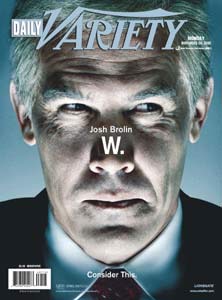
Okay, so I’m not really advocating it. But this has to be one of the best FYC ads I’ve seen so far this season. Whatever other failures “W.” can claim, marketing is not one of them:
 Whenever an awards shortlist is announced, people will inevitably spend as much time, if not more, pondering its omissions as they will its inclusions. And so it has been this week, in the wake of the Academy’s announcement of the 15 titles shortlisted for Best Feature Documentary.
Some are curiously kvetching that Bill Maher’s sporadically amusing but ultimately pedestrian “Religulous” got slighted, instead of commending the Academy for looking beyond the obvious. Others (including yours truly, admittedly) are puzzled that the excellent “Roman Polanski: Wanted and Desired” didn’t make the cut, while some are surprised that last year’s winner in the category, Alex Gibney, was frozen out this time. (Well, had “Gonzo” been half the film “Taxi to the Dark Side” was, he might not have been.) And then there’s “American Teen” and “Bigger, Faster, Stronger” and … well, you get the idea.
The conclusion to draw from this is twofold. First of all, in this category, name recognition isn’t always a deciding factor. Second of all, and more simply, the shortlist is, even with these high-profile exclusions, a markedly strong one. Boiling it down to fifteen titles was clearly a harder task than one might have guessed.
I’m not sure enough people are recognising the breadth and the depth of the competition in this category. Amid the various reactions I’ve read to the shortlist, I’ve noticed the same small handful of contenders coming to the fore: “Standard Operating Procedure” from previous champ Errol Morris, “Encounters at the End of the World” from the long-slighted Werner Herzog, Sundance victor “Trouble the Water,” and the film widely deemed the one to beat, “Man on Wire.”
I’m less convinced. Yes, they’re all highly acclaimed conversation pieces. (Well, almost — Morris’ film appears more polarising than the rest.) Yes, they all have enjoyed comparatively prominent releases. But, like the notoriously wilful Best Foreign Language Film category, this category doesn’t always reward a high profile. For every time they’ve embraced a populist frontrunner like Michael Moore, they’ve ignored a supposed shoo-in. Just ask, well, Errol Morris and Werner Herzog — both previously snubbed for some of their most lauded work.
 Over at Awards Daily, Sasha Stone has taken it upon herself to whittle down the Best Picture race to a brisk 11-title list, and it makes for sobering reading:
“The Curious Case of Benjamin Button”
“The Dark Knight”
“Doubt”
“Frost/Nixon”
“Gran Torino”
“Milk”
“Rachel Getting Married”
“The Reader”
“Revolutionary Road”
“Slumdog Millionaire”
“The Wrestler”
I can’t be the only person looking down that list and gloomily wondering, “Is that it?” (I suppose some might argue for “Australia” still, but even the positive early reviews don’t give me a great feeling.) Sadly, not only is Stone probably right, but she’s still being relatively generous — I would strike “Rachel Getting Married” off the list without too much hesitation. Meanwhile, the level of hype centering on Clint Eastwood’s Best Actor campaign for “Gran Torino” has me wondering whether those who have seen it don’t deem it Best Picture material. (I remain among those unpersuaded by the film’s trailer.)
It seems to me that “Doubt”‘s chances of a Best Picture nomination depend entirely on how much award steam it gathers in the acting races, while “The Reader” remains a puzzle to me — it has the right credentials, the trailer looks solid, but why don’t I sense more excitement around it? Harvey Weinstein is still struggling to regain his golden touch at the Oscars, and it remains to be seen whether that early bout of bad press over the film’s release-date kerfuffle will linger.
 A couple of weeks ago, Dave Karger revealed that he’d seen “The Curious Case of Benjamin Button,” offering a single “wow” as his response. He now feels able to expand on that slightly, though “wow” is still his general gist:
“Button” is an Oscar movie with a capital O, with jaw-dropping production values, a soaring romance, and terrific performances, particularly from supporting-actress candidate Taraji P. Henson as Benjamin’s de facto mother. Even if Brad Pitt doesn’t make it into the tough Best Actor race (the likes of Clint Eastwood and Leonardo DiCaprio may squeeze him out), I still can see “Button” racking up as many as 11 nominations, which could very well be the highest tally for any film this year. Once the film opens on Christmas day, I guarantee we’ll all be talking about one thing: whether or not “Benjamin Button” made you sob.
Nothing that most of us weren’t suspecting anyway, but nice to see it in black-and-white. I’m interested to see that he confirms the chances of presumed contender Henson, after some vague whispers elsewhere that Tilda Swinton might be one to watch in the category. And I agree that, even if his film is a frontrunner, Brad Pitt is up against it in the Best Actor race. (After all, an Oscar juggernaut needn’t always pull its leading man with it — just ask Joseph Fiennes or Leonardo DiCaprio.)
To me, it looks increasingly as if all “Benjamin Button” has to do is be merely good, and it will likely score at the Oscars by sheer default in this weird season. (Incidentally, why stop at eleven nods? I count thirteen, excluding Best Actor. I’m not saying it will get them all, but surely the possibility is there.) I’m really looking forward to Kris’ thoughts once he — finally — sees the whole picture.
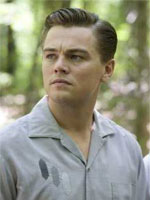 A big week, this, in which the covers were finally lifted off some heavyweight titles. Here’s what we were talking about:
• And speaking of those heavyweights, Kris ran hot on “Revolutionary Road,” but cool on “Australia” …
• … while being offered a frustratingly truncated glimpse of “Benjamin Button.”
• The Academy announced their 15-strong shortlist for Best Documentary Feature, and emerged with credibility largely intact, in my opinion.
• We were fortunate enough to chat to the incredible Roberto Saviano of “Gomorrah” fame…
• … as well as the charming Rosemarie DeWitt, our pick of the “Rachel Getting Married” ensemble.
• Roger Ebert either picked the brain of an Academy insider, or made some bold predictions of his own. Interesting either way.
• This week’s Off the Carpet column played the waiting game.
• Tech Support got musical this week, with a look at the composers in the hunt for gold this year.
• We examined the horses (or lack thereof) in the Comedy/Musical races at the Golden Globes.
• This week’s edition of The Lists delved into the embarrassment of cinematic riches that was the 1970s.
• “The Wrestler” finally got a poster and an impressive trailer.
• We contemplated next year’s BAFTA awards, wondering whether homegrown winners will again dominate proceedings.
• The Best Picture debate over “The Dark Knight” continues apace.
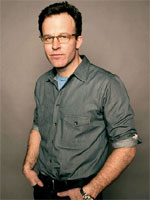 I don’t know why exactly, but the “roundtable” format of interviews that crops up a lot during awards season often strikes me as rather less fascinating than it’s meant to be. Unless the panel is very smartly chosen, I find the discussion tends to veer towards back-patting and faintly smug in-jokery, rather than stimulating argument between widely differing creative forces.
Maybe I’m just blasé. But on reading the Hollywood Reporter’s two recent “Oscar Roundtables” with six screenwriters and six producers that THR thinks are likely to figure in the Oscar race, I couldn’t help being disappointed that, despite the level of talent involved, they didn’t have that many interesting things to say between them. (I’d go so far as to say that the best soundbite is quoted from the not-present Charlie Kaufman.)
The selected writers are Jenny Lumet (“Rachel Getting Married”), Dustin Lance Black (“Milk”), Thomas McCarthy (“The Visitor”), John Patrick Shanley (“Doubt”), Andrew Stanton (“WALL-E”) and J. Michael Straczynski (“Changeling”). I have a hard time imagining the latter two will score writing nominations, but the race is young, I suppose.
Writers can be pretty insufferable when talking about their “process” — I know, I am one. So there’s the usual semi-serious comparing of hours spent at the computer, feverish notebook scribbling and messy first drafts, but there isn’t much discussion of the specific screenplays and films at hand. McCarthy seems to be the most reticent of the group, only entering the discussion halfway through. A shame, really, as I’d venture that he’s possibly the best writer of the lot.
As anticipated earlier this week. Great trailer. Greater film. That Springsteen theme actually brings a lump to my throat.
Click here if you want it in pretty Apple form.
And very lovely it looks, too. You’d expect a marriage between Henry Selick, Neil Gaiman and Focus Features to be on the classy side of the spectrum, and so it appears to be here.
February still seems to me like a curious month to open this kind of product, but I’m guessing if the film lives up to its promise, it’ll be an early contender for the 2009 Animated Feature Oscar. Dive in:
After initially being booted out of awards season into the cinematic no man’s land of March 2009, it seems Joe Wright’s “The Soloist” has been rescheduled yet again.
It’s now apparently slated for release on April 24, which sounds like a beneficial move into early summer-movie territory. Read into that what you will. Perhaps it’s a vote of confidence in the film’s commercial viability, though I suspect this is still no awards contender.
 UPDATE: I was in a bit of a rush earlier, but reading it again in more detail, I suspect these are not the thoughts of an AMPAS member, but Ebert’s own predictions in playfully disguised form. Still an interesting read, but several pinches of salt perhaps required.
EARLIER: Heath Ledger will win the Oscar next February. It’s a done deal. The other four nominees may as well not show up.
That’s not my opinion there. It’s that (albeit in paraphrased form) of the so-called “Deep Vote,” an Academy insider who recently shared his perspective on the race with Roger Ebert. In an amusing post on his website, Ebert has written up the conversation he had with his mole, and runs through Deep Vote’s other picks — some of which are a little more surprising than the one divulged above.
I always take such perspectives with a grain of salt — just because someone is a member of the Academy, after all, doesn’t mean they can read the minds of 6,000-odd other voters. But it does provide some interesting insight into which names are in play and generating heat, even if I find it hard to square with certain proclamations.
For example, I’m sceptical that Jonathan Demme is a “lock” for a Best Director nomination, as is claimed here. It does suggest, however, that there might be more support for him than I expected. I was also interested to see that he has “The Curious Case of Benjamin Button” in his “maybe” pile for a Best Picture nod, behind the likes of “Slumdog Millionaire,” “Frost/Nixon,” “Revolutionary Road,” “Doubt” and “The Reader.” And I liked this tidbit, which suggests he’s a bit more sophisticated than the average AMPAS voter:
‘Synecdoche, New York’ is easily good enough, but they’re embarrassed you had to explain it to them.”
 Looking across the early reviews, I think it’s fair to say that “Australia” has cleared the first hurdle. They’re mixed, for sure — hardly new territory for Baz Luhrmann — but there’s a lot of admiration out there, even within the kvetching. There were a number of voices out there anticipating an outright disaster, but so far, it doesn’t sound like one to me.
The harshest takes so far seem to have been from the Australian press, which isn’t at all surprising. People are more liable to be aggravated by the romanticisation of their own culture than one foreign to them, after all. And “romanticisation” is the operative word here; as with “Moulin Rouge,” one clearly has to buy into Luhrmann’s fanciful stylisation to appreciate the film.
Screen International obviously did, even if they’re a bit winded by it all:
Luhrmann has fearlessly gone for the biggest, lushest goal he could imagine — a romantic, old-fashioned epic to stand beside “Gone With the Wind.” Though it fails to reach such Hollywood heyday heights, “Australia”‘s combination of high adventure, awesome landscapes and panting passions is sure to bring out romance starved adult audiences … If the restless richness becomes somewhat indigestible before the film’s considerable length is reached, that’s part of the Luhrmann package. Who else would dare such excess?
Jackman is the epitome of handsome, untamed individualism: Kidman tempers haughty stridency with a delicate comic playfulness, touching in a scene with young Nullah where she teaches him, with no confidence in her own ability, to sing Over The Rainbow … (Brandon) Walters, aged 12, is perfect as the beautiful, troubled Nullah.
Technically, this is ravishing, from production and costume designs from Catherine Martin to DoP Mandy Walker’s often-majestic footage. Australia is long on digital effects, mostly to good purpose, though some of the wartime Darwin harbour wide shots are wisely held for the briefest of seconds … The soundtrack is a potpourri of heightened effects and soaring musical themes.
 Rosemarie DeWitt is excited.
It can be difficult to gauge emotion in the formal, slightly removed context of a phone interview, but DeWitt’s warm, clear voice betrays an eagerness right from the get-go, articulating thoughts at a pace that occasionally exceeds my shorthand. Only when addressing the heady buzz of awards season does she finally pause to reach for words.
“It’s crazy, seriously crazy, but more than anything, it’s just really flattering,” she says. “This is the best job I’ve ever had, and I’m so, so proud of the film. Anything more than that is just…” A moment passes as she takes a breath, and considers the matter. “Wow,” she concludes simply.
The film in question, of course, is “Rachel Getting Married,” Jonathan Demme’s barbed family drama that has been widley declared the filmmaker’s return to form after some years in the wilderness. The buzz, meanwhile, is for DeWitt’s subtle, complex turn in the title role, which has garnered considerable plaudits for the hitherto low-profile 34-year-old actor, a frequent stage presence only recently receiving her due on screen, both big and small.
Best known until now for her tart, sexy portrayal of Midge, Jon Hamm’s bohemian city mistress in TV critics’ darling “Mad Men,” DeWitt is calling from Los Angeles. She’s just finishing work on another cable series, “The United States of Tara,” a dark, high-concept comedy created by Diablo Cody and starring Toni Collette (an “absolute genius,” DeWitt gushes).
All of which would be enough to get excited about without Oscar talk being thrown into the mix. But as Rachel, the older sister of Anne Hathaway’s self-destructive addict Kym, DeWitt’s attentive, commendably unflattering performance finds itself right in the thick of the Best Supporting Actress competition. Hers is, for me, the most resonant performance in a film that doesn’t want for thespian fireworks, largely because DeWitt never pushes Rachel into the stock character of the saintly, long-suffering sibling.
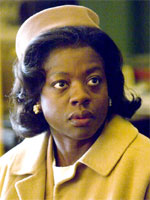 Amid the conflicting reviews that have emerged so far for John Patrick Shanley’s “Doubt,” the one common denominator between them appears to be unanimous praise for the supporting performance of Viola Davis. You may remember Kris describing her work as “gut-wrenching,” amid an otherwise tepid review.
Davis’ role may be small — she has a mere two scenes — but as the Academy has demonstrated in rewarding Beatrice Straight in 1976 (or in nominating Ruby Dee earlier this year), brevity is no obstacle when they are sufficiently moved by a performance.
Knowing the role, I’ve thought for a while that Davis could wind up the film’s strongest contender for gold, despite many supposing the film would be The Meryl Streep Show. Streep, however, has suffered notices as mixed as the film’s, with heady praise balanced out by detractors (including a much-quoted Variety review) who find her performance a tad on the melodramatic side.
Now Nathaniel Rogers at the Film Experience, whose deeply considered views on the female acting races are always worth reading, has seen the film, and he is also climbing off the Streep bandwagon. Venturing that Streep may have to wait a while longer for that elusive third Oscar, he writes:
Sister Aloysius is a sticky role but it’s not the slam dunk “erase memories of Cherry Jones’s powerhouse stage creation”‘ it needed to be for Streep to reach Nicholson’s three statue tally. Best Actress fanatics take note: the way is clear for Kate Winslet (Revolutionary Road / The Reader) if she delivers –it’s getting harder and harder to imagine anyone else winning.
 UPDATE: We’re not out of the woods yet. The Hollywood Reporter gives it the thumbs-down, something I didn’t notice earlier, as the review was buried in their impossible website. (Seriously, guys, work on it.) Anyway, Kirk Honeycutt calls it “didactic” and “emotionally overblown,” and has nothing to say about the performances.
On the other hand, Honeycutt makes no secret of his disdain for the source material (“it fails to escape the novel’s misogyny and contempt for anything suburban”), so make of that what you will.
EARLIER: And it’s good news, even if they have some reservations. Unlike Kris, I haven’t had the privilege of seeing this yet, but it sure as hell sounds like an across-the-board contender to me:
“Revolutionary Road” is a very good bigscreen adaptation of an outstanding American novel — faithful, intelligent, admirably acted, superbly shot. It also offers a near-perfect case study of the ways in which film is incapable of capturing certain crucial literary qualities, in this case the very things that elevate the book from being a merely insightful study of a deteriorating marriage into a remarkable one.
DiCaprio often achieves the kind of double register the film as a whole less consistently captures, as he indicates Frank’s thought process in the split second before he decides what to say. At certain moments, the conjoined cerebral and emotional aspects of his characterization summon the spirit of Jack Nicholson’s breakthrough performances around the time of “Five Easy Pieces.”
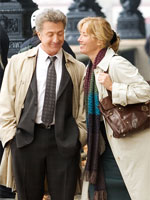 Over at his OscarWatch column, Dave Karger recently asked a question that has been bothering me for some time regarding this year’s awards race.
Namely, how the hell are the Golden Globes going to fill out the ballot in the Comedy/Musical races?
Best Actress looks solid enough. So far, we have two clear-cut frontrunners — Sally Hawkins and Anne Hathaway — in the Actress category, though I wonder if they will wind up placing Hathaway in the drama field, where I think she belongs. Meryl Streep will inevitably get cited for “Mamma Mia!” and I feel confident that Emma Thompson will grab a deserved nomination for “Last Chance Harvey.”
Karger thinks Sarah Jessica Parker could round out the list, though I might look at Beyonce Knowles in “Cadillac Records” (much as the thought of her playing Etta James upsets me) or Rachel Weisz in “The Brothers Bloom” as alternative filler nominees. (The Globes don’t mind elevating supporting roles when there’s a paucity of contenders, though Weisz is a legitimate lead, in my opinion.)
It’s the Best Actor category that’s really problematic. From what I can see, Dustin Hoffman has this in the bag for his endearing autumnal turn in “Last Chance Harvey” — not just because it’s a lovely performance, but because I can barely think of any competition for him. With the news that Josh Brolin has (rightly, I think) been denied comedic classification for “W.,” Karger thinks the other nominees might pan out like so:
I’d also make the case for Paul Rudd, who anchors the current hit Role Models with his signature deadpan delivery, and Ghost Town‘s Ricky Gervais, who was brilliant in a sophisticated comedy that nobody saw. The HFPA could go the more obvious route with Get Smart‘s Steve Carell or Hancock‘s Will Smith, but here’s hoping they’ll think out of the box and recognize another understated humorist: Michael Cera from Nick & Norah’s Infinite Playlist. We can dream, right?
 I have a bit of a love-hate relationship with the BAFTA Awards. On the one hand, they can be far more daring and playful in their choices than the American Academy — this is an organisation, after all, that has handed their Best Film award to such enduring works as “The Purple Rose of Cairo,” “GoodFellas” and “Lacombe, Lucien,” while nominating the Oscar-snubbed likes of “Eternal Sunshine of the Spotless Mind” and “The Usual Suspects.”
Their technical awards are invariably more imaginatively awarded, too — take a look at their Best Film Editing category, for example, which in recent years has crowned “Eternal Sunshine,” “City of God” and “Mulholland Drive” as winners. And they can often be counted upon for gratifying upsets, as when Pedro Almodovar pushed past Sam Mendes for Best Director in 2000, or when “Trainspotting” blindsided “Sense and Sensibility” in the 1996 screenwriting race.
For an awards show that fancies itself world-class, however, BAFTA can be infuriatingly parochial in their selections, stubbornly rewarding their own in the face of bigger, bolder competition. I doubt most of the voters could say with a straight face that “Four Weddings and a Funeral” was the very best film of 1994, nor “The Full Monty” of 1997, but they cleaned up nonetheless.
For the last two years running, that kind of provincialism has ruled the voting, with this year’s awards looking particularly suspect. I think “Atonement” is a fine film, but handing it their top award seemed tokenistic at best, not least when the only other gong it took was for Best Art Direction.
It’s a trend that Variety thinks could continue this year. In an article previewing the British contenders in the acting categories, they point out that Limeys have taken 16 acting BAFTAs in the last decade, compared to seven Oscars. Needless to say, they are frequently justified. It’s fair to say that this year, several British names will be cropping up in awards lists on either side of the Atlantic, and deservedly so — particularly in the Best Actress category, where thesps like Kristin Scott Thomas, Sally Hawkins and the ubiquitous Kate Winslet are all likely to figure.