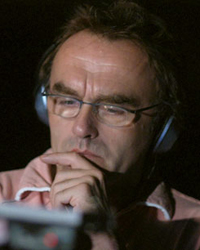
 Roughly halfway through my interview with Danny Boyle, the small, rather alarmingly wallpapered room we’ve been seated in is, by some technical error, suddenly flooded with the opening beats of “Orphans,” the first track off Beck’s “Modern Guilt” album.
Boyle immediately leaps to his feet to report the problem, though he can’t help nodding in
time to the music. “That’s the new Beck, isn’t it,” he notes excitedly. “Fantastic stuff. Now’s not the time, but fantastic stuff.” The music vanishes. Boyle flops back onto the couch, straightening out his rumpled plaid shirt.
It’s a fittingly surreal interlude for an audience with Boyle, demonstrating both his utterly unflappable personality and his keen interest in every sight and sound around him — whether invited or not. It’s a heightened awareness that is apparent in every one of his films; few directors make films as busy as Boyle’s, films as alive to the possibilities of environment, movement and music. His is a sensation-driven cinema that comes into full fruition in his astonishing new film “Slumdog Millionaire,” a breathless rush of visual and narrative energy that marries fanciful storytelling to a rich, perceptive study of a 21st-century nation.
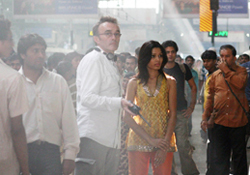
It’s also his first film with an entirely non-Western context, something which seems to have further fired Boyle’s creative impulses. “India is just … everything at once,” he enthuses, gesticulating wildly to convey the scale of it all. “It’s got these amazing extremes of wealth and poverty and religion and landscape, but in the West we go to a lot of trouble to separate those extremes. Nothing is separate in India. That makes it an incredible place to set a story, particularly one that is so tough and so joyful all at once.”
True to form, “Slumdog Millionaire” tells a pretty incredible story, a rags-to-riches tale in the most literal sense. It’s a story that hinges on the fairytale conceit of destiny, but as Boyle notes, that notion still plays into contemporary Indian society. “There’s a bond between the classes there, however far apart they are in terms of wealth. They get each other because they pretty much come from the same place — destiny makes all the difference.”
Boyle pauses to pour himself a fresh cup of tea, cheerfully dismissing the waitress’s offer of bottled water. (An Englishman through and through, he still resides in Mile End, an unfashionably working-class corner of East London.) It’s late in the day, he’s tired and, he sheepishly admits, a little hung over — the previous night saw “Slumdog” close out the London Film Festival, with all the flashing lights and partying that entails.
While it should be noted that a “tired” Boyle still projects more energy than most of the normal human population, this level of media attention is new to him. For all the acclaim his previous work has garnered, he’s never before made a film that received the awards buzz that “Slumdog Millionaire” is receiving (remarkably for an edgy, foreign-set picture with not a single name star attached).
“It’s brilliant, it’s insane,” he says, shaking his head. “It seems I just came here from L.A., and now I’m off to L.A. tomorrow. But you can’t release a film like this, something so potentially alien to audiences, and not work hard to promote it. Fox Searchlight are working me ragged, which is fantastic.”
Only a few months ago, however, the picture for the film looked less rosy, after original backer Warner Independent Pictures folded. “We were dead, abandoned. That was that,” Boyle recalls, grimacing. “The market is just doing all they can to get rid of small films. It doesn’t matter that they win awards. It doesn’t matter that someone like, say, Heath Ledger emerges from small films. They don’t want ’em. They’re just businesses.”
 In stepped Searchlight and honcho Peter Rice, whom Boyle repeatedly refers to as his “savior.” With an unusually blank slate ahead of the studio, Rice was eager for a potential indie hit to ride into awards season and was prepared to take a chance on Boyle’s exotic oddity.
“When we showed the film to Warners, they thought I was absolutely off my rocker,” Boyle laughs. “They couldn’t get with the language, they couldn’t make head or tail of it. But those guys at Searchlight are smart; they especially go out looking for stuff that’s a bit different but still has audience appeal. Peter didn’t care about the language one jot — he said to me, people can read subtitles. Release it the way you want it.”
It’s hard to believe language was an issue, not just because much of the film is in perfectly comprehensible English, but because the wonderfully fluid melding of English and Hindi in the early stages is part of what makes “Slumdog” feel so socially alive and of the moment. “Exactly!” Boyle exclaims. “This is what’s happening in the world today. You feel it everywhere — in India, in the States, here in London most of all. Everything, everyone, is mixing. That’s part of why I wanted to make the film.”
Boyle does admit, however, that he wasn’t tempted by the script at first. “All the agent told me was that it was about this slum kid who gets on ‘Who Wants to Be a Millionaire.’ And I thought, God, I don’t want to do that.”
Things changed as soon as he saw the name of “Full Monty” scribe Simon Beaufoy on the cover sheet. “They didn’t even tell me he’d written it,” he says, rolling his eyes. “And I really like Simon’s work as a writer, so I thought I’d better read it out of respect. I was 10 or 15 pages in, and then wham, I knew. Let’s do this.”
What was the big ‘yes’ moment in the script that did it for him? “I don’t know, there wasn’t one specific moment, really. I was just the world and the atmosphere Simon had built to that point. I don’t know if it was arrogance or naivete, but I knew, a) this story had to be told, and b) I had to be the one to tell it.”
Though the universality of the story is partly what drew him to the material, Boyle admits to being pleasantly surprised that it has turned out to be such a massive crowd-pleaser, the kind that festival audience awards were made for. “It’s pretty tough going, especially at the start,” he says. “A lot of people have told me, ‘You know, I was going to get up and leave,’ which is a little worrying.” He sips his tea, and shrugs. “But then they say, ‘I’m glad I didn’t,’ which is all you can ask for, really. I think that’s what you get when you make a film about India — it shouldn’t just be easy to watch.”
Indeed, the film’s more harrowing stretches have earned it a wholly unjustified ‘R’ rating in the U.S., something about which Boyle is still fuming. “I’ll be honest with you — I’m really fucking annoyed about that still. I specifically shot the film to get a PG-13, making sure that we see nothing happen. It’s one thing I really controlled in the shoot. Fortunately, Searchlight didn’t care and told me to keep the film as it is, but it’s sad. Other kids should see this film.”
He grins wickedly as he finishes the last of his tea. “Hopefully, they’ll just sneak in anyway.” It’s an appropriately subversive way to finish an encounter with this most cheekily defiant of filmmakers.
Comments
4 responses to “INTERVIEW: Danny Boyle”
I am so jealous of you, Guy.
I adore this man. He seems like such an overgrown kid, but in the best possible way. So much energy and passion for what he does when it’s probably easy to get a little jaded after a while. He’s clearly always looking toward the future for new and interesting projects. Kudos to Fox Searchlight for supporting him.
I will go see a remake of “Ishtar” if he directs it.
That’s exactly what he’s like, Liz. Quite possibly the warmest and most infectious personality I’ve come across in the industry.
[…] you’re due to speak to one Mr. Guy Lodge, proceed at your peril. (Directors, however, are apparently […]
[…] Actress, “Doubt”) Marisa Tomei (Best Supporting Actress, “The Wrestler”) Danny Boyle (Best Director, “Slumdog Millionaire”) (also here) James Marsh (director, “Man on […]