
In Contention

Author: Guy Lodge

  • Acting out

    Meryl StreepThe Guardian’s Ryan Gilbey offers an interesting piece today about screen acting, and the narrow criteria by which many of us judge it. He is writing principally in response to a recently released British film, “Helen,” a rigidly stylised meta-film in which actors play actors participating in a police reconstruction, which has attracted divisive reviews for the deliberately stilted performances of its cast.

    Complaining that many audiences place too much stock in “realism” in acting — using the deification of intensely studied, precise performers likes of Meryl Streep (“a walking manual on acting”) as an example — Gilbey argues the following:

    David Mamet writes that “We confuse ‘I like it’ with ‘It is very realistic.’ If we like it we say, ‘Yes, that’s very true.’” So truth becomes our alibi, our defence for that which pleases us.

    Given our myriad ideas of truth, it is no wonder we turn to the awards ceremonies to clarify and ratify. But while Sean Penn, Philip Seymour Hoffman or Meryl Streep win prizes, and their acting may feel true or right, it is detrimental to the craft to hold up as ideal only those performances that work as audition pieces, or as 30-second excerpts on Oscar night. The actors in Bresson’s Mouchette or Dumont’s La Vie de Jésus are but one component of those films’ defining philosophy and meaning; removed from that context, their performances have no meaning.
    (more…)

  • Just the one, then?

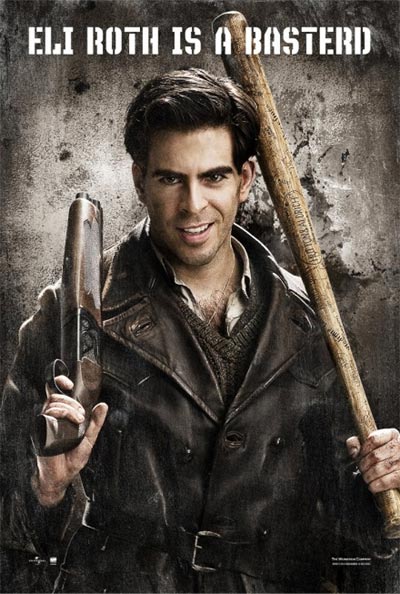
    Quentin TarantinoYou may or may not have caught this piece on Quentin Tarantino in Sunday’s New York Times magazine. Overall, it’s a fairly flimsy Cannes-oriented interview that serves mainly as an accompaniment to some pretty pictures (very pretty, in the case of the Diane Kruger shots), but two of QT’s statements jumped out at me.

    In the first, he (fairly, I think) defends his decision to hand “Fahrenheit 9/11” the Palme d’Or in 2004 as a reward for being “a movie of the moment” — but when the conversation turns to “Inglourious Basterds,” he offers up this line:

    NYT: On this movie, you worked very quickly. Was that partially to have the film ready in time for Cannes?

    QT: Yes. I wanted to have a masterpiece before the decade’s out.

    I’ll let slide the overweening pride of Tarantino’s statement for a moment — partly because, as many misgivings as I personally have about the new film, it’s that brash confidence that also gave birth to a genuine masterpiece like “Pulp Fiction.” Largely, however, it’s because I detect a note of cryptic self-deprecation there.

    Perhaps I’m reading too much into his wording. But the use of the indefinite article “a” rather than, say, “another,” intrigues me. Is he admitting that, “Basterds” aside, he hasn’t made a masterpiece this decade? If so, on behalf of “Kill Bill: Vol. 1” — and only that, I hasten to add — I’d like to disagree.

  • I don’t want my MTV

    Anne Hathaway in Bride WarsWhat do Paramore, The Rock and Kate Winslet have in common? Why, they’re all nominees for the 2009 MTV Movie Awards, of course. Like, duh.
    I have no idea what the MTV Movie Awards are for. Nobody knows or cares who wins them. (Who took Best Actor laurels last year? I doubt Will Smith could tell you — and he won, for Chrissake.)

    Subject to public vote, they serve largely as a popularity contest along the lines of People’s Choice honours — but then they taint the purity of such a credo by throwing in a mention for something incongruously credible like “Milk.” (In the prestigious Best Kiss category, to boot — how honoured Gus Van Sant must feel.)

    Anyway, this year’s nominees are a typically ill-thought and ill-fitting bunch. “Twilight” leads the race, closely followed by “Slumdog Millionaire,” which should tell you pretty much everything you need to know about the awards. They claim that the nominations were also determined by the public, though I have a hard time believing that the same people who decreed Vin Diesel a Best Actor contender for “Fast & Furious” also voted Kate Winslet in for “The Reader.”

    Speaking of which, there’s a delicious hint of Bizarro World in the Best Actress category, which finds Anne Hathaway repeating her nomination success at the Academy Awards — except, wait, it’s for “Bride Wars,” not “Rachel Getting Married.” Riiight. Angelina Jolie, meanwhile, finds herself in the race for “Wanted” rather than “Changeling” — though that’s a preference I heartily endorse.

    One thing is worth noting, however: even the bloody MTV Awards could be bothered to nominate Bruce Springsteen’s “The Wrestler” theme. The Academy will never live that one down. (Check out the MTV nods here, if you dare.)

  • A pleasure deferred

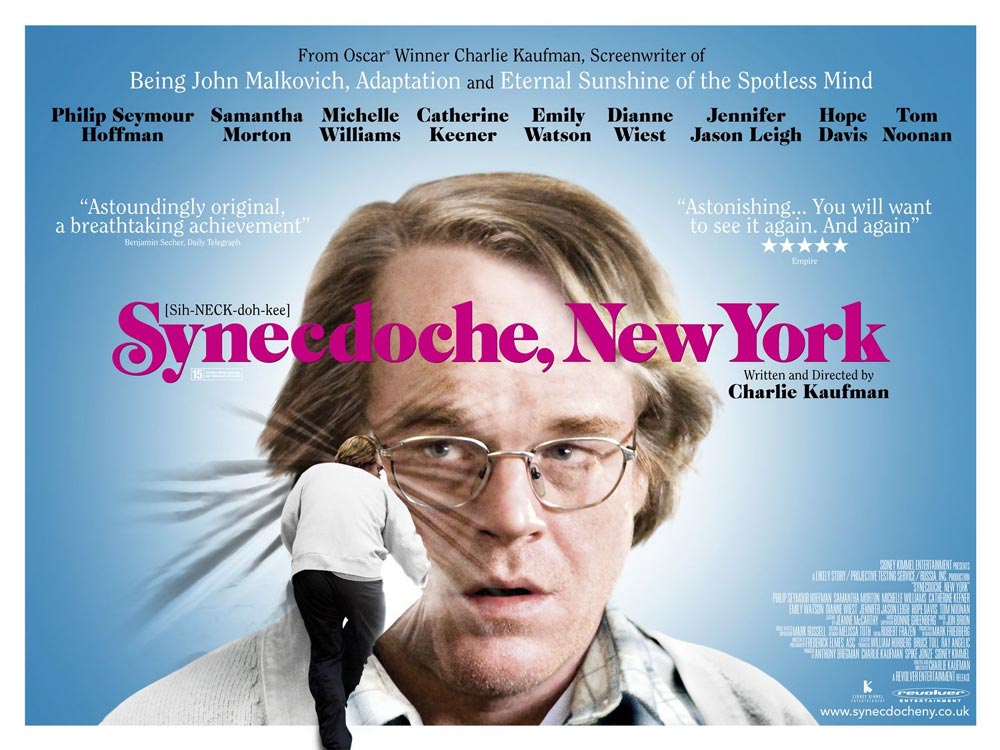
    As I walked past my local cinema (that would be my beloved Dalston Rio, if there are any other fans out there) en route to the supermarket this morning, I was rather struck by this new poster for Charlie Kaufman’s masterpiece “Synecdoche, New York.”

    Synecdoche, New York

    After spending a moment admiring the one-sheet and wondering why I had never seen it before, it only then occurred to me that the film has yet to be released in the UK. Yes, you Yanks read that right: the film only hits Limey screens in a fortnight’s time. (Of course, to make up for it, we get a lot of European titles ahead of the States — with the curious exception of “Let the Right One In,” which only bowed last month.)

    (more…)

  • Not such funny people

    Judd Apatow and Leslie MannI recently discussed the positive buzz building around Judd Apatow’s “Funny People,” which has thus far turned up numerous allusions to the unabashedly sentimental seriocomic stylings of James L. Brooks — a comparison that promises either polished awards-bait, mawkish pap or both, according to taste.

    Suggesting that the Brooks similarities hold true beyond a glib glance-over of the film, Apatow fully acknowledges his debt to the “Terms of Endearment” filmmaker (with whom he worked on the 1990s animated series, “The Critic”) in this recent New York Times piece, which addresses his and his team’s weightier aims for the project:

    Asked why, at 41, he would follow movies about sexuality and childbirth with a film about mortality, Mr. Apatow was circumspect. “I’ve unfortunately been around people who have been ill and seen people figure out how to deal with it,” he said. Some, he added, “just keep plowing on forward, and they don’t seem to change.”

    “What I took from (working with Brooks) was, the audience is supposed to like the movie, as simple as that sounds,” Mr. Apatow said. “If they’re not loving it, you failed.”

    But even Mr. Apatow’s closest confederates recognize that “Funny People” may not be as easily loved as his two previous films. “I wouldn’t describe it as dark,” said Mr. Rogen, a star of “40-Year-Old Virgin” and “Knocked Up.” “I would say it’s more ambitious in what it’s attempting to make light of.”

    This sober tone colours the entire piece, as Apatow expresses his desire to make a “Tuesdays With Morrie”-type story but — before you retch — with the twist that “the main character learns nothing,” while the words “grown-up”, “intensely personal” and even “existential” come up at various points. No pressure, then.

    (more…)

  • Tell me something good

    I quite enjoyed this NYT series of “memos to Hollywood” from Manohla Dargis and A.O. Scott, which include some well-deserved chiding of the Internet, the MPAA ratings board, and romantic comedy producers, among others. But I was disappointed that when it came to the ever-popular sport of bashing the Academy Awards, Scott only had this tired argument to hand:

    It’s just not working: the Academy Awards broadcast, with its mixture of snark and high-mindedness; the pool of pseudoserious, faux-prestigious specialty-division B-pictures; the long, dreary slog of the awards “season.” You’re losing touch with the mass audience on one side and the tradition of popular art on the other. Take some risks, rejigger the formula, expand the membership pool. Do something!

    He’s not wrong, exactly: we can all fill page upon page with a list of the Academy’s recurring failings. Year after year, they demonstrate an aversion to both daring specialist cinema and successful genre work that renders them irrelevant as a yardstick of artistic worth — but it was ever thus. (And to be fair, both critics’ groups and festival juries are capable of making blindingly short-sighted decisions on occasion. Awards are a fundamentally problematic institution, whoever dishes them out.)

    (more…)

  • Coppola on ‘Tetro’

    TetroYou’ve likely seen the trailer for Francis Ford Coppola’s “Tetro” by now. It seems to be going down well with some bloggerfolk, but I must reluctantly say the trailer didn’t really sing to me. It certainly looks attractive (even if the black-and-white lensing struck me as a tad self-regarding when viewed out of context), but there’s a stilted quality to the character exchanges that I can only hope is the result of heavy-handed trailer-cutting.

    Anyway, Pam Grady at FilmStew is significantly more impressed by what she’s seen, and based upon the trailer and some behind-the-scenes footage, is anticipating something rather special. (Though if any critic declares the film “Coppola’s crowning achievement” upon its release, I will gladly eat my hat and film the act for posterity.)

    I was very interested, however, to read Coppola’s description of his dramatic influences for “Tetro,” which fully supports the hints of heightened melodrama in the trailer:

    “The gods were Tennessee Williams and Elia Kazan,” he says. He insists that Tetro – a story of two brothers whose father is a great classical musician and conductor, not unlike Coppola’s late father Carmine – is only very loosely autobiographical. Likening the father in Tetro to “a mythic Greek tragedy father, Desire Under the Elms, a [Cat Under a Hot Tin Roof] Big Daddy,” he insists his own old men was exactly the opposite. “My father was a wonderful father and a very interesting man.” “I’ve set it in Argentina to disguise it so nobody in the family would think it was about us,” he jokes.

    He also explains his entirely personal rationale for shooting in black-and-white, suggesting a desire to channel the classic cinema that has most resonated with him in his own lifetime — but fully acknowledging it may cause audiences to stay away. Here’s hoping otherwise.

  • Oh, Jennifer

    Jennifer Garner in Ghosts of Girlfriends PastI have a horrible confession to make: I am probably going to see “Ghosts of Girlfriends Past” at some point this weekend. As if that wasn’t mortifying enough to admit in public, I’ll go further: I am doing so voluntarily.
    This time, no friend or manipulative relative is dragging me into the theatre as a helpless victim of counter-programming. On the contrary, I’m desperately seeking an ally to spare me the humiliation of sidling up to the ticket booth and mumbling “One for ‘Ghosts of Girlfriends Past,’ please.”

    I have no takers yet, and I understand why -– the film looks fucking dreadful, after all. The trailer cheerfully kills a little portion of my soul every time I see it. And every time a London bus emblazoned with the film’s hideous poster art and godawful title passes my living room window (which is to say about every quarter-hour), I have to resist the urge to hurl a rock at Matthew McConaughey’s bronzed, charisma-vacuumed mug. So why am I punishing myself in this manner?

    Two words: Jennifer. Garner.

    We all have a list of actors who we really know we shouldn’t love, who do terribly little to earn our devotion with an ever-more-dodgy resume — but who, like a really toxic ex, somehow manage to lure us back for their latest effort, however unpromising. And, nestled somewhere between latter-day Jude Law and another Jennifer with TV roots, Jennifer Garner is one of mine.

    Garner has, for me, that indescribable movie-star ‘it’ quality that keeps her empathetic and interesting even when the film around her is going down in flames. I’ve never not liked Garner in a film. (OK, “Elektra” came close.) But I rarely like anything she appears in.

    (more…)

  • Bale puts a bow on THAT rant

    Christian BaleFrom an interview with Christian Bale in the new issue of Total Film:

    I’m not making any excuses, but there is an essential trust and it’s not a tacit one, which is every sound guy says, ‘We are not only not recording, we are not even listening.’ So, well, there goes that.

    I just don’t think it’s in anyone’s interest to know that much either. I’m actually someone that’s very anti the whole B-Rolls, DVD extras and stuff like that.

    I understand people are interested, I get that they want to hear about it, but to me I look at it as old school movie magic and with magic you do not reveal your secrets.

    The man has a point; as repelled as I was by his on-set behaviour, it’s really not an incident of which I should have been aware. We’re all arseholes on occasion, but most of us don’t have those occasions broadcast to the entire world.

    Ahem. Anyway, if that doesn’t sound like the final word on the whole unfortunate affair, I don’t know what does.

  • Cool as Caine

    Michael Caine in Is Anybody There?As we were reminded via Kris’s lovely piece a few days ago, Michael Caine gives great interview. Coupled with his trademark Cockney candour is the kind of unguarded conversational ease that comes from decades in the business — he clearly knows how to politely direct the conversation into the area he deems most productive.

    Such is the case in a recent interview with the thesp  in the Telegraph, in which he spends the requisite amount of time on his widely acclaimed performance in John Crowley’s “Is Anybody There?” before going on a number of enjoyable tangents, both personal and political.

    Under the former banner comes such invaluable advice as the secret to a successful marriage lying in having two bathrooms, while under the latter — well, let’s just say he isn’t a fan of Gordon Bown’s Labour government. (His blunt assessment: “They’ve gone rotten and they’ve gotta go.”) What I really liked, however, was his graceful and pragmatic approach to the issue of his eventual retirement:

    What happens now is that I’ll sit here and see if another script comes in that I really want to do, and if one doesn’t then I’ll be retired. There will be no fanfares, I just won’t appear again. You don’t retire, movies retire you.

    (more…)

  • Playing critic

    Glenn KennyKris’s review of “The Girlfriend Experience” is but one of several that singles out the contribution of esteemed film critic Glenn Kenny to the film. In a sharply self-reflexive bit of casting, Kenny plays another critic of sorts — one who judges and critiques the performance of erotic escorts. But on his ever-readable blog, with tongue firmly in cheek, Kenny is quick to distinguish himself from the sleazebag he inhabits on screen:

    I here pay homage to the pioneers who paved the way for me: the rare film critics who put themselves in the shoes of the performers they analyze and appraise. Steven’s claim that what I do in Girlfriend is “just Glenn being Glenn” notwithstanding, I am not playing myself in the film, for my mother raised me better than that. Rather, I am portraying someone with my vocabulary, and an attitude that’s not entirely foreign to me.

    This serves as an introduction to a witty survey of previous acting efforts from notable critics, including a hilarious discussion of Rex Reed’s performance in the notorious 1970 catastrophe “Myra Breckenridge”:

    He was quite game … But still—he’s terrible. His line readings are flat throughout, and not in a good way. The nadir comes when his Myron is strolling through an orgy and a nude woman asks him, “What movie am I?” He looks down at her pubic area and, not even bothering to work up the tone of indolent contempt that was, and still is, a trademark of his, drawls, “How Green Was My Valley.” Ugh.

    All of which serves to remind me that “Myra Breckenridge” is one of those legendary “all-time worst” staples that I have yet to see. That nugget really whets my appetite.

  • Winslet, Cruz, Herzog crack 2009 TIME 100

    Penelope Cruz and Kate Winslet at the 81st Annual Academy AwardsGiven the debate currently active on these pages over what does and does not merit the term “influential” in the film world, there couldn’t be a better time to link to Time magazine’s list of (supposedly) the world’s 100 most influential people.

    Time slightly sidesteps the inherent comparative silliness of such a list by breaking it down into spheres of influence — though you have to admit there’s something slightly confounding about a survey that places Michelle Obama and Rafael Nadal in the same category. (Apples or oranges? Discuss.)

    But even  by just taking a mini-survey of the film-related figures in their Artists & Entertainers division, one has to conclude that they are as uncertain about what “influential” actually means as so many others are. In many cases, the list could be more plainly described as “famous people who have had a very good year.”

    Take Kate Winslet, for example — an undeniably great actress, a constant media presence in the last few months, and duly rewarded for her pains. But “influential?” As accomplished a performer as Winslet is, I’m not convinced that she has significantly altered the craft in which she works, or given rise to any discernible popular or artistic trends. Going strictly by the book, I’m afraid I’d have to declare Zac Efron a worthier inclusion than Winslet.

    The same caveat goes for Penélope Cruz, also on the list — a very talented and likable figure who some feel scored a personal best in the past year, but success does not equal influence. (On the other end of the scale, while his industry power remains a constant, what has Tom Hanks done in the past 12 months to merit his inclusion? And what did any of these folks do so right that, say, Christopher Nolan did not?)

    (more…)

  • Tribeca awards ‘About Elly,’ Hinds, Kazan

    Mark Rendall and Zoe Kazan in The Exploding GirlThe Tribeca festival has a hit-and-miss record when it comes to picking winners that go on to great things. However, they certainly proved prescient last year, when they handed their top prize to “Let the Right One In,” so it’s worth taking a moment to mention this year’s choices.
    Of course, their Best Narrative Feature winner, Iranian ensemble drama “About Elly,” already has a major festival gong under its belt, having taken the Best Director prize at February’s Berlinale. Following the film’s Berlin premiere, Screen International described the work, which investigates the foibles of a group of friends holidaying at a Caspian beach resort, as “one of the most remarkable Iranian films to surface in the last few years,” while the Tribeca jury’s statement reads:

    Out of a strong selection of films, the jury was unanimous in our passion for this seamless piece of ensemble filmmaking. The universality of the characters and themes, and the directors riveting grasp of this story make “About Elly” a film that collapses barriers and deepens our understanding of the world we share.

    (The statements on each winner are a handy detail, by the way.) Given that Iran went with “Song of Sparrows,” another Berlin-bowing festival hit, as their official Oscar submission last year, I suspect we might be hearing more of this title in the 2009 foreign-language race.

    The jury looked further west for their acting prizes, however, handing awards to Ciarán Hinds for “The Eclipse,” a low-key ghost story from acclaimed Irish playwright Conor McPherson and Zoe Kazan in the American indie effort “The Exploding Girl.” The 25 year-old actress (granddaughter of Elia) has drawn a number of raves for her performance as an insecure college student returning home for a semester break. As someone who was very impressed by Kazan’s delicate character sketch in “Revolutionary Road,” I’m looking forward to seeing this.

    Full list of winners here.

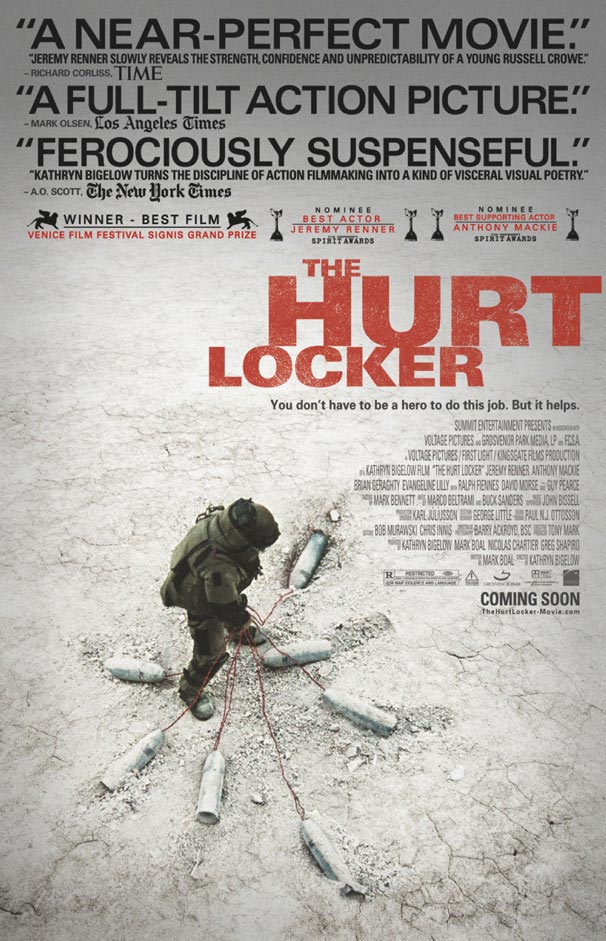
  • Reason why I can’t wait to see ‘The Hurt Locker,’ #183

    Admittedly, I don’t like that too-glib tagline. But just as with a similar tease shot in the trailer, this image alternately stops my heart and sends it racing.  Conveying tension through a one-sheet is not easily done — this may not be the prettiest poster out there, but it’s certainly effective. Meanwhile, that sharp A.O. Scott quote forms a perfect description of what I always hope Kathryn Bigelow’s films will do, but so often fall just short of achieving.

    Even if this year’s blockbuster lineup weren’t quite as unalluring as it is, this would be my most eagerly awaited title of the summer. I’ve been salivating since last autumn — the wait has been too long.

    The Hurt Locker

  • Focus backs Mike Leigh’s latest

    Mike LeighHere’s something to brighten the day. It would seem that a new Mike Leigh joint (sorry, I couldn’t resist) is on its way sooner rather than later — great news considering the four-year gap between “Vera Drake” and “Happy-Go-Lucky.”

    Screen International reports that Focus Features International has secured worldwide rights to the still-untitled project, and will co-fund the film together with the UK Film Council and Film4 (the same folks behind the auteur’s last effort). Poignantly, this will be the last producing credit for the dearly departed Simon Channing Williams, Leigh’s longtime collaborator.

    If memory serves, this marks Leigh’s first go-round with Focus, and it sounds like a pretty good pairing to me — perhaps a necessary change after Miramax’s slightly indifferent handling of “Happy-Go-Lucky.”

    A formidable cast of Leigh veterans is already in place, with the “Vera Drake” team of Imelda Staunton and Phil Davis being joined by “Topsy-Turvy’s” Jim Broadbent — a heavyweight trio, by any standards. No plot details, of course, though the article promises “an intimate portrait of people’s lives” (from Leigh? I’d never have guessed) based on “unique improvisational techniques.” (Well, knock me down with a feather.)

    I’m totally in. But you knew that.

  • “I just don’t know if I’m going to be that dope.”

    will.i.amWith “X-Men Origins: Wolverine” having landed with a bit of a thud, the snarkster in me couldn’t help but smile at a couple of soundbites from this interview with supporting player will.i.am:

    “I’m nervous to see my performance,” said the self-described “X-Men” fan. “My participation in it automatically lends itself to: That dude messed the film up.”

    “This film showed me what I’m capable of doing, and I’m capable of letting go,” he said. “Now I’ve got to let go and watch it. I know it’s going to be dope, I just don’t know if I’m going to be that dope.”

    Well, according to Kris’s review, what he’s “capable of doing” isn’t very much, but clearly, the film’s problems run deeper than having a gimmicky pop-hopper (not a real term, I admit, but how else to describe his music?)  in a supporting role. So to say he “messed the film up” would probably be unfair.

    But as fans of decent music know by now, will.i.am’s presence rarely augurs well for a project, so I guess the curse transfers to film as well. (Bias alert: I’m still bitter about Macy Gray’s hideous last album.)

    Meanwhile, someone from the “Wolverine” supporting gallery who I’d like to think has a brighter acting future is “Friday Night Lights” star Taylor Kitsch. (Gotta love that name.) There’s a fairly unrevealing piece about the young actor here, one of those that describes a process seemingly far more elaborate than the eventual performance. (If the film does indeed portray the “complexity” and multiple “levels” of the Gambit character alluded to in the article, the reviews aren’t reflecting it.)

    (more…)

  • ‘Antichrist’ poster

    Yes, we’ve seen the image and typography already, but since they were so striking, why not carry them through to the poster too? I’m guessing this is not a design you’ll be seeing at your local multiplex any time soon — all the more reason to savour it:

    Antichrist

    [Source: IMP Awards]