In Contention

Author: Guy Lodge

  • Weinsteins announce release dates for winter bait

    Harvey Weinstein has never been one to put much faith in the length of Academy voters’ memories, so as usual, he’s favoring a late-year release plan for his presumed awards contenders — the prospects of which I was discussing only the other day.

    Thanks to Coming Soon’s Ed Douglas for pointing out the newly announced release dates for his holiday-season prestige slate. You won’t be surprised to hear that it’s November and December down the line: “My Week With Marilyn” is first to go forth on November 4, followed by “The Artist” on November 23, “Coriolanus” on December 2, “W.E.” on December 9 and “The Iron Lady” on December 16.

    You can read as much or as little into this schedule as you like, though it’s worth noting that none of them are bowing as late as last year’s Weinstein Company property “Blue Valentine,” the perilously tardy post-Christmas release of which was widely blamed for a meager awards showing — with more time for glowing critical buzz to build, Ryan Gosling and writer-director Derek Cianfrance could arguably have stood a better chance of joining Michelle Williams in the nominee circle.

    (more…)

  • New AMPAS invitees include Sorkin, Hooper… and Beyoncé

    The annual announcement of the new members invited to join the Academy of Motion Picture Arts and Sciences — the latest batch of industry pros we get to blame for next year’s Oscar results — is a moment that always prompts as much satisfied head-nodding as bewildered head-scratching.

    The latter action isn’t always in response to unworthy choices (though I imagine many will deem the inclusion of, say, relatively unproven comedian-turned-movie-star Russell Brand premature), but more to the tardiness of others: every year, I find myself surprised that so-and-so wasn’t already a member. Of course, that doesn’t necessarily mean it’s the first time they’ve been asked — not everyone accepts the invitation.

    I’m surprised, for example, that one of this year’s most esteemed Oscar champs, screenwriter Aaron Sorkin, is only now being brought into the fold. He’s one of a number of 2010 winners on this year’s list of 178 newcomers, including directors Tom Hooper and Susanne Bier, documentarian Charles Ferguson, writer David Seidler, editor Angus Wall, short filmmaker Luke Matheny and “The King’s Speech” producers Iain Canning and Gareth Unwin. A host of this year’s nominees are also joining, among them actors Jesse Eisenberg, Jennifer Lawrence, John Hawkes and Jacki Weaver, as well as female writer-directors Lisa Cholodenko and Debra Granik.

    (more…)

  • Hero takes a fall

    In coming up with an idle, pop-related title for this post, I was faced with two choices: the one I eventually went with, or “We don’t need another hero.” I decided against the latter — partly because I’m sure other writers have already exhausted it, partly because The Bangles can always do with another shout-out — but in This Our Summer of the Superhero, it’d certainly be apt. With “Green Lantern” following “Thor,” “X-Men: First Class” and, earlier, its troublesome near-namesake “The Green Hornet” on the 2011 release schedule, and with “Captain America” still to come, casual moviegoers could be forgiven for wondering if their local multiplex has been part-colonized by ComicCon.

    It stands to reason that with so many darts being thrown at the same aesthetic and commercial target, some will hit their mark more squarely than others. If “Thor” managed to widely surpass expectations, the law of averages decrees that at least one of its Spandex-clad rivals will likely fail to meet them — or at least live down to expectations that had already been lowered. Critically, at least, it seems “Green Lantern” is taking that bullet: Kris may have appreciated Martin Campbell’s revival of one of the DC library’s dustier properties, but the first wave of reviews has been largely dismissive, with even the film’s vastly expensive effects work taking a beating from both high-end print critics and more genre-friendly bloggers like Drew McWeeny.

    (more…)

  • Something else to remember Laura Ziskin by

    Across the movie blogs today, you’ve probably seen news of the sad passing of Hollywood super-producer Laura Ziskin, who lost a long battle with breast cancer over the weekend. Most of the obituaries have her name welded to the word “Spider-Man” in their headlines — certainly, her revival of the franchise in 2002 remains the most profitable work of her career. Still, that superhero franchise is hardly the only thing we owe her: also on her producing résumé are two films that shaped the careers of their female stars, “Pretty Woman” and “To Die For,” while industry legend has it that she was a key champion of “Fight Club” in the face of dismayed execs. One credit of hers I haven’t seen mentioned too often, however, is the 1987 Roger Donaldson thriller “No Way Out” — a remake, but one of my favorite pulp pieces of its era, and a reminder of what a terrific movie star Kevin Costner was back in his pre-Oscar prime. The trailer doesn’t really flatter the film, but if you’ve never seen it, let this be your excuse.

  • Madonna’s ‘W.E.’ joins Weinsteins’ scattered 2011 slate

    Having done all right with the last film to cover the romantic tribulations of King Edward VIII — it was called “The King’s Speech,” it won a few Oscars, you might have heard of it — The Weinstein Company clearly feels there’s an appetite among audiences for more on that chapter of British royal history, with Edward’s story center stage this time.

    So it is that that Harvey and his minions have bought the US distribution rights to Madonna’s sophomore directing effort, “W.E.” — a decades-spanning portrait of the affair between the one-time future King of England and Wallis Simpson, the American divorcée for whom he abdicated the throne, fused with a fictional modern-day story of a young New Yorker inspired by their romance.

    Starring Andrea Riseborough and James D’Arcy as the historical couple, and Abbie Cornish as the woman obsessed with their romance, it all all sounds suspiciously like “Julie & Julia” with crowns replacing the chef’s hats — which, combined with the novelty factor of the film’s celebrity writer-director, leads me to think the Weinsteins may view this more as a light commercial play rather than the hefty awards bait of their last monarchy biopic.

    (more…)

  • Malick goes deeper underground

    First up, some good news for our British readers: the distribution wrangles surrounding “The Tree of Life” have been resolved, and Fox Searchlight will bring the film to UK screens on July 8. Not much longer until you can join the conversation.

    Given Terrence Malick’s usual work rate, it feels almost perverse to begin talking about his next film while his current one is still in theaters, but that’s precisely what his new go-to cinematographer Emmanuel Lubezki does in a fascinating Sight & Sound interview.

    So far we know little about the untitled work, already in post-production, beyond its all-star cast of Ben Affleck, Javier Bardem, Jessica Chastain and Rachels Weisz and McAdams, but Lubezki reveals this much: if you thought “The Tree of Life” was esoteric, you ain’t seen nothing yet.

    (more…)

  • ‘Beginners’: Plummer’s late Oscar vehicle?

    We may be almost halfway through the 2011 release schedule, and as usual, there’s been little in the theaters to trouble the Oscar-minded obsessives among us. That’s not to say the last six months have wanted for deserving work — in a perfect world, one where all good films are created equal, “Certified Copy” star Juliette Binoche would be tough to beat for Best Actress, while “Meek’s Cutoff” would be a slam-dunk Best Picture nominee, but we hardly need to go into the dully pragmatic reasons why those are mere pipe dreams.

    Only two immediate post-Cannes releases, “The Tree of Life” and “Midnight in Paris,” have prompted some awards discussion with their critical provocation and surprising box office, respectively — but beyond a near-certain cinematography nod for the former and a possible writing nod for the latter, further prospects depend largely on the performance of autumn’s big-name prestige draws, as well as a few hot festival purchases from Cannes, Sundance and even Berlin.

    (more…)

  • The experimental urges of ‘The Tree of Life’

    Kris already acknowledged the disproportionate number of Malick-related posts on the site of late, but it’s not often one gets a conversation piece of this magnitude landing in the early summer schedule, so we’re just going to roll with it. (The film would no doubt have been a big deal in any season, but Fox Searchlight’s decision to dodge the autumn prestige deluge with an immediate post-Cannes release is proving rather wise in terms of publicity gained.)

    Anyway, I was drawn to this Fandor piece about the influence of experimental cinema on Malick’s Palme d’Or winner, most evident in the early 20-minute sequence that maps out the earth’s evolution. Along with several other critics, my review noted echoes of Godfrey Reggio’s landmark 1982 tone poem “Koyaanisqatsi” in the sequence, but it appears that some lesser-known experimental films played a more direct role in its creation.

    New York-based Scott Nyerges, whose avant-garde shorts haven’t been seen much outside the festival circuit, was approached by Malick’s production company for permission to license 12 seconds of his 2008 short “Autumnal” (embedded after the cut).

    (more…)

  • POST-CANNES: “Martha Marcy May Marlene” (****)

    [Apologies for leaving my Cannes coverage in limbo as I unwound in Paris before returning to London housekeeping. A handful of films from my festival viewing roster are still owed some discussion in grouped capsule form, and I’ll get to those this weekend — hey, the films aren’t going anywhere, so why stick to the parameters of the festival diary? I’ll begin, however, with the last of my individual reviews from this year’s Cannes, and the last of my three four-star finds of the fest.]

    Elizabeth Olsen’s face is an ellipsis, a perturbingly lovely marker of concerns unspoken and unresolved, in writer-director Sean Durkin’s “Martha Marcy May Marlene,” a sharp blackberry winter of a debut feature that perhaps invites a re-evaluation of how we define the modern horror film. Little happens in the course of Durkin’s curtly time-shifting narrative that is definably horrific, yet the constricting rhythms of the editing combine with the between-the-lines anxiousness of Olsen’s performance to instil a kind of objectless dread in the audience, playing their preconceptions of the film’s sensationalistic subject matter against its own craftier revelations. Watching it, in short, feels like being slowly strangled from behind.

    (more…)

  • REVIEW: “Drive” (****)

    Cannes Film Festival

    It’s not often that opening credits as hideous as the ones in “Drive” — hot-pink cursive squiggles of the kind favored these days only by nail bars in suburban strip malls — are a reassuring omen for the film to come. But Nicolas Winding Refn’s beautiful, bolt-from-the-blue genre trip is a kind of snazzily dressed, testosterone-enhanced bag lady of a movie, one that gathers all manner of tossed-out debris from the Hollywood scrapyard to demonstrate its continued usefulness.

    Accompanied by the irregular heartbeat of Cliff Martinez’s throbbing synth score, those lurid credits are the first clue that we’re in contemporary period piece territory: “Drive” may be set in modern-day Los Angeles, and its measured but grotesque bursts of violence may make use of our Tarantino-elasticated cinematic sensibilities, but in all other respects Winding Refn is partying like it’s 1985.

    Based on American pulp merchant James Sallis’ short, sharp 2005 novel of the same title, the laconic tone and clean structure of “Drive” nonetheless feel adapted more from cinema itself, and not merely from films that share its 80s-pop mood board. The Michael Mann of “Thief” and the William Friedkin of “To Live and Die in LA” may be obvious touchstones here, but so are 70s-era Walter Hall (most obviously the similarly titled and plotted “The Driver”) and even the hard 1960s strut of John Boorman’s “Point Blank.”

    (more…)

  • CANNES: ‘Tree of Life’ wins Palme d’Or, Dunst takes Best Actress

    And so it came to pass that the pre-festival bookies’ odds were on the money. The most talked-about film at this year’s Cannes Film Festival, Terrence Malick’s “The Tree of Life,” was handed the Palme d’Or by Robert De Niro’s jury — a major vindication for a film that has been labelled both a masterpiece and a failure by duelling factions of critics on the Croisette.

    Malick, to the surprise of precisely nobody, did not pitch up to the ceremony, though I imagine he’s feeling somewhat relieved. However it performs outside the insular festival environment, his film’s cultural landmark status has been sealed: armed with this prestigious bit of hardware, Fox Searchlight can set about readying the film for the US awards season, though approval from more mainstream bodies could yet be an uphill battle.

    “The Tree of Life” isn’t the film I would have picked for the Palme by a long shot — as I wrote in my review, I think it’s an intermittently stunning work that ultimately overreaches, never marrying its three disparate sections — but it’s not an unintelligent pick: De Niro and his fellow jurors have opted for the title that looks likely to have the longest shelf-life in popular culture. In that respect, it’s a preferable choice to the film widely viewed as the favorite going into the awards tonight, Aki Kaurismäki’s charming but wafer-thin comedy “Le Havre” — which, in the evening’s most surprising turn, won not a single prize.

    (more…)

  • CANNES: What will win… and what should

    It’s a funny thing. For 10 days at Cannes, the Croisette hums with stimulating discussion and debate about movies; for the final two, all that chatter dissolves into a single blunt question: “What will win the Palme d’Or?” It’s a little like the Oscars, except without the initial stage of stimulating discussion and debate about movies. Let’s do it.

    On the one hand, I kind of want the beautiful, punishing 160-minute anti-procedural epic of Nuri Bilge Ceylan’s “Once Upon a Time in Anatolia” to win, since there’s £140 waiting for me in London if it does. (Gamble responsibly, kids.) On the other, I can make more convincing cases for a number of titles. Unlike last year, when it was easy to single out “Uncle Boonmee” and “Of Gods and Men” for the top two spots, this year’s lineup has been higher in terms of median quality, as well as more contentious — which allows for a wider range of hypothetical jury-room arguments.

    (more…)

  • Kaurismäki, Sorrentino among early Cannes winners

    The Cannes Film Festival closes up shop tomorrow with the announcement of the Competition awards — the final competing film, Radu Mihaileanu’s “The Source,” screened this morning to a tepid reception. Before we get to that, however, a wide array of smaller juries have their own trophies to dish out, and a number of them did so tonight.
    I’ve just returned from the tuxes-and-sneakers affair that is the Un Certain Regard awards ceremony, followed by a screening of one of their prizewinners, Andrei Zvyagintsev’s stunning “Elena.” (I’ll review the film later, but for now, allow to express my bafflement that this remarkable work wasn’t in Competition, particular when the director’s previous film, no more impressive a work, was.)

    There, a jury led by previous Palme d’Or winner Emir Kusturica (choice quote in opening speech: “I was the darling of this festival, and I did not behave myself very well”) infuriated critics across the Croisette by handing half their top prize (in a tie) to one of the festival’s worst-reviewed films: Kim Ki-duk’s documentary on himself, “Arirang.” It’s a handy reminder that critical response should never be the key consideration when predicting festival awards.

    (more…)

  • Shut up and ‘Drive’

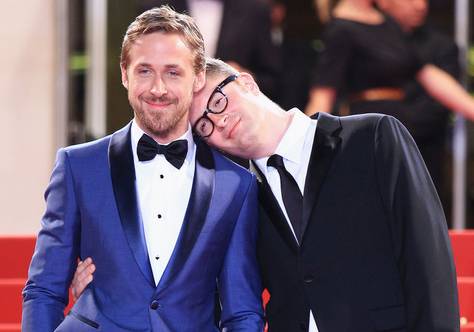
    Those of you who follow me on Twitter already know how I feel about wild-card Palme d’Or contender “Drive,” but I’ll have a review up a little later. For now, though, I can’t resist posting this shot of Ryan Gosling, his awesome royal-blue tux and director Nicolas Winding Refn at last night’s red carpet premiere — handily the sweetest photo of this year’s Cannes fest. Long live bromance.

  • SHORT TAKE: “The Skin I Live In” (***)

    Cannes Film Festival

    Pedro Almodóvar’s new feature opens with a pause: a beautiful young woman holds a tricky yoga position, her already fine-lathed physique vacuumed into a nude body stocking, stretched across a couch like a pale side of meat hung out for curing. So so taut, so fragile, it seems a simple tap on the shoulder will splinter her perfect form into a chandelier’s worth of glass shards — and that’s an apt note of tension on which to begin “The Skin I Live In,” a coldly kinky thriller in which Almodóvar’s career-long concern with the manipulation and violation of the human body is bent back so far it has nothing left to do but break.

    The girl is actress Elena Anaya; who she’s playing is a question the film keeps in play for far longer than you’d think feasible in a narrative that deftly splits and reshapes identity across a pair of linked tragedies in the life of Antonio Banderas’ demented genius of a plastic surgeon. Adapted — rather liberally, I understand — from Thierry Jonquet’s novel “Tarantula,” the film’s dense structure plays Snakes and Ladders with chronology (a late-film title card that reads “back to the present” drew chuckles in the audience for its apparent self-exasperation), staggering major twists across its running time that makes it a challenge to discuss in any narrative capacity. (It hardly flatters the reviewer’s role to say this, but audiences are better off reading as little about the film as possible before entering the theater: ignorance really is bliss here.)

    (more…)

  • ‘Take Shelter’ takes first award at Cannes

    Nine days in, the Cannes Film Festival is winding down. Many of the US journos are flying home, and with Pedro Almodóvar’s “The Skin I Live In” having premiered this morning — review coming tomorrow — the superstar auteurs have all shown their hand. (That’s not to say Nuri Bilge Ceylan or Paolo Sorrentino can’t alter the shape of the festival, however.)

    But with the drop in energy comes the scent of gold, as we prepare for the annual Cannes parlor game of loudly criticizing the jury’s decisions. We’re still three days away from the Competition awards — though Aki Kaurismäki’s broadly liked comedy “Le Havre” (which I frustratingly still haven’t seen after three attempts) has emerged as the sizeable Palme d’Or favorite, while I hear rumors that Olivier Assayas is the lone “Tree of Life” fan on the jury — but the trophy run began tonight with the winners of the Critics’ Week sidebar.

    (more…)

  • How do you solve a problem like Von Trier?

    It couldn’t last. As the closing credits began rolling on Wednesday morning’s 8.30am Cannes press screening of “Melancholia,” Lars Von Trier’s elegant rumination on anxiety, the apocalypse and all those other swell things, I was stunned by how civil the atmosphere in the vast Lumiere theater was.

    Enthusiastic applause greeted the film — more surprisingly, so did a distinct absence of boos. Soaking up the post-screening chatter in the foyer, I didn’t once hear the words “misogynist,” “perverted” or “clitoridectomy,” but I did pick up a bushel apiece of “moving” and “beautiful.” A number of critics disliked it, of course, but it rather seemed as if Lars Von Trier had pulled off the (for him) impossible: a film that touched many and upset no one.

    And then came this.

    (more…)

  • REVIEW: “Melancholia” (***1/2)

    Cannes Film Festival

    It’s the end of the world as we know it, and Lars von Trier feels fine. Well, not “fine,” exactly: he feels as despairing and sceptical and faithless as he usually does, but that’s clearly where he’s comfortable, and where his creative faculties thrive most actively.

    They’re certainly in rude health in “Melancholia,” a ravishing arthouse blockbuster that extends the self-therapy he began in 2009’s bracingly unhinged horror film “Antichrist,” but with more thematic cohesion and tonal restraint. The sensation-hungry, who label any new von Trier film ‘controversial’ before seeing a shred of footage, will likely be disappointed — that is, if they’re not appeased by some tame shots of Kirsten Dunst rutting on a golf course. (Luckily for them, as if realizing the deficit, the director compensated with some trademark shenanigans at the press conference.)

    For the rest of von Trier’s fans, however, the film’s lack of overt audience-baiting serves to place his formal gifts in starker relief. A subdued, even elegant, vision of the apocalypse that begins as a waking dream and continues in an actuality no less feverish, “Melancholia” represents the natural culmination of the depressive doubt in self and society that has needled most of von Trier’s features. As a statement on the spiritual bankruptcy of the human race, it may well prove unfurtherable: after destroying the world we live in — a spoiler only to the most tone-deaf of viewers, I assure you — where does the man have left to go?

    (more…)