
In Contention

Author: Guy Lodge

  • ‘Chéri’ website launched

    CheriAs you know, despite a mixed critical reception over here in the UK, I was quite taken with Stephen Frears’ “Chéri,” a tarter-than-expected Belle Epoque romance that showcases the director’s best work in nine years, and Michelle Pfeiffer’s best work in … well, longer than that.

    I’m not sure how the film, a rather subtle specialty item, will play on its American release in a month’s time, but Miramax clearly has hopes for it, and have launched this rather attractive official website to make their case. (They appear to have dispensed with the accent aigu, perhaps to prevent anyone mistaking it for a foreign-language effort.)

    The site features the standard promotional bumf, but does a good job of showing off the film’s lavish technical credits, particularly Consolata Boyle’s costumes and Alexandre Desplat’s lovely score, which is actually more delicate than the selected excerpt here suggests. Both are, I think, very much in the Oscar mix, while Pfeiffer’s radiant performance may need to find more critical champions Stateside to sustain momentum.

  • ‘Prophet’ tops indieWIRE poll

    A ProphetIn case you didn’t get the message while the Cannes Film Festival was running, it’s clear that Jacques Audiard’s Grand Prix champ “A Prophet” is a title we’re going to be hearing a lot this year. True to its preceived status as the critical favorite, the gritty French prison drama has been voted the fest’s best in a mini critics’ poll by indieWIRE, compiled from the votes of a selection of U.S. journos and bloggers (and, oddly, one critic from a UK right-wing rag).

    Runner-up, interestingly enough, was “Antichrist,” which emphasized its divisiveness by also placing second in the category of worst festival film. (What was the worst, you ask? Why, none other than Best Director champ “Kinatay.”) Third-best honors went to Palme d’Or winner “The White Ribbon” and Un Certain Regard darling “Police, Adjective.”

    Although support was clearly scattered, with no film getting the vote of the majority of critics polled, “A Prophet” came out on top in every voting category, including Best Director, Best Screenplay and Best Performance for breakthrought star Tahar Rahim. (Rahim beat the Cannes jury’s Best Actor choice Christoph Waltz into third place, while second was early Best Actress favorite Giovanna Mezzogiorno.)

    (more…)

  • PAGE TO SCREEN: “Where the Wild Things Are” by Maurice Sendak

    Cover of Where the Wild Things Are by Maurice SendakOf all the literary adaptations reaching our screens this year, none is as seemingly impossible – and yet, simultaneously, rife with possibilities – as Spike Jonze’s long-awaited realization of “Where the Wild Things Are.” A work that occupies multiple positions within the popular culture pantheon – grade-school standard, highbrow literary classic, cult hipster item, fine-arts touchstone, pop psychology standby – it arguably nourishes a broader audience than any children’s text published since.

    As such, Jonze’s film has been complicated throughout by shifting lenses of expectation: as a family film perhaps more eagerly awaited by parents than their children, as a mainstream entertainment aiming to appease art house mavens and indie kids, it is essentially required, like its literary source, to be all things to all people.

    His own artistry notwithstanding, Sendak achieved such catholic appeal through the sparseness of his approach. With a narrative of fewer than 400 words – not even half the length of this very article – “Where the Wild Things Are” is an exceptionally porous feat of storytelling that accommodates a wide range of interpretations and identifications from the reader. It is plainly a metaphor-driven story, yet there isn’t enough text to articulate or prescribe the symbolism that is otherwise so lavishly illustrated.

    Sendak employs minimalism to expansive effect: the unadorned narrative allows the imagination to  roam, enabling the reader to take only what s/he wants from the story. Yet a literal reading thereof – such as may be absorbed by younger readers – is no less compelling in terms of tension and atmospherics, than one more interpretive.

    (more…)

  • Have you seen this?

    In case it doesn’t get said often enough, the internet is a weird thing. One week ago, I had never heard of “Mega Shark Vs. Giant Octopus,” which was recently released straight to DVD. (A technicality that sadly bars it from Oscar consideration.) Since then, however, I’ve seen references to this marvel pop up on any number of my favorite blogs, while at least ten unconnected friends have emailed me the trailer, usually accompanied by a heavily capitalised and punctuated “HAVE YOU SEEN THIS??!!”

    Of course, it’s the same kind of marketing genius that propelled “Snakes on a Plane,” except this looks sincerely craptastic rather than wrapping itself in joyless quotation marks. Plus, Lorenzo Lamas + Debbie Gibson > Samuel L. Jackson. Duh. So have you seen this? Not the trailer, I mean, but the actual movie. Is it as good as it looks? Is that even possible? Your thoughts, please.

  • We, the jury

    (from left) Asia Argento, Isabelle Huppert and Nuri Bilge CeylanIt’s admittedly pretty low-rent, but one of the most enjoyable Cannes traditions is the annual gossip about what went down behind closed doors in the jury room — ranging from minor cultural disagreements to all-out bitter in-fighting. At yesterday’s press conference, juror Asia Argento insisted that their deliberations should remain a secret, but not everyone is so discreet: William Goldman, of course, dedicated half a book to covering his own experience as a juror at the 1988 fest, and most entertainingly too.
    Last year’s Sean Penn-governed jury was reportedly one of the most placid in recent memory, agreeing unanimously on “The Class” for the Palme d’Or. This year’s panel, apparently … not so much.

    Critic Shane Danielsen — who, as the former artistic director of the Edinburgh Film Festival, knows the ins and outs of such proceedings — has done some digging, to juicy effect. Writing in the comments section of the A.V. Club’s Cannes blog, he claims the jury was highly divided, with a notable rift between Isabelle Huppert and James Gray. Meanwhile, contrary to widespread assumption, it might not have been Michael Haneke that Huppert was pushing  hardest for, but Lars Von Trier:

    Unusually troubled, apparently, with president Isabelle Huppert riding roughshod over everyone, and James Grey (sic) reportedly calling her a “fascist bitch” in their final meeting … Huppert reportedly remained ‘Antichrist’s biggest champion on a bitterly divided and fractious jury. Who, as they came onstage, looked either funereal (Lee Chang-Dong, Hanif Kureishi), grimly determined (Nuri Bilge Ceylan) or just plain pissed-off (James Gray).

    (more…)

  • Haneke lands Palme d’Or, Gainsbourg takes Best Actress

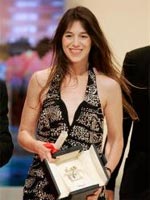
    Charlotte Gainsbourg winning Best Actress at the Cannes Film FestivalAs it turned out, the most logical on-paper prediction turned out the be the right one. After emerging as the bridesmaid from several festivals past — winning the Grand Prix in 2001, Best Director in 2005 — the venerable Austrian auteur Michael Haneke has finally won the Palme d’Or for his stark moral drama “The White Ribbon.”

    Whether or not jury president Isabelle Huppert, a two-time Haneke leading lady in the past, wielded much influence on this decision — or indeed, whether she even needed to — is something for the pundits to debate. (I personally doubt it, though there was no mistaking the sly smile on her face as she announced his name at the podium.) Either way, there’s little denying that Haneke was overdue for world cinema’s highest honor; perhaps there was a career-achievement angle to the award, but the critical acclaim for “The White Ribbon” has been extensive.

    From watching the ceremony, it was clear that Haneke wasn’t the most popular winner of the night; that designation clearly goes to hometown favorite Jacques Audiard, whose “A Prophet” — like “Gomorrah” last year — was by and large deemed the favorite for the Palme, but ultimately had to be content with the silver-medal Grand Prix. The rousing standing ovation he received, however, spoke for itself. (I should add that a second-place finish for Audiard was, embarrassingly, the only correct call I made the whole night.)

    The real talking point of the awards, however, will likely remain Charlotte Gainsbourg’s Best Actress prize for her evidently courageous work in “Antichrist” — a clear gesture of support by the jury for a film that has provoked prolonged media outrage since its unveiling, and a blatant slap in the face of Cannes’ alternative ‘ecumenical’ jury who went out of their way to condemn it. The irony of handing a female performance award to a film that has been repeatedly pelted with accusations of misogyny is rather delicious; at the very least, it’s an indication that this is a film to be taken seriously.

    (More commentary, and a full list of winners, after the cut.)

    (more…)

  • ‘Dogtooth,’ ‘Adjective’ top Un Certain Regard winners

    DogtoothIt’s been a while since a Greek production made any impact on the world cinema scene — arguably not since Theodouros Angelopoulos claimed the Palme d’Or in 1998 — so it’s interesting to see that Yorgos Lanthimos’ “Dogtooth,” a dark family drama about three siblings disconnected from the outside world by their parents, pushed past more fancied contenders to take the top prize in Cannes’ Un Certain Regard strand last night.

    In doing so, it beat out the likes of “Precious” and “Samson and Delilah,” both of which enjoyed substantial attention and acclaim on the Croisette but went home empty-handed. (NOTE: “Samson and Delilah” later won the Camera d’Or award at the final awards ceremony.) Not that the former needed any more of a boost after its Sundance sweep, really.

    The runner-up Jury Prize went to “Police, Adjective,” a comic Romanian policier about on a policeman wrestling with his conscience, which also took a FIPRESCI critics’ award yesterday. Raves have been coming thick and fast for this film, with the Guardian’s Mark Cousins one of several critics I’ve heard declaring it the best of the festival, in any section of competition. (Coming on the heels of “The Death of Mr Lazarescu” and “4 Months, 3 Weeks and 2 Days,” one must wonder: what are they teaching in Romanian film schools?)

    Another common critical line doing the rounds is that the Un Certain Regard selection was, pound for pound, stronger than the Palme d’Or lineup. It’s hardly surprising, given that the strand has become more imposing with each year since it was introduced in 1998: UCR winners that have gone on to estimable arthouse success include “The Band’s Visit,” “Tyson” and the aforementioned “Lazarescu.” It’s a sign that, as I’ve said before, the selectors  need to start taking more chances in the main competition.

    More details on the rest of this year’s Un Certain Regard winners here.

  • The hidden depths of Sasha Grey

    Sasha GreyI absolutely love this. It would appear that porn star Sasha Grey and highbrow film critic Glenn Kenny have more in common than just their mutual appearances in Steven Soderbergh’s “The Girlfriend Experience.” As this Rotten Tomatoes interview proves, Grey’s own cinematic taste is discerning, to say the least.

    Asked to name her five favorite films, she rattles off a decidedly impressive — not to mention catholic — array of titles: Werner Herzog’s “Stroszek,” Catherine Breillat’s “Fat Girl,” John Cassavetes’ “A Woman Under the Influence,” John Carpenter’s “Escape from New York” and Jean-Luc Godard’s “Pierrot le Fou.”

    The latter auteur is apparently something of an inspiration; Grey almost adopted the name of Godard muse Anna Karina as her stage moniker. Who knew? Here’s Grey on “Pierrot le Fou”:

    To me, it’s just a very romantic story. It’s the ultimate, “let’s just drop everything and run away together” movie; the way the story was told was so unique. There’s one scene in particular where Anna Karina is on the beach, and she rolls over and she just says, “F— me.” To put that in a film in that time period — you just didn’t expect that to come out of her mouth. It’s titillating, I guess you could say.

    Interesting to hear that Grey has a very different idea of what is “titillating” onscreen than what she actually practices. The lady continues to surprise.

  • What will take the Palme d’Or?

    Abbie Cornish and Ben Whishaw in Bright Star It’s all over bar the voting. Tomorrow, Cannes jury president Isabelle Huppert will meet with her formidable, female-dominated team of eight – including the diverse likes of Robin Wright Penn, Asia Argento, James Gray and Hanif Kureishi – to pick over the 20 Competition titles they have seen over the last fortnight and select their collective favorites.


    As I’ve said before, the most surprising thing a Cannes jury can do is not to surprise: to hand the Palme d’Or to the critical and/or popular favorite. It can happen, of course – critics and pundits alike called it for “4 Months, 3 Weeks and 2 Days” the day it screened in 2007, and were proved right – but the list of upsets is long and illustrious.

    As you’ve probably heard by now, if the bookies have their way, French auteur Jacques Audiard will be brandishing the Palme this time tomorrow, his prison drama “A Prophet” having wowed critics and audiences across the Croisette. I’ll be delighted if he does, but I’ve questioned whether a French production can win two years running, after a two-decade drought to boot.

    Of course, such streaks aren’t unheard of: the U.S. held onto the Palme for three years between 1989 and 1991. Other questions running through my mind are whether Frenchwoman Huppert might want to avoid making the festival too much of a local affair, and whether Audiard’s all-male film will resonate as strongly with a mostly female jury.

    If not, there are a number of alternatives. By my count there are six titles seriously in the hunt for top honors. Michael Haneke’s “The White Ribbon” is fancied by many to finally land the director the top prize. Earlier today, the film made its presence felt by claiming the FIPRESCI critics’ prize for best in show, though it should be noted that the jury’s and FIPRESCI’s choices have only lined up three times this decade.

    (More speculation, and my final predictions, after the cut.)

    (more…)

  • Christian Cannes jury tells us what to think

    Willem Dafoe and Charlotte Gainsbourg in Antichrist

    UPDATE: I’m pleased at least to report that Cannes festival director Thierry Fremaux is as outraged by the situation as we are, denouncing it as a “ridiculous decision that borders on a call for censorship … scandalous coming from an ‘ecumenical’ jury which what is more is headed by a film-maker.” Well said, Monsieur.

    EARLIER: I shouldn’t allow myself to get worked up over a petty gesture by a small-minded panel of people, but this can’t pass without comment.

    You may or may not be aware that an annual “Prize of the Ecumenical Jury” has been handed out at the festival since 1974. Established and voted upon by a selected panel of Christian film professionals, it aims to honor “works of artistic quality which witnesses to the power of film to reveal the mysterious depths of human beings through what concerns them, their hurts and failings as well as their hopes.”

    I can’t say I’ve ever really understood the point of the award. Still, it has gone to some fine films over time, and not ones necessarily with a spiritual agenda — from “Paris, Texas” to “Cache” — so I always thought it harmless enough. No more. This year, they’ve decided to mount their moral high horses by handing their first ever “anti-award” to Lars Von Trier’s “Antichrist”:

    “We cannot be silent after what that movie does,” said Radu Mihaileanu, a French filmmaker and head of an international jury that announced the awards Saturday.

    In a statement, Mihaileanu said Antichrist is “the most misogynist movie from the self-proclaimed biggest director in the world,” a reference to a statement by Danish filmmaker Lars Von Trier at a post-screening news conference. The movie, Mihaileanu added, says that the world has to burn women in order to save humanity.

    (more…)

  • Teen director rules Cannes Directors’ Fortnight

    Xavier DolanIt’s news like this that reminds me to haul ass and finish another screenplay. 19 year-old Canadian filmmaker Xavier Dolan has swept three of the four feature-category Directors’ Fortnight prizes on offer at Cannes. Dolan landed the Art Cinema Award, the Regards Jeunes Prize and the SACD Award for his debut feature “I Killed My Mother.”

    The film, which Dolan wrote, directed, produced and stars in, is a semi-autobiographical portrait of the dysfunctional  relationship between a gay 16 year-old and his single mother, and has attracted substantial buzz since bowing on the Croisette. Screen Daily raves:

    A stunning, semi-autobiographical tour de force from writer/director/producer/performer Xavier Dolan, it is a film with the sting of shrewdly observed truth … I Killed My Mother succeeds so well because it reflects a truth about human relationships that any viewer can recognise. The bond between Hubert and Chantale may be more extreme and exaggerated than most but in the pettiness, manipulations, reconciliations and heartache it expertly conveys the way we all have the ability to hurt the ones we love the most.

    It’s at points like this that I prefer not to think about what I was doing when I was 19. Okay, so I was a university sophomore like a million other normal folks, so no shame in that, but it’s sobering all the same. Congratulations to Dolan — I look forward to checking out his film.

    (more…)

  • Final Cannes contenders unveiled

    Paz de la Huerta in Enter the VoidThat’s it — all 20 Palme d’Or contenders have now screened for critics, and the final deliberations can begin. Most of the media attention in the past two days has focused on Gaspar Noé’s new film “Enter the Void,” though it hasn’t aroused anything like the firestorm of controversy that his “Irréversible” did in 2002. (Perhaps the media simply hasn’t the energy for a fight after “Antichrist.”)

    Although reportedly as violent and sexually explicit as one would expect from Noé, the film, which screened at the Croisette in still-unfinished form, seems to have prompted more confusion than outrage from the press. The critical response, meanwhile, is more positive than might have been expected. Manohla Dargis leads the cheer team for the film:

    An exceptional work, though less because of its story, acting or any of the usual critical markers. What largely distinguishes it, beyond the stunning cinematography, is that this is the work of an artist who’s trying to show us something we haven’t seen before, even while he liberally samples images and ideas from Stanley Kubrick and the entirety of American avant-garde cinema. The grungy milieu and calculated shocks might have been designed to make you flee – even while your attention is tethered to the camera – but, really, these aren’t the point. The point is the filmmaking.

    ScreenDaily’s Mike Goodridge is somewhat awed, describing the film as “a wild, hallucinatory mindfuck” that is “nothing short of hypnotic,” even suggesting the film as a future staple for narcotic-fuelled viewings — though like Dargis, he dismisses the characterisation and narrative as being of secondary quality and importance. Variety is less forgiving, labelling the film “tiresomely gimmicky” and implying it is less “pure cinema” than “pure trash.”

    (more…)

  • WEEKLY WRAP: ‘Antichrist’ and action

    Willem Dafoe in Antichrist• Scandalising media and polarising critics, Lars Von Trier’s “Antichrist” emerged as the undisputed talking-point of the Cannes Film Festival.

    • That firestorm even managed to overshadow the Cannes debut of Quentin Tarantino’s divisive “Inglourious Basterds.”

    • In other news from the Croisette, “A Prophet” impressed critics, while “Taking Woodstock” took a hit.

    • We celebrated the start of summer (and provoked some argument) with a list of the all-time Top 10 action sequences.

    • Unfortunately, our review deems “Terminator Salvation” unlikely to earn a place on any such future lists.

    • In the wake of that disappointment, “Up” happily lived up to expectations.

    • In box office news, “Angels and Demons” turned out to be a pale shadow of its predecessor.

    • This week’s edition of Page to Screen reviewed the literary source for Jason Reitman’s upcoming comedy “Up in the Air.”

    • John delved further through his personal cinematic treasure trove, returning to the 1990s, and reappraising last year’s “Revolutionary Road.”

  • Ebert makes a bold prediction

    Xavier Giannoli's In the BeginningOscar talk hasn’t surfaced that much on the Croisette this year, with “Bright Star” the only competition title prompting much speculation from the pundits. Roger Ebert, however, believes he has spotted an under-the-radar title that we’ll still be discussing come February:

    I think I may have just seen the 2010 Oscar winner for best foreign film. Whether it will win the Palme d’Or here at Cannes is another matter. It may be too much of a movie movie. It’s named “A l’origine” (“In the Beginning”) by Xavier Giannoli, and is one of several titles I want to discuss in a little festival catch-up.

    This is one of those movies that catches you in its spell. It’s a hell of a story. There’s a difference between caring what happens in a movie, and merely waiting to see what will happen.

    As someone who thoroughly enjoyed Giannoli’s gentle character study “The Singer,” I’m pleased to hear good word for the new film. Still, Ebert’s statement is surprising for several reasons, not the least of which is that “In the Beginning,” a comic fable about a con man who devises a plan to build a highway in a small French town, has enjoyed a mixed critical reception so far.

    (more…)

  • Sony picks up ‘Prophet’

    A ProphetAnne Thompson confirms what had already been widely anticipated: Sony Pictures Classics has bought the rights to “A Prophet,” Jacques Audiard’s brutal prison drama that is the clear critics’ darling of Cannes so far, and the current bookies’ favorite for the Palme d’Or.

    As mentioned last week, SPC has also acquired Michael Haneke’s “The White Ribbon” and the awfully-titled French biopic “Coco Chanel and Igor Stravinsky” — not to be confused with Audrey Tautou starrer “Coco Before Chanel.” It’s a smaller collection of purchases than SPC made at last year’s festival, but they seem to have picked wisely.

    Thompson also wisely reminds awards-watchers not to be overly swayed by the Palme d’Or buzz for Audiard’s film, something I’ve been thinking too. Cannes has a long history of surprise victors, and more often than not, the annointed critical favorite only lands a runner-up gong. Such was the case when “The Wind That Shakes the Barley” topped “Volver” three years ago, or when the massively polarising “Dancer in the Dark” beat out the universally adored “Yi Yi” in 2000.

    It’s worth bearing in mind that jury members are discouraged from reading the press throughout the festival, so they can vote with open minds. In other words, we have absolutely no idea what they’re thinking. Of course, jury opinion and critical opinion have lined up for the last two years running, with “4 Months, 3 Weeks and 2 Days” and “The Class” emerging as roundly approved winners. There’s no reason why “A Prophet” can’t continue the trend, though I still think it could face twin drawbacks in its nationality and its all-male cast.

    Meanwhile, the competition still looks feisty, with “Bright Star,” “The White Ribbon,” “Fish Tank” “The Time That Remains”  and “Vincere,” among others, all drawing vocal support, and two films yet to screen.

  • ‘Parnassus’ causes much head-scratching at Cannes

    Heath Ledger in The Imaginarium of Doctor ParnassusIt was always a safe bet that, in spite of the curiosity value of Heath Ledger’s final screen performance, Terry Gilliam’s “The Imaginarium of Doctor Parnassus” wasn’t cut out to be a crowdpleaser. It’s been over a decade since the defiantly eccentric filmmaker made anything approaching the term “accessible,” much less something widely liked. And the apparent opacity of his latest, beginning with that unwieldy title, didn’t suggest he was going any easier on his audience, or himself.

    So it’s no surprise to report that the reviews thus far are mixed at best, with some vocal detractors already apparent. (Catherine Shoard at the Guardian describes it as “a horrible mix of reheated Munchhausen and stale Faustian mumbo-jumbo.) Still, several critics have salvaged some value from the project, and are unexpectedly supportive in their reviews.

    Todd McCarthy asserts that Gilliam has made “a pretty good thing out of a very bad situation,” commending him for his “visual panache” and “considerable discipline,” but is careful to defuse any exaggerated expectations of Ledger’s work:

    It’s another “Alice in Wonderland”-like playground for Gilliam, and while all the specific action may not be entirely coherent or exciting, it’s always visually stimulating and allows the three incarnations of Tony to host assorted guests.

    Tony is not a demanding dramatic role, nor a particularly flamboyant one like the Joker, so this can’t legitimately be described as one Ledger’s most striking performances. Like most of the other actors here, he’s antic and frantic, dirty and sweaty, as the principals flail around trying to cope with their desperate straits.

    (more…)

  • Stronger stomachs

    Charlotte Gainsbourg in AntichristIt may be just a coincidence, but I’ve noticed that, for all the media kerfuffle over its maker’s supposed “woman-hating” agenda, a number of the most level-headed, inquisitive responses to “Antichrist” seems to be coming from female writers. Put it down to thicker skins, stronger stomachs, or nothing whatsoever — I’m just saying. Manohla Dargis, for one, isn’t a great fan of the film, but seems a lot more amused than shocked:

    At one point one of the characters ominously refers to nature as Satan’s playground or some such, which sounds like a line from Woody Allen by way of Ingmar Bergman. By the time the animatronic fox warns the understandably baffled-looking Mr. Dafoe that “chaos reigns,” it’s clear we’re not in Kansas anymore or even a serious movie. Chaos reigns, if not narrative sense, but I would be lying if I didn’t admit that this impossible movie kept me hooked from start to finish.

    Anne Thompson, meanwhile, defends the film, adding an interesting corrective to the plentiful “misogynist” interpretations:

    The movie does hang together. He knows where he’s going. It’s just that much like Ken Russell in The Devils, Trier’s taking you to horrifying, hallucinatory places where anything can happen. (Hieronymous Bosch comes to mind.) And where most people don’t want to go. Accused of misogyny, the film portrays a woman who is man’s worst nightmare, the embodiment of their anxiety about women.

    (more…)

  • PAGE TO SCREEN: “Up in the Air” by Walter Kirn

    Cover of Up in the Air by Walter Kirn“Airworld” is novelist Walter Kirn’s term for the impermanent realm of regional American air travel, a sleek network of bland local airports and adjacent beige hotel rooms, linked by the plush grey trails of business-class flights. It forms the scattered but otherwise constant home to thousands of American corporate drones, and is the simultaneously alien and mundane setting for “Up in the Air” – soon reaching your screens courtesy of writer-director Jason Reitman and star George Clooney.

    Droll, dry and ultimately rather heartless, it’s clear that Kirn (“Thumbsucker”) positioned his novel as a kind of “Bonfire of the Vanities” for post-millennial readers, a work that diagnoses the ills of corporate America and chimes in with a wider sense of social malaise.

    The novel, however, had the misfortune of hitting the shelves shortly before the events of 9/11 forever shifted the rules of his own Airworld. By the time it appeared in paperback, not only had Kirn’s milieu rapidly dated, but few readers were keen to enter that territory, and “Up in the Air” never took off as was perhaps intended.

    Whether by accident or design, Reitman’s adaptation of the novel also comes along at a time when the material couldn’t be more touchily topical, albeit for different reasons. Its anti-hero of sorts is Ryan Bingham, a 35 year-old human resources exec and first-class Airworld citizen, whose field of expertise is “Career Transition Counseling” – in other words, someone brought in by companies to tactfully fire employees, a self-proclaimed Grim Reaper to white-collar America.

    It’s a nervy subject for a feature film in the midst of a global economic recession that is providing plenty of business for men like Bingham, if few others; but whether audiences will be any more willing to embrace this than they were Kirn’s novel remains to be seen, and will largely depend on the warmth and lightness of touch Reitman and his universally liked leading man can bring to the material.

    (more…)