In Contention

Author: Guy Lodge

  • Sam Mendes on Kate, Chekhov and cricket

    Sam Mendes and Kate WinsletPerhaps it’s telling that this recent Times interview with Sam Mendes mentions his latest film “Away We Go” in a single sentence, while focusing rather more attention on his upcoming theatrical double-bill, directing Chekhov’s “The Cherry Orchard” and Shakespeare’s “The Winter’s Tale” for Kevin Spacey’s Old Vic in London. I have yet to see the thus-far coolly received new film (I’ll catch up with it in Edinburgh next week), but I’ve booked my theater tickets — and I know which evening I’m more excited about.

    Be that as it may, it goes to demonstrate just what a busy guy he is at the moment: not many people can claim to have unveiled two major feature films and a weighty stage project in a six-month period. Not content with that, he also finds time to play cricket for a county team — there’s something I didn’t know.

    As the interview makes clear, Mendes’ sudden spurt of creativity is a sort of compensation for four rather quiet years which he devoted to raising his young family. I hope he maintains the newfound energy level, given the variable nature of his filmography thus far — for a gifted filmmaker, inconsistency is best accompanied by prolificacy. (Ask Woody Allen or Clint Eastwood.)

    (more…)

  • If at first you don’t succeed…

    I Hate Valentine's DayHas Nia Vardalos cloned herself? That’s a pretty terrifying thought, granted, but don’t shudder just yet, because my next statement is even more troubling: Vardalos has another movie out next month.

    Yes, fresh from the roaring success of “My Life in Ruins,” Hollywood’s favorite recycler of Hellenic schtick is striking while the iron’s, uh, hot with a romantic comedy titled “I Hate Valentine’s Day.” IFC are the fortunate distributors; I’d say riding the coattails of Fox Searchlight’s Vardalos project must have seemed like a good idea at the time, but, well, how could it have done?

    Unlike “My Life in Ruins,” this one is written and directed by the star herself, so Vardalos’ numerous fans can rejoice in the fact that her talent will be unbridled this time. And look! John Corbett is back for the ride, to rekindle that old Greek magic. I bet July 3 suddenly seems too long to wait, huh?

    Why had I not heard about this film until today? Why was I not warned? (Hat tip to Stale Popcorn for breaking the news to me gently.) And why, given the title of the film, could they not at least wait until Valentine’s Day 2010 to give us time to recover?

    Remember when it looked like a very real possibility that Nia Vardalos could win a Best Original Screenplay Oscar? And then when, in a rare and frankly astonishing gesture of common sense and good taste, they went for Pedro Almodovar instead? It’s days like this when I feel inspired to write a personal thank-you note to every member of the Academy.

  • Guessing games

    Carey Mulligan in An EducationOK, I held off compiling a set of 2009 Oscar predictions for as long as I could. Actually, I tried to hold off even thinking about them — so long and largely depressing was the 2008 derby that I felt I owed myself a few months of pretending that movies are their own reward. (Not that the artistically desolate spring season is the best time for idealism.)

    Year-in-advance predictions are the strict preserve of crazy people. (And we love them for it.) By contrast, in offering up my first predictions a mere 7-8 months before nomination day, I feel only slightly unhinged.

    Before you peruse my predix, I should offer the disclaimer that my best guesses may just as easily be my worst. Living a continent away, I can’t approach Kris for ear-to-the-ground expertise, and I often run with notions that are fanciful, to say the least. This time last year, I was predicting 5 nominations for “Happy-Go-Lucky,” including a Best Picture bid.  Then again, I walked out of “In Bruges” last April convinced I’d seen a future screenplay nominee. I have my isolated (often very isolated) moments of clarity.

    All of which is to say to say that these predictions aren’t to be taken terribly seriously. At this early stage in the game, with so many variables in the equation, why not have a bit of fun and float a few wild-card possibilities? By the time the unknowns become known and the race starts narrowing down, there’s little room to be playful, so I like to get it out of my system now.

    (more…)

  • A taste of ‘An Education’

    Carey Mulligan and Peter Sarsgaard in An EducationOne of the more popular Oscar bets doing the rounds is that, along with rising star Carey Mulligan, writer Nick Hornby will find himself in the race for Sundance favorite “An Education.” (I have a hunch the film may do even better than that, but that’s me.)

    In contrast to the wealth of popular books reaching our screens this year, however, Hornby’s adaptation has taken a rather more circuitous journey: his script is a fictionalisation of journalist Lynn Barber’s autobiographical short story which appeared in Granta magazine a while back, but is actually just a taster for Barber’s full-length memoir, which is only being published later this month. Still with me? Good.

    I will of course be covering all this in a Page to Screen column eventually. For now, the Observer has helpfully provided a 6000-word extract from Barber’s memoir that essentially covers the events that inspired the film, wherein a wide-eyed 16 year-old girl experiences the rush of first love and heartbreak at the hands of an older man in early 1960s London. It’s a delightful read — warm, melancholy and streaked with acerbic humor — and gives some idea of what to expect from the film. I particularly liked this extract, which balances specific personal emotion and sly social critique quite beautifully:

    Events overtook me in the last few days of term. Miss R Garwood Scott the headmistress somehow got wind of my engagement and summoned me to see her. Was it true I was engaged? Yes, I said, but I would still like to take the Oxford exams. She was ruthless. I could not return to school (in those days you had to stay for an extra term to do Oxbridge entrance) if I was getting married. When was the wedding and which church would it be in? Not in church, I said, because my fiancé was Jewish. Jewish! She looked aghast – “Don’t you realise that the Jews killed Our Lord?” I stared at her. “So I won’t take the Oxford exams,” I said. My little gang was waiting for me outside her study. “I told her I was leaving,” I announced. “She tried to persuade me to stay but I refused.” They all congratulated me and begged to be bridesmaids. Then I went to the bogs and cried my eyes out.

    (more…)

  • Passing prettiness

    Amy Adams As I’ve mentioned before, David Thomson’s trademark star profiles can exert a kind of car-crash fascination these days, the result of a once invaluable critic giving in to his shallowest impulses. Flashes of insight still show through on occasion, but the navel-gazing (and often inappropriate fawning) of his pieces can be hard to take.

    One of the things that has always distinguished Thomson’s analysis of actors is his preoccupation with physicality. At his best, this manifests itself as artful articulation of the intangibles of screen presence. At his worst, this tilts into ‘dirty old man’ territory, as in his repulsive “biography” of Nicole Kidman, in which he waxes lyrical over her breasts and pubic hair.

    This week, the object of his physical scrutiny is Amy Adams, and this time, his gaze is a lot less admiring:

    If Adams is a star now, she had better make the most of it. This may sound harsh, but she has the kind of look that could shift from trifle to pudding by the time she is 40. You may rise up in wrath and say that a critic is not supposed to make personal remarks about an actor’s appearance – but if you really take away that appearance, there is precious little to talk about in acting.

    Ms Adams is where she is now because of a kind of passing prettiness that carries no threat. By contrast, Reese Witherspoon, Emily Blunt and Natalie Portman all carry the promise of intelligence, character and something to say that will trouble many men and the kind of society that relishes passive, pretty girls. That a movie career can still be made out of meek sweetness is a measure of how little progress we have made.

    (more…)

  • Live your life

    Rubina AliMake no mistake, I found 9 year-old Rubina Ali as adorable in “Slumdog Millionaire” as everyone else did. I also found her a rather more expressive actress than her elder incarnation, Freida Pinto. And I was as sad as anyone to hear of her home, along with those of many others, being bulldozed by the Indian government.

    But with all that said, I can’t summon much enthusiasm for the idea of her impending autobiography, even if it is for charity:

    Rubina Ali, one of the child stars of the Oscar-winning film Slumdog Millionaire, is to publish her life story.

    Madeline Toy at Transworld Publishers said on Friday that “Slumgirl Dreaming: My Journey to the Stars” will be published in Britain in mid-July. She said both Transworld Publishers and Random House Children’s Books will publish the book at the same time. Both companies are units of Random House Group Ltd. Toy said all royalties will go to Rubina and Médecins du Monde, a French medical aid organisation.

    I tend to be of the mind that people should have a bit more life under their belt before they commit it to paper. (Or rather, have some anonymous hack do so for them.) I get irked when 20-somethings publish their life stories (as is de rigeur for British celebs, be they footballers or former “Big Brother” contestants), but this is a whole new level of bizarre.

    Can the film adaptation be far away? Can the Academy resist the appeal of “Slumdog” redux, now with added biopic power? How meta would that be?

  • WEEKLY WRAP: ‘Invictus,’ ‘Bones’ and a billion remakes

    Matt Damon in InvictusSlipped my mind to do this on Friday, but better late…

    • We broke the news that Clint Eastwood’s upcoming Mandela film finally has a title: “Invictus.” (And if you’re wondering what it means, we explain that too.)

    • And with that, much “Invictus” talk ensued, as we learned that Eastwood directed the film at Morgan Freeman’s request, and that it’s going up against “The Lovely Bones” in December.

    • Speaking of “The Lovely Bones,” this week’s edition of Page to Screen put Alice Sebold’s bestselling novel under scrutiny.

    • Our slightly disappointing (to some, at least) poll of cinema’s most influential films entered its final stage.

    • With the news of a “Total Recall” remake the final straw, we got on Hollywood’s case for being so apparently allergic to original material.

    • This week’s list counted down the all-time greatest champs in the Best Foreign Language Film category. (Hint: The just-released “Departures” ain’t on it.)

    • We considered the wealth of female filmmakers in the mix for awards consideration this year.

    • A bit of respect for the great Elia Kazan.

    • “Up” stormed the box office, as we all knew it would.

    • Finally, in sadder, and much less expected, news, we said goodbye to actor David Carradine.

  • Lasseter on his Disney ups and downs

    John LasseterTotal Film has done a notably thorough interview with John Lasseter, which takes the form of a chronological tour through the animation maven and “Toy Story” director’s career. It’s a fascinating read, particularly if you, like me, are not entirely au fait with the early history of Pixar and computer animation. I hadn’t realized how the dots all joined between Lasseter and such diverse figures as Steve Jobs, Tim Burton, George Lucas and Chris Wedge. Small world, and all that.

    The overarching narrative that emerges from the interview is Lasseter’s complicated history with Disney Animation Studios. He may run the place now, but getting fired by them decades ago has clearly left its mark. He’s too genial a guy to remain bitter, but he’s still frank about how unpleasant his early Disney days were:

    When I got there I found it was led by people who felt threatened by young talent. I kept suggesting stuff but I remember being told by one of them, ‘Look we don’t want to hear your ideas, just do what you’re told. There are plenty of guys who’d be happy to take your place.’

    In two sentences some guy made me not care about the studio; he made me not care about the project I was working on. And I thought to myself, ‘One day if ever I’m in charge I’m never going to say to a young person what that guy just said to me’. But it didn’t stop me, I just kept trying to push and make things better.

    When we showed the test and gave a pitch (for “The Brave Little Toaster”), the head of the film studio just said, ‘The only reason to produce this by computer is if it makes it cheaper and faster.’And he walked out. Within five minutes I get a call: ‘Your project is incomplete and your employment with the Disney Animation Studios is now terminated.’

    (more…)

  • Two sugars

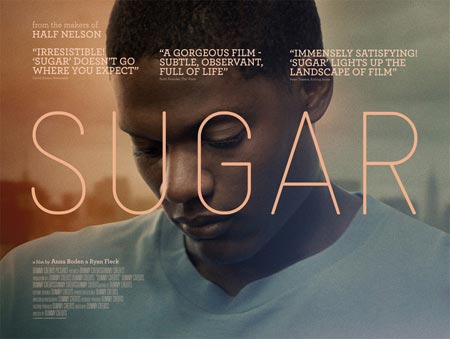
    As you know, we really love Anna Boden and Ryan Fleck’s “Sugar” here at InContention. The film opens today here in the UK, and I sincerely hope discerning Brit audiences can get past the unfamiliar baseball angle and see this for the lovely, universal character piece it is.

    Anyway, I thought I’d share this beautiful poster art from AllCity Design, easily the best in the game when it comes to UK release one-sheets. I love that they include rejected designs on their website — this one didn’t make the cut (the design they went with is pictured after the jump), but the elegance of its palette and composition caught my eye.

    Sugar

    (more…)

  • Jolie tops female-powered Forbes list

    Angelina JolieI must say I’m always somewhat fascinated by the annual Forbes 100 Most Powerful Celebrities list, not least because I’ve never really understood how they arrive at it.

    I have no doubt the financial publishing behemoth has some sort of intricate formula that factors in earnings and media exposure to somehow arrive at a rank order, but as a total idiot in such matters, I remain bewildered by a list that compares the wholly disparate (to me, at least) achievements of such  figures as Rush Limbaugh, Ryan Seacrest and Roger Federer.

    But compare them they have, and this year’s number-crunching informs us that Angelina Jolie is officially the most powerful celebrity in the world.

    I suppose I won’t argue with that: while I wouldn’t call Jolie the most influential actress in the game at the moment (surely that title goes to Meryl Streep in her newfound incarnation as summer-movie titan, which landed her at #64 on Forbes’ list), “celebrity” is a very different animal, and the number of magazine covers Jolie graces weekly at a newsagent’s near you speaks for itself.

    Clearly that kind of exposure is a more crucial factor in Forbes’ estimation than earnings, as I’d reckon Jolie’s personal fortune is meagre compared to that of runner-up Oprah Winfrey. Interestingly, the top four spots in the list are held by women, which belies more than a few media perceptions.

    (more…)

  • Hirsch to join long line of movie Hamlets

    Emile HirschWith three major film adaptations in the latest two decades alone, I wouldn’t have thought “Hamlet” was crying out for another big-screen treatment, but apparently I was wrong. (What’s wrong with Shakespeare’s other plays? Not too shabby, some of ’em.)

    Anyway, news came yesterday that Catherine Hardwicke is to helm the latest outing for the Prince of Denmark, in a film being developed by the rapidly rising Overture Films. No word yet on whether the “Twilight” director’s involvement signals a tween-generation take on the Bard, though Overture has confirmed that the film will refashion as a “suspense thriller” set in contemporary America. (I guess because that 2000 thriller-ized American update with Ethan Hawke never happened? Help me out here.)

    Emile Hirsch will be the latest thesp to step into the role, with Oscar-winning producers Dan Jinks and Bruce Cohen (“Milk,” “American Beauty”) boasting that he’ll be the first age-appropriate actor to play the role on film. Oscar nominee Ron Nyswaner (“Philadelphia,” “The Painted Veil”) is handling script duties.

    I can’t say the triple-H combo of Hardwicke, Hirsch and Hamlet has me salivating, but I’ll do my best to keep an open mind. Still, forgive me if I think this joins the mooted “Total Recall” remake as the week’s least necessary announcement. Press release extract after the jump.

    (more…)

  • PAGE TO SCREEN: “The Lovely Bones” by Alice Sebold

    The Lovely BonesRemarkable cinema can be born of lesser literary source material, and vice versa. An arresting narrative hook can be enough for an adept screenwriter and filmmaker to fashion into an evocative cinematic vision; the artistry (or otherwise) of the prose is of secondary importance.

    Sterling cast and credentials aside, it is for this reason that I hold out much hope for Peter Jackson’s adaptation of Alice Sebold’s “The Lovely Bones,” a wildly popular novel that is nonetheless more exciting in its conceptualization than in its clunky execution. The novel offers bold visual and structural possibilities, not to mention a strong emotional charge, for Jackson and his collaborators to draw upon, but is weighed down by a maudlin, sometimes lurid literary sensibility that could benefit from the more interpretive route of visual storytelling.

    The story, in short, requires a subtler hand than Sebold’s to move into the realm of art; whether Peter Jackson, hardly the gentlest of directors recently, is the man for the job is something I’m intrigued to see. The Jackson of “Heavenly Creatures” could tease out the candid, often mordantly humorous tone that occasionally surfaces in the novel to good effect. The Jackson of “King Kong” risks drowning the delicate core narrative in effects-heavy supernatural dazzle, not unlike how Sebold ultimately smothers her story in spiritual bathos in an utterly unhinged final act. As a match of filmmaker and source material, it’s a double-or-nothing proposition.

    Perhaps that sounds unduly harsh on a debut fiction effort that has redeeming features beyond its overriding stylistic stickiness. Its essential gimmick – as you no doubt know, it’s narrated by the spirit of Susie Salmon, a murdered 14 year-old girl, observing how her family members variously handle the crisis on earth – is distinctive and immediate, and should translate well to film with judicious use of voiceover.

    (more…)

  • THE LISTS: Top 10 Best Foreign Language Film winners

    John RatzenbergerIt is with a notable silence that Yojiro Takita’s “Departures” – best known to many of you as that film that beat “Waltz With Bashir” to the Best Foreign Language Film Oscar – slipped onto U.S. screens last week. Of course, there are various reasons for the lack of hoop-la surrounding its release.

    The film itself is a decidedly unassuming, low-key effort. The critical reception has been, if hardly hostile, slightly soft. (Sure, Ebert gave it four stars, but what does that mean these days?) Meanwhile, more than three months after Oscar night, it’s likely most people barely remember the film’s victory at all. (Probably a good release strategy, given the dismay with which the win was greeted in many quarters.)

    The less charitable explanation, of course, is that the film isn’t terribly good. Pleasant, certainly, and executed with commendable sincerity, but swaddled in the kind of safe, maudlin cinematic cotton-wool that never threatens any real danger, despite the potentially macabre directions the material could go in. It’s a cozy piece of work that doesn’t dare approach “Waltz With Bashir” for formal invention or “The Class” for storytelling verve.

    As such, it’s a textbook illustration of the Academy’s voting tendencies in this category, which repeatedly favor the safe ahead of the searing: the movie you’d take home to meet Mom rather than the one you’d run away to Paris with. This decade alone, we’ve seen such competent, amiable and relentlessly middlebrow fare as “Nowhere in Africa,” “Tsotsi” and “The Counterfeiters” triumph over infinitely more innovative competition – -or, all too often, films that didn’t even make the nominee list. It’s a situation that inspires annual grumbling, on these pages and innumerable others.

    But it’s not all bad. The running-joke status of the foreign-language award tends to obscure the fact that the Academy has rewarded a number of stone-cold classics in their time too –- never more so than in the earliest days of the award, when titans of film history like Kurosawa, De Sica and Fellini made it to the winners’ podium. And even these days, a gem like “The Lives of Others” can still manages to fight its way to the surface.

    Today’s list seeks to at least partially rehabilitate the reputation of this beleaguered (albeit deservedly so) award, reflecting on the most adventurous –- or simply most resonant -– selections in the 62-year history (including the days when it was merely an honorary citation) of the Best Foreign Language Film award.

    (more…)

  • ‘Summer’ loving

    Summer HoursAs we head into June and the year’s midway point looms (I know, how did that happen?), my mind inevitably goes into cinematic stocktaking mode, reflecting on what 2009 has had to offer thus far — and at this stage, the reflections aren’t too pretty.

    In any given year, I usually like to earmark at least one title as the best of the first six months, if only to set the minimum standard for the year’s busier latter half. 2009 has yet to present such a standout to me, which gives me precisely one month to fall in love with something, the way I had with “In Bruges” or “Happy-Go-Lucky” by this time last year.

    If I lived across the ocean, however, this issue would have been solved already. Playing by the rules of U.S. release dates, Olivier Assayas’ “Summer Hours” would easily be my film of 2009 so far — a woozy, wistful comedy of filial disconnect that seems to have found a deserved following in the American critical community. (Rather more so than it did here, in fact.)

    The problem? Well, I already fell hard for Assayas’ gem last summer, upon its July 2008 release in the UK — and consequently already included it in my own “best of ’08” round-up, sandwiched between such compatriots as “A Christmas Tale” and “The Class.” It may be a wonderful film, but asking it to fill two years in my cinematic diary is just greedy.

    (more…)

  • Could female directors hit Oscar paydirt this year?

    Jane CampionOnly the greenest of awards-watchers needs reminding of the following statistic: a mere three women have been nominated for Best Director in the 81-year history of the Academy Awards. It’s long been an embarrassing state of affairs — never more so than in the late 80s and early 90s, when in three out of six consecutive years, the Best Picture nominee denied a directing nod happened to be made by a woman.

    Still, the sad truth is that the workings of the industry are such that female filmmakers are rarely entrusted with the kind of prestige studio product that grabs awards attention. (It’s no coincidence that the three past nominees — Lina Wertmuller, Jane Campion and Sofia Coppola — all come from the foreign and/or independent sector.)

    2009, however, offers a considerably rosier outlook. As I was compiling my own early Oscar predictions (which I’ll share with you next week) in the wake of Cannes, it occurred to me that the Academy has an opportunity to double that paltry aforementioned statistic in the space of a single year. More than double, actually: looking down the list of awards possibilities, it is feasible — if still not very likely — that as many as four of this year’s five Best Director slots could be filled by the fairer sex.

    Apparently, I’m not the only one thinking alone these lines: IndieWire’s Peter Knegt considers the possibilities of three ladies in his post-Cannes awards speculation column, going so far as to predict nods for all three (based only on films he’s seen so far). So who are these women (including the one Knegt isn’t considering) with a chance of making Oscar history come January?

    (more…)

  • WEEKLY WRAP: Closing Cannes and opening ‘Up’

    Isabelle Huppert presenting the Palme d'Or at Cannes• The Cannes Film Festival wrapped up, with Michael Haneke’s “The White Ribbon” taking the gold, and “Antichrist” nabbing honors too. (The Ecumenical Jury was less impressed.)

    • In the wake of the festival, we offered an updated survey of the Oscar landscape ahead.

    • With “Up” finally hitting our screens this week, we chatted to director Pete Docter.

    • And with ten features now under their belt, this week’s list ranked the best (and worst) of Pixar.

    • This week’s Page to Screen also returned to childhood, reflecting on the cinematic possibilities of “Where the Wild Things Are.”

    • The nostalgic vein continues with a revisiting of “Apocalypse Now,” thirty years on.

    • Newly released concept art provided a faint glimpse of what’s coming in James Cameron’s “Avatar.”

    • Speaking of Cameron, a look at what went wrong with “Terminator Salvation” at the box office.

    • On a happier note, “Drag Me to Hell” proved an absolute blast.

  • One against ‘Up’

    UpNo surprise that the first unmitigated critical slam for “Up” should come from the reliably cranky Armond White, who has made his disdain for Pixar’s output clear on a number of previous occasions. His review goes on to lay out his wider problem with “Pixarism” (good word, that), namely that the films are just too cute:

    Pixar’s price sticker includes enough saccharine emotion to distract some viewers from being more demanding; they don’t mind the blatant narrative manipulation of a sad old man and lonely little boy. They buy animation to extend their childhood like men who buy cars for phallic symbols.

    Pixarism defines the backward taste for animation. Refuting Chuck Jones’ insistence that he didn’t create his great Warner Bros. cartoon for children, Pixarism domesticates and homogenizes animation—as if to preserve family values. The only exceptions have been Brad Bird’s Pixar movies The Incredibles and Ratatouille—both sumptuously executed in Bird’s belief that animation should show “how things feel rather than are. Indulging in the human aspect of being alive.” Yet their conceptual weak point was cuteness—same as Up’s glossing over Carl’s “public menace” court conviction and that inconsistently imagined dog pack.

    As someone who finds Pixar more of a hit-and-miss outfit than is generally perceived — and bearing in mind that I haven’t yet seen “Up” — I still don’t think that’s an entirely fair argument. (I do, however, agree that Bird is their most sophisticated storyteller.)

    (more…)

  • Von Trier: “I am the female character”

    Lars von TrierThere isn’t very much more I can say about the writhing can of worms that is “Antichrist” until I actually get to see the film. (Anyone who can make this happen, you know where to find me.) But it’s worth mentioning this interview with Von Trier in the Independent, if only because it draws attention to just how carefully the director planned the ensuing controversy, from that thematically tenuous title to his tongue-in-cheek press-conference posturing.

    One reader recently made the observation that Von Trier “much better at marketing his films than actually making them.” As someone who thinks he’s made at least three stone-cold masterpieces, I don’t entirely agree — but replace the words “much better at” with “as good as,” and we’re on the same page.

    He has a near-unrivalled knack for making commercially hostile films into the stuff of widespread dinner-party talk; even my friends who aren’t especially film-literate are now curious about “Antichrist.”For his part, Von Trier has no problem admitting the manipulation at play:

    There is no denying that von Trier is a provocateur. He describes the device as “a tool”. Saying he’s the best director, making challenging films, creating a furore has been his way of getting what are essentially small-budget films from Denmark noticed … Von Trier, for all his foibles, is definitely no fool and the secular characters are clearly in keeping with the perceived reduction of influence on religion in everyday life in Europe. Von Trier simply says, “I started with the title.”

    (more…)