I imagine “Bob” is getting fired for this. Or maybe it’s just a joke?:
 *All historical figures cited are adjusted to today’s dollars.
Summer keeps puttering along and based on the reaction to Kris’s multiple posts on the subject, we’re all just biding our time until “Inception” comes out. I knew people wanted to see it, but I can’t remember the last time people were refreshing their browsers to see a couple of reviews.
Nolan’s latest is still a week away though, and we have other business to cover. Mainly, some weird cartoon and the re-imagining of an 80’s action classic. Weeks ago I had this pegged as an easy weekend for “Predators” to win, but Fox has lowballed the screen count and skimped on the marketing for what should have been a no-brainer. So, let’s start with “Despicable Me.”
Universal has released a grand total of two computer animated films before this week. The first was the $14.4 million grossing Veggie Tales movie, “The Pirates Who Don’t Do Anything”, which I didn’t see because I think Christian vegetables are weird, but still think it’s one of the best titles of all time. Their second release was the $56.3 million wonder, “The Tale of Despereaux.”
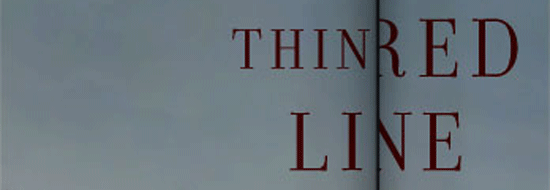
A few weeks ago we told you about the upcoming DVD and Blu-ray Criterion release of Terrence Malick’s “The Thin Red Line,” perhaps one of the most anticipated Criterion announcements yet. The information came with sell sheet cover art, but today we get a look at the actual cover art, and as one would expect, it’s gorgeous. Check out the full image after the jump.
 It may have a hard time distracting audiences from shinier baubles on the summer-movie tree, but there are few films currently in theaters more invigorating and essential than “Restrepo.”
An unprecedentedly first-hand war documentary, shot on the fly by a pair of filmmakers embedded in a U.S. Army unit stationed in Afghanistan’s perilous Korengal Valley, it emphatically earns the previously overused adjective “immersive”: as Taliban bullets rattle past the camera lens, the terror and confusion of combat hits harder than it has – or could – in any narrative war film.
The film, which expands its release considerably today, leads an already impressive charge of American non-fiction cinema in 2010; it won the top prize at the Sundance Film Festival in January, and we can expect an outcry if due respect isn’t paid by the Academy’s documentary branch.
The achievement is all the more impressive for being the debut film of Sebastian Junger and Tim Hetherington, not that either name is an unfamiliar one. Hetherington is an acclaimed British photographer who won the coveted World Press Photo Award in 2007: interestingly, for an image from the same assignment that bore this film. Junger, meanwhile, is something of a superstar journalist, an adventurer best-known for his 1991 book “The Perfect Storm.” That work may have been Hollywood-ized in 2000, but Junger’s own big-screen ambitions were rather more casual.
I’ve seen “Inception” twice now and will most definitely be going back for a third helping. And personally, I’m kind of dying to see this thing on IMAX given how much of a truly immersive experience it is. Coming Soon has an exclusive clip of Nolan discussing his thoughts on as much:
 Steep, STEEP praise for David Fincher and Aaron Sorkin, director and writer of the upcoming “The Social Network.” The praise comes from New York Film Festival director Richard Pena in announcing the film as the opener of this year’s fest.
From Thompson on Hollywood:
[The film] powerfully captures the spirit of its time…David Fincher and Aaron Sorkin are a director/writer team, like Lumet and Chayefsky before them, that make this movie not only of the moment, but reflective of larger cultural issues as well, and confirm their position at forefront of contemporary cinema.
Now, I’m not saying Fincher and Sorkin aren’t worthy of that. I haven’t seen “The Social Network,” after all. But I sure wouldn’t want to be in their shoes having to rise to the level of that compliment. But then again, I consider “Network” to be the best screenplay ever written. Hey, how about that? “The Social NETWORK.”
Anyway, the new trailer, also from Thompson, after the jump.
 Here we go again. We just said goodbye to the 2009 film awards season four months ago, yet here we are, halfway through 2010 and ready to kick the tires on Tech Support, a unique feature here at In Contention.
Tech Support, for those unaware, seeks to highlight below-the-line talent on films. We offer space to recognize the film music and sound design that help set atmospheres, the costume and production design that helps manifest a new world on screen, the film editing that makes the machinery flow, the makeup that can build a character from the surface out, the visual effects that continue to wow us and the cinematography that truly captures a “motion picture.”
Films would be impoverished without the contributions of those tasked with the above duties, to say the least. While many of them like being out of the spotlight, it nevertheless seems tremendously important to acknowledge their work, and so we’re happy to gallop into our fifth year of Tech Support.
Over the next seven months, we will be taking a look at all of these categories, which are often forgotten in the mainstream press. We will take two in-depth looks at nine fields: Best Art Direction, Best Cinematography, Best Costume Design, Best Film Editing, Best Makeup, Best Music (Original Score), Best Sound Editing, Best Sound Mixing and Best Visual Effects. Best Original Song, largely due to difficulties in amassing a list of contenders early on, will only be reviewed once, later in the season. After this, we hope to again feature many of the contenders with interview pieces, allowing you to read about the personal stories involved in creating films from below the line.
 A few weeks ago the Academy’s visual effects committee was set to vote on expanding the Best Visual Effects category to five nominees. Today, the rule has officially gone into the books, according to a press release. The rules governing animated feature eligibility have also been altered to make room for films that run at least 40 minutes, rather than 70 minutes, which could allow space for some obscure entries.
The release, in part:
The governors of the Academy of Motion Picture Arts and Sciences finalized the rules for the 83rd Academy Awards at its most recent meeting (June 22). The most significant change is in the Visual Effects category, which will now feature five nominees rather than three…
In the Animated Feature Film category, the rule governing running time for a motion picture to qualify was changed from at least 70 minutes to greater than 40 minutes, which is consistent with the running time requirements for feature films in all other categories. The running time for a motion picture to qualify as an animated, live action or documentary short film has been and continues to be a maximum of 40 minutes. The previous 70-minute threshold for an animated feature had left a gap for films that ran between 40 and 70 minutes, effectively preventing them from being able to qualify as either features or shorts.
Also, regarding motion capture, new language was put in place to indicate, clearly, that the technique will not be considered animation.
 Catch up with the idea behind this series here.
The Academy was knee-deep in blacklisting around 1957 and Best Adapted Screenplay was given to novelist Pierre Boulle for “The Bridge on the River Kwai,” despite him not writing the film or being able to speak English. The three hour epic dominated the proceedings and Lean’s masterpiece and subsequent work would help lay the groundwork for the genre we now know as “Oscar bait.” Ridiculously, “Sweet Smell of Success,” “Paths of Glory,” and “A Face in the Crowd” all received no love and could easily be featured in this column.
1958 saw “Gigi” break records with nine Oscar wins, while the telecast ended twenty minutes early, leaving Jerry Lewis having to try and improvise for that amount of time on live television. Can you imagine Chris Rock having to do that today? I’d watch that in a heartbeat.
Film industries from all over the world were blossoming and titles from this era are more accessible to us now so my choices have become harder and harder to make. If it comes down to it, I’ll err on the side of obscure because really, you all should know that “Touch of Evil” is required viewing without me saying so.
 Well, this is a pretty nifty ascent for a director whose seven previous features received not a sniff of an Oscar nod between them. Four months after becoming the first female Best Director winner in Oscar history, Kathryn Bigelow has been named one of three first-time electees to the Academy of Motion Picture Arts and Sciences’ Board of Governors.
Joining Bigelow are two other previous Oscar champs: documentarian Michael Moore (I guess AMPAS brass don’t hold a grudge over that acceptance speech) and one of the greatest editors in the history of the medium, Anne V. Coates (“Lawrence of Arabia,” “Out of Sight”). Congratulations all round.
To give you an idea of the exclusivity of the honor, AMPAS has only 43 Governors in total — three for each of their 15 branches (which the exception of Makeup, which has a single representative). Bigelow therefore joins Martha Coolidge and Edward Zwick in leading the Directors branch. Interesting that this long male-skewing branch should now have two female Governors.
 In Kris’s thorough rundown of the collected performances in “Inception,” I was both pleased and unsurprised to see rising British star Tom Hardy come in for praise. From the outset, his is the name I’ve been most intrigued by in the film’s formidable ensemble. Hardy has been doing stellar, even stunning, work on stage, TV and on the Britfilm scene — culminating in a British Independent Film Award for “Bronson” last year that should rightfully have been the start of a longer awards trail.
But “Inception” — a minor role in 2001’s “Black Hawk Down” notwithstanding — really marks the actor’s arrival in mainstream Hollywood, and he’s obviously made it an auspicious one. Call it groundwork for his bid for superstardom in George Miller’s revival of the “Mad Max” franchise: he’s an inspired choice to fill Mel Gibson’s shoes, so here’s hoping the rest of the reboot is similarly adventurous.
It’d be exciting to see Hardy become a star, and not merely because he’s a fine actor. His sullen model’s features and inked-up boxer’s physique don’t quite fit Hollywood’s leading-man mold; nor does his messy (and gladly disclosed) backstory of early alcoholism and addiction.
If you’ve ever thought your YouTube videos merit more than a few “ZOMG LOL” comments from bored teenagers with names like “funkychik817,” Kevin Macdonald and Ridley Scott have a proposition for you. In honor of YouTube’s fifth birthday, the filmmakers are collaborating with the video-sharing website producing the first feature documentary composed entirely user-generated footage.
Members of the public are invited to submit videos reflecting an aspect of their daily lives — all of which must be filmed in the 24-hour period of July 24. Macdonald and a presumably large team of editors will sift through the entries and select a “couple hundred” to make up a film titled “A Life in the Day,” which will premiere at Sundance at next year. (Scott will act as executive producer.) Nifty idea — USA Today’s Susan Wloszczyna has more details here.
 As a number of people have pointed by asking, my review of Christopher Nolan’s “Inception” doesn’t offer much perspective on the performances in the film. The reason is probably a combination of a few things.
For starters, I wanted to be as careful as possible to write a spoiler-free review that could be enjoyed by those who haven’t seen the film, and whenever I would find myself considering this or that performance, I felt detailed commentary on plot seeping in. So I pulled back. But more importantly, and this is no swipe at the talent on screen, the real star of the film is Nolan and his imagination.
That sounds like a cop out, but it’s not. I really and truly didn’t get a whole lot out of the performances. My favorite is perhaps the least emotional turn of the piece, a steely, confident, at times physically demanding piece of work from an actor I admit rarely does it for me: Joseph Gordon-Levitt. He lays claim to the character you’d probably trust sooner than the rest if you found yourself in these mind-bending circumstances and does it without histrionic swagger. I dug that.
 It’s unusual for a Palme d’Or winner to wait this long after Cannes to find to secure a North American distributor — but then, Apichatpong Weerasethakul’s death-dreams-and-monkey-ghosts fantasy “Uncle Boonmee Who Can Recall His Past Lives” is a pretty unusual Palme d’Or winner.
You’ll get why it’s such a tough sell when you see it, but that won’t be until spring 2011 for U.S. audiences. It has just been announced that boutique distribution company Strand Releasing — who previously handled Weerasethakul’s features “Tropical Malady,” “Syndromes and a Century” and “Blissfully Yours” — have once again come to the rescue, and will open the film in the quiet half of next year.
Probably the right call: even with the Cannes fanfare, the film is destined to remain an extreme niche item, and would get buried in the late-year crush of more accessible highbrow fare.
 Even in the most evenly matched and mutually dependent of ensembles, it seems, some will always be deemed more equal than others. So it is with this summer’s great white indie hope, “The Kids Are All Right.” Since the film bowed at Sundance in January, all its players have been warmly received by critics — but it was Annette Bening, as the more authoritative half of a middle-aged lesbian couple, who initially emerged as the consensus standout and likely awards player.
That’s understandable in many respects. It’s a fine performance, and arguably the film’s most surprising: Bening can be a divisively mannered actor, but this is the loosest and most spontaneous she’s yet let allowed herself to be on screen. It doesn’t hurt that, between the film’s adult characters, hers perhaps tests audience sympathies the least.
But in what is plainly a two-lead film at the very least — for my money, there’s a convincing case to be made for Mark Ruffalo’s intruding third parent as a leading player — people shouldn’t be so hasty to hand out best-in-show ribbons.
 Now that the review embargo walls have crashed on “Inception” (though most of what’s out there is web-based media as we’ll wait a while for print reactions), I guess it’s fair to dive into the awards implications of the film. I preferred to stay away from that kind of talk in my review.
The first thing that comes to mind when I think of the history of Best Picture nominees is the fact that, on some level, they are fairly undemanding efforts. There’s a pattern of simplicity of narrative, regardless of genre. Now, most seem to think the general positive assessment Nolan’s film has received should be enough to get it into a field of 10 nominees, but I’m a touch skeptical.
“Inception” is anything but undemanding. It’s a cerebral exercise that will have some recalling Robert Downey Jr.’s swipe at “The Dark Knight” a few years ago: “I clearly need a college education to understand this movie.” We all remember Nolan’s superhero epic did not make the cut with five slots. And the thought process for some is, well, it’s time for AMPAS to kiss and make up. Except that’s not the typical AMPAS thought process, and certainly not for a still youngish talent like Nolan.
 In reviewing 2008’s “The Dark Knight,” I wrote that director Christopher Nolan “has made a brief career of exploring characters built upon their somber, in some instances twisted pasts, however distant or immediate.” The theme continues with “Inception,” a film like nothing you have ever seen before that plays out like a two-hour therapy session, wrapped in the accoutrement of a heist film and bathed in the panache of an entirely immersive cinematic experience.
The hero is Dom Cobb (Leonardo DiCaprio), a man trying to find his way home, to paraphrase the filmmaker. But is home just a dream, some fantasy trapped in the “what if” corridors of his mind? Or is it possible that maybe through one final job of contrived gobbledygook he might find his way to the life he was forced to flee years before?
Cobb’s black market profession is “extraction,” a type of mind theft dependent on dream manifestation technology developed by military intelligence for training purposes. If you want someone’s secrets, Cobb’s your man. For a price, he and his crew will go into the individual’s subconscious and bring it to you on a silver platter. But it’s a dangerous job, given the complexities of the process, not to mention the complexities of dealing with the kind of people who’d pay for such a thing.
 *All historical figures cited are adjusted to today’s dollars.
Happy Independence Day everyone! I trust you ate some grilled meat, camped out on a beach for the day and saw some fireworks. I know I did. Apparently, others also went to see a movie called “The Twilight Saga: Eclipse,” since it topped the four day weekend with $82.5 million. Why is it a four day weekend? Couldn’t tell you. Movie people just like the fourth of July so much that any Monday that falls directly adjacent to it automatically becomes a Holiday too.
Breaking “Eclipse” down, it grossed $93 million on Wednesday and Thursday, $69 million for the traditional three day period, another $13.5 million on Monday, which all adds up to $175.3 million in six days. Catch all that? Technically, that $69 million is the weakest opening weekend figure of the series, but the film has already almost outgrossed the total of the first film, so let’s not get hung up on technicalities. Twihards came out in force and even though the film will drop precipitously from here, it will likely make its $68 million budget back just from t-shirts at Hot Topic so these grosses are almost irrelevant.
The only thing I’ll say is that “New Moon” had $186.9 million after six days and so that film’s total of $309.3 million is already out of reach, indicating that we have seen the peak of Edward and Bella’s popularity. Unless Kristen Stewart does a nude scene in “Breaking Dawn.” Or Taylor Lautner too, for that matter.