In Contention

Category: Tech Support

  • TECH SUPPORT: Best Art Direction — Volume I

    As we like to point out in this space each year, the Academy Award for Best Art Direction is presented to two individuals who have different but key roles in designing a film’s sets and props.

    The first of these, the production designer, is the director of the film’s art department, responsible for the supervision of those in it and the overall architecture of the film’s design. The set decorator, on the other hand, is responsible for filling up those sets with proper scenery to fully bring them to life.  When these individuals, and those who work alongside them in the art department, do their jobs well, we can be fully immersed into the story.

    Historically, the nominees in this field fit into one of two categories: historical or fantastical. At least two – usually three or four – of the nominees every year are set in the past. This is not surprising. Being set outside of day-to-day life, such films require a different sort of research and, moreover, draw attention to themselves by not appearing to be what we encounter every day.

    At the same time, fantasy titles show up at least once, often more, every year as well. Last year’s winner, “Avatar,” is a good example of this.  Rick Carter and Robert Stromberg created a completely different world strictly from imagination.

    (more…)

  • TECH SUPPORT: Diving right back in

    Here we go again.  We just said goodbye to the 2009 film awards season four months ago, yet here we are, halfway through 2010 and ready to kick the tires on Tech Support, a unique feature here at In Contention.

    Tech Support, for those unaware, seeks to highlight below-the-line talent on films.  We offer space to recognize the film music and sound design that help set atmospheres, the costume and production design that helps manifest a new world on screen, the film editing that makes the machinery flow, the makeup that can build a character from the surface out, the visual effects that continue to wow us and the cinematography that truly captures a “motion picture.”

    Films would be impoverished without the contributions of those tasked with the above duties, to say the least. While many of them like being out of the spotlight, it nevertheless seems tremendously important to acknowledge their work, and so we’re happy to gallop into our fifth year of Tech Support.

    Over the next seven months, we will be taking a look at all of these categories, which are often forgotten in the mainstream press. We will take two in-depth looks at nine fields: Best Art Direction, Best Cinematography, Best Costume Design, Best Film Editing, Best Makeup, Best Music (Original Score), Best Sound Editing, Best Sound Mixing and Best Visual Effects.  Best Original Song, largely due to difficulties in amassing a list of contenders early on, will only be reviewed once, later in the season. After this, we hope to again feature many of the contenders with interview pieces, allowing you to read about the personal stories involved in creating films from below the line.

    (more…)

  • TECH SUPPORT: Final stretch, final predictions

    Zoe SaldanaWell, here we are. On Sunday, the statuettes for the Oscars will handed out. It seems difficult to remember that it was eight months ago when we started looking at the categories for the first time. Today, let’s take one last look at the crafts categories to see where we stand.

    Best Art Direction (Oscar Guide)
    One of the easiest predictions for the evening, for me, is Best Art Direction. James Cameron’s “Avatar” has won the Critics’c Choice, BAFTA and guild awards and this category and the sets, while not being typical of winners in this category, were brilliant. “The Imaginarium of Doctor Parnassus” strikes me as too small, “Nine,” too hated and “The Young Victoria,” more of a costumers film. I’d put guild winner “Sherlock Holmes” in second…but a very distant second.

    Will win: “Avatar”
    Could win: “Sherlock Holmes”
    Should win: “Avatar”

    (more…)

  • TECH SUPPORT INTERVIEW: Composer symposium, part two

    Michael Giacchino at the 2010 Golden Globe AwardsI think everyone who has seen Pixar’s “Up” was utterly taken by the scene “Married Life,” where emotions ran high and three characters were built between images and music.  As Kris mentioned in this morning’s Oscar Guide, composer Michael Giacchino had the full aural attention of the audience for 10 minutes.

    Speaking to Giacchino, it’s clear he knew it was perhaps the most pivotal moment to get right into a film where music was destined to play a significant role, no matter what. “I remember watching that scene for the first time,” he recalls, “and even watching it without music, it makes you cry. You’re not just looking at what happens on screen, you’re looking at what happens in your life.”

    He found the scene, and indeed, the film itself, to be quite personal. “You end up analyzing yourself,” he says. “It’s an emotional experience and when I’m writing music for any good film, I know I can only do a good job when I’m reflecting what I’m feeling. It’s like a mirror.”

    Giacchino loves being part of what he describes as the “Pixar family” and came aboard the film eight months before it was released. “I’m always at Pixar for something,” he says, adding that he loves doing the music for their short films as well. “Being at Pixar is like being 10 years old and everyone accepts each other for whoever you are.  It’s a wonderful open, honest feeling of being able to say if you don’t like something.”

    (more…)

  • TECH SUPPORT INTERVIEW: Composer symposium, part one

    Hans ZimmerWhen you’re a film music composer as prolific as Hans Zimmer, unique soundtrack flavors can be a bit elusive. But with Guy Ritchie’s “Sherlock Holmes,” Zimmer found them, pushing the boundaries of what’s acceptable with action film scores in the process.

    But the work isn’t without its inspirations. There seem to be bits of Danny Elfman married with Ennio Morricone, but Zimmer was actually reaching back much further.

    “Let me just be German about it,” Zimmer says with a laugh. “It was actually the Kurt Weill vibe I was after. But it’s sort of all in the family, I suppose. It’s fun for me if I can actually go and embrace some of that European stuff again.”

    The score is a delightful, jaunty construction that relishes in its own peculiarity. The good thing about director Ritchie, Zimmer says, is that he’s a bold director who welcomed these slightly “quirky” and “crazy” intrusions.

    “There was an enormous amount of thinking about how to do this differently,” Zimmer recalls. “It became apparent quickly that Guy and I had similar tastes in music and, in a funny way, what hadn’t been done in a movie of this scale. It’s all soloists. It’s not really orchestral. Every note you hear has a real performance attached to it. You can’t really hide it. Everything is very opinionated and bold. It’s not the sort of homogeneous sound you get from an orchestra.”

    (more…)

  • TECH SUPPORT INTERVIEW: The crafts of ‘Star Trek’

    Eric Bana in Star TrekOne of the year’s biggest blockbusters redefined a franchise and even made it palatable to those unfamiliar with or uninterested in its vibrant history. The film, of course, was “Star Trek,” and as below-the-line craftsmanship goes, it was one of the most impressive efforts of the year.

    Director J.J. Abrams’s mandate was “to renew and refresh, give it back some life,” makeup designer Mindy Hall says. “I had never seen any of the movies, but I grew up watching the series. If we were going to use any reference, it was going to come from that. But I didn’t want my perspective to be too crowded by looking at the archive stuff.”

    With a background in watercolors and ceramics, Hall one day happened upon a documentary on the making of Arthur Penn’s 1970 film “Little Big Man,” which aged Dustin Hoffman nearly 100 hundred years.

    A light bulb went off for the young artist. All she knew was that she wanted to do that, to bring that illusion to life.

    Hall worked in tandem with costume designer Michael Kaplan on the film. A lot of their references were more fashion related, she says. They flipped through European design books and placed a certain emphasis on emulating on the clean and slick look of science-fiction films of the 1950s and 1960s.  “We weren’t trying to do period,” she says. “We were just trying to get the flavor of it.”

    (more…)

  • TECH SUPPORT INTERVIEW: The crafts of ‘Bright Star’

    Ben Wishaw and Abbie Cornish in Bright StarIt’s not every year that my biggest cheer on Oscar nomination morning comes in the technical categories, but such was the case last week when Janet Patterson’s name showed up in the Best Costume Design lineup.

    Patterson’s inclusion (following a senseless Guild snub) is gratifying not merely as recognition for her tangibly textured, richly story-serving threads in “Bright Star,” but as a representation of one of 2009’s most immaculately integrated – and under-rewarded – technical ensembles.

    Jane Campion’s John Keats biopic derives its fresh, fragile romanticism as much from writing and performance as the combined efforts of Patterson, cinematographer Greig Fraser and composer Mark Bradshaw. Their work has prompted countless critics’ punning on Keats’s “a thing of beauty is a joy forever” chestnut, but sometimes the most obvious praise is the most appropriate.

    For Fraser and Bradshaw, “Bright Star” represents their first experience on a Campion feature, having previously collaborated with the New Zealander on a pair of short films, “The Water Diary” and “The Lady Bug.” For Patterson, however, the film extends a collaboration with the filmmaker that dates back to Campion’s 1993 breakthrough “The Piano,” and has yielded previous Oscar nominations for both that film and 1996’s “The Portrait of a Lady.”

    (more…)

  • TECH SUPPORT: Post mortem

    Michael Gambon in Harry Potter and the Half-Blood PrinceSo here we are. For the most part, the crafts category nominations weren’t surprising, and there is not a single film that fared drastically better – or worse – than I expected.
    As for comments on individual categories? In Best Cinematography, Bruno Delbonnel’s nomination for “Harry Potter and the Half-Blood Prince” has got to be one of the biggest surprises of the year. The other nominees were completely expected. Dion Beebe apparently couldn’t overcome “Nine”’s collapse.

    On the other hand, John Myrhe managed to make it in for Rob Marshall’s musical in Best Art Direction after missing with both BAFTA and the guild. Nominations for “Avatar” and, in my opinion, “Sherlock Holmes” were to be expected. But the other nominees were slightly surprising.

    “The Imaginarium of Doctor Parnassus” was richly deserving but still surprising. And “The Young Victoria” evidently had more support than I first thought. The real snub here, however, is David Wasco. If he can’t get in for “Inglourious Basterds,” I’m not sure what it’ll take.

    (more…)

  • TECH SUPPORT: Final predictions, part two

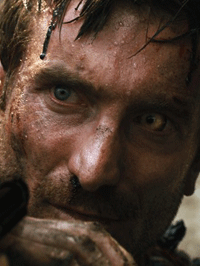
    Sharlto Copley in District 9Continuing from where we left off yesterday, today we look at the fields of makeup, music, sound and visual effects.

    BEST MAKEUP

    The shortlist of seven makes predicting this category slightly easier. “District 9”’s realistic wounds, not to mention the practical elements of the central character’s transformation, likely make it the frontrunner. “Star Trek,” meanwhile, boasted an array of alien species and turned young actors into iconic characters.

    So what will get the last spot? “The Young Victoria” has done better than I would have expected it to do this season and the costumes are assured a nomination. But its shortlisting here seems really for hairstyling, which historically doesn’t lead to nominations.  Then again, a BAFTA nomination shouldn’t be taken lightly.

    I find it difficult to believe that “Night at the Museum: Battle of the Smithsonian” will be nominated when its predecessor failed to even be shortlisted. Admittedly, it worked for “Austin Powers: The Spy Who Shagged Me,” but the characters there were much more iconic. Still, one never knows.

    (more…)

  • TECH SUPPORT: Final predictions, part one

    Melanie Laurent in Inglourious BasterdsIt’s hard to believe we’ve almost made it to nomination morning. Over the past six months here at Tech Support, we’ve previewed all the races and interviewed several of the contenders. On Tuesday, we find out who advances.

    In the way of final predictions, today I’ll preview the art direction, cinematography, costume design and film editing categories. Tomorrow I’ll address the makeup, music, sound editing, sound mixing and visual effects fields.

    BEST ART DIRECTION

    I should begin this category by stating that Rick Carter and Robert Stromberg’s designs for “Avatar” are the sort often avoided in this category because so little is physically built. However, the look of the film has been so embraced, and the precursor citations have been so great, that I don’t think the branch will be able to ignore them.

    David Wasco has been unfortunately passed over by the Academy on many occasion. I’m nonetheless optimistic that “Inglourious Basterds” will end that trend. Wasco has guild and BAFTA nominations behind him, not to mention his most Oscar-friendly opportunity yet.

    (more…)

  • TECH SUPPORT INTERVIEW: Sound mixer Greg P. Russell

    Greg P. RussellWhen you’re coming off of one of the most elaborate and intensive sound mixing gigs in movie history, let alone of your own career, how do you top it with a sequel?
    That’s the challenge sound re-recording mixer Greg P. Russell faced when he and his team set about weaving in the various sonic elements of “Transformers: Revenge of the Fallen.” His seventh collaboration with director Michael Bay, the film proved to be the most aurally ambitious film Russell says he has mixed to date.

    “Back in the day when a large movie had three or four set pieces within a film, we have two set pieces within a reel now,” Russell says in his spacious media room in his home, a number of Academy screeners stuffed into a basket on the coffee coffee table in front of him.  “And this was an eight-reel film, so you can just see the size factor alone.”

    Let alone the new variations in robot sounds and articulation, the amount of artillery and weaponry featured on the screen this time around dwarfed anything Russell had ever seen before.  According to one of the film’s technical advisers, Bay filmed every aircraft that exists in the military save for one.

    “Everything from helicopters to hover boats to aircraft carriers to submarines, the artillery alone just from a human level was enormous,” Russell says.  “Then you add on top of that massive robots and their weaponry and all their intricacies, it’s a very complicated movie to bring to life.”

    (more…)

  • TECH SUPPORT INTERVIEW: The crafts of ‘A Serious Man’

    Aaron Wolff in A Serious ManThe Coen brothers’ latest film “A Serious Man” opens with a quote from French Rabbi Shlomo Yitzhaki (better known as Rashi):  “Accept with simplicity everything that happens to you.”

    It’s obviously quite applicable to the themes of fatalism and inevitability strewn throughout the film.  But that word, “simple,” also comes up over and over again when discussing below-the-line elements with the directors’ collaborators.

    Jess Gonchor is the newest craftsman to join the Coens’ party, having first jumped on board with 2007’s “No Country for Old Men.” When the sibling directors got a look at “Capote” two years earlier, they were quite taken by the stark, understated look of the production design and wanted to meet with Gonchor about potentially designing their Cormac McCarthy adaptation.

    “I guess I just talked about it intelligently enough,” Gonchor remembers, with an air of humility.  “We were on the same page never having met each other.  And also, I come from making movies that are low budget if any budget.  You can do anything with money.”

    (more…)

  • TECH SUPPORT INTERVIEW: The crafts of ‘The Hurt Locker’

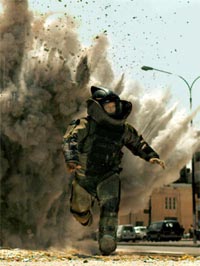
    Jeremy Renner in The Hurt LockerWhen it comes to extravagant Hollywood blockbusters, we’ve become accustomed to the phrase “the money is up on the screen” – delighting in the filmmakers’ own delight in the tools and tricks at their disposal.

    “The Hurt Locker,” however, invites a very different kind of wonder. An independent with a budget of a mere $11 million, it is nonetheless more kinetic action film than many a title coming in at 10 times the price, immersing the audience in the sights, sounds and sensations of Iraq combat. The money is on the screen, sure, but the screen belies the money.

    For this, the already multi-laurelled Kathryn Bigelow shares the credit with a highly resourceful and imaginative team of craftsmen, variously bringing mainstream studio-picture experience and indie-sector knowhow (or both) to the table.

    I talked to cinematographer Barry Ackroyd, editors Chris Innis and Bob Murawski, sound designer Paul Ottosson and special effects supervisor Richard Stutsman about their contributions to this humble spectacular.

    (more…)

  • TECH SUPPORT INTERVIEW: The crafts of ‘The Imaginarium of Doctor Parnassus’

    Jude Law in The Imaginarium of Doctor ParnassusTerry Gilliam’s “The Imaginarium of Doctor Parnassus” is the latest entry in the director’s long history of wondrous, fantastical worlds. The film might be best remembered as containing Heath Ledger’s final performance. But Gilliam’s rich imagination is also seen in the work of below-the-line craftspeople who brought his world alive with splendid visuals and a rich color palette.

    Cinematographer Nicola Pecorini, production designer Anastasia Masaro, original designer David Warren, costume designer Monique Prud’Homme and composers Jeff and Mychael Danna all had pivotal roles in bringing the work to life on screen. I recently spoke to each them about their contributions to the film.

    Without any doubt, the experience of working with Gilliam had an immense impact on the crew. Jeff Danna describes the helmer as “a dream come true for a composer – he understands, reads and plays music, which very few directors do, but he doesn’t try to take over our job.” Danna says Gilliam is clear about want he wants and will “make noises…all sorts of crazy stuff to describe what he’s looking for musically.”

    Masaro agrees that Gilliam will stop at nothing to get at his vision. “He likes to work in chaos,” she says.  “You can see his ideas from film to film to film and what you have to do is carry your aesthetic but work within his framework.”

    Warren describes Gilliam as being very appreciate of the crafts crew on his films.  “He knows what film will look like in his head,” Warren says.  “He’s obviously very visual. He follows certain details into obscene proportions, such as ‘What’s that spoon going to be made out of?’”

    (more…)

  • TECH SUPPORT INTERVIEW: The crafts of ‘Up in the Air’

    Up in the AirBecause some of director Jason Reitman’s work tends to be stylistically traditional and classic, he says there might be the assumption that he’s not a visual filmmaker. But seven years as a commercial director tends to make you as visual as the next guy. And make no mistake.  He is absolutely specific when it comes to below-the-line elements on his features, and “Up in the Air” was no exception.

    Early on the director established a department-wide below-the-line arc on the film that everyone on the crew worked toward. The idea was that at the beginning of the film, the audience is meant to see the world through the main character, Ryan Bingham’s eyes and by the end of the movie, they would see what the world looks like for real.

    For instance, “at the beginning of the movie, camerawork is wide angle, lots of moving shots,” Reitman says. “Color-wise, everything is muted tones. Production design-wise, everything is giant open atriums, walls of glass, everything is gleaming and spotless. Extras-wise, people are attractive, trim, their clothes are tailored, they’re told to walk in straight lines and not bump into each other. There’s a functionality to everything.”

    By the end of the film, things are being shot with longer lenses, hand-held, with warmer tones.  The costumes are sloppier, extras are sloppier, production design is more lived-in. Even the idea of the film’s general setting — airport terminals — reflects this in some way.

    (more…)

  • TECH SUPPORT: Best Original Song

    Jeff Bridges in Crazy HeartOver the last five months, Gerard has diligently canvassed and re-canvassed the various crafts categories here at In Contention.  The one category we have held back on all this time, as contenders have slowly fallen into place, was Best Original Song.  Today, it’s time to dig into the field.

    This has turned into something of a banner year for original songs in feature films.  We’ve had the great pleasure of bringing a number of hopefuls to you via our “listen to” posts, and look forward to continuing that into the new year.  But inevitably, frontrunners are bound to show up, and I think we can successfully narrow the field now.

    Before diving in, it’s worth reiterating the voting process in this category.  I’ll simply let the Academy’s rule book speak for itself:

    “An original song consists of words and music, both of which are original and written specifically for the motion picture. There must be a clearly audible, intelligible, substantive rendition (not necessarily visually presented) of both lyric and melody, used in the body of the motion picture or as the first music cue in the end credits.

    (more…)

  • TECH SUPPORT INTERVIEW: The music of ‘Crazy Heart’

    T Bone BurnettThis marks the first of this year’s Tech Support interviews series with below-the-line crafts personnel, an annual feature at In Contention.

    When Scott Cooper’s adapted screenplay “Crazy Heart” was making the rounds a few years ago, it had the kind of soul a guy like T Bone Burnett wants out of a country-western film. But as far as musical accompaniment was concerned, it was a blank canvas.

    A close friend of actor Jeff Bridges dating back to their time together on Michael Cimino’s “Heaven’s Gate,” Burnett was the selling point when the actor began toying around with the idea of playing Bad Blake in the film. With Burnett came longtime friend and musician Stephen Bruton. With Bridges came his own longtime friend, John Goodwin. With a modest writers’ table assembled (including, of course, Cooper himself), the task then became searching for a voice with an array of original songs for the film.

    “There’s a Nashville voice that comes really from Lefty Frizelle,” Burnett says. “And then Merle Haggard was the next, and there’ve been hundreds of people who’ve learned to sing from Merle Haggard and Lefty. Most of the country singers are essentially in that tambour. Jeff is a whole different thing. So we began looking for prototypes, so to speak, and the first prototype to me was Leonard Cohen, who’s a great writer and sang with a deep chest voice like Jeff did. Don Williams as well, who was a big country star in the 70s, big and good, too, and very much an individual. So we started looking for those kinds of voices that could be country music.”

    (more…)

  • TECH SUPPORT: Best Makeup — Volume II

    Lorna Raver in Drag Me to HellWithout any doubt, one of the most difficult Oscar categories to predict is Best Makeup. Like Best Visual Effects, the final three nominees are chosen from a previously announced shortlist of seven.

    Very frequently, films that would seem to be sure things fail to even make the bake-off. Even so, it is possible to gauge the general sort of films which are nominated, with considerable prosthetics and aging effects being among the most cited accomplishments in this category.

    This branch is one that regularly seems willing nominate dreadful films, or to eschew insularity (which is not to say they don’t have their favorites, such as Greg Cannom and Rick Baker).

    I think many of the films I spoke of in September remain firmly in the running, And perhaps leading the way is Neil Blomkamp’s “District 9.” While much of the work in this was CGI, the makeup was key, not only to the main character’s transformation but also to capturing the injuries of the characters in the slums of Johannesburg. The crew has not been nominated before, but I don’t think that will be a problem.

    (more…)