In Contention

Author: John Foote

  • Which films will be remembered in 50 years?

    Daniel Day-Lewis in There Will Be BloodIt is nothing new for a film to be released, find no audience, no critical favor, and disappear to be discovered by a new generation and raised to the level of masterpiece. In fact, this has been going on since the silents.

    Charlie Chaplin’s masterpiece “City Lights” was released four years after the advent of sound, and though popular at the time with both audiences and critics, it was some years later that it was finally hailed as Chaplin’s finest work. “The Wizard of Oz,” one of the most beloved films of all time that celebrates a 70th anniversary this month, was a dismal box office flop when released in 1939.  It wasn’t terribly popular with the critics either, but years later it was finally championed as a work of art and, of course, now the film is considered one of the greatest films of all time and perhaps a more worthy Best Picture choice than the eventual winner that year, “Gone with the Wind.”

    The “Citizen Kane” tale is so well documented I need not continue, and John Ford’s magnificent “The Searchers,” written off as just another John Wayne western, was discovered by film school professors who taught its brilliance to such young minds as Martin Scorsese, John Milius and Francis Coppola. Even Stanley Kubrick’s “2001: A Space Odyssey” failed out of the gate with both audiences and critics, but within a year of its release, many of those same critics had changed their minds about the film.  Within 10 years it was being declared as important a film as “Citizen Kane.”

    When “Gandhi” won eight Academy Awards in 1982, no one was terribly surprised. Yet within a year there were rumblings within the Academy that a mistake had been made and the rightful winner should have been “E.T. : The Extra-Terrestrial,” now recognized as a sublime work of art. And that same year, “Blade Runner” began its life as a major flop, only to re-discovered on home video over the years and become a cult classic.

    Looking back over the last decade or so, which films released since will be recognized 50 years from now? Which films that were passed over by audiences, critics and/or the Oscars will be hailed as masterpieces in the years to come?  I took a stab as choosing a group of films I believe could fall under this label.
    (more…)

  • ‘The Road’ and others set for TIFF

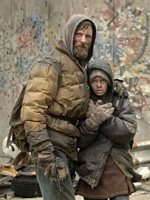
    (from left) Viggo Mortensen and Kodi Smit-McPhee in The RoadRight now, all is right with the world.

    The Toronto International Film Festival has confirmed that John Hillcoat’s “The Road,” the film I am looking forward to most this year, is going to be here in the Special Presentation Program.

    Yes!! I have been waiting for this film since reading that amazing book in three days a year ago.

    Along with the Viggo Mortenson, Charlize Theron and Robert Duvall starrer will be new films featuring Natalie Portman, George Clooney, Annette Bening, Naomi Watts, Demi Moore, David Duchovny, Colin Firth, Omar Sharif, Jeff Bridges and countless others, making for another star-studded Toronto line-up.

    Among the films announced today in addition to The Road are, “Mother and Child” from director Rodrigo Garcia, a study of three women and the unbreakable bonds between mothers and daughters. Annette Bening, Naomi Watts and Kerry Washington star in the film.

    (more…)

  • Remembering ‘Raging Bull’

    Robert De Niro in Raging BullThe first time I saw “Raging Bull” was in 1980, the second day the film was in theater after release. I was an acting student at the time, heading to the theater with my friend Kevin McDonald, who went on to fame as one of the “Kids in the Hall” stars and film roles in “Galaxy Quest,” denim guy on “Seinfeld” and loads of voice work.

    Like me, Kevin was a film junkie, and we both had been looking forward to the new Scorsese film. Our paths went very different ways, but I know for a fact he recalls this evening with much fondness as what we saw changed our lives forever.  Two and a half hours later we left the theater exhausted, drained and stunned by the event.  We talked incessantly about the film on the subway as we headed back home and convinced our classmates to see it with us the next night, if I recall correctly.

    There was little doubt Robert De Niro would win not only the Academy Award for Best Actor but every other acting award n the planet as well, but I remember being shocked when Scorsese himself did not follow suit. When the Oscar nominations were announced, Scorsese and his film were up for eight, but the writing was on the wall: Robert Redford‘s “Ordinary People” was going to win the lion’s share, no doubt about it.

    (more…)

  • Herzog, Moore, Coens plan a stop at TIFF

    Capitalism: A Love StorySome exciting announcements out of Toronto today (still no “Road”).  The festival is shaping up to be very, very cool this year.
    The film I am most excited about, announced today, is Werner Herzog’s remake “Bad Lieutenant: Port of Call New Orleans” with Nicolas Cage in the role that Harvey Keitel made legendary. No in between with this one; they either nailed it or blew it.

    Drew Barrymore will bring her directorial debut here, the roller derby flick “Whip It,” with Ellen Page.  That brings back memories of Saturday afternoons with my grandparents watching roller derby. Barrymore made a startling impact in “Grey Gardens” on HBO earlier this year and hopes are high for this one.

    The Coen brothers are back with “A Serious Man,” as is Michael Moore with “Capitalism: A Love Story,” his latest documentary that will take viewers into the financial brain centers of America.

    (more…)

  • ‘American Graffiti’ — why it still resonates, 36 years later

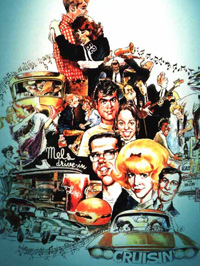
    American GraffitiGeorge Lucas grew up in a small town, Modesto, California, where on Friday nights the guys hopped in their freshly washed and waxed cars and cruised the streets, rock and roll blaring out of the rolled down windows. Everyone knew each other so the streets were alive as though one big party were happening.
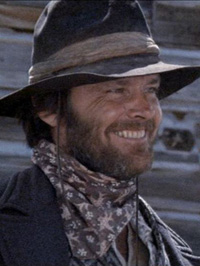
    Lucas, with William Huyck and Gloria Katz, would later write the screenplay for “American Graffitti,” a remarkable little film set in 1962 and a small town in California on the last night of summer before school begins. Loosely based on experiences Lucas had as a teenager, the film would become a touchstone for a generation, having an impact on pop culture no one expected. For the generations after the 1970s that have seen the film, it has the same curious effect, and without sounding self-important or condescending, that impact will grow as they, and we, continue to age.

    Why?  We knew people like this.  We were people like this.

    The film is familiar for almost anyone who ever went to high school, perhaps more so to small town natives. We all knew the town tough guy who hung around with the high school kids long after he had left school because he needs the adoration they give him. There was the class geek: glasses-wearing, short, trying a little too hard to please, but likable just the same.

    The class jock, who would also be the class president dating the head of the cheerleader sqaud, and the intellectual, who could not wait to get out of the town and see what the world held for him. All of us, sometime in our lives at school, knew people like this, perhaps even were people like this.

    (more…)

  • 1976: the last hurrah of the American western

    Jack Nicholson in The Missouri BreaksThe western was not yet dead in 1976 when  four high-profile installments were released to varying degrees of success. Four years later, of course, Michael Cimino’s “Heaven’s Gate” would kill the genre for several years (and United Artists for longer), and though it has seen ups and downs in the years since, for the most part, the western remains one of the least popular genres with studios.

    In my opinion, Cimino’s film was never as bad as the critics said it was at the time.  Many of them were lying in wait for a Cimino failure, hoping to ambush him for the lies told during the press interviews for ‘The Deer Hunter,” which won the man an Oscar and was the Academy’s choice for Best Picture. He was not a Vietnam veteran, he had never seen Russian Roulette used as torture, in fact he had never been out of America until he made the “The Deer Hunter.”  This all but ruined Cimino’s reputation, which is somewhat sad because the man had a hell of an eye for detail.

    That of course was the issue with “Heaven’s Gate”; though stunning in its detail, the film is insufferably slow and ponderous, with perhaps two truly stunning sequences, the best among them the community roller skating sequence, which pulsates with energy driven by a young man, the film’s composer David Mansfield and his fiddle, as they skate around the rink, veering in and out of surrounding bodies.

    There was a time in the 1950s and 1960s when 20% of the films coming out of Hollywood were westerns. There were 26 prime time western programs on television, all popular, and John Wayne ruled as the top box office star. By the 1970s, westerns were made less frequently, and Wayne’s box office throne had been usurped by another star of the genre: Clint Eastwood.

    (more…)

  • ‘Bright Star,’ ‘Precious,’ ‘Informant’ and 19 more to play TIFF

    Matt Damon in The Informant!The Co-Directors of the Toronto International Film Festival took to the stage this morning at the first of three summer press conferences to begin announcing the slate of films that will comprise this, the 34th annual Toronto International Film Festival.

    This morning’s announcement of 22 titles brought some pleasant surprises, as well as some expected announcements.

    The Opening Night Gala will be Jon Amiel’s “Creation” featuring Paul Bettany as Charles Darwin and Jennifer Connelly as his wife.

    There were several Gala Presentations announced, among them “Get Low,” a film featuring the great Robert Duvall as Felix Breazeale, a backwoods eccentric who exiles himself from society for more than 40 years. Bill Murray and Sissy Spacek co-star with Oscar winner Duvall.

    As expected, Lee Daniels’s festival circuit hit “Precious” will land in Toronto, already an Oscar contender, as well as “The Invention of Lying,” directed by Ricky Gervais and Matthew Robinson.

    (more…)

  • Five years on, Gibson’s ‘Christ’ still moving, misunderstood

    Jim Caviezel in The Passion of the ChristFive years have passed since the release of Mel Gibson’s extraordinary film “The Passion of the Christ,” a self-financed work that would eventually stun the industry, bringing in more than $600 million worldwide. There were gales of protest about the film, religious leaders spoke out, some for it , some actually against it, and audiences members wept, or walked out, depending on the person.  I can’t remember a film causing this sort of reaction from so many people. Gibson divided audience right down the middle.

    The actor/director chose not to make a film about Jesus’s life but rather his death, exploring in great detail the horrors inflicted on the poor man as he walked toward a hill where he would be nailed to a cross and left to die a most horrible death. The chain of events is called “the stations of the cross” in religious teaching, but Gibson laid it out in near matter-of-fact fashion.  His faith was apparent but it wasn’t a propagandist’s work in the slightest.

    In essence, Gibson made a film about a man who was driven.  He could have stopped but he pushed through this awful denouement to his life. I suppose that, more than anything else, moved me. The fact that no matter what happened to his body, whether it be scourging his flesh or beating him about the head and face, he just kept going, knowing his purpose, knowing his destiny.  In that way, the film could be seen less as a portrait of a religious figure than a tale about everyday passion, the will to continue, eyes on the prize, etc.  Who can’t relate to that in some way, however comparably small?

    (more…)

  • My stance on foreign cinema

    Beauty and the BeastOn Independence Day, no less…

    There seems to a huge misconception on the site that I dislike foreign language films and know little about them. While it is no secret I love American cinema and praise it frequently, I do indeed believe great films are made around the globe, and try to see every one I can at the festivals I attend and the screenings I attend on a weekly basis. My love for foreign language cinema, admittedly, is not as deep as the one I have for American cinema (and remember, I am Canadian), but when I see a great one (which is often) I do indeed champion it.

    Foreign language films can be extraordinary experiences, though the acting styles differ, the cultures are often radically different, yet the storytelling techniques, for the most part, are the same, which is what makes cinema a universal language.

    If I recall, the first foreign language film I saw was “Beauty and the Beast,” which was a stunning work of art from French director Jean Cocteau that I saw as a child on a French TV station here in Canada. It was wildly imaginative, fantastical and stunning, a black and white beauty. I watched as many films on that station as I could, including “Breathless,” which I knew as a teenager was bold and brilliant, and “Jules and Jim” from Truffaut.

    (more…)

  • Looking back at potential tens

    The Little MermaidOkay, the decision has been made and there is not a thing I can do about it, and let’s face it, even I am going to get bored bitching about it. So I went back 20 years to find films that might have been among the 10 nominees had they been doing this in 1988. It was an interesting experiment that perhaps makes it clear why the Academy had made the move.

    Attention is drawn to films that might otherwise might not have been seen or heard of by the average Joe on the street, and allows for box office hits to find Oscar attention with a Best Picture nomination. Sure, there would be years that the pickings might be slim, but that is the price of doing something like this, and at that point, is it not smart to look at the foreign language films or — to be a bit self-serving — Canadian work?

    Or would sequels such as the superb “The Empire Strikes Back” be nominated along with other good-to-excellent films? It would have been interesting. I did not go for five films each year, but mentioned those I think would have been cinches had there been 10 nominees.

    Here we go…

    (more…)

  • 10 friggin’ nominees — a rant

    OscarsSo the Academy, in one of the dumbest moves since awarding Roberto Begnini an Oscar for his incessant mugging in “Life is Beautiful,” is reaching back into its history to allow for 10 films in the Best Picture category.  I just cannot understand why they would make such a blatantly stupid decision after so many years of five nominees!  My God, if they wanted to shake things up, divide the nominees into drama and comedy/musical like the Globes, which is equally stupid, but makes more sense (somehow). Are they concerned they are that out of touch and need more nominees to cover their ass?

    Would it not make sense to bring in a new group of Academy members, perhaps the critics (some of them) or directors and producers? Maybe the active artists, actors, directors, writers, and on and on should vote. In much the same way they nominate, directors for directors, editors for editors, maybe that is also the way they should vote for the winner?  Anything but this.

    So the Best Picture race becomes moot.  All eyes on Best Director now.  That category will become the indicator of the “real” five nominees for Best Pic.  But do they actually think this will open things up for brilliant work like “Into the Wild” and “The Dark Knight” when the sensible thing to do is get rid of the “old” way of thinking and allow for new blood in the Academy itself?

    Ten?  They can’t even get five right!

    (more…)

  • Toronto announces 26 titles for this year’s fest

    TorontoToronto International Film Festival programmers announced today that they are bringing home the circuit with a group of titles scheduled for the fest that have played previously at other festivals, including Cannes, Berlin and beyond. They will all be North American premieres, spread across several of the festival’s programs.
    In the Masters Program we will have “The Eccentricities of a Blond Haired Girl” from director Manoel de Oliveira, celebrating his 101st birthday this year, and still at work. From Alain Resnais we have “Les Herbes Folles,” a romantic adventure built around the loss of a wallet, and Hirokazu Kore-eda brings us his Japanese film, “Air Doll,” in which a blow-up comes to life and tries to find her way in the real world, leaving behind her role as a sex toy.

    The Discovery Program will give us “Gigante,” a love story from director Adrian Biniez, “The Happiest Girl in the World,” a comedy from Radu Jude, and the love story, “Kelin” from Kazakhstan. Australian director Warwick Thomas gives us “Samson and Delilah,” the tale of a young couple treated as outsiders as they live in an aboriginal community.

    (more…)

  • TIFF 2009 looms ahead

    2009 Toronto International Film FestivalWith Guy off to Scotland for the Edinburgh Film Festival, I’ve just received my invitation to attend the Toronto Fest once again as returning press. This marks the, um, 16th festival for me (I think)?

    I love TIFF.  I think it’s the single most important cultural event in Canada, and the fall’s most important film festival. Obviously I am biased, but having attended others, I think things are done very well here.

    The first press conference is slated for July 14, later than normal, but I trust that festival CEO Piers Handling knows what he’s doing.  After all, he’s the guy who took the upstart Festival of Festivals into international fame as The Toronto International Film Festival.  I am working on a feature article about the history of the fest and its evolution from a small event struggling to get films to the place to be leading in to the awards season.

    So many Oscar winners and nominees have come from Toronto, but what I like are the little discoveries that have been made, films that otherwise may not have been seen.  As I’ve mentioned before, I clearly remember the bidding war for Robert Duvall’s “The Apostle” when, during the screening of the film, two men got up and ran out of theater dialing their cell phones as they shot up the aisle. One was from Miramax, the other October. And of course October got the film and the rest is history.

    Looking at the films that might come this year I have high hopes that “Where the Wild Things Are” will be in the mix, along with “Shutter Island.”  But who knows?

    (more…)

  • The Duke’s greatest hits

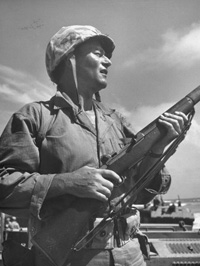
    John Wayne in Sands of Iwo JimaAs Kris mentioned Wednesday, this week marks the 30th anniversary of John Wayne’s death.  I’ve always respected Wayne’s performances and have for a long time, long before it was fashionable, to be sure.

    It was considered somewhat ridiculous for an acting student to admire Wayne’s work in the 1970s and 1980s. My God, we were supposed to be worshipping at the altar of Marlon Brando, Robert De Niro and Al Pacino! Our professors hammered home the importance of truth in a performance, which I of course believe to be essential.  But I’ve always felt that Wayne’s finest performances were as truthful and as real as anything Brando did.

    Wayne could not do Shakespeare, and was horribly out of place in certain genres, but in his element — the American western, the war film, high adventure or romantic comedy — he was as good as anyone working in movies. There were some critics who appreciated his work while he was alive, but most came around after his death in 1979, which to me is rather sad.

    I have proposed a book on Wayne, slightly different from those out there already, that would focus on his best work on film. There are 11 performances in the Wayne filmography that were truly outstanding, in my opinion.  Here is perhaps a primer for Wayne fans, new, old and emerging — a list of his best performances and some comments as to why I think they deserve to be remembered forever. Let me know what you think.

    (more…)

  • Elia Kazan sparks renewed interest

    Elia KazanSo many of today’s youth have not seen films made before the year they were born and they are missing so much. I remember being 18 and spending some time with my girlfriend at the time at her job, which allowed for me to get a lot of reading done. One of her co-workers expressed some surprise that I was reading Charlie Chaplin’s autobiography.  “Do you have to know everything about movies John?” Without hesitation I answered, “yes,” and still feel that way.  The great directors of cinema past and present knew as much as they could ABOUT cinema past and present.  Aspiring filmmakers should certainly take their cue.
    Once, while showing “Psycho” in my film history class, a student suddenly shouted, “Marcellus Wallace and Butch…man Tarantino lifted this,” and he was right. There is a scene in the film where Marion Crane encounters her boss crossing a street in much the same manner Butch encounters Marcellus in “Pulp Fiction.”  It’s small but I’m so happy someone in that class picked it up.  You have to know where you’ve been to understand where you are and, certainly, where you’re going.

    There is a retro-interest in Elia Kazan, the great director of the 1950s, that I find quite thrilling.  Known as a bi-coastal director, Kazan enjoyed great success in film as well as stage, helming some of the first productions of the greatest plays of the 20th century, including “All My Sons,” “Death of a Salesman,” “A Streetcar Named Desire” and “Cat on a Hot Tin Roof.”  He would direct the film version of “A Streetcar Named Desire” in 1951 to great acclaim.

    No other director before Kazan so understood the art of acting and was able to work with actors in the manner he did. He was among the first directors to make the actor part of the creative team, listening to his or her ideas and admitting when he had actually been wrong. It was unheard of for directors such as John Ford, William Wyler, Chaplin or Orson Welles to admit being wrong — they never were in their minds — but Kazan had no fear, believing the creative process allowed for error.

    Having been trained as an actor befor he became a documentary filmmaker, Kazan understood the actor’s process, but as a director he wanted to be more than just the sort of director who blocked talent; he wanted to work with actors to create something as realistic as possible. Though he started his career as a director with Method Acting guru Lee Strasberg, the two parted ways when Kazan began evolving the style. Kazan went off to direct with his new ideas about the Method and found great success, winning two Academy Awards, Tony Awards and in 1999, under the cloud of controversey, an Academy Award for Lifetime Achievement.

    (more…)

  • ‘Apocalypse Now’ — 30 years later

    Apocalypse NowIt was 30 years ago this summer I stumbled out of the old University Theater on Bloor Street in Toronto in shock, too dazed to speak, to stunned to make human contact. Finding a bench on the street I sat down and tried to collect my thoughts.

    I was 20 years old, an acting student minoring in cinema, quite happy with my life though wondering if acting was for me. Going to movies alone was something I enjoyed, even though my girlfriend at the time did not care for this habit. My feelings were it allowed me to see the films she did not care to see, right? Though I was learning the method, it seemed movies were my first love, and not to perform in them. “Apocalypse Now” defined for me what I wanted to do with cinema and my life.

    In this case I had just seen the first public Toronto screening of Francis Ford Coppola’s long awaited film, and emerging from the theater into the summer sun I knew I had been altered in some way, that this film had galvanized me and changed my life. At the time I had no idea that the film had made this impact, of course, but I knew deep in my gut that something extraordinary had just happened.

    As a film junkie I was aware of the history of the film, and because it was Francis Ford Coppola, who had directed “The Godfather,” “The Conversation” and my favorite of all time, “The Godfather Part II,” I was more than a little anxious to see the film. Coppola could do no wrong in the 1970s, having won Academy Awards for writing “Patton” and co-writing ‘The Godfather.”  He received a Best Picture Oscar nomination for the latter and won the DGA award.  For the film’s 1974 sequel, he won his Oscar for directing.

    That same year his film “The Conversation” was also a Best Picture nominee, a remarkable achievement for the young director. He then made the decision to head into the jungles of the Philippines to bring “Apocalypse Now,” a loose adaptation of Joseph Conrad’s “Heart of Darkness,” to the screen, hoping to entice Steve McQueen, Robert Redford, Al Pacino or Jack Nicholson to take roles in the film. All declined. He eventually cast Marlon Brando as the certifiable Col. Kurtz and Harvey Keitel as Willard (who was fired a few days into shooting in favor of Martin Sheen).

    (more…)

  • New to DVD, ‘Revolutionary Road’ may yet be discovered for the masterpiece it is

    (from left) Kate Winslet and Leonardo DiCaprio in Revolutionary RoadWhen “The Wizard of Oz” was released in 1939, neither audiences or critics were particularly fond of the film and it died a rather quick death at the box office. When “Citizen Kane” was first released in theatres in 1941, audiences did not warm to it, and despite winning the New York Film Critics Circle award for best film, and nine Academy Award nominations, it too died a fast death.

    In 1956, John Ford’s magnificent western “The Searchers” was not nominated for a single Academy Award, and though well liked at the time, no one seemed to think it was the work of art it is considered to be today. Even Martin Scorsese’s “Raging Bull” did not find an audience when first released, and though the film had many strong reviews, no one thought iof it on the level they do today.

    It happens all the time.  Great films get ignored by both audiences and film critics. And though it would be an obvious stretch to consider Sam Mendes’s “Revolutionary Road” in the above company, it is nevertheless a perfect recent example.

    True enough, some critics (myself included) admired “Revolutionary Road” when it was released, but there were simply not enough of us to get the word out. Not even the casting of Leonardo DiCaprio and Kate Winlet could help the film pull in audiences. Incredibly, the Hollywood Foriegn Press Association (their choices sometimes dubious at best) nominated the film for several awards and Kate Winslet rightfully won Best Actress in a Drama for her performance in the film. A couple of weeks later, collective jaws hit the floor when she was nominated for a leading actress Oscar, but for “The Reader,” a lesser performance and film.

    Earlier this week I received my DVD of the film, which hits shelves on June 2, and so I sat down at once to watch it again.  I made my way through the features, wanting to learn more and more about this astonishing film.  And it is my sincere hope that “Revolutionary Road” will some day come to be recognized for the sublime work of art it truly is.

    (more…)

  • Those underrated gems of the 1990s

    Miller's CrossingSo here we go again.  The 1990s were an odd decade cinematically, ripe with excellent films, ground-breaking work, innovations as well as a large number of duds. There were also films released to rave reviews that never found an audience.

    I combed through the decade and came up with 15 films worthy of discussion as the more under-appreciated of the 1990s, though I am positive you will all add immeasurably to the list, as you did with my take on the 1980s.

    The independent movement gave us many great films through this span, as well as some formidable new talent, but I must confess I grew tired of the studio slagging through the decade.  Among the critical community it became almost a rite of passage. There was some wonderful studio product here and there, of course: “Goodfellas,” “JFK,” “Unforgiven,” “Schindler’s List,” “Apollo 13,” “Saving Private Ryan” and “LA Confidential” are just a few.

    My list, in no particular order…

    In “Miller’s Crossing,” the Coen brothers do a masterful job of creating a funny and dark gangster film with superb performances from the great Albert Finney, Marcia Gay Harden, and the sleazy John Turturro in a film that gently pulls the audience into its story. Made on the cheap, the art direction and costume designs are great, and that story…man those Coens get so much out of, “What’s the rumpus?”

    (more…)