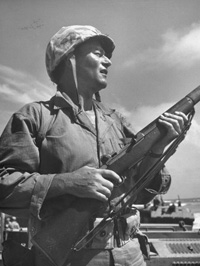
 As Kris mentioned Wednesday, this week marks the 30th anniversary of John Wayne’s death. I’ve always respected Wayne’s performances and have for a long time, long before it was fashionable, to be sure.
It was considered somewhat ridiculous for an acting student to admire Wayne’s work in the 1970s and 1980s. My God, we were supposed to be worshipping at the altar of Marlon Brando, Robert De Niro and Al Pacino! Our professors hammered home the importance of truth in a performance, which I of course believe to be essential. But I’ve always felt that Wayne’s finest performances were as truthful and as real as anything Brando did.
Wayne could not do Shakespeare, and was horribly out of place in certain genres, but in his element — the American western, the war film, high adventure or romantic comedy — he was as good as anyone working in movies. There were some critics who appreciated his work while he was alive, but most came around after his death in 1979, which to me is rather sad.
I have proposed a book on Wayne, slightly different from those out there already, that would focus on his best work on film. There are 11 performances in the Wayne filmography that were truly outstanding, in my opinion. Here is perhaps a primer for Wayne fans, new, old and emerging — a list of his best performances and some comments as to why I think they deserve to be remembered forever. Let me know what you think.
“Stagecoach” (1939)
This was the film that made Wayne a star and he is terrific as The Ringo Kid, the hero of the piece with an unmistakable entrance. John Ford took his actors on location to Monument Valley for this excellent black and white western that elevated the genre from it’s B-level typicalities. The film was nominated for Best Picture. Wayne is excellent as the Kid, typically heroic, and in fact, somewhat raw in his performance as he had begun to discover his gifts as an actor. His next great role did not come for nine years, but his work in this film saw to it that he worked steadily and grew as an artist.
“Red River” (1948)
Kris mentions this is his favorite Wayne performance and it is easy to see why. After seeing the film, his longtime Wayne friend and mentor, John Ford, was rumored to have said, “I didn’t know the big son of a bitch could act.” Wayne is extraordinary in the film as Thomas Dunson, the leader of a cattle drive who has his herd taken away from him by his adopted son (sort of) Matt Garth (Montgomery Clift), giving the film a “Mutiny on the Bounty” feel. Enraged, Dunson storms across the praires to find the herd and his son, in order to kill the younger man. As a much older character, Wayne sinks deep into the role and portrays not a cruel man, but certainly a man with brutality inside him. The film is nicely directed by Howard Hawks, but the ending does not quite work. Regardless, Wayne is remarkable and Oscar should have been paying attention.
“She Wore a Yellow Ribbon” (1949)
One year later Wayne gave another superb performance as an older man, this time as Nathan Brittles, a retiring Calvary man called back into duty one last time. With grey streaks in his hair, Wayne looks the part of a rugged, heroic cowboy, though he is also a man deeply in love and we get to see the tender side of the actor. Shot in color (Winton Hoch won the Oscar for cinematography), this was one of the best films Wayne and Ford made together. Again, Oscar missed the boat, though in fairness there was a very good reason, which brings me to…
“Sands of Iwo Jima” (1949)
John Wayne received his first Best Actor Oscar nomination for this Allan Dwan war picture. As tough-as-nails Sgt. Stryker, Wayne is given the task of whipping a group of young men into shape for combat, and then leads he them into it. Tough with a heart, and a deep fatherly sense, Stryker is protective of his men and understands their fears. His final moment on the screen is alarming and real. The film and performance are dated today, but it’s still fine work from the Duke.
“The Quiet Man” (1952)
No love story exists without heat from the actors in the film, and John Wayne and Maureen O’Hara have it from the moment they first lay eyes on one another. In the film, Wayne is an Amercian boxer, Sean Thornton, who killed a man in the ring and is seeking to live out his life in peace in his ancestors’ home, Ireland. There he runs afoul of O’Hara’s brother, a bully who controls her dowery, causing all hell to break loose and climaxing in a good old fashioned donnybrook. Wayne is wonderful; warm, sincere, stubborn, tough and head-over-heels for the girl of his dreams. If there are still any knuckleheads out there who doubt his acting abilities, watch him in this non-western, non-war romantic comedy. He is the film’s anchor and greatest strength. That moment when they kiss in the shack he calls home after she has cleaned it? Incredible. One of John Ford’s greatest films.
“The Searchers” (1956)
The greatest western ever made and Wayne’s greatest performance. As raging Ethan Edwrads, a man consumed with hate and rascism, the actor gives a towering performance that should have won him an Academy Award. After the massacre of his brother’s family, the two girls taken to be raised as Indians, Edwards embarks on a search that will take him years. He finds the teenaged girl raped and murdered in a canyon, which only fuels his anger and obsession. Never was Wayne so dark, so unforgiving, so full of rage. When he finds his niece, he lifts her high over his head as he did when she was a child, and then sweeps her into his massive arms: “Let’s go home Debbie.” The last thing he expected to find on this search was his humanity, yet even having that he cannot enter the home at the end, forced like the natives he hates so much to wander between the winds. My God I love this movie.
“Rio Bravo” (1959)
Howard Hawks directed what many people consider the perfect studio western with The Duke in the classic John Wayne role. Strong, willful, loved by all who know him, he is the sheriff of the town, holding a man in his jail, knowing that his partners are coming to bust him out. As his deputies: a drunk, nicely played by Dean Martin; a kid, Ricky Nelson; and an old codger portrayed by three-time Oscar winner Walter Brennan. Though I could live without the singing from Martin and Nelson, the film is a solid paint-by-numbers western (the first) that has been imitated many times since.
“The Man Who Shot Liberty Valance” (1962)
This film was more of an ensemble than any film Wayne had done since “Stagecoach” and he fit right in as Tom Doniphon, the friend of a gawky lawyer portrayed with charm and strength by James Stewart. The town bully, brilliantly portrayed by Lee Marvin, torments the lawyer unmercilessly, forcing a showdown in which Stewart appears to kill him. He becomes the stuff of legend, but there is more to the story, as the film’s famous line of dialogue later conveys: “When the legend becomes fact, print the legend.” An effective work, it was the last great film directed by John Ford.
“Hatari” (1962)
Taking place on the vast African landscape, this film stars Wayne as the boss of a group of hunters who capture wild animals for zoos around the globe. Looking as at home on the African plain as he did Monument Valley, Wayne is terrific, giving a strong performance outside his favorite genres. Nicely directed by Howard Hawks, the film has action sequences galore and some nice supporting performances, best of all from Red Buttons.
“True Grit” (1969)
As Rooster Cogburn, the fearless, one-eyed, drunken marshall, Wayne knew after reading the galleys to the as-of-then unpublished work that he had to play the part. Paramount had already bought the rights and director Henry Hathaway cast his old friend with hesitation. As the brave old marshall, Wayne was terrific, both spoofing his image and embracing a role that allowed him to play his age and not be the typical western hero. As I have stated before, the greatest moment for me of pure movie courage is The Duke in the meadow, outnumbered four to one by Lucky Ned Pepper and his gang, sizing up the sitaution, twirling his rifle and marching into battle. Moments later he will put the reins in his teeth, draw a weapon in each hand and charge. It’s one of the last great westerns and the one for which he won an Oscar.
“The Shootist” (1976)
Wayne was deeply hurt when he was not nominated for an Aacdemy Award for his superb (and final) performance here as J.B. Books, a famous gunman who comes to a small western town on the cusp of change as it moves into the 20th century to see an old friend, his doctor. He has cancer (as did Wayne), advanced, and has just a few weeks to live. Told his death will be agonizing, he makes other plans. Along the way he has a gentle romance with a widow (portrayed with melancholy by Lauren Bacall) who runs the rooming house in which he is staying, and he is worshipped by her son, nicely played by Ron Howard. The Duke is haunting in this film, terrified to die, yet not wanting to live dependent on anyone. As he tells the widow, “I’m a dying man, afraid of the dark.” Paramount dropped the ball on the release of this Don Seigel-directed work, one of the best films of 1976.
Wayne was one of a kind. We will never see his like again. Every now and then I pull a Wayne title off the DVD shelf and watch it, just to remember him, because I never want to forget. Neither should you.
Comments
10 responses to “The Duke’s greatest hits”
Great run-down, of course, but I remain stunned any time someone calls “True Grit” a good film or Wayne’s performance therein anything other than embarrassing.
My opinion, of course.
I’ve only seen Stagecoach and The Searchers, but he was fantastic in both. Besides, the intense method actors have a tendency to burn out. Wayne was a major star for almost 40 years and beloved by audiences. And today, The Searchers ranks as one of the greatest westerns and his character Ethan was an early example of the contradictory characters prevalent in New Hollywood. So yeah, give Wayne some critical love, he deserves it.
Hey Kris — love “True Grit”, always have, always will — I think Wayne saw the chance to spoof something of his image and the chance to play a tough old bastard hero — he had fun doing it — is it a masterpiece, nope, but dpgoddam I live it. As for the second cooment about the method — consider this — after Brando all actors, and I mean all of them put a greater emphasis on truth in their performance, even the Duke, whose best work came post-Brando — method or not, nothing else in acting matters but the truth and who cares how they get there?
I always considered Wayne a great movie star but not a great actor. And I think he would agree. Comparable to Arnold Schwarzenegger, who is always just delivering his lines to the best of his ability and when the surrounding script and director know how to utilize it, they can carry an entire movie.
Chad: Comparable to Arnold? You’ve lost it. Have you seen Wayne’s films? I mean, I don’t think he was the consummate performing artist John does, but he was certainly a better performer than Arnold, come on.
Have always thought “She Wore a Yellow Ribbon” Wayne’s best performance, but it’s been an awfully long time since I saw it. (Or many of these films, for that matter.)
I have to side with Kris on “True Grit” (sometimes giving a sympathy Oscar is more embarrassing than a lifelong snub), and must say I found “The Quiet Man” so twee as to be virtually unwatchable, but maybe I need to give it another go.
i like your lineup, especially Iwo Jima, Liberty Valance, Rio Bravo, and The Shootist. Probably 4 of my top 5. But number 1 for me has always been and always will be The Cowboys. Easy.
I guess I meant that his specific acting chops weren’t comparable to Arnold’s. More that his persona didn’t rely on acting chops to begin with.
I’m with Kris on Wayne’s performance in “True Grit.” Just consider the other nominees that year: Burton, Hoffman, O’Toole and Voight.
I still think his best performance was in 1953’s “Hondo,” opposite Geraldine Page.
Well, let’s not consider O’Toole in that particular year ;)