As buzz grows about “The Dark Knight” aiming to eclipse “Titanic”‘s box office record, I thought this an opportune moment to point out at least one corner of the world where that’s not going to happen. Us wily Brits, eh?
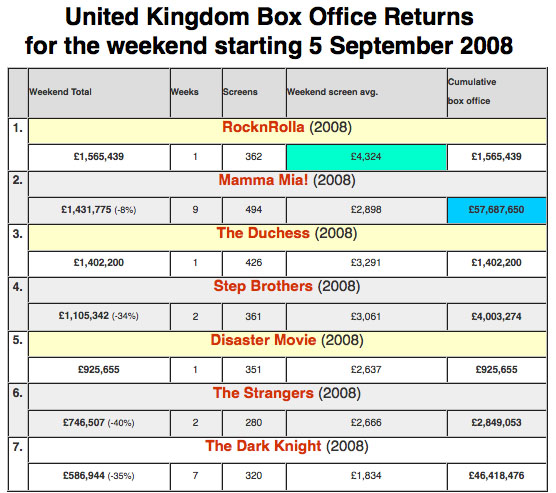
As buzz grows about “The Dark Knight” aiming to eclipse “Titanic”‘s box office record, I thought this an opportune moment to point out at least one corner of the world where that’s not going to happen. Us wily Brits, eh?
 Looking down the list of titles in the newly-revealed lineup for next month’s London Film Festival lineup, my initial reaction was one of mild disappointment. Plenty of exciting titles, for sure, but it doesn’t quite match last year’s feast that included everything from “The Diving Bell and the Butterfly” to “The Assassination of Jesse James” to “Juno” to “4 Months, 3 Weeks, 2 Days.”
My second thought, however, was that the lineup reflects more on what a tepid year for film 2008 is shaping up to be, rather than any lack of effort on festival director Sandra Hebron’s part. Tellingly, this morning Hebron herself cited critical opinion that, in the wake of a roundly derided Venice festival, “it wasn’t a vintage year for cinema.”
But enough of the hand-wringing. There’s still much to get excited about, including “Che,” the two parts of which, interestingly, will be screened both together and apart; Oliver Stone’s potentially polarising “W”; “Hunger,” featuring a potential dark horse for Best Actor; “Religulous”; “Rachel Getting Married,” “Nick and Nora’s Infinite Playlist,” “Gonzo: The Life and Work of Hunter S. Thompson” and, to my immense delight, “Synecdoche, New York.”
Not to mention that, as previously announced, the festival will be bookended by the world premiere of “Frost/Nixon” and Danny Boyle’s red-hot Toronto hit “Slumdog Millionaire.”
Scoff if you must. But from where I’m standing, the new “Quantum of Solace” trailer pretty much ticks all the boxes. Chases. Pretty girls. Explosions. Hot cars. Hot cars exploding. Daniel Craig squinting moodily. Mathieu Amalric hamming it up in a tux. What’s not to like? Count me in.
Or watch it here for a prettier picture.
 Anybody who’s kept even half an eye on film news recently knows by now that, compared to previous years, the consecutive Venice and Toronto festivals have done little to illuminate the Oscar race. (Unless, I suppose, you were one of those predicting major glory for “Miracle at St. Anna.”)
The Hollywood Reporter adds their verdict to the pile here, quoting an executive as declaring the fest “an Oscar-less Toronto.” There’s little new perspective in the article, but it’s a handy enough precis. They do think one race has benefited from the festival:
But the festival might have helped clarify at least one category: the best actress race. The beneficiaries have been Anne Hathaway in Jonathan Demme’s dysfunctional-family drama “Rachel Getting Married”; Sally Hawkins in “Happy-Go-Lucky,” the Mike Leigh film about a chipper young schoolteacher; and, if Searchlight chooses to make an awards push for her, “The Secret Life of Bees” star Dakota Fanning.
Hmmm. It’s not as if Hathaway and Hawkins weren’t deemed contenders before Toronto. (The Golden Globes may as well drop the other three slots for Best Actress in a Comedy/Musical, right?) And Dakota Fanning? With those reviews? Yeah, right.
In any case, as they acknowledge, Searchlight has other priorities now, having nabbed the two hottest Toronto titles:
The lone film that has emerged as a genuine standout is Darren Aronofsky’s “The Wrestler,” which went in as a question mark and will leave as a contender in pretty much every major awards category. To a lesser extent, Danny Boyle’s “Slumdog Millionaire” also is generating awards talk, though its cast is entirely unknown.
The full lineup for next month’s London Film Festival is to be revealed tomorrow — but in the meantime, the latest issue of Sight and Sound reveals a couple more exciting inclusions.
In addition to the already-announced opening and closing films (“Frost/Nixon” and “Slumdog Millionaire,” respectively), S&S confirms that the French Palme d’Or winner “The Class” will appear, with director Laurent Cantet in attendance.
The magazine also reveals that there will be twelve international premieres at the festival, including “Sugar,” the baseball-oriented film from “Half Nelson” creators Ryan Fleck and Anna Boden, which bowed to warm reviews at Sundance in January. (By “international,” they mean outside the US, obviously.)
More signs of a great festival to come. I await tomorrow’s announcement like a kid on Christmas Eve.
 As awards geeks, bitching about the Academy’s supposed mistakes is pretty much our favourite sport. The question of who should and shouldn’t have won provides endless material for discussion — frequently on these pages.
One of the titles that comes up often in the “shouldn’t have won” category is Richard Attenborough’s “Gandhi,” that well-mounted, well-acted and thoroughly indigestible biopic that managed to beat such more-beloved nominees as “Tootsie” and “E.T. The Extra-Terrestrial.” It was an unpopular choice even at the time. After the ceremony, NYT critic Vincent Canby famously wrote: “”E.T.” and “Tootsie” are films. “Gandhi” is a laboriously illustrated textbook.”
Interestingly, Lord Attenborough, of all people, agrees. In a recent interview with BBC Radio Five, he admits that “E.T.” was robbed, being “an infinitely more creative and fundamental piece of cinema” than his own winning film. Attenborough continues:
[Business partner] Diana and I went to see “E.T.” in Los Angeles shortly before all the awards and we used language, when we came out, to the extent of saying ‘we have no chance – “E.T.” should and will walk away with it’.
Without the initial premise of Mahatma Gandhi, the film (“Gandhi”) would be nothing. Therefore it’s a narrative film but it’s a piece of narration rather than a piece of cinema, as such. “E.T.” depended absolutely on the concept of cinema and I think that Steven Spielberg, who I’m very fond of, is a genius. I think “E.T.” is a quite extraordinary piece of cinema.
I couldn’t have said it any better myself. I’ve never been a fan of Attenborough as a filmmaker (“Shadowlands” excepted), but he sure is a classy guy. There are a lot of undeserving Oscar winners out there who must know they got lucky, but few of them have the guts to come right out and say so.
Anyone else want to come forward? Kevin Costner? Gwyneth Paltrow? John G. Avildsen? Anyone?
 There’s a startling scene near the beginning of “The Duchess,” in which the teenaged Georgiana Spencer (Keira Knightley) has intercourse for the first time with her new husband, the much older Duke of Devonshire (Ralph Fiennes). Ordered, with dispassionate reserve, to strip naked and lie on the bed, Georgiana trembles with positive terror as her husband enters her with all the wordless efficiency of a man fulfilling a prescribed brief; Knightley’s exquisite face gradually crumbles as it dawns on her that this is how it shall always be.
It’s a brilliantly unsettling bit of visual storytelling — and it’s all the more memorable in retrospect because nothing else in this lavishly appointed historical biopic comes close to matching its emotional honesty or alluring strangeness.
I was never bored watching “The Duchess,” but I was never exactly engaged either. The film has the slick, diverting pull of a glossy magazine article, and goes about that deep. Knightley’s Georgiana is sufficiently sympathetic to carry you with her through the various storytelling hoops, but as the credits rolled, I didn’t feel I knew her at all.
The story of Georgiana, Duchess of Devonshire, is simple enough. Forced at 17 into a loveless marriage to a frigid aristocrat, she has but one duty to fulfill: provide the Duke with a male heir. As she repeatedly fails to deliver on this “promise,” bearing only daughters, her increasingly cruel husband engages in a series of barely-concealed affairs, the last of which culminates in an awkward ménage à trois with Georgiana’s former confidante, the disgraced Bess Foster (Hayley Atwell). Georgiana, meanwhile, falls in ill-fated love with handsome future Prime Minister Charles Grey (Dominic Cooper).
Even if you don’t know the history, it’s a familiar narrative with a number of clear reference points, both cinematic and historical, from the story of Marie-Antoinette (especially as told in Sofia Coppola’s impressionistic re-imagining) to that of Georgiana’s own great-great-great-great-niece, Princess Diana (the connection to which has been so crassly emphasized in the film’s marketing here in the UK).
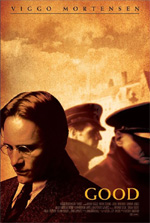 A few weeks ago, Viggo Mortensen was riding high going into awards season, with no fewer than three baity-looking prospects on his slate: Ed Harris’ western “Appaloosa,” Holocaust drama “Good” and the eagerly-awaited “The Road.”
At Toronto, however, the picture has cleared, and the options have narrowed. First off the bat, “Appaloosa” was greeted with a shrug, both here and elsewhere. And now, if Variety’s damning review is anything to go by, “Good” faces an even more indifferent reception:
This tepid adaptation has an international-pudding feel unlikely to spark much critical or aud enthusiasm … Considering its theme and setting, there’s something very wrong with a “Good” that seems merely competent, uninspired and a bit old-hat. But the milieu, characters and emotions just don’t come alive. (Director) Amorim brings little personality or passion to the material … the often impressive Mortensen can’t make Halder much more than a stereotypical academic milquetoast.
I must say that’s pretty much what I expected. Sure, the Academy often responds well to Holocaust stories, but the director couldn’t have a lower profile, and that trailer always looked rather stodgy to me.
So another one bites the dust, it seems. Mortensen will be disappointed — according to Anne Thompson, he had pinned his personal Oscar hopes on “Good.” Now it looks like “The Road” is the right horse after all — but we knew that all along, right?
I love Anjelica Huston. Always have — ever since she scared the shit out my 7 year-old self in “The Witches.” We don’t see her enough on screen, so it’s nice to see her indulging in a little bit of self-parody.
The Orange Film Funding Board ads, featuring an ongoing parade of slightly past-their-peak thesps, are one of the pleasures of going to the movies in the UK. (Kris was similarly tickled by the Rob Lowe one a few months back.) This latest one isn’t their best, but Huston cracks me up:
 Of all the bizarre calls that have been made in the process of creating “W,” the one that possibly threw me the most was the casting of Thandie Newton as Condoleezza Rice.
I’ve admittedly always been lukewarm on Newton as actress, but nonetheless, nothing about her onscreen or off-screen personae suggested that she had it in her to channel the world’s most powerful woman.
So it’s refreshing to read, in this lengthy Sunday Times interview with Newton, that she felt pretty much the same way:
“Oliver woke me up,” she says. Stone had an “absolute belief that I could play this character who was absolutely nothing like me. She didn’t look like me; she’s a couple of decades older than me. And I’m English, for goodness’ sake”.
In her favour, Newton appears to have a healthily objective stance on the character she’s playing (more so, I suspect, than her director):
Then she began working on her mannerisms, the quirks and ticks that an impressionist might exaggerate to tell you as much about a person as the “inner truth”. She won’t tell me what they are. “Look, I do have a kind of reverence for who I am playing. This is a human being, and whatever you think, as an example of discipline, she’s unbelievable … (But) seeing her in more undone situations, there was this difference in her. You can see her posture change at certain times. It’s almost imperceptible, but it’s there. I got a sense of the human being behind the construct. And I did feel compassion for her.”
She’s clearly an open and articulate interviewee — read the rest here. (Note to the interviewer, however: I know it’s customary to flatter your subject, but calling Newton’s turn in “Crash” the “definitive performance” of that film is a blatant lie. And I don’t even like “Crash.”)
 With the acting races getting more crowded by the day, it seems new contenders will need to make quite some impact to stay afloat in awards season. Nonetheless, David Poland and Tom O’Neil are beating their respective drums for a couple of veteran actors in decidedly low-key projects that have just bowed at Toronto.
David Poland is excited about “Lovely, Still,” a small-scale holiday pic charting the December-to-December romance between Ellen Burstyn and Martin Landau. I thought the film sounded fairly ghastly when I first heard about it, but Poland is won over, citing “home run performances” from the leads:
All of those “Boynton Beach Club” movies that get distribution… this is going to be the king of them. Maybe it’s just $10 million in theatrical, but given the Academy composition and the very real love of these two actors, don’t be shocked to hear award buzz around this one all season.
Cinema Blend has also come over all warm and fuzzy on the film, and describes the performances as “dazzling.” The stars are obviously Academy stalwarts — and I’m always happy to see recognition for Burstyn, one of America’s greatest living actors — but I need more convincing.
Meanwhile, over at Gold Derby, O’Neil is hoping the Academy might finally give in to poor Peter O’Toole, the man who now holds the record for most losses (eight) without winning. Two years ago, everything seemed set for O’Toole to finally collect for “Venus” — and he might well have, had the film not been so feeble.
 To commemorate their 75th anniversary, the British Film Institute has launched a nice little project called “Visions for the Future.” They’ve selected 75 figures from the world of film — actors, filmmakers, critics and other industry pros — and invited them to name one film they would choose to share with future generations, as well as asking for their thoughts on the future of the medium.
The results — mainly in the form of video interviews — are really rather insightful. Obvious (albeit worthy) choices abound, from “The Wizard of Oz” to “The Third Man” to “Tokyo Story.”
But there are a number of interesting left turns. As if there weren’t enough reasons to like her already, Cate Blanchett proves her taste and intelligence by picking Andrei Tarkovsky’s mind-blowing “Stalker,” though she admits it took her three days to get through it. (Her choice also gives me a nice excuse to post one of the most beautiful posters of all time as an illustration.)
My favourite choice, however, is that of the brilliant playwright and screenwriter Patrick Marber — Powell and Pressburger’s “The Red Shoes,” a twisted, romantic and visually breathtaking fairytale that he economically describes as being “about wanting things too much and not getting them.”
It’s no secret that Danny Boyle’s “Slumdog Millionaire” is shaping up to be one of the indie darlings of 2008. The film was the uncontested hit of the Telluride festival, bowing to sensational reviews, of which Todd McCarthy’s (key phrases: “a blast;” “fantastic energy;” “a vital piece of work”) represents the consensus.
Almost immediately, Oscar buzz began building around the film, with pundits suggesting that the film’s combination of gritty sociological themes and ultimately uplifting narrative would prove irresistible to voters seeking to annoint this year’s ‘little film that could.’ (Glib comparisons have been made to “Juno,” based on, well, nothing really — except it’s a small film that audiences like.)
Now, the latest to board the “Slumdog” train in Toronto are Tom O’Neil and Jeffrey Wells. In this video from Gold Derby, O’Neil says the film has the “passionate rooting factor” that a film needs to get those first-place votes on the nomination ballot. In closing, O’Neil and Wells agree that the film is “without question” one of 2008’s five Best Picture nominees. Article continues after the cut:
 As Kris just reported, Darren Aronosky’s “The Wrestler” has won the Golden Lion at the Venice Film Festival. No surprise there — in what was widely deemed a lukewarm festival, Aronofsky’s film, which only screened yesterday on the Lido, was one of the few outright critical sensations.
What is surprising is that Mickey Rourke, whose lauded comeback performance is the predominant source of the film’s buzz, missed out on the Best Actor prize, which went to Italy’s Silvio Orlando for “Giovanna’s Father.”
Perhaps the jury wanted to spread the love. Perhaps after wins for David Strathairn, Ben Affleck and Brad Pitt in the last three years, they felt American actors had been sufficiently rewarded for a while. Prize or no prize, however, this recognition for the film — to which his performance is so integral — makes it quite clear that Rourke is on the awards trail.
But what of the film itself? In years past, the Golden Lion has been the start of a healthy awards-season run for a couple of films — examples include “Atlantic City,” “Vera Drake,” and most notably, “Brokeback Mountain.”
It’s no guarantee of future glory, though. In 1996, Neil Jordan’s lavishly mounted biopic “Michael Collins” seemed poised for an awards sweep after it took the Golden Lion and its star, Liam Neeson, nabbed the Best Actor prize. But the film never quite clicked with other awards bodies — and on Oscar nomination morning, all that awaited it was a pair of technical nods.
Here’s some happy news. After being put so far on the back burner as to be almost invisible, Spike Jonze’s intriguing adaptation of Maurice Sendak’s “Where the Wild Things Are” has been assigned a release date by Warner Bros.
The film will apparently open on October 16, 2009, which should allow Jonze plenty of time to complete his vision — hopefully unimpeded. (No confirmation yet on whether Karen O is really doing the music.)
I understand the studio’s concerns about audience accessibility, but c’mon — you don’t put Spike Jonze on a project and expect “Charlotte’s Web.” We’re talking about a potential audience that goes way beyond the kid demographic. Let the man’s freak flag fly.
Sorry this news is a few days old, but it escaped my notice until now. Variety reports on a new independent drama that enters production next month. I’m just going to lay down the details, one by one:
Renee Zellweger plays a wheelchair-bound former singer.
Forest Whitaker plays an emotionally damaged fireman.
Together, they embark on a road trip to Memphis, wherein they work through the tragedy they have both faced in their lives.
And apparently find love.
It’s written and directed by Olivier Dahan, he of “La Vie en Rose.”
And it’s called “My Own Love Song.”
I should keep an open mind. Maybe it’s a masterpiece in the making. But based on those facts, is there not a strong possibility this could literally be the worst film of all time?
 Looking at the latest contenders to muscle in on an already crowded Best Actor field, you could be forgiven for thinking it’s 1986 or something.
First, the formerly washed-up Mickey Rourke rebounds with an apparently career-best performance in “The Wrestler” that is generating loud Oscar buzz.
Now Rourke’s relative contemporary, Jeff Goldblum, is setting tongues wagging for another indie effort, albeit one with a much lower profile going in. As Holocaust survivor Adam Steiner in “Adam Resurrected,” the latest film from the ever-underrated Paul Schrader, Goldblum is attracting the kind of attention he hasn’t seen since, well, his career-making performance in “The Fly.”
Writing from Telluride, where the film bowed, Cinematical’s Kim Voynar began beating the drum:
Goldblum’s performance as Adam is complex and engrossing to watch, and while I can’t begin to fathom what it must have taken out of him to get inside this story and character to pull the performance off at this level, it’s truly a wonder to behold onscreen. The Oscar buzz circulating Goldblum’s turn in this film is far from hype; he educes the death and rebirth of a man’s soul in such a way that I’d be hard pressed to compare it to anything I’ve ever seen onscreen.