In Contention

Author: Guy Lodge

  • Warner ventures into the arthouse with ‘Chanel’

    Well, if nothing else, 2009’s Best Costume Design award is forespoken.

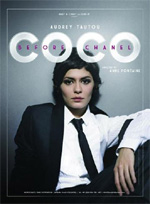
    Screen Daily reports that Warner Brothers is beginning production next month on “Coco Before Chanel,” a French-language biopic of the iconic fashion designer. Warner will distribute the film internationally next year.

    Audrey Tautou will play Chanel (presumably after flipping a coin with Marion Cotillard), while an interesting supporting cast includes Alessandro Nivola and Emmanuelle Devos. Actress-turned-filmmaker Anne Fontaine, probably best-known for the family melodrama “How I Killed My Father” is at the helm; she also wrote the script, with Christopher Hampton, no less, as consultant.

    In a nice touch, proving that Warner really is throwing a lot into the project, they’ve lined up none other than current Chanel director Karl Lagerfeld to personally supervise the costumes.

    A lot could be riding on this: after shamefully shutting down both Warner Independent Pictures and Picturehouse (which interestingly had great success with another biopic of a French icon, “La Vie en Rose”), “Coco Before Chanel” will test how well the parent studio can handle this kind of bijou release. It’s not the most adventurous foray into the arthouse they could have made – we all know how wary the Academy is of pretty period biopics – but it’s an encouraging sign nonetheless.

  • ‘Rachel’ not just about the women?

    In his autumn preview, Noah Forrest at Movie City News briefly kinda-reviews Jonathan Demme’s “Rachel Getting Married,” which will make its official bow at Venice next week. Having seen an unfinished cut, he gives it the thumbs-up, citing “beautiful music, excellent performances and a few surprises I didn’t see coming.”

    Most excitingly, he compares it to Demme’s loosier, funkier output from the 1980’s, which is fine by me. If the film has anything approaching the wit and danger of “Something Wild,” I’m there.

    Forrest also throws a new, relatively unheralded name into the Oscar cauldron. Much has been made of the awards potential the film offers for Anne Hathaway and Debra Winger – though in the latter case, the buzz seems to be built more on industry goodwill towards the actress than on anything else. As Kris has pointed out, Rosemarie DeWitt (best known as Jon Hamm’s boho mistress in “Mad Men”) appears to have the meatier supporting role, and could well make an awards run. Forrest, meanwhile, has someone else in mind:

    While Anne Hathaway and Rosemarie DeWitt (are) excellent in it, I want to start beating the Best Supporting Actor drum for Bill Irwin. He plays the patriarch of the fractured clan and he is so damn good that I couldn’t stop shaking my head, awed by how effortlessly he brings both pathos and humour to the role.

    A respected Tony-winning stage actor whose screen work ranges from “Sesame Street” to Ron Howard’s ill-fated “Grinch” film, Irwin hasn’t had a breakthrough film role yet – this could be it.

    So far, “Rachel” is looking more like a contender for acting (and possibly writing) nominations than the big prize, but the Academy can occasionally give a lot of acting slots to an otherwise low-profile pic (“Iris” being a good example). This film seems to have a lot of balls in the air.

  • Countdown to Venice: the future of festivals?

    So the Venice Film Festival kicks off tonight with its glossiest title, the out-of-competition “Burn After Reading.” Reviews ought to start trickling in tonight, though it’s worth bearing in mind that festival fever can often give the premature illusion of critical consensus.

    Screen International has a very handy rundown of the festival lineup – both in and out of competition – which paints a much clearer picture of the more international entries than anything else I’ve read so far.

    Less-covered competition films that particularly caught my eye include “Inju: The Beast in the Shadow,” a Franco-Japanese thriller starring the excellent Benoit Magimel, marking a return to fiction film for Oscar nominee Barbet Schroeder, “Jerichow,” a German riff on “The Postman Always Rings Twice,” and, by far the least heralded of the US entries, “Vegas: Based on a True Story,” a portrait of down-and-outs in the titular city from Iranian director Amir Naderi.

    (Not to mention an out-of-competition contingent that includes new works from such weighty auteurs as Claire Denis, Agnes Varda and Abbas Kiarostami, whose “Shirin,” starring Juliette Binoche, I’ve already mentioned is my most anticipated film of the fest.)

    (more…)

  • Jeff Wells buys into the Hawkins hype

    As Kris pointed out earlier today, Jeff Wells is no fan of Mike Leigh’s “Happy-Go-Lucky.” I suspected from the get-go that the film and Poppy, its gobby, exaggeratedly high-energy protagonist, would polarise audiences – but I still find Wells’ argument does a disservice both to the film and to his own critical perspicacity.

    In his extended critique, Wells judges the film to a rather alarming extent simply on the basis of his loathing for Poppy herself – going so far as to call her, with typical Wells dramatics, an “emotional fascist.” More crucially, he makes the error of assuming that the perspectives of Poppy and Leigh himself are interchangeable – an interpretation that, in my view, ignores a considerable portion of the film’s irony and pathos. (If anything, the film’s fundamental message is that even the most oppressive optimists are incapable of changing the world around them.)

    But no matter. For all his personal dislike of the film, Wells can see the skill involved in the whole endeavour, and is quick to credit the achievement of Best Actress contender Sally Hawkins:

    It is probably inevitable that Sally Hawkins … will be talked up as a Best Actress nominee once the film starts showing around. An elementary-school teacher who happy-vibes just about everything and everyone, Polly is an unstoppable alpha dispenser — spirited, effervescent — and Hawkins certainly inhabits her whole-hog.

    She carries “Happy-Go-Lucky,” she carries its spirit, and she does handle herself well in the sad-shock scenes at the end of the film with Eddie Marsan, the driving instructor with the correct manner and ferociously uptight, anti-immigrant attitude. In fact, the last 15 to 20 minutes contain the best stuff in the film, and I throughly respect Hawkins for her performance in this section. She handles her scenes with quiet maturity and resigned grace.

    This kind of reluctant admiration suggests to me that Hawkins in conclusively in the race, even if the film could still go either way. As Kris said, this one is gonna divide people right down the middle. For every Jeff Wells, there will be a Patrick Goldstein. At the very least, after an incredibly dull spell for specialty film, it’s nice to have a title that provokes some argument.

  • Do you believe?

    God only knows where the Telegraph managed to dig up this rumour – if it was in The Sun, I’d assume some intern made it up during a particularly slow bank-holiday interlude.

    But just for fun, let’s humour them and enter their world of make-believe for a moment. Okay? By that token, I’m excited to inform you that, in Christopher Nolan’s next Batman installment, the role of Catwoman will be played by…

    Cher.

    Riiiiiight. Even with my full guard of irony intact, that’s still hilarious. Don’t get me wrong, I like Cher’s acting work back in the day – when her face could still move and Ronald Reagan was still president. She’s great in “Moonstruck,” better in “Mask,” better still in “Silkwood.” But the thought of the 62 year-old strapping herself into the leather suit and getting frisky with Christian Bale … well, “beggars belief” is putting it lightly. According to them:

    A studio executive said: “Cher is Nolan’s first choice to play Catwoman. He wants to her to portray her like a vamp in her twilight years.

    “The new Catwoman will be the absolute opposite of Michelle Pfeiffer and Halle Berry’s purring creations.”

    Well, I must say I like the idea of a revisionist take on the character, particularly after Berry pretty much shredded the credibility of Catwoman’s conventional incarnation. They’d need to do something radical with her along the lines of Nolan’s reconceptualisation of the Joker, and the prospect of Catwoman as a surgery-paralysed Norma Desmond type sure fits with Nolan’s bleaker approach. It’s arguably insane enough to work … but I still don’t believe a word of it. (Not least because the story takes as a given the casting of Johnny Depp as the Riddler.)

    Kris’ own Batman casting call a while back generated numerous suggestions for Catwoman, ranging from Milla Jovovich (Kris’ choice) to Angelina Jolie (seemingly the default selection) to Christina Hendricks (my own left-field pick). All that, and not one of us picked Cher. Shame on us. I’m switching.

  • Beyond the biopic

    Halfway through watching the recently uncovered trailer for Ron Howard’s “Frost/Nixon,” I felt my stomach sinking with involuntary dread, and it took me a beat or two to figure out why.
    The problem didn’t appear to be the film itself; in fact, the relatively zippy trailer promises something somewhat tighter and wittier than I’ve been expecting from the odd (to my eyes) pairing of Ron Howard and Peter Morgan.

    No, what had me grimacing in anticipation of things to come were the glimpses we are offered of Frank Langella as Tricky Dick – a showcase that, in the space of two minutes, manages to tick so many Academy boxes that Langella could probably nab a nomination for the trailer alone.

    The studied gait, the mannered vocal cadences, the escalating, booming rage in his confrontations with Michael Sheen’s David Frost (anyone want to lay bets on the “when the president does it, it is not illegal” clip being used in the Best Actor presentation on Oscar night?) … all the elements appear to be in place for the kind of superficially impressive inhabitation of celebrity that has lately dazzled the voters on a yearly basis.

    Let it be said, I’m not dismissing Langella’s performance – he may be very good indeed. (Though now that The Guardian has pointed out the vocal similarities between Langella’s Nixon and Sean Connery, that discordant parallel will remain firmly lodged in my brain.) And after a long career with two recent near-misses at an Oscar nomination (“Good Night, and Good Luck” and the wonderful “Starting Out in the Evening”), I could hardly begrudge the man some recognition.

    But at the same time, if someone were to issue a moratorium on rewarding biopic performances for the next decade or so, I would be right on board. For the last ten years running, at least one of the four winning performances each year has been a portrayal of a real-life figure. Daniel Day-Lewis just broke a three-year biopic run in Best Actor category; over in Best Actress, a mere two of the last nine victors played fictitious characters.

    I’m not so contrary as to assert that none of them were deserving, but I don’t mind admitting that I’m a little fatigued. More than that, I’m exasperated at how easily, and consistently, impressed the Academy has been by this particular trick.

    (more…)

  • T.L. Stanley calls for a stop to the ‘Thunder’ madness

    I hadn’t checked in with T.L. Stanley’s ever-entertaining blog for a while, partly because she hasn’t been dealing with that much film-related content lately. But here she offers an amusing take on the breathless awards prognostications floating round the blogosphere for decidedly non-prestige titles:
    Not sure what’s more off-the-wall these days: Web-fueled discussions that try to advance some non-Oscar performances for the major award, or blog chatter handicapping the race based on movies that no one has seen. It could be a draw.

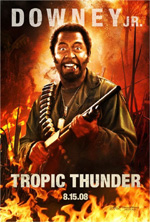
    Well, we’re all guilty of the latter – otherwise there’d be precious little to write about for half the year. But she has a point on the former, and it comes into focus when she addresses the Best Supporting Actor rumblings around Robert Downey Jr.’s performance in “Tropic Thunder.” Stanley, for one, ain’t buying:

    The latest to catch our eye has been the meta-moment call for a best supporting actor nod for Robert Downey Jr. for his blackface actor/soldier in “Tropic Thunder.” Not that we didn’t love him — not that we don’t always love him — but we can come to no other conclusion than that the awards drive itself is satire, as in, you guys must be kidding … In no way is that an Oscar performance, zeitgeist-catching and guffaw-inducing though it was.

    (more…)

  • ‘Religulous’: Variety is a believer

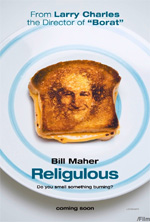
    Concerns have been expressed on this site that Larry Charles’ and Bill Maher’s “Religulous” would emerge as an exercise in left-leaning smugness, taking potshots at easy, cherry-picked targets to equate faith with absurd naivete. Certainly, the jokey, swiftly-edited trailer didn’t do much to shift this feeling.

    But Variety’s review of the film paints a decidedly different picture. Going so far as to call it “brilliant (and) incendiary,” they describe the film as a study that, while not neglecting its obvious comic angles, tackles its subject with appropriate profundity and inquisitiveness:

    To the film’s credit, Maher never engages in Michael Moore-style gotcha tactics, but rather asks questions that raise more questions, in the form of a Socratic dialogue. To believers expecting a blind hatchet job, this will prove both thought-provoking and a bit disarming; skeptics may be surprised (as Maher is) by the occasionally smart replies to his queries.

    Though the review does make reference to Maher’s occasionally flip comic tactics (contradictory subtitles accompanying interviews, and the like), the critic seems a little taken aback by a solemn conclusion to the film:

    Ending minutes, though, will catch auds up short: Suddenly, the laughs die down, and as in his closing monologues on “Real Time,” Maher turns deadly serious with a final statement that will stir raging arguments in theater lobbies.

    (more…)

  • Foreign film race begins… get ready to groan

    Variety carries details of the first official entry that I’ve heard of in the Best Foreign Language Film derby – Denmark has put forward “Worlds Apart,” from director Niels Arden Oplev. The country has a pretty good track record in this category, having won back-to-back in the 80’s with “Babette’s Feast” and “Pelle the Conqueror,” while Susanne Bier’s popular “After the Wedding” nabbed a nomination two years ago.

    “Worlds Apart,” which has already secured US distribution, is a small-scale pic focusing on a teenage Jehovah’s Witness forced to make a difficult choice when she falls in love with a non-believer. It all sounds terribly earnest, but that’s right up the Academy’s alley when it comes to this category. Reviewing the film at the Berlin festival back in February, Variety called it a “provocative, well-turned drama,” and speculated that a US remake could be on the cards.

    Apparently, the Academy has invited 96 countries to enter the race this year, with the submission deadline looming large on October 1. They should be looking to regain some credibility in this category after the embarrassing fiasco of last year’s race, which saw a banner year for world cinema reduced to the most tepid slate of foreign-language nominees in recent memory, as landmark pictures like “4 Months, 3 Weeks, 2 Days,” “Lust, Caution” and “Persepolis” were, one by one, either snubbed or disqualified.

    (more…)

  • Forster on Bond: It’s about character

    Odd to be linking to Time Out twice in one day, but I couldn’t let this interview with Marc Forster, director of the keenly awaited “Quantum of Solace,” go by. The interview finds Forster in London, scrabbling to complete the first edit of the latest 007 outing in a fortnight’s time.
    Many eyebrows were raised when it was revealed that the low-key director of “Monster’s Ball,” “Finding Neverland,” and “The Kite Runner” was taking on this most commercial of franchises – I always thought it rather a nice fit. For me, Forster never injected much individual flair or perspective into his otherwise workmanlike ‘serious’ pictures; I have a feeling more of his creative personality might emerge when working against the grain of his interests. Certainly, Forster doesn’t seem to be radically modifying his storytelling approach – he believes he was hired because the producers wanted a more “emotional component” to the film:

    Several times (Forster) mentions what he believes will be at the heart of the new film: character. ‘The great thing is that Daniel and I had an intense relationship, so between us we could always go back to the character … There’s this conflict going on: he’s an assassin, but he’s also lost someone he loves. We’re asking: where’s the psychological conflict in that?

    Sounds good to me. Other promising tidbits include Forster citing genius production designer Ken Adam, who worked on the first Bond films, as an influence on his creative vision, and a sneak peek at what promises to be the most exciting foe in some time for 007:

    We see a flash, too, of the new Bond villain, French actor Mathieu Amalric, who plays a character with the decidedly unvillainous name of Dominic Greene. ‘In the old Bond films, it was clear who were the good guys and who were the bad guys. Today, it’s not so clear. I feel like Mathieu looks so sympathetic and normal, the type you can’t see right away is the villain.’

    (more…)

  • Revisiting ‘Naked’

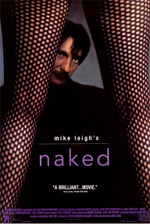
    I’m pleased that at least one person correctly identified Tuesday’s mystery quote (despite my initial absentminded misquoting) as coming from Mike Leigh’s 1993 film “Naked,” a brilliant, bruising urban portrait that still stands, for this writer, as the auteur’s finest film to date. It won Leigh and lead actor David Thewlis richly deserved awards at Cannes, though unsurprisingly, its talkiness (the film is less a narrative than it is a series of ingeniously constructed conversations) and unrelenting pessimism never really caught fire with audiences, least of all Stateside.

    Incredibly, it is only this week that the film has been released on DVD in its home country – a move that, however overdue, at least cunningly coincides with the local DVD release of Leigh’s latest, “Happy-Go-Lucky.” Bringing them out simultaneously is a clever move, not least because the films complement and inform each other so nicely. Very much two sides of the same coin, the films examine the fragile moods and  tensions of middle-class London society through the eyes of two protagonists (dissolute bum Johnny in “Naked” and cheery schoolteacher Poppy in “Happy-Go-Lucky”) poles apart in terms of perspective and ideology.

    Watching the films together, as I did back in April (thanks to the wonder of VHS), puts into quite striking relief the changes (physical, political and sociological) that Britain and its capital have endured in the space of fifteen years. Some would say the contrast points to a change in Leigh himself, though I’m not so convinced – partly because “Happy-Go-Lucky” isn’t as optimistic in its worldview as the title suggests, and partly because “Naked” was preceded by the infinitely warmer and gentler “Life is Sweet,” the closest tonal match for the new film in Leigh’s oeuvre. Like any artist, the man’s moods don’t follow a regular arc.

    (more…)

  • Under the radar: ‘Disgrace’

    With the Toronto festival just around the corner, one title set to bow there that isn’t garnering that much attention yet is Australian production ‘Disgrace,’ the long-gestating adaptation of Nobel Prize-winner J.M. Coetzee’s searing 1999 masterpiece.

    That’s not exactly surprising, given that it’s a sophomore effort from a director, Steve Jacobs, whose previous credit, the flavourful but slight comedy “La Spagnola,” didn’t make much of an international ripple in 2001. The film is tiny; it also promises to be (if they do it right, at least) intensely bleak. The lone ‘name’ involved, John Malkovich, is something of a niche figure. Suffice to say that there are any number of starrier, sexier prospects in the TIFF lineup.

    But in a quarter already boasting its fair share of prestigious literary adaptations (“Revolutionary Road” and “The Road” being just two of the most anticipated), this is the title that has me most intrigued. I admit my South African bias possibly comes into play here. But you don’t have to be from the country to know what an astonishing novel “Disgrace” is – one that picks apart the moral identity of post-apartheid South Africa with a precision and ruthlessness of Dostoyevskian proportions. In 2006, The Observer named it the greatest “British” (cheekily including the Commonwealth) novel of the last 25 years.

    (more…)

  • Patrick Goldstein falls for ‘Happy-Go-Lucky’

    With “Happy-Go-Lucky” out on DVD today in my corner of the world, it’s odd to think that America has yet to discover its charms. Early Stateside rumblings, however, suggest that’s just what might happen, as Miramax’s marketing campaign goes out of its way to portray Mike Leigh’s unruly, bittersweet comedy as the cutest thing since newborn kittens.

    Meanwhile, advance press, like this preview from the LA Times’ Patrick Goldstein, plays right into their hands. Goldstein likes the film a great deal, going so far as to portray it as a lone ray of hope in a “calamitous year for specialty films.” Right off the bat, he dismisses the comic competition from the indie sector (“Synecdoche, New York” is “murky,” while “Hamlet 2” runs into into comic “dead ends,” apparently), before singing the praises of Leigh’s film:

    So now for the good news. After a four-year layoff since “Vera Drake,” which earned three Oscar nominations, Mike Leigh is back with “Happy-Go-Lucky,” a film about an irrepressible free spirit named Poppy (played by Sally Hawkins) who manages to giddily bounce around London, full of life-affirming good cheer, but without an ounce of cloying or mawkish sentimentality. (After all, it’s still a Mike Leigh movie.)

    So far, so familiar. Anyone who hasn’t seen the film (and indeed, many who have) must be sick to death by now of hearing umpteen variations of the term “life-affirming” in connection with it. Refreshingly, however, Goldstein sees in the film the emotional depth and complexity which is so far escaping the general blogosphere, not to mention the Miramax marketing department (though that’s deliberate on their part):

    It being a Leigh film, the story is chock-full of oddball characters, from a high-strung flamenco instructor to a troubled child in the kindergarten class Polly teaches. But the best part of the film is the way it so casually allows us to grasp how intertwined each relationship can be. No one is easily stereotyped. Mike Leigh’s world, even a world dominated by a character who appears full of way-too-much unquenchable optimism, is always a world full of surprises.

    (more…)

  • Just do it… Joker style

    Amidst all the “Dark Knight” hysteria, it’s nice to see there’s still a place for the subtler brand of tie-in:

    Anyone remember when kids wanted sneakers like Michael Jordan’s?

  • Putting the Bat on the couch

    So this is the weekend that the Bat proved stronger than the Force. You’ve surely heard by now that “The Dark Knight” is officially the second-highest grosser of all time in the US, with only “Titanic” sitting above it. Thrilled as I am to see “Star Wars” knocked down a peg, I have to say I never saw this coming. I knew the film would be big – I’m not a moron, I like to think – but I’m still at a loss to explain just what about the film has connected with the public on such a monumental level.

    So is The Sunday Times, it seems. In an interesting piece, journalist Christopher Goodwin poses a number of theories, but can’t really pin it down. (Can anyone?) He covers the obvious angles – the repeated fanboy viewings, the Heath Ledger angle bringing in an unusually broad audience for the genre – but ultimately thinks it comes down to something less tangible than that. Citing the film’s zeitgeisty qualities, he states:

    The film has become a touchstone, beguiling audiences with what appears to be popular, comic-book entertainment, but explores some of the most critical social and ethical issues we face today — in particular, the issues being wrestled with by countries, notably America, fighting the “war on terror”. As those who have seen it will know, The Dark Knight explicitly examines how far it is permissible for individuals and society to go in the fight against “evil”.

    Nothing new there, really. The political resonance of the film in today’s climate has been discussed ad nauseum, something Goodwin emphasises as he quotes extensively from critics such as Richard Corliss and Kyle Smith. For the sake of balance, he also pulls from Andrew Klavan’s perverse conservative reading of the film (covered by Kris here), wherein Klavan called the film “a paean of praise to the fortitude and moral courage that has been shown by George W Bush in this time of terror and war.”

    (more…)

  • Can ‘Revolutionary Road’ be too good for film?

    It’s a slow month for news, so I understand that film bloggers’ minds can wander. I sympathize with that. But even taking that into account, Jeff Wells’ recent post outlining his doubts over the upcoming ‘Revolutionary Road’ struck me as pretty tenuous. Wells’ essential argument is that the film’s stumbling block looks to be the sheer brilliance of Richard Yates’ source novel:
    The more formidable the reputation of the book that’s been made for the big screen, the greater the odds that the film will have problems of one kind or another. The motto, in short, is that it’s not the beauty of the prose but the strength of the bones that counts.

    Truthfully or not, fairly or unfairly, that’s the general belief. And given this, it’s hard not to feel a little queasy about Sam Mendes’ “Revolutionary Road,” the forthcoming Leonardo DiCaprio-Kate Winslet drama that’s based upon Richard Yates’ hugely respected novel about suburban middle-class malaise in the 1950s.

    In response, let me begin by offering offer a subjective, by-no-means comprehensive selection of exceptions to Wells’ stated theory – literary adaptations that are in equal proportion of greatness to their source material. “One Flew Over the Cuckoo’s Nest,” for one. “The Unbearable Lightness of Being” is another. “To Kill a Mockingbird” was okay, and “A Clockwork Orange” didn’t totally suck either. “The Grapes of Wrath,” “LA Confidential,” “Tess,” “Trainspotting,” “Kes,” “Howards End” … you get the idea.

    (more…)

  • Palahniuk gets lost in wishful thinking

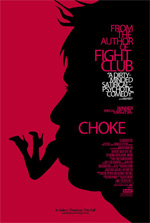
    Bad news for everyone who got excited when Chuck Palahniuk blabbed to the BBC that Radiohead were composing the score for “Choke.” Seems Palahniuk himself got a bit overexcited when he said:

    Clark Gregg … knew that I’d written “Choke” while listening to “Pablo Honey,” with “Creep,” over and over and over. So Clark got Radiohead to contribute a song; to write a song for the very end of the movie, the final credits. Apparently Radiohead liked the movie so much, they’ve written the score, most of the ambient music throughout it. So it’s “Choke” – with the music of Radiohead.

    It’s a sweet story. Pity it’s not really true. Radiohead have categorically denied that they’ve written the score. Though there will indeed be a Radiohead song over the end credits, it’s not an original composition but a track from last year’s “In Rainbows” album. (“Reckoner,” to be precise.)

    So anyone hoping the Academy might be presented with an opportunity to make up for this year’s Jonny Greenwood fumble – as if – will have to keep waiting.

    (On a side note, The Guardian caught the film at last week’s Locarno festival and deems it “amiably shambolic (and) oddly soft-centred.” Check out their festival wrap-up here.)