In Contention

Tag: Tilda Swinton

  • Sorry, Josh

    I like Josh Brolin a great deal, and I particularly like his performance in “Milk” — a courageous display of against-type delicacy and ambiguity that would be a worthy winner of Best Supporting Actor honours in most years.

    Unfortunately for him, most years don’t have the perfect storm of industry sentiment, audience popularity and landmark performing represented by Heath Ledger this year. Not to put too fine a point on it or anything, but I don’t think Brolin — or anyone else, for that matter — stands a snowball’s chance in hell of beating the late Australian. In a chat with the NYT’s Baguette, however, it appears that Brolin himself feels differently:

    “After what happened to Tilda Swinton last year, I think pretty (much) anything can happen… That was a surprise. It was. But again. Is it most deserving? Not necessarily.”

    Mr. Brolin said that as an Academy member who had voted for the first time last year he gained some insight into the whole voting process. “I think it’s an important film and I think that goes into people deciding what they’re going to vote for … It’s a very strange process. It’s very unlike what I thought it would be because suddenly you personalize it. You look at the body of work of the nominee. Lots of stuff goes through your mind.”

    For one thing, Tilda Swinton’s victory last year wasn’t entirely unanticipated, so saying “anything can happen” is a bit of a stretch. Upsets can happen, for sure, but there has to be some semblance of a crack in the frontrunner’s armour, and I don’t see one in Ledger’s case. For me, this is as much a foregone conclusion as Daniel Day-Lewis last year, or Helen Mirren in 2006, but I give Brolin credit for not completely surrendering.

    (more…)

  • Standard crowns ‘Hunger’ best film

    I have to hand it to the Evening Standard Awards: they are a breath of fresh air in a suffocating awards season. While their choices can have a bit of an over-democratic, drawn-from-a-hat feel to them (Stephen Daldry for Best Director? On what planet?), they are never afraid to veer from the herd.

    And so they have done this year, justly and imaginatively handing their Best Film prize to Steve McQueen’s magnificent “Hunger” at last night’s London awards dinner. It’s a small but prestigious citation for the film, voted as it is by a panel of leading British critics, including Standard stalwart Derek Malcolm and the Telegraph’s excellent Tim Robey.

    If you ask me (which no one did, but I’ll say it anyway), they royally fluffed Best Actor, curiously settling on a tie between Michael Sheen and the admittedly very good Pat Shortt, which rather embarrassingly left Michael Fassbender — easily the most deserving nominee — the lone loser.

    They redeemed themselves, however, with an inspired choice in Best Actress. Bypassing the obvious Kate Winslet option, they instead honoured Tilda Swinton for her extraordinary, bruising work in “Julia,” which I’m beginning to think may well be the thesp’s finest performance to date. (No mean feat, that.) The fact that BAFTA essentially handed Swinton a nod for just showing up in “Burn After Reading,” but failed to even longlist her for “Julia,” is yet another reason why we shouldn’t even be paying attention to that particular shindig this year. (But hey, tune in for my BAFTA live-blog on Sunday!)

    Elsewhere, Martin McDonagh racked up another screenplay win, filmmaker Joanna Hogg deservedly took the Newcomer award (beating Dev Patel in the process), and the wonderful Sally Hawkins pipped co-star Eddie Marsan (now wouldn’t that have been a good tie opportunity?) to the Peter Sellers Award for Comedy. (I still wouldn’t quite call “Happy-Go-Lucky” a comedy, but let’s not split hairs.) Yep, the best performance of 2008 still won’t go away, no matter what the Academies on either side of the Atlantic think.

    Mike Leigh, meanwhile, bagged a career achievement award. Full list of nominees and winners (in italics) after the cut.

    (more…)

  • Unlucky thirteen?

    Stu Van Airsdale is cheekily posing a scenario whereby “The Curious Case of Benjamin Button” converts precisely zero of its 13 nominations into victory on Oscar night.

    It’s not really worth picking holes in his argument — though we could start with the fact that “Button” is nominated for Sound Mixing rather than Sound Editing, or that he doesn’t seem to consider “Slumdog” the frontrunner for Film Editing — because the article is less interesting for its specifics than for how it taps into the general indifference that “Button” seems to be facing. Has a film with such an impressive Oscar tally ever looked a less formidable competitor going into the race?

    On nomination day, AwardsDaily posted a handy list of the ten previous films that have received 13 or 14 nods. Seven of them won Best Picture. Two of them (“Mary Poppins” and “Who’s Afraid of Virginia Woolf?”) each took a healthy haul of five awards apiece, major acting trophies among them. The last, “The Lord of the Rings: The Fellowship of the Ring,” was limited to technical victories, though in an odd year, with splintered support for “Moulin Rouge!” and eventual champ “A Beautiful Mind,” it wasn’t a complete non-starter — and in any case, everyone knew there was more to come.

    Right now, I side with Kris in predicting a scant three trophies for “Button,” in the Art Direction, Makeup and Visual Effects field. (Unpredictably scattered as the tech categories have been in recent years, I’d be very surprised if it missed in the latter two categories, at the very least.) So, is the film set to reap an all-time low from its nomination tally? Or are we underestimating it?

    As it stands, I’m starting to wonder if Taraji P. Henson may have more of a shot in the comparatively open Best Supporting Actress field than I thought earlier. Last year, Tilda Swinton eked out a victory in the same category after “Michael Clayton” fans realized she represented the film’s only shot at a major award. If voters don’t want to humiliate the season’s biggest, most-nominated film, could Henson be a similar beneficiary? Just a thought.

  • Cesar nods include ‘Class,’ ‘Loved,’ Swinton

    Now here’s a set of nominations I can get behind. As I may have mentioned before, 2008 was all about the rejuvenation of French cinema for me, with Gallic productions occupying a quarter of my year-end Top 20, including the two poll spots.

    So it’s hardly surprising that I’m immensely pleased by the list of nominees revealed yesterday for the Cesar Awards, otherwise known as the French Oscars –- not least because my two list-topping films, “I’ve Loved You So Long” and newly-minted Oscar nominee “The Class,” feature strongly.

    The former grabbed 6 nods, including a surefire Best Actress bid for the sadly Oscar-snubbed Kristin Scott Thomas, while I’m pleased to see her wonderful co-star, Elsa Zylberstein, finally getting some awards love in the supporting category. “The Class” managed five, though I’m a little disappointed to see the film’s excellent ensemble go unacknowledged, even in the ‘young actor’ categories.

    Both films feature in the Best Picture lineup, as does “Public Enemy Number One,” a sprawling biopic of gangster Jacques Mesrine that has been a local box-office smash and leads all nominees with 10 bids. Close behind, with nine, is Arnaud Desplechin’s critical favourite “A Christmas Tale,” though I’m surprised to see its two most dynamic stars, Catherine Deneuve and last year’s Best Actor winner Mathieu Amalric, both snubbed.

    Incidentally, Kristin Scott Thomas wasn’t the only Brit to receive notice: also landing in the Best Actress lineup is Tilda Swinton, for her astounding performance in Erick Zoncka’s “Julia.” Together with the insane snubs of Scott Thomas and Sally Hawkins, the fact that this fearless piece of work never even entered the Oscar discussion boggles the mind. But I digress.

    (More thoughts, and a list of nominations, below the cut.)

    (more…)

  • ‘Slumdog,’ ‘Button’ lead BAFTA pack with 11 nods each

    Each year, the BAFTAs never fail to find new and frustrating ways to surprise me.

    It wasn’t hard to guess that “The Curious Case of Benjamin Button” and “Slumdog Millionaire” would come out on top here — though even as a fan of the latter film, I do wonder whether nominations for Best Production Design and Best Supporting Actress are pushing it a little. (Sure, Freida Pinto is gorgeous, but… )

    But look closer and the oddities come thick and fast. Who would have guessed, come nomination morning, that “Changeling” would land 8 nominations (including mentions for Best Director and Best Original Screenplay), while “Happy-Go-Lucky” gets zilch? I was aware that Mike Leigh’s delightful film has played better with critics Stateside than it did over here in the spring, but failing to even nominate Golden Globe winner Sally Hawkins is a blatant — and in my opinion, unforgivable — slap in the face.

    As I predicted, despite the film’s mixed reception, BAFTA voters responded well to “The Reader,” which lands in the Best Film derby alongside four of the Oscar favourites in the category. While I thought “Milk” might miss with the Brits, it was actually “The Dark Knight” that came up short — and while I’m not entirely surprised that it proved too genre-oriented for their top category, their failure to nominate Brit helmer Christopher Nolan is pretty stunning.

    Bar the Hawkins snub, the acting categories name most of the usual suspects, though there’s still room for typically BAFTA-esque eccentricities. Brendan Gleeson is an pleasant surprise in the Best Supporting Actor category, and while I anticipated Brad Pitt’s appearance in that field for “Burn After Reading,” Tilda Swinton’s Supporting Actress nod for the same film is the kind of out-of-nowhere hometown favoritism that only BAFTA can come up with. The real headscratcher in that category, however, is Amy Adams’ inclusion at the expense of Viola Davis — one has to wonder whether voters actually watched “Doubt,” or voted on name recognition alone.

    (More thoughts, and the full list of nominees, below the cut.)

    (more…)

  • ‘Slumdog,’ ‘Hunger,’ ‘Happy’ rule London crix nods

    Sorry for following up on this so long after Kris’ teaser… what can I say? It’s Christmas party central round these parts.

    Anyway, the London Film Critics’ Circle Awards are a bit of an odd duck in the kudos calendar, but not an uninteresting one. They tend to try to have their cake and eat it — honouring both British and international achievements in categories that seem segregated at first glance, but actually aren’t. So this year, you’ll see Danny Boyle crop up in both the Director of the Year and British Director of the Year fields. The same goes for Kate Winslet in the actress races. (They also hedge their bets there, nominating her jointly for “Revolutionary Road” and “The Reader.”)

    Meanwhile, only one screenwriting category exists, while only British actors are singled out for supporting honours. Which is why non-British supporting players like Heath Ledger and Penelope Cruz are competing in the Actor and Actress of the Year categories, respectively — so don’t get too excited about that. (Meanwhile, the Brit supporting categories are a real stretch… I mean, Toby Jones?)

    If you’re confused, I don’t blame you. It’s a haphazard system, but nonetheless, when you dig through the nominations there’s some real gold to be found. The nod for Tilda Swinton’s extraordinary work in Eric Zoncka’s “Julia” is truly inspired, while one has to applaud the anti-herd mentality that leads to such inclusions as Josh Brolin for “W.” or Terence Davies in the British Director category. Compared to the dull-as-dishwater SAG nominees foisted upon us this morning, at least there’s a little initiative at play here.

    More commentary, and a full list of nominees, after the cut.

    (more…)

  • THE LISTS: Top 10 ‘right actor, wrong film’ Oscars

    As we head into the thick of awards season, one of the biggest “will-they-won’t-they” questions about this year’s Academy Awards concerns one of their most favored sons, Clint Eastwood. Specifically: despite wildly polarized responses to the film, and a widespread perception that he has already been amply rewarded in other categories, can Eastwood ride the wave of sentiment to a first acting victory for “Gran Torino?”

    That sneaky National Board of Review award last week suggests it’s still very much a possibility, whether or not people believe that it’s a performance for the ages — and, more to the point, whether or not it ranks with the best of Eastwood’s own onscreen work.

    It’s no secret that, in the acting races, the Academy frequently bases their vote less on the performance at hand than the actor delivering it — one can point to any number of Oscar victories determined less by merit than by personal affection for an already rewarded star (let’s say Michael Caine in “The Cider House Rules”) or industry guilt over an under-rewarded one (most recently, Alan Arkin in “Little Miss Sunshine”).

    Meanwhile, recent victories by the likes of Russell Crowe and Cate Blanchett point to the familiar “deferred-Oscar” syndrome, where an actor widely believed to have been snubbed in the recent past is hastily handed a statuette as a kind of cumulative acknowledgment of their recent strong work, frequently for a performance that doesn’t represent any particular breakthrough. (Kate Winslet might be vying for one of those this year.)

    All are variations of the oft-lamented “right actor, wrong film” Oscars that are peppered throughout Academy history — a solution generally deemed more credible (though I’m not sure why) than the honorary “quick, before they die” lifetime achievement gongs doled out to the likes of Peter O’Toole and Kirk Douglas, actors who continually slip through the cracks in Oscar voting.

    Age isn’t always the determining factor, though.  The Academy has shown in recent years by passing over Lauren Bacall and Ruby Dee — both of whom would have been exemplary “right actor, wrong film” honorees — they’re not always in a sentimental mood.  As the following list shows, reasons for rewarding actors for lesser work are many and varied: genre bias on the Academy’s part, mainstream emergence on the actor’s, or simply the voters’ collective nostalgia for a familiar face at the podium.

    The one thing all these names have in common is that they’re distinguished, even great actors who deserve to have “Academy Award winner” forever attached to their monikers — just not necessarily for that performance. Will Clint Eastwood be the latest name to join their ranks? The jury is out.

    (more…)

  • 11/22 Oscarweb Round-up

    Tilda Swinton• Jeffrey Wells hangs with the “Revolutionary Road” crew in the Big Apple. [Hollywood Elsewhere]

    • Ditto Glenn Kenny, who moderated the post-screening Q&A. [Some Came Running]

    • David Poland waxes on about how much he thinks “Revolutionary Road” fails, and judging by his charts, clearly hasn’t seen “Australia” yet. [Movie City News]

    • Steve Gaydos reports on a Rod Lurie event at UCLA for “Nothing But the Truth.” [Thompson on Hollywood]

    • Peter Sciretta talks to Pixar honcho John Lasseter. [/Film]

    • Pete Hammond thinks there’s a hex on Paramount screenings because of a couple of snafus of late, reports from a “Doubt” reception. [Notes on a Season]

    • Which songs will get the ole’ Oscar shove for “High School Musical 3?” [Gold Derby]

    • Simon Hattenstone meets with the “contradictory” Tilda Swinton. [The Guardian]

    • Eugene Hernandez and Peter Knegt debate the documentary shortlist. [indieWIRE]

  • Karger predicts paydirt for ‘Button’

    A couple of weeks ago, Dave Karger revealed that he’d seen “The Curious Case of Benjamin Button,” offering a single “wow” as his response. He now feels able to expand on that slightly, though “wow” is still his general gist:

    “Button” is an Oscar movie with a capital O, with jaw-dropping production values, a soaring romance, and terrific performances, particularly from supporting-actress candidate Taraji P. Henson as Benjamin’s de facto mother. Even if Brad Pitt doesn’t make it into the tough Best Actor race (the likes of Clint Eastwood and Leonardo DiCaprio may squeeze him out), I still can see “Button” racking up as many as 11 nominations, which could very well be the highest tally for any film this year. Once the film opens on Christmas day, I guarantee we’ll all be talking about one thing: whether or not “Benjamin Button” made you sob.

    Nothing that most of us weren’t suspecting anyway, but nice to see it in black-and-white. I’m interested to see that he confirms the chances of presumed contender Henson, after some vague whispers elsewhere that Tilda Swinton might be one to watch in the category. And I agree that, even if his film is a frontrunner, Brad Pitt is up against it in the Best Actor race. (After all, an Oscar juggernaut needn’t always pull its leading man with it — just ask Joseph Fiennes or Leonardo DiCaprio.)

    To me, it looks increasingly as if all “Benjamin Button” has to do is be merely good, and it will likely score at the Oscars by sheer default in this weird season. (Incidentally, why stop at eleven nods? I count thirteen, excluding Best Actor. I’m not saying it will get them all, but surely the possibility is there.)  I’m really looking forward to Kris’ thoughts once he — finally — sees the whole picture.

  • 10/3 Oscarweb Round-up

    WALL-E• A clip from “Changeling.” [Oscar Watch]

    • And another. [The Envelope]

    • Or, if you prefer, the first five minutes of “Blindness.” [Yahoo! Movies]

    • David Poland breaks the news that “Che” will get its U.S. debut at AFI Fest here in Los Angeles — at the Grauman’s Chinese Theatre. [The Hot Blog]

    • Tom O’Neil makes it clear that “Elegy” screeners only went to the AMPAS acting branch. [Gold Derby]

    • Rounding up the 50 greatest animated films of all time.  Further into the tank for “WALL-E.” [Rotten Tomatoes]

    • Famous cameos.  I heart the first one on the list. [The Independent]

    • David Thompson chats it up with “Burn After Reading” star Tilda Swinton. [The Guardian]

    • Has Dirty Harry become anti-cop? [The Big Picture]

    • Ed Harris and Viggo Mortensen continue to make the rounds on “Appaloosa.” [USA Today]

    • Emily Parker goes head-to-head with a thoughtful Fernando Meirelles. [Wall Street Journal]

    • Glenn Kenny doesn’t care about what you don’t care about. [Some Came Running]

    • The Big Apple’s finest thespians. [New York Magazine]

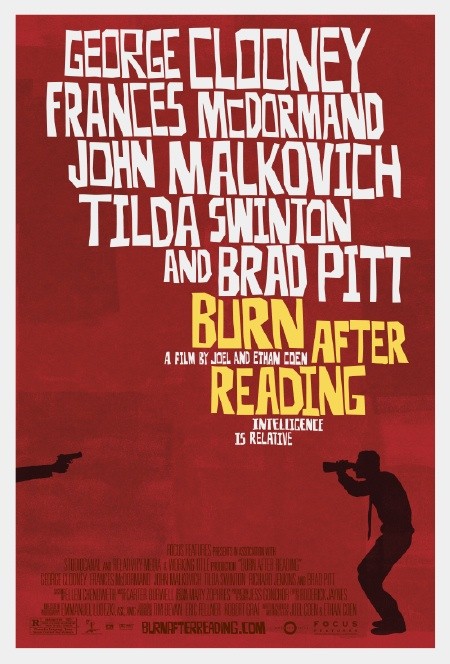
  • SHORT TAKE: “Burn After Reading” (*1/2)

    Focus Features' Burn After ReadingI really didn’t like “Burn After Reading,” but I laughed.  A LOT.

    I think the Coen brothers are probably the only filmmakers who can generate such a reaction.  The entire film is expendable.  It doesn’t even work on the grounds of slapstick, really.  It’s a series of events strung together, no point, no thematic ingenuity, a tapestry of…stuff.

    And that’s obviously the point.  The film willfully aimless.  Like J.K. Simmons says at film’s end, “I’ll be damned if I know what happened.”  And I stand on my chair and applaud the Coens for doing exactly what they wanted to do after the critical embrace of “No Country for Old Men” last year, because it takes balls to crank out (probably knowingly) your least accomplished film one year after what could be considered your most successful one.

    Only the Coens.

    The star of the film’s wacky ensemble is, without a doubt, Brad Pitt.  The actor’s age, however, pokes through sometimes, making his character oddly askew and somewhat…creepy?  But he takes the bull by the horns and rides this character for all it’s worth.  Chad Feldheimer is without a doubt Pitt’s most inventive creation since Jeffrey Goines in “Twelve Monkeys.”

    The rest of the cast is merely passable.  Frances McDormand gets the appropriate snorts as a superficial, middle-aged gym employee trolling the Internet for love interests.  Tilda Swinton is awkward as the stuck-up wife of John Malkovich’s disgraced CIA agent.  Malkovich provides plenty of laugh-out-loud moments but seems consistently aware that the story is spiraling out of control.

    Elsewhere, George Clooney is probably the runner-up for talent on display as he makes his way through a character addicted to sex in the most humorous and matter-of-fact ways, while Richard Jenkins kind of gives the audience something to attach themselves to as a life jacket in the choppy waters.  Kind of.

    But ultimately, the film is nothing more than a romp.  A harmless one, but a difficult one to qualify in any sense.  Enjoyable, yes, but hollow and lacking any ability to fully satisfy.  Not unlike eating large amounts of candy.

  • PAGE TO SCREEN: “The Curious Case of Benjamin Button” by Eric Roth

    Page to Screen at In Contention“Time is the most precious of God’s gifts. It is untouchable, unseeable, unknowable…it is as light as a feather…as heavy as a stone…Time, my darling, what precious little there is, is all we have…”
    I’ve known from Eric Roth for a few years now. I’ve spent some time investigating his process, picking apart his tendencies and have committed such findings, in addition to personal impressions of the man, to print. So one thing I’ve always taken to heart when sitting down to read one of his scripts is that, “bastardized art form” or not, he is insistent on challenging himself with his screenwriting, stretching the potential for thematic resilience and above all, treating the work like an exercise in elegant prose.

    Such is the case with “The Curious Case of Benjamin Button,” a 159-page adaptation of a 30-page F. Scott Fitzgerald short story. It’s a rare thing to flip through the pages of a script written by someone focused on the words almost more so than the images he or she expects them to become. And as part of an art form that can be insufferable as a result, I have to say that “Benjamin Button” is something of a masterpiece.

    The script begins with an aging Daisy (to be played by Cate Blanchett), recounting, via the reading of a diary by her daughter Caroline (Julia Ormond), the life and times of Benjamin Button (Brad Pitt). The love of her life, the one that got away, the one that came back and the one that will stay in her heart forever, Benjamin was born, as you certainly know, “under unusual circumstances.”

    Roth decides to do away with the hilarity of Fitzgerald’s take on Benjamin’s birth. We aren’t treated to a full-grown 85-year-old man in a baby crib greeting his father with a hearty hello. Instead, he treats Benjamin’s early years as something of a potential disease that makes a newborn aged beyond his or her years, so to speak. Frail skin, deformities…”His body is failing him before it has begun,” a doctor conveys with flabbergasted wonder.

    Benjamin’s mother does not survive childbirth, while his father instinctively passes him off on a lonely Baltimore doorstep before disappearing from his life…for a time. It is there, not hours old, that Benjamin is taken in by Queenie (Taraji P. Henson) at an old-timers’ home, for lack of better vernacular on my part.

    It was actually a stroke of brilliance by Roth to place Benjamin in such a setting for his formative years (and he’ll come back frequently throughout the tale). The writer’s commentary on wisdom and its many vessels is perfectly conveyed in this environment, simultaneously providing a fair share of comedic relief here and there, most of the time via unexpected flatulence (but it works).

    (more…)

  • OFF THE CARPET: 2008, a year in advance

    Another year, another set of wins…and another look ahead at what’s in store NEXT year.

    It’s never too late to take a long gander at what we might see dominating the film awards landscape in 365 days, and with that in mind, I’ve been doing my usual mulling over the possibilities for a few weeks to put together the sadly thorough examination of the 2008-09 award season that follows. Let’s get into it. There are some major considerations to take into account. right off the top.

    Like Leonardo DiCaprio, for instance, who is set to be the entertainer of the year. With performances in “Body of Lies” (Ridley Scott) and “Revolutionary Road” (Sam Mendes), DiCaprio is working with a duo of awards-proven talent this year. Perhaps that will work against him, much like it did in 2006, and no major Oscar success will come knocking. But we’ll wait until we see the performances. Each of them could be enticing.

    This year’s Best Picture Oscar victor Scott Rudin is back again, by the way, with “Revolutionary Road,” recently inherited by Paramount Vantage and probably one of the true “frontrunners” this far out that we could put our finger on. The only other film in Vantage’s arsenal is Edward Zwick’s “Defiance,” which could simply be a commercial success, but might find its way to multiple nods like “The Last Samurai” and “Blood Diamond” in recent years.

    (more…)

  • REVIEW: “The Chronicles of Narnia: The Lion, the Witch and the Wardrobe” (***1/2)

    The Chronicles of Narnia: The Lion, the Witch and the WardrobeJeff Wells is half right when he says “There’s a new Best Supporting Actress contender in town…10 year-old Georgie Henley, the soul and natural light-beam of ‘The Chronicles of Narnia: The Lion, the Witch and the Wardrobe’…came out of nowhere…but she’s Drew Barrymore in “E.T.” without the cloying I-know-I’m-cute-and-you’re-going- to-adore-me attitude.

    “Henley’s serene little-girl aura…her beauty, obvious intelligence, cultured British accent, etc…plus the generosity of feeling from within make for a potent combination.”

    Henley is nowhere near a Best Supporting Actress nomination (especially with co-star Tilda Swinton chewing the scenery), but she is one of the cutest and most talented youthful actor discoveries in a long time.

    “The Chronicles of Narnia: The Lion, the Witch and the Wardrobe” is inevitably going to find itself compared to Peter Jackson’s “The Lord of the Rings” franchise. And in the wake of those films, it will likely come off as old news to an Academy so desperately out of touch with depth of cinema over external labeling.

    (more…)