One of the great unknowns of the season (as I’ll get into momentarily with today’s Off the Carpet column) is Clint Eastwood’s “J. Edgar.” Well today, we finally get a glimpse of the film via the trailer at Apple. The first thing of note, naturally, is Leonardo DiCaprio’s accent, which seems to come in and out in just these few minutes. Also notable is the makeup, which I’ve been saying for a while will be transformative and most certainly something to watch for in that race. Finally, I’ve been hearing that Judi Dench gives the supporting performance to watch for, and that seems evident here. Check out the trailer by clicking on the image below or watch an embed after the jump.
Tag: Judi Dench
-
OFF THE CARPET: Strong year for double-dippers
We find ourselves right in the middle of the big Toronto press junket, er, film festival, where 200-plus films are landing, many of them as world premieres, and the landscape of this year’s Oscar race is really beginning to take shape.As I looked out at the various films in play this year, it suddenly occurred to me that, perhaps more than ever, there are a lot of double-dipping actors and actresses in the hunt. Not all of these performances are or will be awards bait necessarily, but there could still be cases for more than a few saddling up to dual nominations this year.
At the top of that list would have to be Brad Pitt. After already giving what many believed to be his best performance to date in Terrence Malick’s “The Tree of Life,” the paparazzi-hounded star found himself the recipient of a lot of great ink for his work in “Moneyball” when it screened in Toronto at the end of the week. Wisely, Fox Searchlight will be planning a supporting actor push for the actor in Malick’s film, which is both practical (given his clear lead in the other film), and organic (given that, at least in my opinion, he is supporting to Hunter McCracken’s lead in “The Tree of Life”).
-
On painful ‘Tides’
Guy was balancing two options in Cannes this morning: Take in the press screening of Rob Marshall’s “Pirates of the Caribbean: On Stranger Tides” or catch up on some much-needed rest. Given that I had already suffered the experience, I suggested he spare himself the 130-odd minutes of anguish and, I don’t know, lie in a park and eat a baguette or something.Truly, this film is the embarrassing, excruciating fourth installment of a franchise that bottomed out somewhere in the middle of the second. I wanted it to end the minute it started, and knowing there were over two hours to come, it was a trying, trying experience. The only thing that kept my attention was the placement of Penélope Cruz’s crucifix necklace.

But no one is pretending this is anything beyond a paycheck for talent and a conservative money-grabbing maneuver on the studio’s part. I guess you can’t blame them. Opening weekend will be huge. Nevertheless, I don’t think I’ve ever wanted to stand in the streets and scream, beg for consumers not to spend their money on a film so badly. Hopefully the final receipts will fall short of the marks reached by the other entries.
-
Ubiquitous
When I heard today that Mia Wasikowska had landed the lead in Cary Fukunaga’s upcoming adaptation of “Jane Eyre” for Focus Features, my first thought was, “Well, who else?”Not that there aren’t other suitable young actresses who could ace the part. But 20 year-old Australian Wasikowska seems to have hit a sweet spot in the Hollywood casting game. A year ago, few who didn’t watch HBO’s “In Treatment” had heard of her; today, she seems to be nabbing every plum role going in her age bracket.
Two years ago, Ellen Page’s name was linked to this latest dusting-off of the Charlotte Brontë chestnut; the eventual casting of Wasikowska suggests that even young Hollywood has its minute generational shifts.
Not that I’m complaining about Wasikowska’s sudden rise. I was as impressed as everyone else by her tangy work as a suicidal teen in “In Treatment,” and was pleased to see that promise completely followed through with a precise, perceptive turn as the daughter of Annette Bening and Julianne Moore in Lisa Cholodenko’s deserved festival hit “The Kids Are All Right.”
-
The Great Performances: 2005
2005 was the year of Heath Ledger’s beautiful, moving performance in “Brokeback Mountain,” which I saw for the first time in Toronto. It instantly became the talk of the festival, and the film became the one to beat for the Academy Award.Ledger was astonishing as the taciturn cowboy who is more surprised than anybody when his soulmate turns out to be another cowboy, portrayed superbly by Jake Gyllenhall. If there is a more deeply felt moment in film history than Ledger gently adjusting Gyllenhall’s shirt at the end of the film, his eyes filled with tears, I don’t know what it is. That’s loss, that is absolute heartbreak, that is one of the greatest acting performances of the decade.
Phillip Seymour Hoffman would win the Oscar for his transformation into “Capote” and he’s very good, but just not in the same league as Ledger. I wondered from time to time if “Infamous” had been released earlier if Toby Jones might have won the Oscar instead of Hoffman. Each becomes Capote in a very different manner, and side by side it is difficult to choose the stronger portrayal. Certainly I prefer Hoffman’s as it is darker, and for me more realistic, but there can be no denying Jones.
-
Oh yeah, the ‘Nine’ embargo lifted…
It’s one of those things when you show a film early and hold everyone to an embargo for a number of weeks. I imagine there are people like me who run out of the passion and desire to write about some films, and over the last few weeks, “Nine” has been that film for me.I discussed the film, of course, with Anne in last week’s Oscar Talk and I think I said most of what I would write anyway. I will say that I’m probably 99.9% in agreement with what David Poland has written, especially his thoughts on casting, Marion Cotillard’s final number being one of the few moments of actual emotion in the film, the detriment of a central character’s frivolous motives and desires, etc.
Oscars? I think what you see in the sidebar, for the most part. I saw the SAG go wild for it, but I also know this is a film that could run into trouble when it comes to resonating. So a month from now, would the applause be so grand? I don’t know. Marshall could run into trouble with the directors, unless they just feel like honoring him for knowing how to stage a number (keyword: stage). Day-Lewis could miss. Dench could slide in over Cruz, given the more interesting throughline she represents for the main character, etc.
Below the line, of course, nods all the way across. But it’s a real question mark about how this film will ultimately settle when the high of the music is long gone and people are left with their thoughts on what they just saw, and whether it has the substance to keep reminding them. We’ll see.
-
The Great Performances: 2001
In one of the weakest years in memory, not just for performances but for great films, 2001 saw Denzel Washington and Halle Berry knock “two birds out with one stone,” as the former declared on Oscar night, as two African Americans won the top acting prizes for the first time ever. And it was difficult to argue with either.Washington was superb in “Training Day,” clearly loving his role as crooked cop Alonzo, walking the line without ever going over the top, blowing everyone off the screen. In many ways it was a make-up award for his having lost for “Malcolm X” in 1992 to Al Pacino’s ranting work in “Scent of a Woman” and perhaps, though lesser so, for his loss for “The Hurricane.”
Berry gave a raw, sexually charged performance in “Monster’s Ball,” one of such searing truth and rage you could never look away from the screen. Robert Duvall called her performance the finest by an American actress he had ever seen and was not the least bit surprised when she won the Oscar for Best Actress.
My question remains: Should Denzel Washington have won over the non-nominated performances of Gene Hackman in “The Royal Tanebaums” or the vastly under-appreciated Jack Nicholson in “The Pledge,” one of his finest recent performances? Don’t think so.
There was a lot of love shown to Tom Wilkinson for his heartbreaking work in “In the Bedroom” as well as Russell Crowe (again) for his performance in “A Beautiful Mind,” which eventually won the Best Picture Oscar. I was very surprised that Sean Penn was nominated for his performance in “I Am Sam” because though I consider Penn one of the greatest actors in the history of the cinema, his work in that film represents one of the very few times I could “see” him acting.
-
‘Nine’ gets big response from SAG
Rob Marshall’s hotly anticipated movie musical adaptation “Nine” played before a jam-packed SAG Nominating Committee crowd at the Pacific Design Center Wednesday night, and judging by the response, we’ve got a real player on our hands.Of course, one can never tell with these things. Especially SAG Nom Comm, which tends to be a bit, shall we say, star-drunk when it comes to these seasonal screenings. The evening’s Q&A boasted most of the cast — Daniel Day-Lewis, Nicole Kidman, Kate Hudson, Judi Dench, Penelope Cruz and Marion Cotillard — so it was inevitable that standing ovations would occur.
But even still, given the mood of the crowd, I’d say they sincerely ate it up. One guy even said the film was better than “8 1/2” (make of that what you will) before asking a question about Fellini when the session was turned over to questions from the audience. And everyone was certainly in awe of the stars (or their careers, at the very least — gee, I’m cynical.) It seemed that nary an opportunity to applaud was missed.
-
The Great Performances: 1998
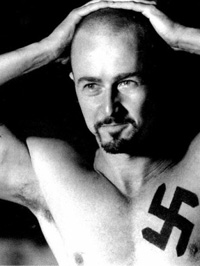
For all my bitching about Roberto Benigni winning Best Actor in 1998 for his incessant mugging in “Life is Beautiful,” I was also thrilled the Academy watched enough films and paid enough attention to realize that Edward Norton was deserving for his magnetic turn as a neo-Nazi who sees the light in “American History X.” Norton was electrifying as Derek, the charismatic leader of a group of skinheads, handpicked by the older gentleman, played with menace and sleaze by Stacey Keach, who believes in what Hitler taught and seeks to spread the word to the youth of California.Norton gave the best performance by an actor I saw in 1998, but the Academy got caught up in the groundswell of support of Benigni’s movie, a fable set in a death camp. I’m not a fan, either of his overwrought, over the top performance, or the film itself. No rant, you all know what I think there.

That said, there was a bounty of great male performances in 1998, many of which went unnoticed by the Academy. They did their best to get it right, though. Joining Norton and Benigni for nominations were Nick Nolte in “Affliction,” Ian McKellen, superb in “Gods and Monsters,” and Tom Hanks as the weary soldier in Steven Spielberg’s magnificent “Saving Private Ryan.”
Not even nominated, however, were Warren Beatty for his brilliant turn as the truth-talking senator in “Bulworth,” Joseph Fiennes in Best Picture winner “Shakespeare in Love,” Jim Carrey in “The Truman Show,” George Clooney in “Out of Sight,” Brendan Gleason in “The General” and John Travolta in “Primary Colors” or “A Civil Action,” take your pick. And perhaps the most deserving of all: Jeff Bridges as The Dude in “The Big Lebowski,” the actor’s finest work, in my opinion.
Each of the aforemenetioned men gave stronger performances than the eventual Oscar winner, yet failed to nab a nomination. Jeez!
-
OFF THE CARPET: Looking at the supporting ladies
A few weeks ago in this space I took a dedicated look at the lead actress category. With little in the way of actual development (this season is curiously divided on the timeline as we’ve got maybe another month before more major titles begin screening), I figured it would be a good idea to keep things going on that front and take a look at the supporting actress race.It’s a little difficult to ignore the fact that Mo’Nique stands way out ahead of the pack in this race for her work in “Precious.” Unless her reported behind-the-scenes drama-queen tactics somehow poison the cause, she should be holding a statue in four months’ time. She is fierce and focused in a monstrous role and when viewers get over the initial “she had this in her?” shock, they’ll also see it for the expert piece of acting that it is.
Mo’Nique is joined in her film, however, by what I’d call an awards-worthy turn from Mariah Carey. The singer-turned-actress has been lurking in Mo’Nique’s shadow throughout the film’s publicity and festival tour this year, and she also lost something of a diva battle with Mary J. Blige to have a featured track in the film. The poor girl can’t catch a break here, but I think she deserves a look from voters and, perhaps, even prognosticators.
A few weeks ago I mentioned in an episode of Oscar Talk that “Up in the Air” star Vera Farmiga would be pushed as a lead actress. Some things have changed.
-
THE LISTS: Top 10 ‘right actor, wrong film’ Oscars
As we head into the thick of awards season, one of the biggest “will-they-won’t-they” questions about this year’s Academy Awards concerns one of their most favored sons, Clint Eastwood. Specifically: despite wildly polarized responses to the film, and a widespread perception that he has already been amply rewarded in other categories, can Eastwood ride the wave of sentiment to a first acting victory for “Gran Torino?”That sneaky National Board of Review award last week suggests it’s still very much a possibility, whether or not people believe that it’s a performance for the ages — and, more to the point, whether or not it ranks with the best of Eastwood’s own onscreen work.
It’s no secret that, in the acting races, the Academy frequently bases their vote less on the performance at hand than the actor delivering it — one can point to any number of Oscar victories determined less by merit than by personal affection for an already rewarded star (let’s say Michael Caine in “The Cider House Rules”) or industry guilt over an under-rewarded one (most recently, Alan Arkin in “Little Miss Sunshine”).
Meanwhile, recent victories by the likes of Russell Crowe and Cate Blanchett point to the familiar “deferred-Oscar” syndrome, where an actor widely believed to have been snubbed in the recent past is hastily handed a statuette as a kind of cumulative acknowledgment of their recent strong work, frequently for a performance that doesn’t represent any particular breakthrough. (Kate Winslet might be vying for one of those this year.)
All are variations of the oft-lamented “right actor, wrong film” Oscars that are peppered throughout Academy history — a solution generally deemed more credible (though I’m not sure why) than the honorary “quick, before they die” lifetime achievement gongs doled out to the likes of Peter O’Toole and Kirk Douglas, actors who continually slip through the cracks in Oscar voting.
Age isn’t always the determining factor, though. The Academy has shown in recent years by passing over Lauren Bacall and Ruby Dee — both of whom would have been exemplary “right actor, wrong film” honorees — they’re not always in a sentimental mood. As the following list shows, reasons for rewarding actors for lesser work are many and varied: genre bias on the Academy’s part, mainstream emergence on the actor’s, or simply the voters’ collective nostalgia for a familiar face at the podium.
The one thing all these names have in common is that they’re distinguished, even great actors who deserve to have “Academy Award winner” forever attached to their monikers — just not necessarily for that performance. Will Clint Eastwood be the latest name to join their ranks? The jury is out.