In Contention

Tag: Best Foreign Language Film

  • Foreign film watch: China picks Olympics doc

    Heading the latest round-up of Best Foreign Language Film entries, China has taken the unusual step of submitting a documentary in the race. As you may gather from the title, “Dream Weaver: Beijing 2008” is a study of the country’s seven years of preparation for last month’s Olympic Games, and was produced by a state-owned company.

    It’s certainly a distinctive and topical selection, though I really can’t imagine it making the lineup. “Mei Lanfang,” Chen Kaige’s lush, Ziyi Zhang-starring biopic of the eponymous opera star, would have been a more expected choice, though sources reveal the film isn’t finished yet.

    Staying in that part of the world, Hong Kong has submitted “Painted Skin,” a fantasy epic from Gordon Chan centred on the love affair between a scholar and a beautiful, man-eating demoness. Featuring production design from Oscar nominee Chung Man Yee (“Curse of the Golden Flower”), it all sounds rather wild and wonderful — though probably a bit too “out there” for the voters.

    Potentially more in their comfort zone is the Czech Republic’s entry, “The Karamazovs.” A portrait of a travelling Czech theatre troupe staging a production of the titular Dostoyevsky novel in a Polish steelworks, it was described by Variety as an “excellent but extremely highbrow pic that should enrapture festival-goers.” (The review also makes structural comparisons to Almodovar’s “Bad Education.”) The film will screen at next month’s London Film Festival.

    Finally, Bosnia-Herzegovina, the nation that scored an upset win in 2002 with “No Man’s Land,” has gone with “Snow,” a female-oriented debut film about rural village life in the wake of the Bosnian genocide. The film bowed at Cannes to respectable reviews, and went on to take the Critics’ Week Grand Prize.

  • ‘Gomorrah’ is in — do we have a frontrunner?

    Well, as speculated a few hours ago, Italy has announced their submission for Best Foreign Language Film. And, to the surprise of precisely nobody, they have gone with Matteo Garrone’s “Gomorrah” — the sprawling, breathlessly acclaimed portrait of Naples mafia life that was arguably the breakout hit of May’s Cannes festival. (It received the runner-up prize.)

    It’s almost impossible to declare frontrunners in this category, given the foreign film committee’s wilful voting habits. Still, it’s safe to say that “Gomorrah” is the most anticipated and discussed contender to officially enter the race so far.

    Whether it will prove too bleak and violent for the blue-hair voters is difficult to predict — they acknowledged the edgy brilliance of “Amores Perros” in 2001, but since then, they’ve been unable to stomach the likes of “City of God” or last year’s “4 Months, 3 Weeks, 2 Days.”

    Based on the unanimously good word for the film, I’ve long been predicting that “Gomorrah” could even score breakout noms in the Best Director and Adapted Screenplay categories (a la “City of God”), but that was when I imagined Italy picking the more parochial “Il Divo” as their foreign-language entry. As it is, they’ve chosen the title with more crossover potential — it’ll be interesting to see what momentum Garrone’s film can build from its New York Film Festival screening.

    For my part, I’m seeing the film at its UK premiere this Sunday — hopefully to be followed by a Q&A with Garrone. I can’t wait.

  • ‘Three Monkeys’ joins the Foreign Film mix

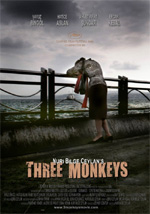
    Nobody who was paying attention at Cannes will be surprised that Turkey has selected Nuri Bilge Ceylan’s “Three Monkeys” as their entry in the foreign-language derby.

    The film was one of the critical sensations of the festival back in May and was many pundits’ pick for the Palme d’Or — it wound up with the Best Director award. Just to jog your memory, here’s a rave from the ever-reliable Jonathan Romney:

    An ostensibly routine noir-style psychological thriller vaults into the realms of high art in “Three Monkeys” … For the first time, Ceylan really involves himself in narrative complexity, spinning a subtly-twisty yarn with echoes of such crime writers as Simenon and James M. Cain … the smallest amount of trimming could well turn an exceptional film into a near-perfect one.

    I have been excited by this for some time. Ceylan’s 2002 film “Uzak (Distant)” is one of my favourite films of the decade so far, a work of visual wonder and immaculate storytelling grace. While wildly acclaimed, his follow-up, “Climates,” did less for me — it was exquisitely rendered, but on a narrative and thematic level, Ceylan seemed to me to be treading water. So I like the idea of this move into more genre-tinged territory. It’s one of my must-sees at the upcoming London Film Festival.

    I suspect the film may prove a little too resolutely arthouse for the frequently auteur-shy Foreign Film committee, but no matter. As when Mexico selected Carlos Reygadas’ bold, beautiful and thoroughly Academy-unfriendly “Silent Light” last year, I applaud Turkey for the bravery of their selection.

    (more…)

  • Israel picks the animated ‘Waltz’ for its foreign Oscar contender

    A website called cinemascope is reporting that Israel has chosen Ari Folman’s “Waltz with Bashir” to represent the country in the foreign film Oscar race.  Very wise.  Nice to see animated films getting this kind of an awards push, what with “Persepolis” repping France last year.  Let’s just hope “Waltz” doesn’t get the shaft like “Persepolis” and “4 Months, 3 Weeks and 2 Days” last year from a majorly disfunctional branch of the Academy.

    Guy, by the way, has been doing a nice job of wrangling the foreign film news lately, so keep it hear as updates keep coming.

  • ‘O’ Horten’ among further Foreign Film entries

    Leading a quick roundup of some recent entries in the Best Foreign Language Film race, Norway has unsuprisingly selected Bent Hamer’s absurdist comedy “O’ Horten” as their pony. The film garnered a number of followers at Cannes and Telluride, with Variety declaring it a “warm and gently humorous divertissement.”

    I was a big fan of Hamer’s previous films “Kitchen Stories” and “Factotum,” the latter a sadly underexposed Charles Bukowski adaptation that featured a career-best performance from Matt Dillon. I’m looking forward to “O’ Horten”; I wouldn’t be surprised to see it in the final shortlist, at least.

    Other titles joining the mix (that we haven’t already reported) include:

    “Taare Zameen Par,” from India, starring and directed by Aamir Khan, a 2001 nominee for “Lagaan”;

    “Last Stop 174,” from Brazil, a Toronto entry from Bruno Barreto, a 1997 nominee for the brilliant “Four Days in September”;

    (more…)

  • France submits ‘Class’ over ‘So Long’ for foreign Oscar

    François Bégaudeau in The ClassOne big question mark floating around since the foreign language film submissions started trickling in has been which film France would submit, the Cannes sensation (and Palm d’Or winner) “The Class” or Philippe Claudel’s “I’ve Loved You So Long.”

    Anchored by a critically acclaimed performance from Kristin Scott Thomas, Claudel’s film is one of the most buzzed films to come out of Telluride and Toronto.  “Best film of the year” has been a typical verdict.

    Then again, it’s hard to argue with Laurent Canet’s Palm d’Or winner, which beat out some thick competition on the Croisette this year.

    Well today we get an answer.  France will be submitting “The Class” as their foreign language film contender in this year’s Oscar race.  The result is similar to last year’s debate when the country had a critical darling and a film packing a performance punch to work with in “Persepolis” and “La Vie en Rose” respeticvely.  The former ended up making the trip before being unceremoniously cut from the competition during the early stages.

  • More foreign film submissions trickle in

    With the deadline for submissions for Best Foreign Language Film coming at the end of the month, these are virtually being announced on a daily basis. The latest:

    Canada, whose “The Barbarian Invasions” took the gold in 2004, has selected French-Inuit period drama “The Necessities of Life.” The film, a period piece about the relationship between a hunter (played by Natar Ungalaaq from “Atanarjuat: The Fast Runner”), dying in a Quebec City hospital, and a young Inuit orphan, premiered at the recent Montreal Film Festival, where it won the audience award.

    Variety describes it as “a finely wrought drama” and “a model of emotional restraint.” Hopefully my fellow contributor John can offer a local perspective on the selection.

    Elsewhere, Finland has chosen “Home of Dark Butterflies,” another Montreal entry. The film is centred on a group of teen boys at an isolated reform school, got only a middling Variety review — they criticise it for “veering into melodramatic excess.”

  • Sweden and Germany loom large in Oscar race

    As anyone who follows the arcane workings of the Best Foreign Language Film award knows, there is no such thing as a sure thing in the category. However, it’s fair to say that Sweden and Germany have emerged as strong contenders in the race after both countries selected high-profile films as their official entries.

    Unsurprisingly, Sweden has chosen “Everlasting Moments,” a highly personal biopic from veteran filmmaker Jan Troell — a Best Director nominee back in 1973 for “The Emigrants.” The film is a portrait of Maria Larsson, Sweden’s first female photographer, who also happens to be the grandmother of Troell’s wife (and co-scripter) Agnes. The film bowed at Toronto last week to warm reviews, including this rave from Screen International:

    Discreet, old fashioned, traditional and altogether admirable, this is Jan Troell in what he does best … Paying minute attention to the smallest details, taking its time but never appearing to drag its feet, immensely sympathetic to its heroes and villains alike, this is an intimate family portrait and at the same time a rich canvas of working class life … This picture has quality stamped all over it, awards are likely to come its way whether for direction, photography or the performances of Maria Heiskanen and Mikael Persbrandt.

    By all accounts, it’s a stately, beautifully crafted period piece with a degree of social gravitas — difficult to see the Academy resisting that one.

    On a very different note, Germany has gone with Uli Edel’s terrorism thriller “The Baader Meinhof Complex” as its entry. The film, a chronicle of the infamous left-wing Red Army Faction group that terrorised the country through the late 60s and early 70s, has yet to open in its home country, but advance word is promising. (Jeff Wells gives some useful insight here.)

    (more…)

  • 9/16 Oscarweb Round-up

    Brad Pitt in Burn After Reading• Sasha Stone rounds up a few of the foreign language film submissions coming in. [Awards Daily]

    • Peter Bart seems to think the Coen brothers’ best opening weekend yet for “Burn After Reading” has more to do with turning “cold” into “hot” than with Brad Pitt extracting laugh after laugh in trailers for the past few months. [Peter Bart]

    • Sony Pictures Classics nabs the Toronto documentary hit “Every Little Step.” [The Hollywood Reporter]

    • Hirokazu Kore-Eda’s “Still Walking” edges out “Goodbye Solo” and “The Wrestler” for the best of Toronto as Eugene Hernandez polls critics and bloggers at the fest. [indieWIRE]

    • Keira Knightley keeps the “Duchess” publicity tour going with a stop under Donna Freydkin’s microscope. [USA Today]

  • Jeff Wells calls it for Scott Thomas

    There has been so much hype around Kristin Scott Thomas’ apparently devastating performance in Philippe Claudel’s “I’ve Loved You So Long” that a lot of the press I’ve read tends to sideline the film itself.

    Now Jeff Wells has rectified that with a piece in which he declares it the best film of the year so far:

    The film itself is a landmark-level achievement. It’s remarkably tight, absorbing and affectng every step of the way — a genuinely profound growth journey taken with quiet and gentle steps. Whatever happens on the Oscar nomination front, this film has immediately shot to the top of my list of the year’s best films.

    Not that he neglects to discuss the film’s esteemed British star. Indeed, he thinks she’s a shoo-in for an Oscar nod — and possibly more:

    She’ll definitely land a Best Actress nomination, and she just might win, considering that she achieves so much in ILYSL with very little “acting” plus the fact that she’s been around for a couple of decades.

    (more…)

  • 9/6 Oscarweb Round-up

    Gerard Butler and Thandie Newton in RocknRolla• Nancy Kriparos keeps her Oscar diary going with looks at “Passchendaele,” “RocknRolla” and “Burn After Reading.” [Awards Daily]

    • Tom O’Neil and Jeffrey Wells talk up the Oscar prospects of Danny Boyle’s “Slumdog Millionaire.” [Gold Derby]

    • Wells, meanwhile, seems to be talking himself out of seeing Spike Lee’s “Miracle at St. Anna” as best he can. [Hollywood Elsewhere]

    • David Poland calls “Lovely, Still” the first real surprise of Toronto. [The Hot Blog]

    • Anne Thompson responds positively to Richard Linklater’s “Me and Orson Welles.” [Thompson on Hollywood]

    • The Kingdom of Jordan will leap into Oscar’s foreign language film race for the first time ever with Amin Matalqua’s “Captain Abu Raed.” [Variety]

  • Foreign film watch: Holland and Taiwan pick their horses

    For those of you keeping track of the Best Foreign Language Film race, Screen Daily carries details of submissions from two countries with good previous form in the category.

    After fouling foul of the Academy’s arcane rules last year — their entry “Lust, Caution” was disqualified for not being sufficiently Taiwanese — Taiwan is hoping for better luck this time with “Cape No. 7,” a romantic comedy about a group of coastal townspeople who form a support band for a visiting pop star.

    The Netherlands, meanwhile, has selected “Dunya and Desie,” a youth-oriented road comedy about two best friends travelling through Morocco. I find it a surprising choice — the sweeping period weepie “Bride Flight” seemed more Oscar-friendly to me — but the film’s topical theme of Muslim-Western relations might resonate with voters.

    Variety, reviewing it at the Berlin fest in February, loved the film, saying it “positively sings with upbeat energy and humor,” drawing favourable comparisons to “Bend It Like Beckham,” and finally citing “enormous remake potential.”

    For a country with such a small industry, the Dutch have an enviable track record in this category, having won three times, as well as managing nominations for such minor works as “Zus en Zo” and “Twin Sisters.” They are always ones to watch.

  • Cinematical swoons over Scott Thomas

    Compared to the drought of previous years, where the five nominees have been all but pre-determined for months in advance, the Best Actress race is looking rather crowded at this point. (It’s certainly the major category that gave me the most pause when I updated my predictions this morning.)

    What’s gratifying to see is that the field features so many contenders from independent films, including the much-discussed Sally Hawkins, Charlize Theron (coming off a lot of Venice buzz), Anne Hathaway, Melissa Leo and Michelle Williams.

    But perhaps the darkest horse of all is Kristin Scott Thomas, an actress whose star has dimmed somewhat Stateside since receiving her only Oscar nomination twelve years ago. In that time, she’s been working more and more frequently in her adopted homeland of France, and she now returns to prominence with the French-language “I’ve Loved You So Long,” a dark domestic drama in which she plays a woman reconnecting with her family after fifteen years in prison.

    Scott Thomas has been garnering steady acclaim since the film bowed at Berlin in February. Now, in the wake of its Telluride screening, and in the midst of a rave review declaring the film a “rare masterpiece,” Cinematical joins the chorus with this bold assertion:

    Thomas’s performance here has been generating Oscar buzz for a while now, and deservedly so; she will almost certainly garner a Best Actress Oscar nod for this film.

    (more…)

  • The top 15 greatest foreign language films ever

    Nosferatu the VampyreI thought I’d respond to some harking in a recent post about my tendency to lean toward domestic cinema.  The assumption seems to be that I don’t care for foreign language cinema, but that couldn’t be further from the truth.

    One of the great joys of attending a film festival is to seek out films from other countries, to learn what one can about their cultures through their brand of cinema and to understand that art, in any form is really not so different around the globe.

    I discovered foreign language film at a very young age thanks to a local rep cinema that constantly played movies like “Breathless,” “Beauty and the Beast,” “The Wild Child” and “Rules of the Game.” The first time I went to see “Breathless” I was 13 and was thrilled by this “new” experience of reading subtitles and watching something that seemed so different to me. Of course as I matured I realized that what seemed new was the artistic vision of a different culture.

    The old theater ran some films directed by the great Indian filmmaker Satyajit Ray: The Apu Trilogy. For the first time I saw what extraordinary realism could be created on the screen. I remember when “The Tin Drum” was banned in Ontario (stupid, stupid, stupid). I headed down to Buffalo to see it…loved it.

    I remember the first time I saw a film directed and written by Lina Wertmuller, who was huge in the 1970s for a short time, as well as my discovery of Ingmar Bergman and Bernardo Bertolucci as well, Akira Kurosawa and Federico Fellini, their films forever seared into my mind.

    Now back to the reason for posting this entry: Do I prefer North American cinema? Shoot me, but yes I do, because it is what I was raised on, what I am used to.

    Random asides on some of the greats…I believe Ingmar Bergman is overrated, and though I have enjoyed a few of his films, I certainly do not believe everything he makes is a masterpiece. His work, the two exceptions on this list below, strikes me as pretentious and over-intellectualized.

    Though Jean-Luc Godard did something rather extraordinary with “Breathless,” I have not liked much of anything else he has directed, some of it nothing more than artistic masturbation.

    I think it is somewhat sad that so few foreign language films actually make it to these shores, however.  But on with the list…

    (more…)

  • Foreign film race begins… get ready to groan

    Variety carries details of the first official entry that I’ve heard of in the Best Foreign Language Film derby – Denmark has put forward “Worlds Apart,” from director Niels Arden Oplev. The country has a pretty good track record in this category, having won back-to-back in the 80’s with “Babette’s Feast” and “Pelle the Conqueror,” while Susanne Bier’s popular “After the Wedding” nabbed a nomination two years ago.

    “Worlds Apart,” which has already secured US distribution, is a small-scale pic focusing on a teenage Jehovah’s Witness forced to make a difficult choice when she falls in love with a non-believer. It all sounds terribly earnest, but that’s right up the Academy’s alley when it comes to this category. Reviewing the film at the Berlin festival back in February, Variety called it a “provocative, well-turned drama,” and speculated that a US remake could be on the cards.

    Apparently, the Academy has invited 96 countries to enter the race this year, with the submission deadline looming large on October 1. They should be looking to regain some credibility in this category after the embarrassing fiasco of last year’s race, which saw a banner year for world cinema reduced to the most tepid slate of foreign-language nominees in recent memory, as landmark pictures like “4 Months, 3 Weeks, 2 Days,” “Lust, Caution” and “Persepolis” were, one by one, either snubbed or disqualified.

    (more…)

  • What’s the worst Best Actor choice of all time?

    Roberto Benigni at the Academy Awards in 1999With the Bat frenzy settling down, and the Toronto Fest looming just ahead, I thought I’d get back to, well, complaining about the Academy’s more lame-brained calls over the years!

    What has been the group’s single worst choice for Best Actor in its 80 year history?  My choice: Roberto Benigni for “Life is Beautiful” in 1998.

    I remember sitting stunned when his name was called out at the Screen Actors Guild awards for his incessant, mugging in the film, possibly the most over-praised endeavor of 1998. What this meant of course was that he now had the inside track to win the Academy Award for Best Actor for this ridiculous performance.

    And he did just that, clowning around, jumping up on the seats of those around him, massacring the English language (which he speaks perfectly fine) with his acceptance speech, trying his best to be endearing and beloved.

    How and why did this performance — and this film — become so beloved by the AMPAS?

    Among the performances Benigni defeated that year were Edward Norton’s seething work in “American History X,” Tom Hanks’s superb turn in “Saving Private Ryan” and Nick Nolte’s raging performance in “Affliction.” Each performance was vastly superior to Begnini’s, and as always, some of those not nominated could have easily taken his place.  Jim Carrey in “The Truman Show” comes to mind.

    Hollywood, however, fell in love with Mr. Begnini as he cruised through cocktail party after cocktail party, dinner at Barbara Streisand’s house, the entire town entranced by a brown-eyed clown.

    His performance was little more than over the top shameless mugging for the camera — “acting” at its worst. For that he gets an Oscar, along with nominations for Best Director and a win for Best Foreign Language Film??

    There have been terrible Oscar wins in the past, of course: “The Greatest Show on Earth,” Elizabeth Taylor for “Butterfield 8,” Al Pacino in “Scent of a Woman.  But has the Academy ever been so incredibly bamboozled by a film and a performer as they were in 1998?

    What about you?  What do you think is the Academy’s all time worst choice for Best Actor?  Or Best Foreign Language Film for that matter?

  • On the Candian cinema

    With the recent announcement of Paul Gross’s “Passchendaele” as the opening night film at this year’s Toronto International Film Festival (and honor traditionally handed to a Canadian endeavor), I thought I’d dedicate some space to the best of Canadian cinema.  But first, a history of sorts.

    Growing up in Ontario, Canada, I fell in love with cinema at a very young age. I loved watching those old Universal monster movies on Friday nights, or the Sunday afternoon Big Show of the Week, which was usually yet another showing of “Man of a Thousand Faces” or “Red River.” Essentially, I grew up on American films, and I believe American cinema is the most exciting on the globe.

    I say this as a Canadian who loves our national cinema, as a critic who has access to Canadian films that are often never released, and as a huge supporter of the Canadian film industry. As long as the government controls what is happening with the money that makes these films, we will never have as strong an industry as we could, and it will be forever difficult to get a film made in this country.

    Ask Sarah Polley, a national treasure and world-reknowned actress who struggled to get funds to make “Away from Her,” one of the best reviewed films of last year. The reason films get made at all is through government grants and funding. It is a dangerous catch 22.

    The first Canadian that mad an impact on me was “Goin’ Down the Road,” a wonderful picture made in 1970 by director Don Shebib (who attended film school with Francis Coppola). His picture was about Canadians, for Canadians made by Canadians and dealt with plights recognized by Canadians. But of course one did not have to be Canadian to enjoy it. In fact, the film played for more than a year in New York City in 1970 when films lasted longer than two months in theaters. More than the great documentaries from the National Film Board, this film seemed to announce to the world that Canada had a filmmaking community waiting to be unleashed.

    (more…)

  • AMPAS sort of cleans up music and foreign categories

    Oy.  We’ve got a long way to go.

    According to the hot-off-the-presses release, the two categories that received the most nipping and tucking were these two infamously flawed arenas.

    Here’s what they have to say regarding the composers:

    Three items of note were altered in the Original Song rules.  First, while there continues to be no limit on the number of songs from a given film that can be submitted for consideration, no more than two songs from any one film may be nominated for an Academy Award.

    Good.  No cuts out the possibility of another poor track (*coughhappyworkingsongcough*) pushing out far superior work (*coughsocietycough*).  But there’s more:

    Also, in addition to the annual screening event at which members of the Music Branch view clips featuring the eligible songs as they appear in the films and vote, DVDs of those same clips will be made available to branch members who are unable to attend the screening; ballots will accompany the DVDs and must be returned by mail.

    Also good.  Maybe some informed decisions can be made by a larger majority.  But there’s no accounting for taste, so we’ll see how it goes.

    No alteration of that pesky, subjectively rendered Rule 16B that keeps biting artists in the ass.

    Music Branch members who have one or more songs in contention for nominations do not vote in that phase of the balloting.  They remain eligible to vote on the final ballot to select the winner.

    Got that, Shaiman?

    On to the foreign language film category, where the Academy seems to be putting a band-aid on a broken arm:

    The only other category with a notable change is the Foreign Language Film Award and as was the case in 2006, the alteration is a procedural one rather than one in the rules per se.  For the 81st Academy Awards, the two-phase process by which the nominees are selected will remain intact.  However, the Phase I committee – which is open to any voting member who views a minimum number of the eligible films – will now vote to determine only six of the nine films that will ultimately go to the Phase II committee.  The other three titles will be determined by those members of the 20-member Foreign Language Film Award Executive Committee who have qualified to vote in the category.  The executive committee’s selections will be made after the Phase I voting has been tallied.

    Again, there’s no accounting for taste.  We’ll see how it goes.