I’ve been tied up all week so I’m just now catching up on things like the trailers for “The Road” and “Nine,” so forgive the belated drooling, but I have to offer this space for Ms. Cruz. Yowsers.

I’ve been tied up all week so I’m just now catching up on things like the trailers for “The Road” and “Nine,” so forgive the belated drooling, but I have to offer this space for Ms. Cruz. Yowsers.
I have to say, this looks sillier than I anticipated. It’s comical (not in the way intended) and leans a bit too heavy on the farce throttle. When the title screen came up, I chuckled. It’s not to say that the film doesn’t look fun, because clearly it does. But it has a rather unwelcome gloss to it and, of course, is such a bastardization of the source material that I’m glad we have some time to square ourselves with the direction of the project before release.
Anyway, that’s me. What do you think?
 Maybe I’m slow on the uptake here, but I had no idea Johnny Depp has been circling the role of John Dillinger for 20 years now. Chalk it up to one more reason to be chomping at the bit in anticipation of this summer’s “Public Enemies” from director Michael Mann.
In this San Francisco Chronicle story, Ruthe Stein talks to the director about the film’s coincidental timeliness (what with the general negative attitude toward banks in these troubling economic times), Mann’s typical encouraging of his actors to heavily research their roles and the contention that the film glorifies a menace to society. There’s even a bit where Mann defends Bale in the wake of the “Terminator” outburst (which was probably nothing compared to the shit-fits Mann has reportedly thrown on sets).
The most intriguing quote has to be this dissection of Depp by the director, leaving me to wonder whether Mann might have pulled a career-best performance out of the actor, whose grandfather was a bootlegger during the Depression and apparently served as an inspiration for the performance:
“A lot of what goes on inside Johnny Depp could be used and revealed,” Mann said. “I know there are dark currents within Johnny and also from his past life, and I know he has a lot of John Dillinger inside of him. He has a deep understanding of a troubled past and a troubled life, but is someone who is a very passionate man. He could understand those currents in unique ways.”
It’s a great read. Check out the full piece here. As previously reported, “Public Enemies” will be the centerpiece presentation of this year’s Los Angles Film Festival and will open nationwide on July 1.
 So here we go again. The 1990s were an odd decade cinematically, ripe with excellent films, ground-breaking work, innovations as well as a large number of duds. There were also films released to rave reviews that never found an audience.
I combed through the decade and came up with 15 films worthy of discussion as the more under-appreciated of the 1990s, though I am positive you will all add immeasurably to the list, as you did with my take on the 1980s.
The independent movement gave us many great films through this span, as well as some formidable new talent, but I must confess I grew tired of the studio slagging through the decade. Among the critical community it became almost a rite of passage. There was some wonderful studio product here and there, of course: “Goodfellas,” “JFK,” “Unforgiven,” “Schindler’s List,” “Apollo 13,” “Saving Private Ryan” and “LA Confidential” are just a few.
My list, in no particular order…
In “Miller’s Crossing,” the Coen brothers do a masterful job of creating a funny and dark gangster film with superb performances from the great Albert Finney, Marcia Gay Harden, and the sleazy John Turturro in a film that gently pulls the audience into its story. Made on the cheap, the art direction and costume designs are great, and that story…man those Coens get so much out of, “What’s the rumpus?”
 Flipping through Empire Online’s typically entertaining list of features recently, I stumbled across this portrait of filmmaker Charlie Kaufman (whose brilliant “Synecdoche, New York” opened in the UK this weekend) giving one-offs on the six features sprung from his twisted mind to date.
There’s talk of his working relationship with director Michel Gondry on their first effort, “Human Nature” (which I still haven’t seen), the agony of adapting Susan Orlean’s “The Orchid Thief” into 2002’s “Adaptation” and meeting Harvey Keitel and Pierce Brosnan at the Oscars in 2004 (when Kaufman one the original screenplay award for his masterpiece, “Eternal Sunshine of the Spotless Mind”). My favorite is this aside about “Being John Malkovich”:
“There’s something about John Malkovich that’s odd and unknowable. There’s a look in his eye that makes me imagine there’s someone else looking out from inside his head. His name is funny, you know – when people say ‘Malkovich, Malkovich, Malkovich’, it’s funnier than any other name I’ve tried. And I’ve tried other names, because we didn’t know if we can get him. We also thought of Christopher Walken, we thought about Willem Defoe. I don’t know what that group is exactly, but they’re serious actors, they’re good actors, but they’re slightly odd. So it’s funny, but it’s not a joke in the way it would be if it were, say, Jerry Lewis.”
Kaufman also calls “Synecdoche” a “horror film,” which I’d be willing to go along with. I’d be willing to go along with just about anything he has to say on that film, to be honest. It’s the most bizarrely brilliant film that I can’t qualify to come across my path in a long, long time. And suddenly I want to see it again.
 Now this is an exciting pairing. You might remember that I’m pretty crazy about “Il Divo,” Paolo Sorrentino’s blazing political biopic-thriller that took a well-deserved Jury Prize at last year’s Cannes fest. (Seriously, check it out when you have a chance.)
Between that triumph and his intricate, super-stylish 2001 noir “The Consequences of Love,” Sorrentino has shown a kinetic narrative sense and visual dynamism that seemed a virtual siren-call to Hollywood, so it’s no surprise to hear that he’ll be making his English-language debut with his next feature.
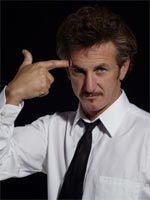
Variety reports that Sean Penn — who, coincidentally or not, headed the jury that was so impressed by “Il Divo” last year — is set to star in “This Must Be the Place,” which will see Sorrentino teaming up with his regular producers once more. The thriller-ish pitch runs as follows:
Penn would play a wealthy rock star who becomes bored in his retirement and takes on the quest of finding his father’s executioner, an ex-Nazi war criminal who is a refugee in the U.S.
Penn strikes me as a good trans-Atlantic match for Sorrentino, both men having a muscular, showy approach to their respective crafts. I’m not sure what to make of the premise on paper; it seems to allow for quite a pulpy, heightened treatment, but there’s so little to go on. For now, the names alone have me hooked.
 God is so 2006. “Angels & Demons” was the number one movie at the box office this weekend but the $48 million it raked in is barely more than half of the $84.5 million registered by “The Da Vinci Code” in its opening frame. What happened? Three things.
First, the free publicity generated by the media and the “controversy” surrounding the first film’s opening was nowhere to be found this time. Second, the source material was much less popular. And third, the first film was generally considered pretty dull by critics and audiences. Add all that up and you have a lackluster debut when compared to the original, but on its own terms, you gotta be pretty happy with close to $50 million for an adult-leaning summer thriller. Especially when the film racked up $100 million in overseas territories this weekend as well.
“Star Trek” showed “Wolverine” and Mr. Hanks what happens when audiences love your product by dropping a solid 43% for a $43 million weekend. It even out-grossed “Angels & Demons” on Saturday and Sunday, so expect the weekday grosses to be neck and neck. It will pass “Wolverine”’s gross on Monday or Tuesday. J.J. Abrams clearly got it right with moviegoers and this one could see as much as $250 million before it’s done. Don’t think that doesn’t affect the Oscars because it does, and nominations in the sound and visual effects categories, and perhaps other technical fields, are a safer bet than they were a few weeks ago.
Since “Wolverine” is pretty much already a box office non-factor, there’s not much else to report in the top 10, except that “Monsters vs. Aliens” dropped only 8% due to the fact that families have no other options out there. Expect that to bode well for “Night at the Museum: Battle of the Smithsonian,” as parents clearly want something to take their kids to and Ben Stiller is ready to deliver.
 As I expected, Ken Loach’s “Looking For Eric,” his first Cannes entry since winning the Palme d’Or in 2006, hasn’t exactly set the Croisette alight. Critics seem to agree that the football-themed comedy is a modest charmer, but too slight to really hold its own in the competition. (Probably a welcome shift in pace, what with critics still reeling from “Antichrist.”) Variety’s Derek Elley speaks for most of the critics with his kind but reserved take on the film:
Loach and writer Paul Laverty’s ninth feature together is a curious hybrid: Three movies — boilerplate, socially aware Loach; personal fantasy; romantic comedy — wrap around a central core of a hopeless soccer fanatic who’s given a second chance to sort out his life. As in many of Laverty’s scripts, problems of overall tone and character development aren’t solved by Loach’s easygoing direction, though when it works, “Eric” has many incidental pleasures.
The Guardian’s Peter Bradshaw also likes it well enough, drawing comparisons to “Play It Again, Sam,” and describing the presence of football legend Eric Cantona — certainly the film’s biggest commercial drawcard, in France especially — as “excellent comic value.” The word “nice” is used at several points, which seems rather telling.
As much as I like the 72 year-old director’s work — though it’s been aeons since he made anything approaching the level of “Kes” or “Poor Cow” — one has to once more wonder whether this is the kind of film that really needs to be on the Palme d’Or shortlist, at the expense of bolder, less exposed talent.
It’s my fault you haven’t seen John and Chad’s columns this weekend. After I drop off family at the airport and my life gets back to normal later this afternoon, you’ll have them. Cross my heart.
…that, if it’s domestically released this year, Lars Von Trier’s “Antichrist” will pop up somewhere in my top 10?
 • “Star Trek” looks to be a hit off-world. [The Carpetbagger]
• It looks like Kenneth Branagh and Marvel have found their Thor: Chris Hemsworth from “Star Trek.” [Deadline Hollywood Daily]
• Jeff Sneider takes a long, hard look at the MTV Movie Awards. [Examiner.com]
• Tom O’Neil poses the obvious question: Will “Angels & Demons” bring another Razzie bid for director Ron Howard? [Gold Derby]
• Speaking of which, someone finally calls out the two worst writers in the business as responsible for the clunky film. [Peter Bart]
• Dan Jolin wonders if the latest 3D craze is a bunch of hogwash. [Empire]
• Laughing stock Roger Friedman gets a new gig as “senior correspondent.” [Hollywood Reporter]
“Night at the Museum: Battle of the Smithsonian” premieres in D.C. [Washington Post]
• On the stamina of fan-movie filmmakers. [The Independent]
• Sad to see a once-great magazine reduced to nothing but constant top 10 lists, but here’s another one: top 10 “safe for work” movie strip scenes. Oy. [Premiere]
• Tom Shone talks to Ryan Fleck and Anna Boden, writer/directors of the brilliant “Sugar.” [The Guardian]

UPDATE: Sorry, my fascination is unending. The Guardian’s Xan Brooks comes out in full support of the film:
I stumble out in a daze, momentarily unsure whether I loved it or loathed it. Abruptly I realise that I love it. Von Trier has slapped Cannes with an astonishing, extraordinary picture – shocking and comical; a funhouse of terrors (of primal nature, of female sexuality) that rattles the bones and fizzes the blood before bowing out with a presumptuous dedication to Andrei Tarkovsky that had sections of the crowd hooting in fury … Pound for pound, (“A Prophet”) is surely the strongest film of the competition so far. Why, then, is it “Antichrist” that keeps me awake last night, whirling like a dervish in the darkness of the room?
EARLIER: Somehow I get the feeling that Lars Von Trier went to bed last night a very satisfied man. After the deafening indifference that greeted “The Boss Of It All” and “Manderlay,” he arrived at Cannes with one objective more crucial than any other: to prove that his work could still inspire feeling and discussion. Point proven.
Whether or not “Antichrist” is as awful as some people seem to think — and indeed, not everyone does think so — is beside the point. For all his genius (and I do think he is one of the most extraordinary filmmakers of his time), Von Trier shamelessly thrives on attention; when his work is ignored, as has been the case these past six years, his own creative mojo appears to flag. Much has been said about how “Antichrist” is the product of a recent bout of severe depression; perhaps his rediscovered capacity for provocation signals a renewed willingness to engage, and a more fruitful creative period to come.
From this morning’s Telegraph (among other sources):
Jamie Foxx, the African-American actor, singer and comedian, has been named as a potential contender for the role of Frank Sinatra in Martin Scorsese’s biopic of the entertainer.
Foxx, who won a Best Actor Oscar for his portrayal of Ray Charles in the 2004 film Ray, reportedly considered to be “perfect” for the role. If he is chosen for the part, it will be one of the most prominent examples of “colour-blind” casting in Hollywood history. Also in the running are George Clooney, Leonardo di Caprio, Harry Connick Jnr and Justin Timberlake.
They forgot to mention Dakota Fanning.
 Curiouser and curiouser. Roger Ebert is clearly still processing Lars Von Trier’s latest crowd-terroriser, but there appears to be respect in his initial assessment:
Whether this is a bad, good or great film is entirely beside the point. It is an audacious spit in the eye of society. It says we harbor an undreamed-of capacity for evil. It transforms a psychological treatment into torture undreamed of in the dungeons of history. Torturers might have been capable of such actions, but they would have lacked the imagination. Von Trier is not so much making a film about violence as making a film to inflict violence upon us, perhaps as a salutary experience. It’s been reported that he suffered from depression during and after the film. You can tell. This is the most despairing film I’ve ever have seen.
What can be said is that von Trier, after what many found the agonizing boredom of his previous Cannes films “Dogville” and “Manderlay,” has made a film that is not boring. Unendurable, perhaps, but not boring. For relief I am looking forward to the overnight reviews of those who think they can explain exactly what it means. In this case, perhaps, a film should not mean, but be.
There is no film on the planet that I want to see more, right now, than “Antichrist.”
Unlike the appropriately sober (if aesthetically half-assed) UK poster, this U.S. one-sheet for “Chéri” does much the same thing as the trailer in selling the film as an effervescent romantic comedy.
The film plays along for its first half, though as I said in my review, the chick-lit crowd may find themselves surprised by the melancholy turn the proceedings take. Still, whatever means necessary, and all that. Meanwhile, you’d never guess that Rupert Friend plays the title character. (Thanks to commenter Red Wine for the tip.)

[Source: IMP Awards]
Oh dear — this is turning out to be a pretty rough weekend at Cannes. We’re still awaiting the first official reviews of Lars Von Trier’s “Antichrist,” which just screened this evening, but it seems to have attracted the full ire of the notoriously excitable Cannes crowd. Boos, gasps and laughter reportedly greeted the screening on the gory, sexually explicit film, which apparently throws everything from talking animals to genital mutilation into the pot.
Jeff Wells pulls no punches in his assassination of the film:
Easily one of the biggest debacles in Cannes Film Festival history and the complete meltdown of a major film artist in a way that invites comparison to the sinking of the Titanic … It’s an out-and-out disaster — one of the most absurdly on-the-nose, heavy-handed and unintentionally comedic calamities I’ve ever seen in my life. On top of which it’s dedicated to the late Russian director Andrei Tarkovsky, whose rotted and decomposed body is now quite possibly clawing its way out of the grave to stalk the earth, find an axe and slay Von Trier in his bed.
In trying to disentangle the order of Martin Scorsese’s upcoming projects (in the wake of this week’s news that the master is taking on Sinatra), AwardsDaily’s Ryan Adams takes a peek at the range of titles that IMDB Pro lists on the director’s slate.
I am mistrustful of IMDB’s information at the best of times, particularly with a director like Scorsese who seems to nurture multiple projects indefinitely. (For how many years has “Silence” been in the conversation, after all?) But I was intrigued and a little puzzled to see an optioned property titled “Cache” at the head of the list, with a projected date of 2011.
Is this the long-mooted American remake Michael Haneke’s 2005 masterpiece, or is it unrelated? (There’s no accent aigu on the title, after all.) Can anyone enlighten me? I remember recoiling in horror when Ron Howard was mentioned in connection with the project a few years ago. Scorsese is obviously a step up, but a remake — by anyone — of Haneke’s very idiosyncratic film still strikes me as a dicey prospect, given how rooted it is in a very specific historical and political context.