
In Contention

Blog

  • Final Cannes contenders unveiled

    Paz de la Huerta in Enter the VoidThat’s it — all 20 Palme d’Or contenders have now screened for critics, and the final deliberations can begin. Most of the media attention in the past two days has focused on Gaspar Noé’s new film “Enter the Void,” though it hasn’t aroused anything like the firestorm of controversy that his “Irréversible” did in 2002. (Perhaps the media simply hasn’t the energy for a fight after “Antichrist.”)

    Although reportedly as violent and sexually explicit as one would expect from Noé, the film, which screened at the Croisette in still-unfinished form, seems to have prompted more confusion than outrage from the press. The critical response, meanwhile, is more positive than might have been expected. Manohla Dargis leads the cheer team for the film:

    An exceptional work, though less because of its story, acting or any of the usual critical markers. What largely distinguishes it, beyond the stunning cinematography, is that this is the work of an artist who’s trying to show us something we haven’t seen before, even while he liberally samples images and ideas from Stanley Kubrick and the entirety of American avant-garde cinema. The grungy milieu and calculated shocks might have been designed to make you flee – even while your attention is tethered to the camera – but, really, these aren’t the point. The point is the filmmaking.

    ScreenDaily’s Mike Goodridge is somewhat awed, describing the film as “a wild, hallucinatory mindfuck” that is “nothing short of hypnotic,” even suggesting the film as a future staple for narcotic-fuelled viewings — though like Dargis, he dismisses the characterisation and narrative as being of secondary quality and importance. Variety is less forgiving, labelling the film “tiresomely gimmicky” and implying it is less “pure cinema” than “pure trash.”

    (more…)

  • WEEKLY WRAP: ‘Antichrist’ and action

    Willem Dafoe in Antichrist• Scandalising media and polarising critics, Lars Von Trier’s “Antichrist” emerged as the undisputed talking-point of the Cannes Film Festival.

    • That firestorm even managed to overshadow the Cannes debut of Quentin Tarantino’s divisive “Inglourious Basterds.”

    • In other news from the Croisette, “A Prophet” impressed critics, while “Taking Woodstock” took a hit.

    • We celebrated the start of summer (and provoked some argument) with a list of the all-time Top 10 action sequences.

    • Unfortunately, our review deems “Terminator Salvation” unlikely to earn a place on any such future lists.

    • In the wake of that disappointment, “Up” happily lived up to expectations.

    • In box office news, “Angels and Demons” turned out to be a pale shadow of its predecessor.

    • This week’s edition of Page to Screen reviewed the literary source for Jason Reitman’s upcoming comedy “Up in the Air.”

    • John delved further through his personal cinematic treasure trove, returning to the 1990s, and reappraising last year’s “Revolutionary Road.”

  • Is pre-selecting seats really a big deal?

    I’ve got to get some reaction to this.  Our friend John Campea at The Movie Blog has cooked up another bitch-fest (he’s given to them), this one regarding the system of pre-selecting seats at movies.  It seems the poor guy has been spoiled senseless by living a mile up the street from the glorious Arclight Theater here in Hollywood (though now he’s taking in the rays in glorious Corona).

    Anyway, I should say I’ve been spoiled too, by press screenings, and I generally avoid midnight showings like the plague.  So when I do dish out the bucks, I prefer the time-honored tradition of showing up on time and picking a seat when I get inside the theater, thank you very much.  But this is an entertaining rant nonetheless.  Give us your thoughts:

  • Tell us what you thought of ‘Terminator Salvation’

    (from left) Christian Bale and Sam Worthington in Terminator Salvation

    The film dropped yesterday so I figure it’s a good time to go ahead and get this post up.  I’ve certainly made my thoughts known on McG’s new installment in a beloved sci-fi franchise, but I’m really interested to hear what the crowd has to say.  Cut loose in the comments section below.

  • Ebert makes a bold prediction

    Xavier Giannoli's In the BeginningOscar talk hasn’t surfaced that much on the Croisette this year, with “Bright Star” the only competition title prompting much speculation from the pundits. Roger Ebert, however, believes he has spotted an under-the-radar title that we’ll still be discussing come February:

    I think I may have just seen the 2010 Oscar winner for best foreign film. Whether it will win the Palme d’Or here at Cannes is another matter. It may be too much of a movie movie. It’s named “A l’origine” (“In the Beginning”) by Xavier Giannoli, and is one of several titles I want to discuss in a little festival catch-up.

    This is one of those movies that catches you in its spell. It’s a hell of a story. There’s a difference between caring what happens in a movie, and merely waiting to see what will happen.

    As someone who thoroughly enjoyed Giannoli’s gentle character study “The Singer,” I’m pleased to hear good word for the new film. Still, Ebert’s statement is surprising for several reasons, not the least of which is that “In the Beginning,” a comic fable about a con man who devises a plan to build a highway in a small French town, has enjoyed a mixed critical reception so far.

    (more…)

  • New to DVD, ‘Revolutionary Road’ may yet be discovered for the masterpiece it is

    (from left) Kate Winslet and Leonardo DiCaprio in Revolutionary RoadWhen “The Wizard of Oz” was released in 1939, neither audiences or critics were particularly fond of the film and it died a rather quick death at the box office. When “Citizen Kane” was first released in theatres in 1941, audiences did not warm to it, and despite winning the New York Film Critics Circle award for best film, and nine Academy Award nominations, it too died a fast death.

    In 1956, John Ford’s magnificent western “The Searchers” was not nominated for a single Academy Award, and though well liked at the time, no one seemed to think it was the work of art it is considered to be today. Even Martin Scorsese’s “Raging Bull” did not find an audience when first released, and though the film had many strong reviews, no one thought iof it on the level they do today.

    It happens all the time.  Great films get ignored by both audiences and film critics. And though it would be an obvious stretch to consider Sam Mendes’s “Revolutionary Road” in the above company, it is nevertheless a perfect recent example.

    True enough, some critics (myself included) admired “Revolutionary Road” when it was released, but there were simply not enough of us to get the word out. Not even the casting of Leonardo DiCaprio and Kate Winlet could help the film pull in audiences. Incredibly, the Hollywood Foriegn Press Association (their choices sometimes dubious at best) nominated the film for several awards and Kate Winslet rightfully won Best Actress in a Drama for her performance in the film. A couple of weeks later, collective jaws hit the floor when she was nominated for a leading actress Oscar, but for “The Reader,” a lesser performance and film.

    Earlier this week I received my DVD of the film, which hits shelves on June 2, and so I sat down at once to watch it again.  I made my way through the features, wanting to learn more and more about this astonishing film.  And it is my sincere hope that “Revolutionary Road” will some day come to be recognized for the sublime work of art it truly is.

    (more…)

  • ‘Deadwood’ to re-air on DirecTV

    Ian McShane in DeadwoodDavid Milch’s “Deadwood” was, to my mind, the best show on TV until it was unceremoniously canceled in 2006.  It’s heartbreaking that its many complex plot threads were left twisting in the wind and that, in all likelihood, Milch will never bother with the feature films he once promised would close the chapter on his western yarn.

    As obsessed as I was with the series, I actually never picked up any of the seasons on DVD, though they were recently consolidated into a handsome set encapsulating the whole series.  Nothing on Blu-ray yet, but I’m sure I’ll buy it if it ever makes the HD leap.

    You might be like me, or you might have simply never seen the show and want to give it a look.  Well DirecTV is coming to your rescue.  Beginning May 31, the satellite company’s 101 Network will begin re-airing the entire “Deadwood” series Sunday nights at 9:00pm (the show’s old time slot at HBO).

    Here’s a brief synopsis from DirecTV:

    The town of Deadwood, South Dakota in the weeks following the Custer massacre is a lawless sinkhole of crime and corruption. Into this uncivilized outpost ride a disillusioned and bitter ex-lawman, Wild Bill Hickok, and Seth Bullock, a man hoping to find a new start for himself. Both men find themselves quickly on opposite sides of the legal and moral fence from Al Swearengen, saloon owner, hotel operator, and incipient boss of Deadwood. The lives of these three intertwine with many others, the high-minded and the low-lifes who populate Deadwood in 1876. At its core, Deadwood® is a western with modern-day sensibilities, encapsulating the birth of capitalism, democracy, justice, and Good vs. Evil.

    The 101 Network also came to the aid of “Friday Night Lights” last year, airing the third season before NBC finally picked the show back up (and subsequently re-aired that third season for those who don’t have DirecTV).  Stuff like this makes me happy.

  • Sony picks up ‘Prophet’

    A ProphetAnne Thompson confirms what had already been widely anticipated: Sony Pictures Classics has bought the rights to “A Prophet,” Jacques Audiard’s brutal prison drama that is the clear critics’ darling of Cannes so far, and the current bookies’ favorite for the Palme d’Or.

    As mentioned last week, SPC has also acquired Michael Haneke’s “The White Ribbon” and the awfully-titled French biopic “Coco Chanel and Igor Stravinsky” — not to be confused with Audrey Tautou starrer “Coco Before Chanel.” It’s a smaller collection of purchases than SPC made at last year’s festival, but they seem to have picked wisely.

    Thompson also wisely reminds awards-watchers not to be overly swayed by the Palme d’Or buzz for Audiard’s film, something I’ve been thinking too. Cannes has a long history of surprise victors, and more often than not, the annointed critical favorite only lands a runner-up gong. Such was the case when “The Wind That Shakes the Barley” topped “Volver” three years ago, or when the massively polarising “Dancer in the Dark” beat out the universally adored “Yi Yi” in 2000.

    It’s worth bearing in mind that jury members are discouraged from reading the press throughout the festival, so they can vote with open minds. In other words, we have absolutely no idea what they’re thinking. Of course, jury opinion and critical opinion have lined up for the last two years running, with “4 Months, 3 Weeks and 2 Days” and “The Class” emerging as roundly approved winners. There’s no reason why “A Prophet” can’t continue the trend, though I still think it could face twin drawbacks in its nationality and its all-male cast.

    Meanwhile, the competition still looks feisty, with “Bright Star,” “The White Ribbon,” “Fish Tank” “The Time That Remains”  and “Vincere,” among others, all drawing vocal support, and two films yet to screen.

  • ‘Parnassus’ causes much head-scratching at Cannes

    Heath Ledger in The Imaginarium of Doctor ParnassusIt was always a safe bet that, in spite of the curiosity value of Heath Ledger’s final screen performance, Terry Gilliam’s “The Imaginarium of Doctor Parnassus” wasn’t cut out to be a crowdpleaser. It’s been over a decade since the defiantly eccentric filmmaker made anything approaching the term “accessible,” much less something widely liked. And the apparent opacity of his latest, beginning with that unwieldy title, didn’t suggest he was going any easier on his audience, or himself.

    So it’s no surprise to report that the reviews thus far are mixed at best, with some vocal detractors already apparent. (Catherine Shoard at the Guardian describes it as “a horrible mix of reheated Munchhausen and stale Faustian mumbo-jumbo.) Still, several critics have salvaged some value from the project, and are unexpectedly supportive in their reviews.

    Todd McCarthy asserts that Gilliam has made “a pretty good thing out of a very bad situation,” commending him for his “visual panache” and “considerable discipline,” but is careful to defuse any exaggerated expectations of Ledger’s work:

    It’s another “Alice in Wonderland”-like playground for Gilliam, and while all the specific action may not be entirely coherent or exciting, it’s always visually stimulating and allows the three incarnations of Tony to host assorted guests.

    Tony is not a demanding dramatic role, nor a particularly flamboyant one like the Joker, so this can’t legitimately be described as one Ledger’s most striking performances. Like most of the other actors here, he’s antic and frantic, dirty and sweaty, as the principals flail around trying to cope with their desperate straits.

    (more…)

  • 5/22 Web Round-up

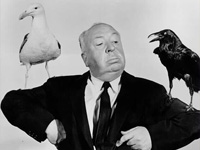
    Alfred Hitchcock• Devin Faraci talks to “Terminator Salvation” star Moon Bloodgood, whose nude scene probably should have stayed in the film.  No, I’m not a perv, but…well, you tell me if you believe the relationship that develops. [CHUD]

    • Ian Freer wishes a happy 10th birthday to “Star Wars: Episode I — The Phanom Menace.” [Empire]

    • If it’s good for the ladies it’s good for the boys.  Alonso Duralde on Dylan Vox, the latest adult film star to follow in Sasha grey’s footsteps and bridge the gap to mainstream films. [MSNBC]

    • Jamin Borphy-Warren talks to Mike Judge about his latest animated foray, “The Goode Family.” [Wall Street Journal]

    • The great (yes, the great) Shane Black talks to Sam Delaney about what makes a good action film. [The Guardian]

    • Talking the machine uprising depicted in the “Terminator” franchise with a military technology expert. [Slate]

    • Speaking of which, the newly named SyFy channel could be in an opportune position to pick up the recently canceled “Terminator: The Sarah Connor Chronicles.” [Premiere]

    • John Walsh on the timeless Alfred Hitchcock, whose work will be enjoying a tele retrospective across the pond. [The Independent]

    • Susan Wloszczyna digs into the risks of Pixar’s 10th entry, “Up.” [USA Today]

    • 3D at home: awesome or awful? [Cinematical]

    • Big ole’ rumor that stems from a /Film commenter, but some are saying the cute pink teddy bear you’ll catch a glimpse of in “Up” is named Lotso and will be the villain in next year’s “Toy Story 3.” [Pixar Planet]

  • Overture Films sets release date for Michael Moore’s latest

    Michael MooreTotally beside the point, but the first thing I thought when this press release popped up into my inbox was how happy I am to see studios like Overture and Summit succeeding in what has too long been an industry run by the big guns.  I miss the days when an October Films could get stuff done, or an Orion.  Anyway, here’s the press release, in part:

    Overture Films and Paramount Vantage have announced that Oscar-winner Michael Moore’s new documentary feature will be released domestically on October 2, 2009. The as-yet-untitled film will explore the root causes of the global economic meltdown and take a comical look at the corporate and political shenanigans that culminated in what Moore has described as “the biggest robbery in the history of this country” – the massive transfer of U.S. taxpayer money to private financial institutions.

    On this, the 20-year anniversary of his masterpiece Roger & Me, Moore returns to the issue that began his career: the disastrous impact that corporate dominance and out-of-control profit motives have on the lives of Americans and citizens of the world. But this time the culprit is much bigger than General Motors, and the crime scene far wider than Flint, Michigan.

    Says Moore: “The wealthy, at some point, decided they didn’t have enough wealth. They wanted more — a lot more. So they systematically set about to fleece the American people out of their hard-earned money. Now, why would they do this? That is what I seek to discover in this movie.”

    Full press release after the jump. Along similar lines, Vanity Fair editor Graydon Carter has written a scathing indictment of the banking industry (via Hollywood Elsewhere):

    It can fairly be said that the chain of catastrophic bets made over the last decade by a few hundred bankers may well turn out to be the greatest nonviolent crime against humanity in history. They’ve brought the world’s economy to its knees, lost tens of millions of people their jobs and their homes, and they could drive an estimated 200 million people worldwide into dire poverty. In other words, never before has so few done so much to so many.

    The full press release on Moore’s film after the jump.  Oh, and a suggested title for the film: “Mint Condition.”  Other ideas?

    (more…)

  • REVIEW: “Up” (***1/2)

    UpWatching Pixar Animation grow and develop as a studio has become almost more fascinating than experiencing one of the company’s many creative films unfold on screen. Beginning with an industry leap in 1995’s “Toy Story” and eventually moving into its daring own with 2008’s “WALL-E,” the studio has, at the very least, shown a desire for creative progression.

    This naturally brings us to “Up,” the next evolution in Pixar’s insistence on growing up while maintaining the heart of a child. With its focus on relationships and the harsher realities of life, the film might well be the studio’s most human production to date. While claims that the film is a high mark for emotional resonance might be a touch over-stated, “Up” is nevertheless a sterling entry in the studio’s impressive streak of hits.

    The film’s unlikely hero is 78-year-old balloon salesman Carl Fredricksen, and a few moving early moments set the scene: Carl met his wife Ellie as a child, and being the shy sort, was immediately taken by her lust for life. They married, they endured loss (a single frame reveals an apparent miscarriage) and they vowed to one day travel to the exotic Paradise Falls made famous by their childhood hero, explorer Charles F. Muntz.

    But, as the poet said, the best laid plans of mice and men often go awry. That brutal fact is creatively depicted in the consistent smashing of a giant savings jar for this or that fiscal emergency and eventually, life has passed the couple by, their dreams left unrealized, and when the narrative catches up to Carl following this brief montage, we see that loss weighing heavily in the form of a rather disagreeable disposition.

    (more…)

  • Glenn Kenny’s ‘Girlfriend Experience’ set diaries

    Glenn KennyIf you’ve seen Steven Soderbergh’s “The Girlfriend Experience” (which opens in theaters tomorrow after being available On Demand and for Internet download since April 30), you no doubt remember former Premiere film critic Glenn Kenny’s cameo performance as “The Erotic Connoisseur,” an assayer of upscale prostitutes in New York who digs into Sasha Grey’s call girl with fury toward the end of the film.

    To me, it’s a fantastic, biting portrayal that proves Kenny should try his hand at it once more.  Kenny has already written about this before, but as it turns out, he has now launched an exclusive series of set diaries, which kicked off yesterday at The Auteurs.  There is plenty of the critic/actor’s dry wit to go around, but I particularly liked this passage, which follows a recounting of the initial phone call he received about taking the part:

    A word, here, on my own acting career: Its major triumph was in my junior year of high school, playing The Silent King in Once Upon A Mattress, at Jefferson Township High, in 1976. So strongly did I prevail that I was considered pretty much a shoo-in for the lead role in Jefferson’s 1977 dramatic offering, Dracula. But no. Even before auditions were announced, the drama coach informed me that I would not be getting the part, because, as he put it, I “lacked sex appeal.” Which is a heckuva thing for an adult to say to any 17-year-old male, when you think about it. To add insult to injury, he handed the role to an individual even more awkward and gawky than myself. Who, not to make a bad pun or anything, sucked. And I was left to end my scholastic acting career in Jefferson’s second production of ’77, The Sound of Music, in the role of Uncle Max, which anyone can tell you is the most nothing part in the history of The American Musical Theater. Well. Now I would show that drama coach.

    As one guy notes in the comments, Kenny’s performance has already stirred some talk in the, as he puts it, “hobbyist” community.  Anyway, the diaries make for a great, if at times cruel (Harry Knowles gets an unnecessary dig), read, and I imagine there’s more to come.  Check it all out here.  And my short review of the film, in case you missed it.

  • Stronger stomachs

    Charlotte Gainsbourg in AntichristIt may be just a coincidence, but I’ve noticed that, for all the media kerfuffle over its maker’s supposed “woman-hating” agenda, a number of the most level-headed, inquisitive responses to “Antichrist” seems to be coming from female writers. Put it down to thicker skins, stronger stomachs, or nothing whatsoever — I’m just saying. Manohla Dargis, for one, isn’t a great fan of the film, but seems a lot more amused than shocked:

    At one point one of the characters ominously refers to nature as Satan’s playground or some such, which sounds like a line from Woody Allen by way of Ingmar Bergman. By the time the animatronic fox warns the understandably baffled-looking Mr. Dafoe that “chaos reigns,” it’s clear we’re not in Kansas anymore or even a serious movie. Chaos reigns, if not narrative sense, but I would be lying if I didn’t admit that this impossible movie kept me hooked from start to finish.

    Anne Thompson, meanwhile, defends the film, adding an interesting corrective to the plentiful “misogynist” interpretations:

    The movie does hang together. He knows where he’s going. It’s just that much like Ken Russell in The Devils, Trier’s taking you to horrifying, hallucinatory places where anything can happen. (Hieronymous Bosch comes to mind.) And where most people don’t want to go. Accused of misogyny, the film portrays a woman who is man’s worst nightmare, the embodiment of their anxiety about women.

    (more…)

  • Is Wes Anderson corroding the cinema?

    Rachel Weisz in The Brothers BloomI should say at the top that I have not yet seen Rian Johnson’s “The Brothers Bloom,” but I was an absolute disciple of the director’s 2005 debut “Brick.”  That said, “Bloom” has always had a particular sheen to it that has obviously kept it from being a must-see since the first screenings began back in September of 2008.  Elbert Ventura, writing in Slate, may have pegged the reasoning, at least as it pertains to my taste:

    Rian Johnson’s caper comedy The Brothers Bloom begins its nationwide rollout already burdened with a reputation as an imitation of an American original. If Johnson’s terrific debut, Brick, crackled with the borrowed brio of the Coen brothers, early notices for The Brothers Bloom have identified a new muse: Wes Anderson…

    But The Brothers Bloom is only the latest addition to a burgeoning subgenre. Over the last few years, Anderson’s movies have become touchstones for indie culture. In the 1990s, it seemed every NYU graduate and Sundance contender was making his own Tarantino knockoff. These days, the Tarantino imitators have been replaced by the Wes wannabes. A popular strain in recent American indie cinema has been the Andersonian quirkfest, a tendency that runs through movies like Juno, Napoleon Dynamite, Son of Rambow, Charlie Bartlett, and Garden State, among others.

    The appropriation doesn’t stop there. Anderson’s trademarks—poker-face eccentricity, affection for the oddball, fastidiously arranged clutter, an affinity for the precocious and childlike—have now become conventions in the larger culture. You can glimpse his style and sensibility in TV shows, music videos and—a true sign that you’ve arrived—commercials.

    Of course, I like one or two of those films, but as someone who considers nearly the whole of Wes Anderson’s portfolio to be incredibly disposable, and as a guy from the film school generation Ventura indicates (and therefore, witnessed the development of this new “wannabe” culture), allow me to simply say: God help us. I won’t pass judgment on “The Brothers Bloom” until I see it, of course, but items like this make it difficult to drum up enthusiasm.

  • PAGE TO SCREEN: “Up in the Air” by Walter Kirn

    Cover of Up in the Air by Walter Kirn“Airworld” is novelist Walter Kirn’s term for the impermanent realm of regional American air travel, a sleek network of bland local airports and adjacent beige hotel rooms, linked by the plush grey trails of business-class flights. It forms the scattered but otherwise constant home to thousands of American corporate drones, and is the simultaneously alien and mundane setting for “Up in the Air” – soon reaching your screens courtesy of writer-director Jason Reitman and star George Clooney.

    Droll, dry and ultimately rather heartless, it’s clear that Kirn (“Thumbsucker”) positioned his novel as a kind of “Bonfire of the Vanities” for post-millennial readers, a work that diagnoses the ills of corporate America and chimes in with a wider sense of social malaise.

    The novel, however, had the misfortune of hitting the shelves shortly before the events of 9/11 forever shifted the rules of his own Airworld. By the time it appeared in paperback, not only had Kirn’s milieu rapidly dated, but few readers were keen to enter that territory, and “Up in the Air” never took off as was perhaps intended.

    Whether by accident or design, Reitman’s adaptation of the novel also comes along at a time when the material couldn’t be more touchily topical, albeit for different reasons. Its anti-hero of sorts is Ryan Bingham, a 35 year-old human resources exec and first-class Airworld citizen, whose field of expertise is “Career Transition Counseling” – in other words, someone brought in by companies to tactfully fire employees, a self-proclaimed Grim Reaper to white-collar America.

    It’s a nervy subject for a feature film in the midst of a global economic recession that is providing plenty of business for men like Bingham, if few others; but whether audiences will be any more willing to embrace this than they were Kirn’s novel remains to be seen, and will largely depend on the warmth and lightness of touch Reitman and his universally liked leading man can bring to the material.

    (more…)

  • Strong reviews for Haneke’s ‘White Ribbon’

    Michael Haneke's The White RibbonCould this year bring a close to Michael Haneke’s bridesmaid’s run at the Cannes Film Festival? Haneke has come within touching distance of the Palme d’Or before, taking the Grand Prix in 2001 for “The Piano Teacher” and Best Director in 2005 for “Caché,” but the big prize has so far eluded him.

    Now Haneke’s latest, “The White Ribbon,” has screened to largely admiring reviews from the Cannes press. The film, a black-and-white, score-free period drama studying the social disintegration of rural German community, was written with the collaboration of master scripter Jean-Claude Carriere, and is now inspiring repeated comparisons to the work of Ingmar Bergman. Nonetheless, it apparently still serves up the clinical narrative jolts we have come to expect from Haneke. IndieWire’s Eric Kohn raves:

    Pairing visual mastery with a quietly immersive story, “The White Ribbon” plays like a morbid version of “Our Town,” patiently revealing the inward discord beneath the surface of a settled community. It’s a frightening depiction of mortality.

    With this detailed exploration of anonymous retribution, Haneke returns to the haunting terrain he last explored in “Cache,” although in this case, the retribution expands from a personal level to a larger critique of religious zealoutry. As the violent acts cumulate, they expand to the larger world surrounding the village – especially with the political assasination and the eruption of World War I closing the movie. However, these events remain notably off-screen. Absence in “The White Ribbon” is the quality that makes it a harrowing work of art, rather than a historical soap opera.

    (more…)

  • 5/21 Web Round-up

    Sasha Grey• AFI launches its own YouTube channel. [YouTube]

    • Robin Sanders reports on the Stephen Frears event from Cannes. [indieWIRE]

    • The wars continue: Patrick Goldstein lays into Peter Bart (and Variety) once again for being soft on the industry. [The Big Picture]

    • Lionsgate launches an impressive new website for festival Sensation “Precious.” [WeAreAllPrecious.com]

    • Chris Lee talks to “The Girlfriend Experience” star Sasha Grey. [Los Angeles Times]

    • Kim Voynar, meanwhile, dissects Grey’s character and wonders whether the film objectifies women. [Movie City News]

    • The publicity floodgates open for “Terminator Salvation,” starting with Irina Aleksander’s interview with the film’s rookie producers. [New York Daily News]

    • Todd Gilchrist, meanwhile, corners director McG. [Cinematical]

    • And finally, headline of the day, from John Anderson’s review of the film: “Hasta La Levity, Baby.” [Washington Post]

    • Aha, headline of the day #2: “Tarantino ‘Basterd’-izes Cannes. Such sweet truth. [USA Today]