In Contention

Author: Guy Lodge

  • Watch this face

    You can’t lose much by making “star is born” pronouncements. If you’re right, you get to brag about your stunning foresight, and if you’re wrong — hey, nobody remembers anyway.

    But back in October last year, as I watched stunning young French ingenue Léa Seydoux illuminate Christophe Honoré’s lovely, woozy teen romance “La Belle Personne,” I was convinced there and then that I was seeing a major talent in the making. The César voters agreed, nominating her for Most Promising Actress. (The film, which you may remember I liked a great deal, got a limited U.S. release over a fortnight ago — catch it if you can.)

    So I was excited to see her name pop up on yesterday’s press release for Ridley Scott’s as-yet-untitled Robin Hood venture. My guess is the role won’t amount to much — but hey, Marion Cotillard did her time as eye candy in a Scott film (let’s not name it, shall we?) a little over two years ago, and she’s doing all right for herself these days.

    Seydoux will also be seen shortly in “Inglourious Basterds.” The girl’s going places, I tell you.

  • All in good taste

    There’s no real reason to pay attention to the Chlotrudis Awards,which took place on Sunday. After all, they’re a casually organised set of honours determined by an enthusiastic group of Boston-based film lovers — that apparently get mentioned on IMDB and precisely nowhere else.

    But hey, when their taste is this exemplary, they deserve a bit of notice. After all, in the thick of awards season, people actually bother with the innumerable, obscure regional critics’ awards and their largely yawnsome copycat choices. The Chlotrudis Awards, by contrast, go commendably against the grain.

    Any organisation that singles out the exceptional, Oscar-snubbed work of Kristin Scott Thomas and Elsa Zylberstein in “I’ve Loved You So Long” is in my good books, while “The Edge of Heaven” is a pretty fresh, adventurous choice for Best Picture of 2008. “Happy-Go-Lucky,” meanwhile, continues to generate affection, taking Supporting Actor kudos for Eddie Marsan and half a Best Director award — in another inspired move, Mike Leigh and Guy Maddin (“My Winnipeg”) tied for that honour.

    OK, so nobody really notices or cares about these awards, but it’s the principle that counts. I applaud them. Check out a full list of winners and nominees here, if you’re so inclined.

  • Dog years

    Given that Kris’ recently declared love for the 45-year-old-and-still-sexy-thank-you-very-much actress Hope Davis seems to be shared by a few of you out there, you may be tickled by this extract from a Guardian piece, in which Hadley Freeman tackles the eternal issue of Hollywood’s double standards of gender and age:

    It is all too easy for a female actor to find herself cast as the mother of someone who once played her boyfriend as soon as she blows out the candles on her 35th birthday cake. This has long been an accepted fact of Hollywood life, and one that most women keep schtum about as they know they should be grateful to get any roles at all in their decrepit post-30s.

    But last weekend, Hope Davis finally broke ranks to admit she was somewhat “peeved” when she was recently offered a role playing the mother of Johnny Depp, a concept that would have tested the skills of the most talented special effects department, seeing as Davis was actually born the year after Depp.

    Heh. I have no idea what film Freeman is referring to, but that’s a pretty hilarious tidbit. Suggesting that Hollywood views the man-to-woman age ratio as roughly akin to that of man-to-dog, Freeman goes on to list other familiar examples of the trend, such as Glenn Close playing Gertrude to Mel Gibson’s Hamlet, and the bizarre spectacle of seeing Angelina Jolie mother Colin Farrell in “Alexander.” By comparison, Taraji P. Henson’s playing opposite a shrunken, digitised version of Brad Pitt seems positively conventional.

  • Called it

    You may recall that a few weeks ago, I mentioned that Harvey Weinstein had a Judy Garland biopic in the works.

    Back then, I contemplated the potentially perfect Oscar storm represented by the lead role: a biopic of a showbiz icon, covering substance abuse and mental instability, requiring song-and-dance skills, all backed up by the mighty campaigning power of Weinstein.

    Wondering which actress might be lucky enough to nab the opportunity, I suggested that Anne Hathaway could be a neat fit for the part.

    Well, if Jeff Wells is to be believed, it seems that Weinstein is of a similar mind: Hathaway is “officially attached” to the project. I wonder if her game Broadway-style hamming at last month’s Oscar ceremony helped her cause at all?

    Seriously, though, this is perfect timing for the starlet: if “Rachel Getting Married” served as a sketchy but intriguing blueprint of what talents she had stored up, this is the kind of expansive, weighty mainstream project that would solidify her arrival as potentially the go-to leading lady of her generation. If she pulls it off, I maintain that it’s hard to imagine the Academy resisting.

  • Treading water?

    I have a complicated relationship with Richard Curtis. (Well, with his work, at least.)

    On the one hand, I’m keen to defend the man: it’s become fashionable here to direct aggressive vitriol his way for daring to stick to an upbeat formula that, while hardly pushing the envelope artistically, has proved both popular and crowdpleasing. While more considered than most, this critique by Tim Adams in yesterday’s Observer is typical of the scepticism with which local critics regard him:

    This desire to be a one-man band, and not just a writer of scripts, appears to be born of an unlikely immodesty. There was a likable kind of humility about the scale of Four Weddings … but as the budgets have grown, so, apparently, has Curtis’s sense of what he is capable of. Somewhat like Blair, he seems to feel he is a pretty straight guy, but also a lone positive voice.

    He seems to want his films to evangelise the idea that the world is nowhere near as grim as most film-makers like to think … It is admirable, that faith, but when translated wholesale to movies it borders on sanctimoniousness.

    Like I said, I want to go against that elitist grain, but the truth is that Curtis’ maddeningly inconsistent oeuvre doesn’t entirely justify such loyalty. Yes, “Four Weddings and a Funeral” still stands as an exemplary, structurally inventive rom-com, even if it occasionally misjudges the audience’s affection for its characters. (Andie MacDowell over Kristin Scott Thomas? Really?)

    (more…)

  • Wild thing

    USA Today recently offered another taste of “Where the Wild Things Are” — Susan Wlosyzczyna’s article (essentially a brief chat with child lead Max Records) doesn’t reveal much, but a bunch of new (and some old) stills sure do.

    With every glimpse I get of this film, I’m more impressed by how Spike Jonze seems to have found the appropriate visual textures to enliven Maurice Sendak’s all-but-untouchable imagery, without resorting to slavish or contrived imitation. Seriously, how gorgeous does this thing look? More pics here.

  • And now for something completely different

    Never let it be said that the Brothers Coen are predictable in their choice of projects. Having had their greatest crossover success to date with a film that dabbled in elements of the genre, Variety reports that they are set to make their first all-out Western — a remake of that hoary 1969 oater “True Grit,” best known today as the film that finally won John Wayne his gold-watch Oscar.

    On the surface, this isn’t the most promising of prospects — the story of a teenaged girl joining forces with a crotchety, aged US marshal to avenge her father’s death, the original “Grit” was a creaky, sentimental work that must have appeared dated even in its own time.

    But the Coens, obviously, are promising an interpretation far removed from that of Henry Hathaway’s film. Their intention is apparently to hew closer to Charles Portis’ source novel, telling the story from the girl’s perspective and placing less emphasis on the veteran character — which sounds like an improvement to me already. I admit I’ve never read the novel, though I gather it’s got harder edges than the 1969 adaptation.

    Encouragingly, the Paramount production will reteam the brothers with “No Country” producer Scott Rudin. Apparently, this project takes priority over their Rudin-produced adaptation of Michael Chabon’s “The Yiddish Policeman’s Union” that was being mooted — which, frankly, I’d have been more interested in seeing. But the Coens work in mysterious ways, so my mind is open.

    Finally, here’s a good omen: the last time they attempted a remake, they took on a masterpiece (“The Ladykillers”) and fell on their faces. Perhaps tackling a lesser work should reap greater rewards.

  • Are you there, Fox? It’s me, ‘Margaret’

    I have to say, I’ve all but given up hope that Kenneth Lonergan’s “Margaret” will ever see the light of day. For years now, I’ve kept an optimistic eye out for the film, kept putting it on my early Oscar prediction lists, kept checking the Fox Searchlight release schedule — only for the film, originally shot in 2005, to fall further and further beneath the radar.

    There’s talk of an unruly, wildly overlong shooting script as being to blame, while chronic perfectionism on Lonergan’s part has also been rumoured. I’m not sure what to believe — but as someone who thinks that “You Can Count on Me” is looking to remain one of the decade’s finest American films (yeah, we have to start thinking about such things, don’t we?), it’s certainly a frustrating state of affairs.

    It’s certainly hard to imagine a film of “Margaret’s” pedigree — to jog your memory, the cast includes Anna Paquin, Matt Damon and Mark Ruffalo, while Scott Rudin and the late duo of Anthony Minghella and Sydney Pollack all have producer credits — just falling by the wayside.

    So I was intrigued to stumble upon this news tidbit that suggests the film hasn’t been entirely forgotten — and that it doesn’t only share a trio of producers with last year’s “The Reader.” It would appear that prodigious young composer Nico Muhly has taken on the job of scoring the film, which may or may not mean anything. Searchlight’s website offers no helpful information, for one thing. Still, it’s nice to hear that “Margaret” hasn’t completely vanished off the face of the earth.

    (Coincidentally, this is the second time Muhly has cropped up in my thoughts today. This morning, I was checking out the lineup for the ATP UK Weekend, a music fest I’m attending in May — and lo and behold, there he was, alongside the likes of The Jesus Lizard and Spiritualized. Dude’s got it going on.)

  • Beautiful rejects

    Yesterday’s post about the UK poster for “Let the Right One In” alerted me to the existence of a nifty little site. Not a Movie Poster showcases notable poster concepts that were ultimately rejected by the powers that be — usually, it seems, in favour of far lesser work.

    They are mostly UK designs (hence the quad format) for arthouse releases, and there is some really masterful work in the mix. It’s so rare that you see film poster design of this calibre these days — what a shame that the marketers aren’t as adventurous. Take one of my favourites, this rejected design for “I’ve Loved You So Long”:

    Now, how much better is that than the one they went with? Two more favourites,for “4 Months, 3 Weeks and 2 Days” and “Elephant,” after the cut.

    (more…)

  • Too much, too soon?

    I’m not as outraged as some are by the news that “The Curious Case of Benjamin Button” is to be granted a Criterion Collection DVD release in May — as has been pointed out, if not one but two Michael Bay films have made the cut in the past, the label’s aesthetic standards are a bit of a mystery. And “Button” is, at the very least, an immaculate piece of craftsmanship.

    I am, however, a bit puzzled. Why does “Button” get to jump to the front of the queue while an assortment of  classics have to wait years for this seal of approval?  (For the sake of context, other titles in Criterion’s ‘coming soon’ pile include “Last Year at Marienbad” and “The Last Metro.”) And more importantly, isn’t it bizarre that this is David Fincher’s first title to get the royal Criterion treatment? Whether you like the film or not (and I admit I’m in the “not” camp), I haven’t heard many people suggesting that it’s his most significant work.

    If you ever needed a textbook illustration of the difference an Oscar nomination can make, I think we have one right here. Your thoughts?

  • The right one

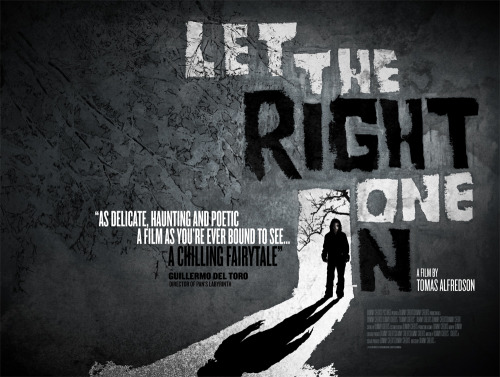
    Believe it or not, “Let the Right One In” is still awaiting its UK theatrical release — for whatever reason, the powers that be decided to hold it back until April. (But hey, at least we got “Hunger” ages ago.)

    Anyway, if the delay meant more time to devise a poster as brilliant as this one, perhaps it was all worth it. It’s rare that a poster really utilises the spacial possibilities of the UK quad format, but this nails it — an early contender for Poster of the Year, even if the film was, y’know, last year:

    (Not a Movie Poster via The Film Experience)

  • Gumption

    If you’re an awards geek and you haven’t yet discovered Nathaniel Rogers and friends’ series of “Best Pictures from the Outside In” discussions, you have a treat in store.

    The premise is both eccentric and beautifully simple: word from both ends of the Oscar timeline, each episode pits two Best Picture winners against other for discussion, re-evaluation and occasional ridicule, with the comparison of two often wholly disparate films bringing out interesting elements in each other.

    In the ring for the latest instalment are “How Green Was My Valley” and “Forrest Gump” — an appropriate match-up in that they are both sentimental pieces that beat out more daring, enduring works in their respective years, and have retrospectively become less popular choices for it.

    I’m pleased to see Rogers, together with his two fellow bloggers Nick Davis and Mike ‘Goatdog’ Phillips, giving “How Green Was My Valley” more respectful attention than most people, who routinely dismiss it as “That Movie That Beat ‘Citizen Kane’” and little more.

    It’s still a John Ford film, after all, and one of his most intimate, visually lyrical works, even if it succumbs to hokum on more than one occasion. As Davis so aptly puts it, it’s a film wherein “you really feel the cycles of the day and the season, sometimes within a single shot.”

    They don’t, however, hold back on their mutual loathing for “Gump,” which I have to agree is one of the most artistically and ideologically objectionable films ever to wins Best Picture. (“Gump” and “Braveheart” back-to-back represent the Academy’s all-time nadir, as far as I’m concerned.)

    (more…)

  • Thoughts on Cannes, Huppert and ‘Up’

    Dull but hindering circumstances kept me offline yesterday, so I couldn’t get to the Cannes/”Up” news that Kris recently posted.

    By the way, before I get into that, can I just say what a great choice the Cannes organisers have made in selecting Isabelle Huppert as their jury president this year?

    It’s been a while (8 years, to be specific) since a woman took on the role, and as one of the most adventurous, intelligent and hard-working actors of her generation, Huppert (a two-times Cannes winner herself) has earned the position. Here’s hoping she brings the same kind of fearless thinking to the panel that she does to her roles.

    As for “Up, “Being the first animated title to open the world’s most prestigious film festival is obviously a notable accomplishment — and probably an overdue one, at that.

    Chiming in with last year’s tide of critical accolades for “WALL-E” and “Waltz With Bashir” (which, of course, began its buzz at Cannes), it’s clear that the artform is increasingly nearing an equal footing with live-action filmmaking as far as cineastes are concerned — even if some conservative viewers (and of course, AMPAS voters) would like to pretend otherwise.

    However, amid the breathless reporting of “first evers,” it seems to me one crucial detail has been somewhat neglected — the film is playing out of competition.

    This strikes me as an opportunity missed. I’m guessing it was Pixar’s decision not to submit the film for competition consideration, but one has to wonder what they stood to lose by trying. Given Cannes’ arthouse bent, nobody would have expected the film to win anything anyway, but a Palme d’Or nomination could have lent the film some impressive additional cache.

    (more…)

  • ‘Chéri’ trailer … finally

    I wrote about this trailer after being surprised by it at the cinema almost two weeks ago. Now it’s finally appeared online, you can see for yourselves. I’m still a little uncertain of the brittle, faintly campy comic tone present here — Colette’s novella (which I’ll get into when our Page to Screen series begins) is a rather more delicate, melancholy animal. But it looks like a classy outing all round. We’ll see.

  • ‘A rollicking struggle, a joy to watch’

    Breathe, my fellow Almodovar devotees — the first reviews for “Broken Embraces” are in. While they’re not unqualified raves, it would appear that the master has pushed himself into new and challenging tonal and thematic territory, and the critics are duly appreciative.

    Screen International’s Barry Byrne suggests that it will delight fans and befuddle others, but isn’t that usually the case with auteur works as singular and stylised as Almodovar’s? Extracts from Byrne’s measured take on the film (beware of spoilers, however):

    The film is awash with references to the noir genre, Italian neo-realism and even to Almodóvar’s own quirky oeuvre. Stylistic nods to films including Nicholas Ray’s In a Lonely Place and Vincente Minnelli’s The Bad and the Beautiful form part of Almodovar’s valentine to cinema.

    Fans of Almodovar will get plenty of what they expect here – rich saturated colours, hyper plotting, stylistic pyrotechnics and off-centre comedy. But there are carefully nuanced male characters too and the bleak, distant tone coupled with the unassuaged pain of the leads is a new departure for the director.

    In the more successful first half of the film he elegantly pulls it off … (but) With the action moving ponderously towards a baffling denouement, we enter the terrain of high melodrama.

    (more…)

  • Five reasons to pay attention to ‘Nowhere Boy’

    1. It’s a biopic chronicling the formative years of one of popular music’s most gifted and fascinating icons. (How has it taken this long for a John Lennon project of any significance to come to fruition?)

    2. It’s the feature film debut of Sam Taylor Wood — the British conceptual artist, musician, photographer, Anthony Minghella protegee and all-purpose celebrity. Her media ubiquity could arouse wariness if her award-winning 2008 short, “Love You More,” hadn’t been really rather lovely indeed. As it is, she could just be this year’s Steve McQueen.

    3. It is written by Matt Greenhaigh, who scored a home run with “Control,” another jagged, intimate portrait of a British rock legend. And anything or anyone connected with a film as brilliant as “Control” deserves our full attention. Fact.

    4. It stars Kristin Scott Thomas, inarguably one of the greatest thesps around these days, in the potentially rich role of Lennon’s loving but eternally disapproving aunt and guardian, Mimi Smith. It’s ideal casting, and Thomas carries a major IOU from this last awards season. Which brings me to my final point…

    5. Rights to the film have just been acquired by The Weinstein Company, with a view towards a year-end release.

    Harvey Weinstein reportedly “fell in love” with Greenhaigh’s script, which apparently focuses heavily on the emotionally charged custody battle between the aforementioned Smith and Lennon’s biological mother. It should be a meaty performance piece for Thomas and British TV actress Anne-Marie Duff (otherwise known as Mrs James McAvoy), and something tells me Weinstein might see a glimmer of awards potential there.

    It doesn’t hurt that that it’s being co-produced by Film4, which, between “Slumdog Millionaire,” “In Bruges,” “Happy-Go-Lucky” and “Hunger” had perhaps the most impressive slate of any production outfit last year.

    Okay, so it only started shooting on March 8, so there’s no way of knowing which way this one’s headed. Still one to keep an eye on, methinks.

  • The trades really like ‘Duplicity’

    I must say, I liked the look of Tony Gilroy’s “Duplicity” from the get-go. However, being a sucker for jazzy caper thrillers in the “Charade” vein, as well as for most things starring Clive Owen, I wasn’t sure whether to trust my instincts there.

    In any case, given the amiable slightness of the trailer and the indifferent release date (not to mention that awful title), I wasn’t expecting a critical hit — but going on the early trade reviews, it looks like that’s what we may have here. Todd McCarthy’s Variety rave gushes as follows:

    Smart, droll and dazzling to look at and listen to, writer-director Tony Gilroy’s effervescent, intricately plotted puzzler proves in every way superior to his 2007 success “Michael Clayton.” The twisty, time jumping narrative forces viewers to keep on their toes, and it could well be that “Duplicity” is too smart for its own good as far as the popcorn masses are concerned. Still, this is about as good as it gets these days for sharp-minded Hollywood entertainment made for an intelligent audience.

    Topping “Michael Clayton” isn’t the hardest of tasks in my mind, but given the devoted following the film enjoys, that’s no light praise: McCarthy invokes Lubitsch comparisons at one point. Meanwhile, nearly every major cast member and craftsman (a pretty dazzling array, it must be said, including Robert Elswit, Albert Wolsky and James Newton Howard) is singled out for kudos.

    (more…)

  • Keeping score

    By now, “Watchmen” has been assessed and widely shat on from a large array of angles, but one voice I didn’t necessarily expect to pipe in was that of classical music critic Tom Service. Writing for the Guardian, Service praises the film’s “carefully conceived” use of existing music, particularly the heavily intertextual use of Wagner, though he complains:

    A shame, then, that they go for the easy option of Mozart’s Requiem, in a poorly edited version, near the end of Watchmen, after the pseudo-apocalypse that wipes out Manhattan. Surely a bit of 80s electro would have made the point better, and saved Mozart from becoming yet more of a morbid musical cliche?

    Against such familiar themes, however, Service is distinctly unimpressed by Tyler Bates’ original score for the film, and uses this as a springboard for a broader lament on the state of Hollywood scores in general. He claims composers have recently “trodden the path of the generic or the frankly redundant” — with Jonny Greenwood’s extraordinary work on “There Will Be Blood” the last notable exception.

    I tend to agree with him, having found 2008 a particularly weak year for film scores in general. But we part ways when Service chooses to single out for criticism one of the few scores that actually got under my skin (and onto my iTunes) last year:

    Anyone remember “The Dark Knight’s” score? Hans Zimmer and James Newton Howard’s music, I thought, got mired in a single idea, an obsessively repeated minor third, that gloomy interval of impending doom, but could not generate any real tension or dramatic counterpoint with the onscreen action. It’s a pity, given the complexity of drama and ideas in both films (“Knight” and “Watchmen”), that the music didn’t add to the experience.

    To each their own, I guess.