…but here’s a nice new poster in the meantime:
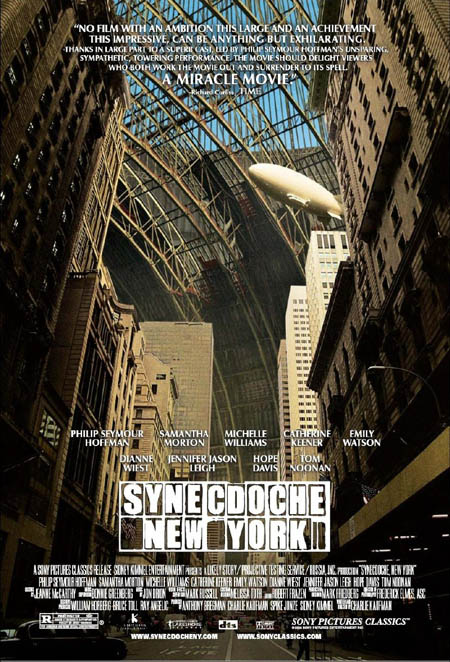
 Everyone has a favourite Oscar category, and Best Original Screenplay is mine. It’s partly because I’m a screenwriter myself, so I feel a little more invested in the outcome. My evaluation of the category often comes down to the question: “Which screenplay do I most wish I’d written first?”
More importantly, however, it’s the category where the Academy takes its greatest artistic risks. With the Best Picture category generally weighted towards adaptations, they often use Best Original Screenplay as a way to acknowledge the edgier, more adventurous work that voters can see the greatness of, but don’t yet have the guts to honour with their biggest prize. Hell, once in a blue moon they even give it to (gasp) a foreign-language film.
It’s this convenient ghettoising mentality that ensures the likes of “Citizen Kane,” “The Red Balloon,” “Chinatown,” “Pulp Fiction,” “Talk to Her” and “Eternal Sunshine of the Spotless Mind” don’t go empty-handed. Sure, it sucks that they couldn’t win more. And, being the Academy, they make more than their share of screw-ups. (Let’s try and forget that, in 1960, “Pillow Talk” beat — wait for it — “Wild Strawberries,” “North by Northwest” and “The 400 Blows,” shall we?) But they occasionally hit on an otherwise-snubbed masterpiece, and for that we should be grateful.
This year’s Best Picture slate appears to be heavy on prestige adaptations, allowing for a more idiosyncratic ragbag of contenders on the Original Screenplay front, mixing familiar Academy-anointed favourites with some exciting new voices.
There is, of course, a chance this could be a year when the paths of the Best Picture and Best Original Screenplay races converge, principally in the shape of “Milk” scribe Dustin Lance Black. Already high hopes for “Milk” were amplified by an excellent trailer, and a number of Oscar clairvoyants are labelling it the front-runner in the top race. If this turns out to be the case, Black will likely benefit.
Heading out to Agoura Hills this afternoon to interview Jeff Beal, composer of Ed Harris’s “Appaloosa.” Then a “Synecdoche, New York” screening later in the day. Nothing more out of me until this evening, though the crew might have some odds and ends. Happy Friday.
…is here. I think I’m going to avoid it because I’m seeing the film Friday. It’d be more interesting. But tell me what you think of it.
Not much going on today, so I’ve added a few new buzz pages to the collection: “Blindness,” “Gran Torino,” “I’ve Loved You So Long,” “Synecdoche, New York,” and “The Wrestler.”
As always, you can take a look at all pages by checking out the Contenders page, or by clicking on various links in the predictions sidebar. Still a little ways to go, but we’re almost complete.
 Looking down the list of titles in the newly-revealed lineup for next month’s London Film Festival lineup, my initial reaction was one of mild disappointment. Plenty of exciting titles, for sure, but it doesn’t quite match last year’s feast that included everything from “The Diving Bell and the Butterfly” to “The Assassination of Jesse James” to “Juno” to “4 Months, 3 Weeks, 2 Days.”
My second thought, however, was that the lineup reflects more on what a tepid year for film 2008 is shaping up to be, rather than any lack of effort on festival director Sandra Hebron’s part. Tellingly, this morning Hebron herself cited critical opinion that, in the wake of a roundly derided Venice festival, “it wasn’t a vintage year for cinema.”
But enough of the hand-wringing. There’s still much to get excited about, including “Che,” the two parts of which, interestingly, will be screened both together and apart; Oliver Stone’s potentially polarising “W”; “Hunger,” featuring a potential dark horse for Best Actor; “Religulous”; “Rachel Getting Married,” “Nick and Nora’s Infinite Playlist,” “Gonzo: The Life and Work of Hunter S. Thompson” and, to my immense delight, “Synecdoche, New York.”
Not to mention that, as previously announced, the festival will be bookended by the world premiere of “Frost/Nixon” and Danny Boyle’s red-hot Toronto hit “Slumdog Millionaire.”
 It may be Labor Day, but the work at hand is breathing down our necks. So it is that we come to the first weekly Oscar column of the new awards season.
Though to be frank with you, I’m beginning to wonder whether we’ll be able to keep the conversation going, much less interesting on a weekly basis as we push through the last four months of the year. I knew going in to this year that it was going to be a somewhat low-key season, and my own worst fears have been founded in a number of pre-Toronto screenings of films that will be discussed in a week’s time, films leaving me cold, irritated or otherwise just unconvinced.
I don’t sense a lull on the level of 2005 by any means, but I do get the feeling that after two solid years of cinematic goodness, 2008 could just be one of those “rebuilding” years, to steal a sports term and painfully attempt its application here. It’s interesting (and telling) that my two favorite films of the year are a stoner comedy and a superhero adaptation respectively (though the latter obviously has a legion of fans banking on major awards success…more on that later).
The most intriguing component for me is the playground that Toronto will provide for a bevy of independent and genuinely smaller product. The heavy-hitters (or, at the very least, the presumed heavy-hitters) are incomplete and not prepared for fall fest unveiling (aside from “Frost/Nixon,” which has already been seen and seems to be riding a wave of confidence at Universal).
But efforts like Mike Leigh’s “Happy-Go-Lucky,” Jonathan Demme’s “Rachel Getting Married,” Vicente Amorim’s “Good,” Guillermo Arriaga’s “The Burning Plain,” Rian Johnson’s “The Brothers Bloom,” Richard Eyre’s “The Other Man,” etc. — true indies with a fighting chance to turn some heads — won’t have to suffer in the shadows of big studio films angling for the press of an Oscar season starting gun.
Meanwhile, Cannes entries such as Fernando Meirelles’s “Blindness,” Charlie Kaufman’s “Synecdoche, New York,” Matteo Garrone’s “Gomorrah” and Steven Soderbergh’s “Che” get an uninhibited second chance in front of festival audiences. Ditto Clint Eastwood’s “Changeling,” in the case of the New York fest.
 With “Happy-Go-Lucky” out on DVD today in my corner of the world, it’s odd to think that America has yet to discover its charms. Early Stateside rumblings, however, suggest that’s just what might happen, as Miramax’s marketing campaign goes out of its way to portray Mike Leigh’s unruly, bittersweet comedy as the cutest thing since newborn kittens.
Meanwhile, advance press, like this preview from the LA Times’ Patrick Goldstein, plays right into their hands. Goldstein likes the film a great deal, going so far as to portray it as a lone ray of hope in a “calamitous year for specialty films.” Right off the bat, he dismisses the comic competition from the indie sector (“Synecdoche, New York” is “murky,” while “Hamlet 2” runs into into comic “dead ends,” apparently), before singing the praises of Leigh’s film:
So now for the good news. After a four-year layoff since “Vera Drake,” which earned three Oscar nominations, Mike Leigh is back with “Happy-Go-Lucky,” a film about an irrepressible free spirit named Poppy (played by Sally Hawkins) who manages to giddily bounce around London, full of life-affirming good cheer, but without an ounce of cloying or mawkish sentimentality. (After all, it’s still a Mike Leigh movie.)
So far, so familiar. Anyone who hasn’t seen the film (and indeed, many who have) must be sick to death by now of hearing umpteen variations of the term “life-affirming” in connection with it. Refreshingly, however, Goldstein sees in the film the emotional depth and complexity which is so far escaping the general blogosphere, not to mention the Miramax marketing department (though that’s deliberate on their part):
It being a Leigh film, the story is chock-full of oddball characters, from a high-strung flamenco instructor to a troubled child in the kindergarten class Polly teaches. But the best part of the film is the way it so casually allows us to grasp how intertwined each relationship can be. No one is easily stereotyped. Mike Leigh’s world, even a world dominated by a character who appears full of way-too-much unquenchable optimism, is always a world full of surprises.
 John hasn’t addressed this yet, so I’ll put it out there…
Variety’s Anne Thompson is reporting on 20 new films added to the line-up of this year’s Toronto International Film Festival. Following suit with yesterday’s New York fest news, Darren Aronofsky’s “The Wrestler” and Steven Soderbergh’s “Che” (listed as “Part One” and “Part Two” for Toronto) will make the trip up north.
Other special presentations of note include Rian Johnson’s “The Brothers Bloom,” Richard Linklater’s “Me and Orson Welles,” Danny Boyle’s “Slumdog Millionaire,” Kevin Smith’s controversial “Zack and Miri Make a Porno,” Guillermo Arriaga’s “The Burning Plain” (could be Oscar bait for actress Charlize Theron), Charlie Kaufman’s “Synecdoche, New York” and Marc Abraham’s “Flash of Genius” (which could be an awards vehicle for Greg Kinnear).
The big news, however, seems to be that Clint Eastwood’s “Changeling” will not be heading to the fest. Here’s Thompson on that front:
Clint Eastwood’s Cannes Fest entry “Changeling,” which will be the centerpiece of the New York Film Festival, will not be at Toronto because there was uncertainty about new mother Angelina Jolie’s availability to participate in a gala premiere. “We would have loved to have had Clint Eastwood,” said Bailey, “but the only way to present the movie in a big way was as a gala with Eastwood and Jolie.”
Basically, the Toronto crew can’t star-fuck, so they’d rather not show it. Gotcha.
Anyway, read all about the new additions here. The full line-up will be unveiled next Tuesday.
 British film magazine Sight & Sound has a nice new tradition of interviewing the jury president of the most recent Cannes Film Festival, which makes for interesting reading. (Last year’s prez, Stephen Frears, presciently predicted in his interview that “No Country for Old Men” would “do really well,” despite not winning anything at the festival.)
Unsurprisingly, 2008 president Sean Penn is rather more candid in his interview with Richard T. Kelly. After admitting that he had four clear favourites in the competition (two of which, “The Class” and “Che,” were unanimously awarded their respective Palme d’Or and Best Actor prizes), he then launches into an impassioned defence of Steven Soderbergh’s polarising opus, as well as an attack on the journalists who dismissed it:
Right through the festival I had no awareness of what the ‘buzz’ was, and I shut people down if they tried to talk about movies in front of me. But when I did a little bit of catch-up browsing afterward I read some of the stupidest, ugliest, most cynical responses to what had gone on, and I had the front-seat to be aware of their inconsistencies.
“Che” is a great example. I pray it finds distribution in the four-hour-plus form I saw, because otherwise people will be missing out. The film-making is stellar: there are so many details in the execution of that huge story. Every sentiment about Guevara I’ve heard passionately expressed when I’ve travelled in Cuba and South America was not only dramatised, but without exposition, seamlessly, fulfilling the narrative. Then you have one of the first tour de force performances in film history that doesn’t rely on the close-up.
This is a film, I later find, that had some negative responses…I was in a jury room of nine people with more expertise in their big toenails than any of the people writing in these papers: nine out of nine wanted to go out and change the world afterwards.
 Wells is already speculating and Foote is ready to move on, but let’s think it out here. In a festival that has been a bit underwhelming to most, both artistically for the critics and fiscally for the buyers, someone’s still gotta win best in show.
Matteo Garrone’s “Gomorra” and Nuri Bilge Ceylan’s “Three Monkeys” might be the safe guesses, as both were quite well-received. But the Palme has made a habit of being elusive to the films one would expect to claim it.
Clint Eastwood’s “Changeling” enjoyed a pleasant love-fest for a time, before the director was roughed up by a colleague and then hit a wall of sorts with The New York Times.
Then there are the fringe possibilities of Steven Soderbergh’s “Che” — mixed on receipt, but that hasn’t stopped efforts in the past — and “Synecdoche, New York” from Charlie Kaufman, which has the benefit of being the last film out of the gate.
What’s it going to be?
If I had to bet, I’d say “Three Monkeys.” If I ventured a guess in the midst of rampant unpredictability (which is Cannes in a nutshell), I’d say “Synecdoche, New York.”
We’ll see how it pans out over the weekend.
 Thankfully SOMEONE took some time to properly respond to Steven Soderbergh’s one-two punch of “The Argentine” and “Guerrilla” — “Che,” for the Cannes world premiere. I respect as much as anyone the need to get the reaction out there fast, but more than a few critics were a bit hasty in rounding up extended thoughts hours after the 6:30 screening Wednesday night.
After all, the film’s first reaction came from Jeffrey Wells, who has paced himself yet and refrained from offering a full-blown review until the dust has at least settled somewhat.
A.O. Scott’s piece in The New York Times is part-review, part-Cannes immersion study, and he ties his thoughts to a partial reaction to Charlie Kaufman’s “Synecdoche, New York.” He doesn’t venture solid opinions on either effort, though he does note that the filmmakers have perhaps raised the bar too high with their previous work to judge these films as anything other than a little disappointing.
It is regardless an intriguing think piece presenting his American perspective on the global cinema 7-11 that is Cannes:
This is one of the frustrations of Cannes, for American critics at least. We see lots of fascinating movies — not all good, but very few completely worthless — and then wonder if we, or our readers, will ever see them again. I’m not in the movie business (a mutually beneficial arrangement, believe me), and not inclined to speculate with someone else’s money. I do hope, however, that sometime in the near future I can take part in the long and contentious conversation that “Che” deserves, and also see how my own initial ambivalence about the film resolves itself.
(Pull-quotes on “Che” and “Synecdoche, New York” after the jump.)
 UPDATE (5:38 a.m.): Allan Hunter of Screen International has written the first full review out of the fest I’ve come across. He raves the effort as follows:
Synecdoche is about one man’s lifelong struggle to understand the meaning of his existence. Unadventurous audiences may feel the film is a two hour struggle to understand the meaning of its intentions but as the story appears to move in ever decreasing circles, it remains incredibly engaging and ultimately very moving. Hoffman gives a bravura performance that provides the film with all the focus it requires, capturing everything about Caden that makes him immensely sympathetic and instantly recognizable as a symbol of everyone on planet earth who is…struggling with the challenges of being human.
EARLIER: We should be hearing word in the next few hours on Charlie Kaufman’s directorial debut, “Synecdoche, New York,” starring Philip Seymour Hoffman and Samantha Morton — and one my most anticipated flicks of the Cannes fest this year.
Here is Jeff Wells’ one-off, on his way to the post-screening goings-on:
I’ve just emerged from the semi-nourishing, semi-tortured Fellini-esque Chinese box mindfuck-dreamscape that is Charlie Kaufman’s Synecdoche, New York…and the press conference is just starting. [Ten minutes later] Kaufman has just explained the title’s pronunciation: Syn-ECK-duh-kee. At least that’s settled.
Mike Jones at Variety, meanwhile, had some fun yesterday with Croisette-goers about said pronunciation.
More to come, I’m sure.
Rope of Silicon recently posted a series of stills from upcoming releases, including Steven Soderbergh’s “Che” films and Fernando Meirelles’s “Blindness.” But this image from Charlie Kaufman’s “Synecdoche, New York” has me wondering if we don’t have another major contender for Best Makeup, a category shaping up to be more competitive than in years past.
Here’s the pic:
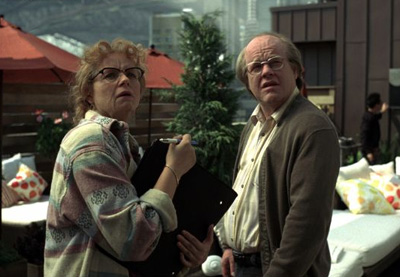
In addition to this new hopeful, I’d say there are solid bets to be placed on “The Chronicles of Narnia: Prince Caspian,” “The Curious Case of Benjamin Button,” “The Dark Knight,” “Frost/Nixon,” “Hellboy II: The Golden Army” and “Tropic Thunder.” Not a shabby start.
 So Cannes Film Festival president Gilles Jacob has revealed the lineup for this year’s competition… and it’s a doozy.
Suffice to say that next month we’ll have some clarity on at least three of the titles being talked up for next year’s derby, all from formidable Oscar champs – Charlie Kaufman’s “Synecdoche, New York,” Clint Eastwood’s “Changeling” and Steven Soderbergh’s Che Guevara double-whammy, “The Argentine” and “Guerrilla.”
Interestingly, Soderbergh’s films will screen (and compete) as one four-hour entry, titled simply “Che”; I can’t help wondering whether this is a road-test for an alternative distribution strategy. Seems to me that having only one release to deal with would heighten the project’s awards prospects… not that Soderbergh is any stranger to competing against himself, mind you.
For Eastwood, meanwhile, this marks his fifth directorial appearance in the Cannes competition, after “Pale Rider,” “Bird,” “White Hunter, Black Heart” and “Mystic River.” As the mixed fortunes of those titles attest, a place in the lineup is no guarantee of future awards glory. Nevertheless, the unexpected inclusion of “Changeling” on the list (a last-minute addition, like the Soderbergh films), combined with Eastwood’s impeccable recent form, certainly boosts the cache of a film that, with its supernatural story elements and the maddeningly inconsistent Angelina Jolie in the lead, has me guarded about its awards potential.