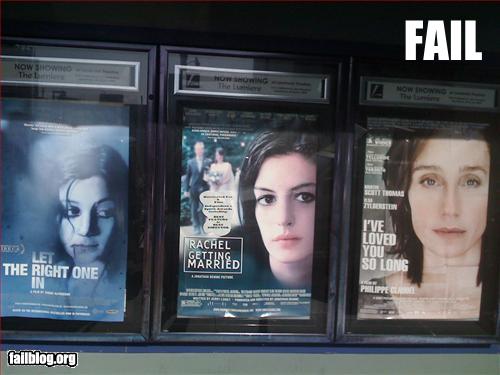
A reader sent me this pic, it amused me, so I’m posting. Simple as that:
 You may recall that a few weeks ago, I mentioned that Harvey Weinstein had a Judy Garland biopic in the works.
Back then, I contemplated the potentially perfect Oscar storm represented by the lead role: a biopic of a showbiz icon, covering substance abuse and mental instability, requiring song-and-dance skills, all backed up by the mighty campaigning power of Weinstein.
Wondering which actress might be lucky enough to nab the opportunity, I suggested that Anne Hathaway could be a neat fit for the part.
Well, if Jeff Wells is to be believed, it seems that Weinstein is of a similar mind: Hathaway is “officially attached” to the project. I wonder if her game Broadway-style hamming at last month’s Oscar ceremony helped her cause at all?
Seriously, though, this is perfect timing for the starlet: if “Rachel Getting Married” served as a sketchy but intriguing blueprint of what talents she had stored up, this is the kind of expansive, weighty mainstream project that would solidify her arrival as potentially the go-to leading lady of her generation. If she pulls it off, I maintain that it’s hard to imagine the Academy resisting.
… when you have the gold medal from Nathaniel Rogers’ peerless Film Bitch Awards? After teasing us for far too long, Nat has finally wrapped up his nominees and revealed his rankings. Anyone with a passing acquaintance with The Film Experience of late won’t be surprised to learn that “Rachel Getting Married” has done rather well, but I’m thrilled to see justice at last for Sally Hawkins, his Best Actress winner. Take that, Academy.
Dig in here. It’s a riot.

The season is winding down this week. The slow President’s Day holiday yesterday seemed to be more of a harbinger than a lull in the excitement. This time next week, we’ll probably be over the fallout of the circuit and on to debating the contenders we’re likely to see a year from now.
It’s a vicious, beautiful, sad, interesting circle.
But before the 81st Annual Academy Awards telecast puts a bow on the festivities Sunday night, it seems a decent enough time to reflect. And not to be too negative, but this became one of the most irritating seasons I’ve ever covered, both in the lack of excitement to the dichotomy that circumstance presented for me (given that my favorite film of the year has lead the field throughout).
With that in mind, I fully expect this piece to grate the nerves of more than a few readers. Then again, I’m sure plenty of these views are shared by a handful as well, but whatever the case, a list of pet peeves began to stack up early on in the season. I thought it reasonable to collect them here, so feast your eyes (or roll them), this is what got under my skin this year.
 Over at USA Today, Susan Wloszczyna has come to the conclusion that, in a fairly weak year for film with a less-than-competitive Best Picture slate to show for it, the performance categories are where it’s at this year:
The real action this year is in the acting. Sets were chewed with delicious relish and scenes were snatched with delectable finesse, even if the films themselves have underwhelmed.
“I look at my ballot and see all these amazing actors,” says an overwhelmed Donna Gigliotti, a producer on The Reader and a trophy winner for 1998’s Shakespeare in Love. “It’s just staggering. That role was a game changer for Anne Hathaway, nothing that anyone expected from her. And Melissa Leo in Frozen River? What is she, 48? Her nomination just made me want to stand up and cheer. Richard Jenkins is such a fabulous actor. And Taraji P. Henson is the soul of The Curious Case of Benjamin Button.“
I’m inclined to agree. Though I still think the Academy dropped the ball in some areas (Best Actress, in particular, could have been a far richer and more diverse race had the likes of Sally Hawkins and Kristin Scott Thomas been invited), it’s true that, while 2008 hasn’t been as rewarding for auteur works as some previous years, we’ve seen a lot of films either wholly constructed around their performances (“The Wrestler” being a prime example) or saved by them (for my money, Anne Hathaway and Rosemarie DeWitt are the most focused elements of “Rachel Getting Married”).
The result is, I think, that people seem a lot more invested in this year’s acting races than the ones for Picture or Director — and it’s not just because the latter two are foregone conclusions. (Let’s face it, there’s not much more suspense in some of the acting categories, and I think you know what I’m referring to.) It seems to me that the performances of 2008 have been more complete, complex and adventurous than the films — in some cases, the very films in which they appear.
Since I was talking about original screenplays earlier today, I was interested to see that Jeff Wells is also on the topic. He offers a brief rundown of the nominees for Saturday’s WGA Awards, and offers this theory on why Jenny Lumet missed out on both Guild and Oscar nods for “Rachel Getting Married”:
Lumet’s screenplay didn’t render enough bombast and sword thrusts in the big-money confrontation scene between Anne Hathaway and Debra Winger. They start to get into the “why did you leave me with him?” issue, Winger freaks and slaps and then Hathaway runs out — not satisfying!
I’m not sure ‘bombast’ is the word I’d use (I rather think more subtlety was called for), but I’m glad to see that scene singled out — for me, it was a lazy, artificial bit of dramatic shortcutting that caused the film’s whole emotional construction to fall apart somewhat. Anyway, old news and apropos of nothing really, but I’m glad someone else said it.
As for the WGA, we all know Simon Beaufoy is taking the adapted category. Does Dustin Lance Black win original by default, since he’s the only Oscar nominee of the bunch? I guess so — barring a surge of peer affection for four-time winner Woody Allen. But if Black does lose — not likely, of course — I wouldn’t fancy his Oscar chances much. Just an idle thought.
If you saw his TV chat with Charlie Rose and A.O. Scott, you won’t be surprised to read that critic David Denby doesn’t think much of this year’s Oscar crop. (And if you didn’t, you could probably guess.) Anyway, in this very lucid New Yorker piece, he expands on the points he raised on the show, tearing apart every Best Picture nominee but “Milk,” and lamenting the exclusion of “Happy-Go-Lucky” and “Rachel Getting Married.” I don’t agree with everything he says (and I do think he’s unnecessarily cynical about “Slumdog Millionaire”), but he’s bang on-target here:
In the well-acted “Frost / Nixon,” a nice journalistic coup—David Frost’s pushing Richard Nixon into semi-confessional mode, in 1977—has been elevated to a great transformative moment in history, which, alas, it was not. These two films (“Frost/Nixon” and “The Reader”) may have been controlled more by their directors and their writers than by their studios, but they’re still the kind of middlebrow pictures that the Academy used to nominate in the bad old studio-dominated days—the contemporary equivalents of “Judgment at Nuremburg” and “Guess Who’s Coming to Dinner?” They are “important” pictures that “say” something about public issues. They’re good for the industry’s image.
Note the quotation marks. The rest here.
 Like I said, I’m on the record. I’ve given some left-field choices (as have you). But here are some lingering thoughts bouncing around inside my tired old head this evening:
1) I think we’re going to see tomorrow, finally, that “Rachel Getting Married” is nothing more than a critical fave. Personally, I liked it enough, but all the “one of the year’s best” talk was dubious to say the least. A SAG ensemble nod would have kept me quiet. Talk about a place it could have made a stand. And that WGA snub was just one more smack by the industry, in my view. Maybe it’s just like one voter told me: “I couldn’t stand these people.” Anne Hathaway, step up for the film’s consolation nod.
2) “Gran Torino,” “Gran Torino,” “Gran Torino.” I can’t say it enough…this film is creeping up. It’s possible it came on too late and Clint missed the timing this time out, but, like I’ve said…watch it. Personally I think it’s a bigger threat than “The Reader.” A bad-ass white guy kicking kids off his lawn or a porno about a sympathetic Nazi. Which film is going to resonate more with the Academy? You tell me.
3) Everyone says, in varying degrees, that everything from “The Dark Knight” to “Frost/Nixon” to “Milk” are on the bubble. But here’s a radical idea: what if the weak link is the film many have called cold and removed? “The Curious Case of Benjamin Button” sure does have a lot of guild support…but so did “Dreamgirls.”
4) Could one of the biggest stories tomorrow be the snubbing of Brangelina? Some think he’s out, some think she’s out…but what if they’re both out? Eesh.
5) Better yet, might the biggest shock of the day be a “Man on Wire” snub in the documentary feature category? All I’m saying is films dominated by preexisting footage can struggle here sometimes.
Then again…maybe I’m off my rocker. But there you have it.
I’ve only made one prediction alteration, FYI, and that’s swapping “Slumdog Millionaire” for “Quantum of Solace” in the sound editing field. The latter was just an arbitrary choice to reflect the mixers’ feelings, but I’m thinking of a sweeper possibility there and I like the advenurous choice of “Slumdog” more than “The Curious Case of Benjamin Button.” But really, that category lately? Flip a coin.
Enjoy the morning.
Yesterday I mentioned how Lone Scherfig’s British period romance “An Education,” starring much-buzzed ingenue Carey Mulligan, had become the talk of Sundance, with Fox Searchlight zeroing in on the film.
Now Anne Thompson reports that Searchlight, and several others, have been beaten to the punch by Sony Pictures Classics, who have acquired the North American rights for $3 million:
Fox Searchlight came back into the negotiation on a second round but was unable to close … Also bidding on An Education were The Weinstein Co., Focus Features, Lionsgate and Overture. SPC will launch the film in the fall with an eye on an awards campaign.
Wow, that some hefty interest there. SPC sounds like an appropriate fit for the film, given that they’ve had some success lately with female-skewing arthouse titles like “Rachel Getting Married,” “I’ve Loved You So Long” and their canny acquisition from last year’s festival, “Frozen River” — even if those films’ campaigns have lost some steam over the course of the season.
The news of an awards-oriented release is certainly interesting … could Mulligan be this year’s Ellen Page? Stu Van Airsdale thinks she’s rather better than that, saying that Page’s “Juno” turn comes off looking like “a Lifetime reject” by comparison.
 Back in December, Kris offered his take on how he would fill out his nominee ballot if he were an Academy member (affording himself the luxury, obviously, of voting in all categories). Of course, playing voter is a popular sport in the blog world, with Nathaniel Rogers’ annual Film Bitch Awards as thorough and intelligent a rundown as you could ask for. Would that the Academy displayed such passion and imagination in their choices.
For my part, finalising my predictions was a dispiriting procedure, as I realized the range and depth of work that will inevitably go unrecognized as the AMPAS gravitates towards the favoured and the familiar. And so it is that, as the nominations loom over us, I decided to chalk up my own ballot, acknowledging those who I feel most deserve to hear names called on Thursday morning, whether or they’re deemed possible — or even eligible.
Today’s post focuses on the technical categories; tomorrow’s will run through the main ones. (Before I begin, let me add the caveat that, much to my chagrin, I haven’t yet seen “Let the Right One In.”)
Best Cinematography
Wally Pfister, “The Dark Knight”
Sean Bobbitt, “Hunger”
Luca Bigazzi, “Il Divo”
Darius Khondji, “My Blueberry Nights”
Maryse Alberti, “The Wrestler”
After last year’s banner year for the art of cinematography, this was a year of subtler accomplishments in the field. I must admit that much of the year’s most celebrated work in the field didn’t particularly dazzle me, with several revered names only working at (or below) par. Pfister’s muscular, burnished lensing of “The Dark Knight,” however, did not disappoint, while Bigazzi’s hyper-stylised work on “Il Divo” was no less kinetic.
In something of a breakthrough year for female DPs, Alberti effortlessly captured the rhythms of human movement, while Khondji conjured up the year’s dreamiest palette for Wong Kar-Wai’s otherwise muddled “My Blueberry Nights.” The year’s crowning achievement, however, came from Sean Bobbitt, whose breathtaking compositions for “Hunger” took equal inspiration from the art gallery and the newsroom. Just missing the cut were “The Fall,” “Gomorrah” and “The Good, The Bad, The Weird.”
 Rarely does the lead actress category provide more suspense than leading gentlemen and rarely is it as packed with fine performances as it is this year. I can remember years when it was a struggle to come up with five nominees for best actress, 1975 and 1992 springing to mind. It might have less to do with quality female performances than it does the amount of quality female roles Hollywood provides.
But the Academy won’t have any trouble this year. There are going to be excellent performances left off the list of nominees this year due to uncharacteristically heated competition, that is a sad fact, and there is not a thing anyone can do about it except continue to love and support the performances snubbed. In fact it is not even that they will be snubbed, it’s just that there is only room for five ladies, and this year, selecting those final five must be proving an enormously difficult task for the Academy.
With her two Golden Globe wins, Kate Winslet seems to be a shoo-in for her superb performance in “Revolutionary Road,” a truly heartbreaking piece of acting that is sadly underseen at the moment. Meryl Streep, meanwhile, will be nominated for the 15th time for her tyrannical nun in “Doubt” and Anne Hathaway will get a welcome to the big show for “Rachel Getting Married,” in which her caustic turn as Kym has altered the course of her career and announces her as a serious actress in the industry.
And then it becomes tricky — those final two spots.
 In the 1970s there simply wasn’t a greater director of actors than Sidney Lumet. Roles in his films came with Academy Award nominations virtually attached. From 1973 to 1988, Lumet directed actors to 16 Oscar nominations, three of those eventually winning an Oscar. He himself was nominated for Best Director for “Dog Day Afternoon,” “Network” and “The Verdict” and most certainly should have been nominated for “Prince of the City,” which earned him a New York Film Critics Circle award.
A former actor himself, Lumet understood inherently how to work with his on-screen talent, how to allow them the space they needed to create without seeing them run away with his film. Most importantly, he understood how to direct them to best serve the piece. Incredibly he never won an Oscar for his work at the helm, but the Academy did give him an Honorary Award a couple of years ago, which he followed with his best work in years: “Before the Devil Knows You’re Dead.” In his 80s now, he is as fresh and alive as he has ever been, and still one of the great living directors.
And now his daughter Jenny could become a first-time Oscar nominee for her screenplay “Rachel Getting Married.” Lumet must be pleased — Sidney, I mean. I had the pleasure of interviewing him last year and he was an utter delight, frank, unafraid to speak his mind. He mentioned his daughter was working on a film I might see within the year. With a smile and a twinkle in his eye he said, “It’s very good.” Ever the proud father.
 • Noah Forrest talks with “Che” scribe Peter Buchman. [Movie City News]
• David S. Cohen takes a deeper look at the visual effects bake-off. [Thompson on Hollywood]
• Tom O’Neil chats with Dave Karger and Michael Musto about the seemingly Oscar-locked Heath Ledger. [Gold Derby]
• Reed Johnson talks to the descendents of “Defiance”‘s Bielski brothers. [Los Angeles Times]
• Yet another “what’s up with all the movie Nazs” piece. [The Independent]
• Christopher Goodwin talks to Daniel Craig about his experimentalism. [The Times]
• Anthony Breznican profiles “Rachel Getting Married” star Anne Hathaway. [USA Today]
 I almost let this one slip by without taking a stab at it. It’s all happening!
Anyway, the Writers Guild of America (WGA) will be announcing its list of screen nominees tomorrow. I figured I’d take an in-depth look at both categories, starting with the original scripts, which provide a much broader field than the adaptations.
Understand that foreign films and animated films are not eligible with the WGA, so you won’t be seeing nominations for “I’ve Loved You So Long” or “WALL-E.” The former probably didn’t have much of a shot, but with Andrew Stanton and company out of the picture, it helps to narrow things a bit…but not by much.
Looking deeper at the equation, Mike Leigh has only been nominated by the guild once, way back in 1996 for “Secrets & Lies.” My hunch is the guild doesn’t much respect his penchant for improvisation as opposed to proper screenwriting, even if the Academy’s writing branch has allowed for it in recent years.
Woody Allen’s whopping 18 nominations would make him a seeming lock but then again, his last guild nod was back in 1995 for “Mighty Aphrodite.” The Academy has nominated him for “Deconstructing Harry” and “Match Point” since that time, but “Vicky Cristina Barcelona” is probably his most well-liked film in over a decade, so it’s probably secure.
Next, it’s worth noting that the WGA likes its comedies. “The 40 Year Old Virgin,” “Garden State,” “The Station Agent,” “Bend It Like Beckham” and “Best in Show” represent a handful of original screenplays that have been nominated here even if they managed to be left out of the Academy’s tally. So something tells me a shocker like “Pineapple Express” or “Tropic Thunder” showing up shouldn’t be much of a shock at all, but I’m more tempted to go with Martin McDonagh’s brutally dark “In Bruges” instead.
I see no real reason to bet against Jenny Lumet’s “Rachel Getting Married” (though I could be on autopilot with that assumption) or Thomas McCarthy’s “The Visitor” (as mentioned, recognized here in 2003 for “The Station Agent”). So that leaves one more spot to fill.
There is always one Best Picture nominee left out of this guild’s slate of nominees even if it manages to find love with the Academy’s writing branch. Examples have included “Atonement,” “Letters from Iwo Jima,” “Munich” and “Finding Neverland.” My guess is it’s a toss-up between “Frost/Nixon” in the adaptations and “Milk” here in the originals for that unfortunate designation this year. But I’m going to go ahead with the assumption that Dustin Lance Black is on sturdy ground with his work on the Harvey Milk biopic.
One quick note before I get to my predictions, however: I have no idea how any industry guild or organization will respond to Charlie Kaufman’s “Synecdoche, New York.” If the WGA sees the brilliance, great, grand…but I’m not counting on it.
I’m going with this set:
“In Bruges” (Martin McDonagh)
“Milk” (Dustin Lance Black)
“Rachel Getting Married” (Jenny Lumet)
“Vicky Cristina Barcelona” (Woody Allen)
“The Visitor” (Thomas McCarthy)
Other possibilities:
“Burn After Reading” (Ethan Coen, Joel Coen)
“Pineapple Express” (Seth Rogen, Evan Goldberg)
“Tropic Thunder” (Etan Cohen, Ben Stiller, Justin Theroux)
“The Wrestler” (Robert D. Siegel)
What about you?
 In lieu of a proper Tuesday list, I thought I’d do something a little different this year, since we have a slew of contributors and In Contention is no longer the brain space of just one person. I polled all our writers for their individual top 10 lists, which you can find detailed after the jump. But with the lists in hand, I pulled out the trusty abacus and went about the painstakingly in-depth analysis of each to surmise a collective top 10. The results were interesting.
No film appeared on all five lists, which is already an accomplishment, I’d say. Four films appeared on four lists and four on three. The remaining two films on the collective appeared on two lists. No film popping up on just one list was taken into account, so you don’t get to march with torches over a “Bolt” inclusion.
“The Dark Knight” became the obvious victor early on, but Charlie Kaufman’s “Synecdoche, New York” came a lot closer than you might think. I used a simple point system per ranking, but in all scenarios, the number of lists featuring a film was given precedence over points. This made for a good tie-breaker here and there and, in some cases, caused for this film or that to leap-frog another.
Consider this my ultimate salute to our contributors who, I doubt I’m alone here, did a bang-up job in 2008. Here’s to an equally splendid 2009.
In Contention’s top 10 films of 2008:
1. “The Dark Knight”
2. “Synecdoche, New York”
3. “Slumdog Millionaire”
4. “WALL-E”
5. “Milk”
6. “The Curious Case of Benjamin Button”
7. “The Wrestler”
8. “Let the Right One In”
9. “Rachel Getting Married”
10. “In Bruges”
Honorable mention: “Gomorrah,” “Hunger,” “Pineapple Express”
(Individual lists after the jump.)
 It’s no secret that I don’t expect 2008 to be remembered as a banner year for cinema, though with that said, there are plenty of exceptional films to be remembered.
Perhaps 2007 spoiled us and got our hopes up and 2008 brought far too many let downs and disappointments from great filmmakers. Usually when I sit down to write up the year’s best, the first short list stands at around 30, perhaps 35 films that range from very good to great. This year I was at less than 20, and in some cases, I was probably stretching to allow space for this or that.
But I got it down to 10, so here they are…
10. “VICKY CRISTINA BARCELONA”
This film was not vintage Woody Allen, as he has grown so much as a director for anything new from him to be considered a throw-back, but it is certainly refreshing Allen. Sexy and sleek, this film is part of the newest stage in the director’s career, moving away from the comfort and familiarity of New York to an exotic locale with Americans mixing it up and getting into all sorts of bizarre situations. Penélope Cruz all but burns a hole in the screen with her sensuality in this film, which is terrifying because she just might be psychotic. Welcome back Woody…we’ve missed you.
 • Jeff Wells is still peeved at the critical snubs of “Revolutionary Road,” aside from a few exceptions. [Hollywood Elsewhere]
• Tom O’Neil and Michael Musto debate the likely Best Picture victor. [Gold Derby]
• Another un-bylined Calendar piece. What gives? Anyway, David Fincher is talking to somebody about “The Curious case of Benjamin Button.” [Los Angeles Times]
• Alonso Duralde spotlights the year’s best, sans Oscar bait. [MSNBC]
• John Hiscock chats with “Rachel Getting Married” star Debra Winger. Anyone wondering, half-way through the season, why anyone was crazy enough to think she had an Oscar play? [Daily Telegraph]
• Jenni Miller digs into the role of a stripper with critical kudos champ Marisa Tomei. [Premiere]
• Bryan Appleyard talks “The Reader” with director Stephen Daldry. [The Times]
• “Let the Right One In” tops David Ansen’s list of the year’s best. Nice. Beware a cop-out tie at #10, though. [Newsweek]
 As I said a few weeks ago, I would not analyze the last “tech” category until the eligible entries had been announced. Now that the Academy has named 49 finalists for Best Original Song, and with the BFCA and HFPA rattling off their list of nominees (though they are, admittedly, not great predictors), the time seems appropriate to have an in depth look into the category.
It’s a good mantra to say “there are no locks” in this field. Since the rules were changed three years ago, forcing voters to watch the songs in the context of the movie, some surprises have certainly been in store. Nonetheless, there are two titles this year I’d be very surprised to see miss the cut.
The first is Bruce Springsteen’s title track for Darren Aronofsky’s “The Wrestler.” One of the most deserving winners ever in this category (for “Streets of Philadelphia”), his ends credits track seems poised to bring him his third Oscar nomination. In addition to the song perfectly fitting the film, it is also simply a great tune.
I expect Springsteen to battle it out for the win with “Down to Earth,” the “WALL-E” tune from Peter Gabriel and Thomas Newman. Now here is a film whose performance in the precursors has absolutely shocked me (albeit in the best way possible). Gabriel has yet to have a hit with the Academy but he’s never written anything that was so Oscar friendly before either. And while Newman has yet to be nominated for a song, he’s never had a song in contention before and he’s also yet to win for his portfolio of classic scores.
Admittedly, both these tunes only play at the end of the movie, over the credit roll. This seems to have become a disadvantage in recent years. But I still would be surprised if either title failed to make the cut when all is said and done.