Just had to pass this along. Kind of dig it. Courtesy David Chen:

Just had to pass this along. Kind of dig it. Courtesy David Chen:
 Here’s an easy one for serious Oscar trivia geeks: what’s unusual about Hal Mohr’s 1935 Best Cinematography win for “A Midsummer Night’s Dream?” I offer no prize, but pat yourself on the back if you knew that Mohr was the first and only person to win an Oscar on write-in votes — or in other words, that he won despite not being nominated.
Mohr’s victory was the result of a groundswell of industry support for his work on the Best Picture nominee after he surprisingly failed to secure a nomination; the year before, Bette Davis was the beneficiary of a more famous, but less successful, write-in campaign for her acclaimed, un-nominated work in “Of Human Bondage.”
As it turned out, she received fewer votes than two of the three actresses who beat her to the nomination, but the legend stuck — and Davis got a blatant make-up Oscar a year later.
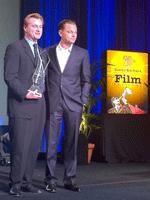 “He no longer challenges our ideas about film,” actor Leonardo DiCaprio said of Christopher Nolan tonight, before presenting him with the Modern Master Award. “He has helped define them.”
It was a great bow on a fine evening meant to celebrate the director’s work over the last decade. The Modern Master designation is Santa Barbara’s highest honor and, despite an unexpected Oscar snub for Best Director from the Academy last Tuesday afternoon, this is certainly the year to single him out in such a light.
Pete Hammond served as moderator for the evening as he queried Nolan on his brief if dense career to date. It was shrewd to note that “Following” in 1998, a $6,000 movie that grossed $40,000 and “Inception” in 2010, a $160 million movie that grossed $800 million worldwide, only have 11 years separating them. The director’s latest “has been successful on its own terms, not on Hollywood’s,” Hammond said by way of introduction. It’s a good way to put it.
 A reader comment got me thinking on box office and Oscar as the usual blockbuster and genre fare led the way in ticket sales this weekend. It dawned on me that pickins might be extra slim when it comes to representing populist filmmaking in 2010’s Best Picture crop.
Box office and finding room for ratings-friendly titles have long been assumed considerations in the decision to expand the Best Picture category to 10 nominations last year. One year after Christopher Nolan’s “The Dark Knight” nearly reached “Titanic”-level numbers and was snubbed of a Best Picture nomination, there were suddenly five more spots to be filled, widening the net.
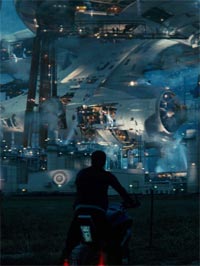
Academy members had seven films to choose from the $100 million-plus club in 2009 that had any legitimate excuse for being in the conversation. They were: “Avatar,” “The Blind Side,” “District 9,” “The Hangover,” “Inglourious Basterds,” “Star Trek” and “Up.” And some would consider “The Hangover” and “Star Trek” to be a stretch. As such, they missed, and the other five made it.
 I kind of don’t like calling it “Batman 3,” but in any case, Mike Fleming is reporting at Deadline that Tom Hardy, star of Christopher Nolan’s “Inception,” has been cast in a “lead role” in the sequel to 2008’s “The Dark Knight.”
Naturally, “insiders are keeping the role secret and won’t even say if he’s up for a villain role, but that seems a reasonable assumption,” Fleming writes. I find myself wondering. I heard an interesting theory (there are many surrounding these films) some time ago that Hardy would be an intriguing choice for actor Basil Karlo, aka Clayface (given his actorly role in “Inception”). All talk, of course.
There is also discussion that, solely based on the fact that the film is shooting in New Orleans, the villain might be bayou-centric…Killer Croc. I’d frankly be all about that if they could pull it off. Part of me wants this third film to embrace the heightened reality of the universe, rather than boil too much further into realism. Supernatural elements could be done in a classy fashion, I think.
 It seems almost mandatory to begin any discussion of “Inception” with an acknowledgement of its scale of ambition – both aesthetic and intellectual – not least when set against the sights of most other $200 million summer studio pictures.
So yes, let’s acknowledge it. Christopher Nolan’s latest is an uncommonly heady and intricate tentpole blockbuster, taking on themes of memory, mortality and family that, in conventional Hollywood logic, don’t tend to mesh with noisy, rain-sodden car chases and 007-style explosions in remote Arctic fortresses. I saw it on Monday in pristine IMAX splendor, and took immense pleasure in watching something on that scale that demanded to be kept up with, puzzled out, mentally reassembled, and not merely looked at. And yes, in a season of few mainstream pleasures — and unsurprising ones at best – I’m glad it’s in theaters.
But it’s easy to praise “Inception” for not being the film it was never intended to be in the first place. Certainly, we can pat Nolan on the back for having crafted an immeasurably brainier and more beautiful summer blockbuster than “Transformers 2,” or even “Iron Man 2,” but to me, it feels glib and condescending to do so: handling with kid gloves a work that asks to be judged by more rigorous standards.
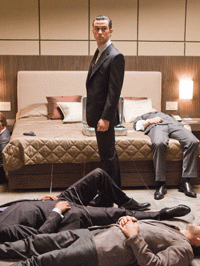 The word of the day Friday will most certainly be “Inception,” as casually interested movie-goers and anxious fanboys alike line up to take in Christopher Nolan’s latest effort.
Now, I have suggested in this space that the film’s ensemble is an organic one, alive and driven. And that the performances are separately less than their sum impact. It nevertheless seemed a good time to look back over Nolan’s septet of offerings thus far and cherry pick the best portrayals for a return to this semi-regular feature at In Contention.
Nolan always puts together a great cast. His carefully selected leads tend to ably balance themes of identity, control and psychosis, while highlighted supporting parts always prove to be charming outside-the-box considerations.
With the latter in mind, I’d have loved to make room for the Steven Tobolowskys, Rutger Hauers, David Bowies, Ritchie Costers and Tom Berengers, but I naturally kept settling on the larger roles when push came to shove.
So, without further ado…
 Now that the review embargo walls have crashed on “Inception” (though most of what’s out there is web-based media as we’ll wait a while for print reactions), I guess it’s fair to dive into the awards implications of the film. I preferred to stay away from that kind of talk in my review.
The first thing that comes to mind when I think of the history of Best Picture nominees is the fact that, on some level, they are fairly undemanding efforts. There’s a pattern of simplicity of narrative, regardless of genre. Now, most seem to think the general positive assessment Nolan’s film has received should be enough to get it into a field of 10 nominees, but I’m a touch skeptical.
“Inception” is anything but undemanding. It’s a cerebral exercise that will have some recalling Robert Downey Jr.’s swipe at “The Dark Knight” a few years ago: “I clearly need a college education to understand this movie.” We all remember Nolan’s superhero epic did not make the cut with five slots. And the thought process for some is, well, it’s time for AMPAS to kiss and make up. Except that’s not the typical AMPAS thought process, and certainly not for a still youngish talent like Nolan.
 • Nikki Finke says Oscarcast producers may be secretly considering a third host. [Deadline Hollywood Daily]
• Julian Sancton talks to the brilliant (and all but forgotten this season) Anthony Mackie. [Little Gold Men]
• Davis Guggenheim’s education crisis documentary “Waiting for Superman” is Sundance’s first pick-up. [The Wrap]
 “It might as well rain until September,” wrote Carole King in her jaunty 1960s ditty of that title, an ode to summertime breakup blues that may as well have been composed for the autumnally-activated awards season. Swap September for December, and you have an apt description of the approach many studios and Oscar-watchers alike take to the race — a short-memory mentality that I argued against in a column almost three months ago.
Back then, I appealed to specialty and independent studios to release smaller titles earlier in the year, before the holiday-season crush of studio prestige titles – citing “The Hurt Locker,” amongst others, as a title that would likely benefit from the head start.
With the year up and the full field revealed, I take the robust awards-season performance of the former film, as well as the surprising durability of “Inglourious Basterds,” as evidence that more offbeat contenders often benefit from a longer lead – not least when even hefty studio ponies are currently struggling to keep their heads above water, despite the visibility afforded by December release dates.
Which leads us to the quartet of studio titles long labeled the “Big Four” by awards-watchers – the “Big” speaking not of the most enthusiastic anticipation so much as the longest delay. Months ahead of their respective press premieres (the earliest of which came in late November), “The Lovely Bones,” “Nine,” “Invictus” and “Avatar” crafted an aura of importance around themselves by sheer virtue of being the last seen, hogging four slots on many predicted Best Picture lineups on theory and expectation alone.
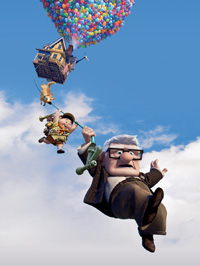 As the year (and decade) slowly winds down, I thought it would be a pretty good time to revive our long-slumbering Lists feature here at In Contention. And what better way to do so and salute the year at hand than to lay out the most significant movie-related moments of 2009?
The American Film Institute kind of tried its hand at this yesterday. I was already considering a list along these lines, but the AFI thing definitely got my the ole’ gears turning once again. Suffice it to say, I think they missed a few spots.
It was an intriguing year. For me, as mentioned many times, it was the best year of filmmaking the decade has seen. But it was also a pivotal year for the film industry, as everything from standardized digital projection to 3D technology, experimental distribution schemes to economic effects on the business seemed to be on the table as points of consideration along the way.
It was the first year of the Obama administration, something that found its way into the arts discussion as well. Whether it was the consideration of “Slumdog Millionaire” (which ultimately won the Best Picture Oscar this year) as the “first film of the Obama era” or the desire to include films like “Precious” (a stretch) and “Invictus” (not such a stretch) in that conversation, the political environment, as ever, was in the cinema air.
It was a year of many things, so obviously, a list like this could be filled with any number of instances. But these 10 stuck out to me as the most significant ticks on the clock of 2009. Agree, disagree, whatever the case, don’t look too hard for a “Twilight” mention (though I suppose one may have been warranted).
My picks…
 “My God, they’ve thrown in everything but the Teenage Mutant Ninja Turtles.”
Quoted by writer Anthony Holden in his gossipy history “The Oscars,” this was one publicist’s dismayed response to the 1990 Academy Award nominations, which included such unusual concessions to popular (as opposed to critical) opinion as a Best Picture nomination for “Ghost” and a Best Actress nod for Julia Roberts in “Pretty Woman.”
I remember this year well – I was eight years old, and it was the first Oscar race I followed in detail from burbling Christmas hype to the ceremony itself, digging up and scrapbooking all the press and TV coverage I could find.
And from what I recall of my fledgling research, the unnamed publicist above wasn’t alone in her discontent. In particular, the “Ghost” nomination attracted levels of critical scorn even higher than those usually reserved for the Oscars – the common line being that the Academy had sold out to commerce rather than art, and that the sky would be falling at any given moment.
Does this situation sound at all familiar?
It should do. Though it was a response to an outcome rather than a possibility, the kvetching over the 1990 nods more than slightly resembles the panic that set in among certain pundits and fans alike (including, admittedly, yours truly) when the switch to 10 Best Picture nominees was announced in June.
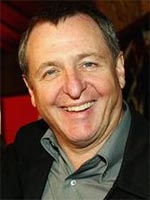 As a former Fox chairman with a background in marketing, it’s unsurprising that Tom Sherak, who recently replaced Sid Ganis as president of the Academy, wants to bring a more populist approach to the Oscars.
In this LA Times interview, he makes it clear that the primary objective of the move to 10 Best Picture nominees is to get more blockbusters into the race — having himself voted for “The Dark Knight” last year — but admits that they may not succeed:
The point of it was to do something … We need to not be afraid to try things. We need to be positive. The people who are against the idea say, ‘What if it doesn’t work?’ Then we won’t do it again.
 There was a moment last season where I gave up going against the grain on the notion that “The Dark Knight” would be nominated for Best Picture. I was called a fool, I was told I wasn’t with the program, I was told certain milestones related to the film would not be overlooked, etc. I just didn’t think it was going to happen.
But I relented. I used the healthy precursor trail the film blazed as reason enough to join the (perhaps fanboy-driven) chorus and say sure, the film will be nominated. Why not? Still didn’t feel right. And we all know how that turned out.
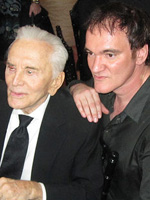
I’m getting a similar vibe from “Inglourious Basterds,” which is even being considered a sure-fire lock in some quarters. An extra five nominees change the dynamic, of course, and most would argue that “The Dark Knight” would have made it in with 10 nominees. But even with a wider target, I still don’t think Quentin Tarantino’s latest will make the cut. And if I go down in flames sticking to that inclination, so be it. But I don’t think I will. Fool me once, as the saying goes.
But all of this doesn’t mean there isn’t an old-school concentrated effort on the part of The Weinstein Company to appeal to the Academy membership, and things really kicked off in earnest on that front Thursday night in Montecito.
 • If you’re dismissing the Oscar potential of “The Men Who Stare at Goats,” Gregory Ellwood says, “Not so fast.” [Awards Campaign]
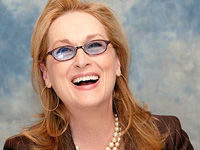
• Meryl Streep on why Hollywood’s men don’t trust women. [The Times]
• Betsy Sharkey sits down with “Precious” director Lee Daniels. [The Envelope]
 Over at IMDb there is a new feature called “The Power of Film” (lofty title, that), which has listed out the top 15 films of the millennium as voted on by IMDB users, i.e., fans, the public, regular folks.
The IMDb top 250 is an ever-changing mish-mash of high-,middle- and low-brow entertainment that always makes for an amusing cross section of what the public thinks of cinema from one moment to the next. “The Godfather” and “The Shawshank Redemption” trade off the #1 spot consistently, save for the spike of interest in this major new release or that, films that insinuate themselves high early on but inevitably fall down the list as more viewers get a look.
The new feature, unsurprisingly, features Christopher Nolan’s “The Dark Knight” at the top, but strewn throughout is a diverse mixture including the “Lord of the Rings” triology, German Oscar-winner “The Lives of Others” and Pixar entries “WALL-E” and “Up.” And speaking of Oscar, MTV’s Terri Schwartz has spun her wheels on the idea that, with a larger slate of Best Picture possibilities, the IMDb list could prove an omen for the potential blend of eclectic and entertainment cinema so many expect the Academy’s line-up to resemble from this year forward.
(Schwartz’s thoughts and IMDb’s list after the jump.)
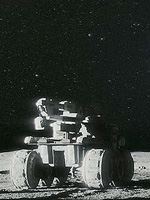 The success of Neill Blomkamp’s “District 9,” (thoughts) and hopefully (eventually), Duncan Jones’s “Moon” (review) has fed into what I’ve been consistently calling a banner year for sci-fi cinema in 2009. That is, of course, assuming “Avatar” does come along and lay a giant egg in December.
One of the galvanizing aspects to, well, two of these films, anyway, is the independent focus. The modestly budgeted aspect that keeps the spirit of high concept indie filmmaking alive. And in the case of Jones’s film, the use of practical effects free of frivolous CGI is cause for celebration. At least that’s what Guardian writer Phelim O’Neill is getting at with a recent piece that declares the film’s old-school effects should be a model for today’s sci-fi films.
In particular, it’s the model work in the film that is so exciting to O’Neill. There is a humorous “then and now” photo of George Lucas that has made the rounds, the underlying point being that the director lost his creative drive when he began using heavy CGI in the “Star Wars” franchise. Personally, I think that’s silly, because, well, the “Star Wars” films are bad with models or without them (my opinion). But there is something about the tangible quality of practical effects that makes the reward of watching a film that much richer. “Moon” is one level on that scale. “The Dark Knight” is another. It doesn’t have to be a money concern. C reatively, it can have a more visceral impact.
 Today marks the beginning of a fourth year of Tech Support here at In Contention. Over the past four years, we’ve sought to bring the otherwise under-reported crafts categories and crafts artists the attention they seldom receive, despite their enormous contributions to the art of cinema.
This year, we plan on looking at nine of the categories – Art Direction, Cinematography, Costume Design, Film Editing, Makeup, Original Score, Sound Editing, Sound Mixing and Visual Effects – twice thoroughly between now and the morning the nominations are announced. Best Original Song will be previewed once, when we have a better idea of eligible contenders.
I will be offering the analysis of these categories but Kris will also be joining me for the first time this year with Tech Support features and interview pieces throughout.
Last year, a contemporary film – “Slumdog Millionaire” – managed to triumph in five of the 10 categories, a truly remarkable achievement, while “The Curious Case of Benjamin Button” unsurprisingly took three others. (Meanwhile, the year’s blockbuster “The Dark Knight” managed one.) It will be interesting to see whether this year will be seen as having tech sweepers like “Millionaire” and “Button” or a greater spreading of the wealth, as we saw in 2007, when eight different films shared the 10 crafts awards!