In Contention

Tag: Clint Eastwood

  • Eastwood tells Lee to ‘shut his face’

    After a terse response at Cannes to Spike Lee’s accusation that “Flags of Our Fathers” sidelined African-Americans’ contribution to WWII, Clint Eastwood has spoken at greater length about the matter. In a substantial interview in today’s Guardian, he makes his feelings toward Lee quite clear:

    “He was complaining when I did Bird. Why would a white guy be doing that? I was the only guy who made it, that’s why. He could have gone ahead and made it. Instead he was making something else.” As for Flags of Our Fathers, he says, yes, there was a small detachment of black troops on Iwo Jima as a part of a munitions company, “but they didn’t raise the flag. The story is Flags of Our Fathers, the famous flag-raising picture, and they didn’t do that. If I go ahead and put an African-American actor in there, people’d go, ‘This guy’s lost his mind.’ I mean, it’s not accurate.”

    In what appears to be a pre-emptive strike, he defends his new film “Changeling” against similar accusations, noting that it takes place in Los Angeles before it had a significant black population:

    “What are you going to do, you gonna tell a fuckin’ story about that? Make it look like a commercial for an equal opportunity player? I’m not in that game. I’m playing it the way I read it historically, and that’s the way it is. When I do a picture and it’s 90% black, like Bird, I use 90% black people … A guy like him should shut his face.”

    Well, I wouldn’t expect the Clintster to mince his words, but still… wow. It will be interesting to see if Lee has (another) rebuttal prepared. For one thing, one wonders what makes of Eastwood taking on Nelson Mandela in “Human Factor.” (Eastwood has a quip prepared already: “I’m not going to make Nelson Mandela a white guy.”)

    Lots of good stuff in the interview besides, particularly for fans of the Dirty Harry films. Check it out here. 

  • Eastwood finds his ‘Human Factor’

    Does Clint Eastwood ever sleep? With “Changeling” and “Gran Torino” set to keep his profile high in 2008, Variety reports that he’ll begin shooting his next film, “Human Factor,” in South Africa early next year.

    The project, based on John Carlin’s upcoming book “Playing the Enemy: Nelson Mandela and the Game That Made a Nation,” is a study of South Africa’s landmark 1995 home-turf victory in the Rugby World Cup; an event that symbolically consolidated a new era of hope for the country after its first democratic election in 1994. Key to the proceedings was recently-elected president Nelson Mandela, whose wholehearted endorsement of the Springbok rugby team went a long way towards breaking down racial barriers in the post-apartheid state.

    Morgan Freeman (did you really expect anyone else?) was drafted in to play Mandela some time ago. Now Matt Damon, after a long period of speculation, has finally been confirmed to play Francois Pienaar, the captain of the Springbok team. (The none-too-pretty Pienaar should be flattered with that casting – the two look about as alike as… oh, say, Nelson Mandela and Morgan Freeman. But I digress.)

    So far, so Hollywood. But as a South African myself, I must admit to having mixed feelings about the whole enterprise. As someone who remembers exactly where he was on the 24th of June 1995, when the Springboks squeaked past New Zealand 15-12 to claim the trophy, part of me is stunned and a little thrilled that the day that made such an impression on me, as a 12 year-old kid in Johannesburg, would capture the imagination of otherwise disinterested Hollywood execs. And if anyone in Tinseltown can handle the material without letting it slip into gloopy underdog sports-drama treacle, it’s probably latter-day Eastwood.

    (more…)

  • No surprises as Cannes jury surprises

    Well, I missed that one badly. As is so often the case, the Cannes jury threw a curveball, handing their top prize to a late-breaking film that had generated very few column inches. Admittedly, I should have paid more attention to “The Class,” French auteur Laurent Cantet’s school-based docudrama.

    I was a huge fan of Cantet’s 2001 film “Time Out,” an ingeniously constructed character study, and while his 2005 follow-up “Heading South” was a major disappointment, Cantet’s name on the competition list should have rung more bells – not least when the very warm reviews started rolling in yesterday. Variety called it “one of the most substantive and purely entertaining movies in competition at Cannes this year.”

    Congratulations to Cantet then, and to France, scoring their first home victory at Cannes since “Under Satan’s Sun” triumphed in 1987. The other awards threw up fewer surprises, with Benicio Del Toro taking Best Actor as I, and many others, predicted. Meanwhile, “Three Monkeys” and the Italian one-two punch of “Gomorra” and “Il Divo” all took home major silverware, if not necessarily in the categories that I anticipated.

    I must admit to being shocked that the widely beloved “Waltz With Bashir” went home empty-handed; an omission for which Sean Penn and fellow juror Natalie Portman seemed almost apologetic. No matter: Ari Folman’s animated war documentary leaves the festival with a dedicated following, and I’m certainly putting it on my Best Animated Feature shortlist.

    The full list of competition winners follows:

    Palme d’Or: “The Class”

    Grand Jury Prize: “Gomorra”

    (more…)

  • Which film will take the Palme d’Or?

    Wells is already speculating and Foote is ready to move on, but let’s think it out here. In a festival that has been a bit underwhelming to most, both artistically for the critics and fiscally for the buyers, someone’s still gotta win best in show.

    Matteo Garrone’s “Gomorra” and Nuri Bilge Ceylan’s “Three Monkeys” might be the safe guesses, as both were quite well-received. But the Palme has made a habit of being elusive to the films one would expect to claim it.

    Clint Eastwood’s “Changeling” enjoyed a pleasant love-fest for a time, before the director was roughed up by a colleague and then hit a wall of sorts with The New York Times.

    Then there are the fringe possibilities of Steven Soderbergh’s “Che” — mixed on receipt, but that hasn’t stopped efforts in the past — and “Synecdoche, New York” from Charlie Kaufman, which has the benefit of being the last film out of the gate.

    What’s it going to be?

    If I had to bet, I’d say “Three Monkeys.” If I ventured a guess in the midst of rampant unpredictability (which is Cannes in a nutshell), I’d say “Synecdoche, New York.”

    We’ll see how it pans out over the weekend.

  • As Cannes winds down, TIFF looms…

    With Cannes on the downswing, it becomes time to to start making preparations for the annual Toronto International Film Festival, for which screening announcements begin next month. I have been covering Toronto for more than 15 years and can safely say it is Christmas to a film critic.

    Each September I move into the Delta Chelsea Hotel for the duration of the festival — it makes no sense to make the 90 minute drive home each night as the days begin at dawn and often tie into the following morning. My wife and girls make the drive into the the city for the weekend and swim while I screen. And if time permits, I take Sherri to a Gala screening at Roty Thomson Hall.

    Over the course of each festival I see between 30 and 50 films (50 being my personal high, in fact) and though it sounds like tons of fun, and I would not miss it for the world, it is exhausting to say the least.

    (more…)

  • A bit of perspective

    A day after its Cannes premiere, more “Changeling” reviews are coming through, and while the general feeling towards the film is still positive, some high-profile dissenters are emerging. The inestimable Manohla Dargis at The New York Times, usually an Eastwood die-hard, is surprisingly agnostic on the film, particularly with regard to Jolie’s performance:

    Despite Ms. Jolie’s hard work and Mr. Eastwood’s scrupulous attention, the difficult, fairly one-dimensional character fails to take hold. For much of the film, Christine weeps and pleads, begging the police for help and fending off disbelievers. She clings to hope, the problem being that Ms. Jolie, whose off-screen role as Angelina Jolie is so much more vivid and all-consuming than the parts she now plays on screen, this one included, does not come across as a clinger or a whiner or a pleader or even much of a waterworks. Like Joan Crawford, Ms. Jolie seems capable now of only playing variations on herself, which is why she was more persuasive holding back her tears as a steely Mariane Pearl in “A Mighty Heart.”

    On this side of the ocean, meanwhile, The Guardian’s Peter Bradshaw is distinctly underwhelmed, declaring the film “long, self-conscious and cumbersome.” He goes on to say:

    The film’s heart is very obviously in the right place, but it is trying to be so many things at once: family drama, cop-corruption thriller, child-snatcher nightmare – and, for Jolie, another flight over the cuckoo’s nest, only this time with far more queenly dignity than in Girl, Interrupted. Accompanied with a syrupy musical score to cushion the dramatic blows (and to ensure that the audience isn’t too horrified or upset too early on) this over-long film fails to convey – is in fact afraid of conveying – the real horror of child loss.

    Finally, Jeff Wells has posted his verdict, and while he joins the yea-sayers, he ultimately deems it “not a great film, but a very fine one.”

    Make no mistake, “Changeling” still sounds like a helluva contender, but it’s useful to get some balance of opinion. The industry adores Eastwood, which explains the trade papers’ lyrical reviews; but that doesn’t always make for critical consensus. With another 2008 release still on the cards for Clint, it anyone’s guess how the man’s awards season will play out. He sure keeps the game interesting.    

    As for the whole title issue, there still appears to be confusion – even Eastwood doesn’t know what it’s called. I say they should take a cue from Awards Daily, retitle it “The Changelina,” and stick with it.

  • Heavy

    Asked twice by The Times to respond to Lee’s criticism, Eastwood stared out into the audience as the compere refused to accept a question that did not relate to L’Échange.

    LINK

  • Cannes update: Eastwood scores…again

    Well, I’m pleased to report that my initial doubts about Clint Eastwood’s latest, “Changeling,” were obviously unfounded.

    His Angelina Jolie-starrer, based on a true story about a child’s kidnapping in 1920s Los Angeles, premiered this morning at Cannes, and, judging from the reviews so far, the man’s impeccable recent run of form hasn’t hit a snag yet. (Incidentally, both Jeff Wells and Screen Daily report that the film has been retitled “The Exchange,” a far less intriguing title, in my opinion. However, some trade papers are still going by the original title in the reviews, so I’m sticking with that for now.)

    Clearly, however, the film’s a stunner by any name. Todd McCarthy’s rave for Variety puts it thus:

    A thematic companion piece to “Mystic River,” but more complex and far-reaching, “Changeling” impressively continues Clint Eastwood’s great run of ambitious late-career pictures … Graced by a top-notch performance from Angelina Jolie, the Universal release looks poised to do some serious business upon tentatively scheduled opening late in the year.

    McCarthy also puts to rest the rumours that film was a foray into hysterical genre territory, which I admit had me concerned for its awards prospects:

    Fears that the story is now destined to veer off into “The Snake Pit” or, given Jolie’s presence, “Girl, Interrupted” looney-bin horrors prove largely unfounded, despite a couple of brief electroshock scenes. Rather, this is where the picture really spreads its wings, as ramifications of this tragic but unexceptional case seep through the police department, the legal system, the medical establishment and City Hall in entirely unexpected ways.

    The word on the other side of the Atlantic is just as hot. In his Screen Daily review, Mike Goodridge minces no words abouts the film’s quality or its prospects:

    Beautifully produced and guided by Eastwood’s elegant, unostentatious hand, it also boasts a career-best performance by Angelina Jolie who has never been this compelling. Like “Mystic River” in 2003, it should go all the way from the Palais to the Academy Awards next March.

    (more…)

  • Cannes arrivals: ‘Blindness’ set to bow

    Wow, that seemed to sneak up on us quickly. The 61st annual Cannes Film Festival kicks off today, with Fernando Meirelles’ hotly anticipated “Blindness” opening the proceedings tonight.

    Pete Hammond at The Envelope has a neat round-up of the Cannes arrivals, with an emphasis on the Oscar prospects of the American films in competition. (Although, as I mentioned in an earlier post, the world cinema lineup this year is equally, if not more, mouthwatering.)

    Hammond does take care to point out to the awards-watchers out there that Cannes glory and Oscar victory don’t often go hand in hand, however:

    This year, particularly with the talent involved, there is lots of speculation about Oscar potential for new Cannes entries from past academy nominees and winners like Fernando Meirelles, Atom Egoyan, Charlie Kaufman, Walter Salles, Steven Soderbergh, Clint Eastwood, Woody Allen and others, although the sad fact remains that since it won, no film other than “Marty” has gone on to win the best picture Oscar after also nabbing the Palme d’Or — and that was in 1955!

    Several Palme D’Or victors over the years, like “Friendly Persuasion,” “MASH,” “The Conversation,” “Taxi Driver,” “Apocalypse Now,” “All That Jazz,” “The Piano” and “Pulp Fiction” did go on to best picture nominations.

    Roman Polanski’s 2002 Cannes winner “The Pianist” probably came closest, taking the academy’s director, actor and screenplay awards before what we imagine had to be the narrowest of losses to “Chicago” in the big category.

    All true, of course, but still – it’s been a while since the Cannes slate featured this many Oscar darlings in the official competition. And they don’t come any more Academy-beloved than the venerable Clint Eastwood, whose “Changeling,” starring Angelina Jolie, is one of the Cannes titles generating the most buzz from the awards-geek set. I remain less excited about the film than others, but one cannot overestimate the amount of industry goodwill out there towards Eastwood (and indeed Jolie, whom many feel was unfairly snubbed by the Academy for “A Mighty Heart” – though I thought that was one of their smarter calls, personally.)

    (more…)

  • Clint Eastwood — anything he does grabs Oscar’s attention

    Let me begin with something very personal, something I prefer not to do in this column. Movies have not mattered much this past week, as my wife of 18 years, the love of my life was diagnosed with a malignant brain tumor. This Thursday we journey to Sunnybrook Hospital in Toronto to allow the finest surgeons in the country to go in and take the tumor out, with the hope she does not have to have chemotherapy or radiation. There is a chance I could lose her, and that I couldn’t bear. The past few days have been a blur, and yet it is her who urged me back to the computer, with a gentle, “You can’t let the movie writing stop because of this…please…write…” God I love that girl. She is at this moment snoozing behind me as I write this.

    Later this year we will see the release of “Changeling,” the latest from Clint Eastwood who over the last 16 years has become one of the finest directors working in movies. Now seriously, had anyone ever told me in the 70s that one day I would be celebrating the works of Eastwood the director by writing a book about him and his work, I would have laughed in their face at the thought.

    Dirty Harry, the man who acted with apes, becoming a world class director? Yet here we are in 2008 and Eastwood has won two Academy Awards for Best Director, twice been honored by the Directors Guild of America, and won countless critics prizes for his work. Revered by actors, beloved by the studios for whom he works, and respected by his colleagues, he has quietly risen to the very peak of the directing world, sitting alongside Steven Spielberg and Martin Scorsese. His films have the lean feel and look of the best work of John Huston and Howard Hawks to whom story was paramount.

    (more…)

  • Actors winning Best Director — always deserved?

    Of course not. Quite often the Academy gets behind an actor for the simple reason they pulled of the film without screwing too much up.

    How else can one explain Mel Gibson’s win for “Braveheart” but failure to be nominated for his masterpiece “The Passion of the Christ” and “Apocalypto,” easily two of the finest directed films of the last ten years? Somewhere along the road, the Academy fell in love with actors who try their hand at directing (unless your name is Sean Penn or Barbara Streisand) and began giving away Oscars, quite often over more deserving directors.

    Poor Martin Scorsese has watched actors win the Best Director prize over his work three times. In 1980, of course, Robert Redford won for his drama “Ordinary People” over Scorsese’s searing “Raging Bull,” while ten years later Kevin Costner won the Oscar for “Dances with Wolves,” besting Scorsese for “Goodfellas.” But hey — this is the Academy…right? Clint Eastwood also bested Scorsese’s “The Aviator” in 2004 with a win for “Million Dollar Baby.”

    One year after Redford won his Academy Award for Best Director, Warren Beatty took home the award, much deserved for his criminally under-appreciated epic “Reds.” But he would watch in shock as “Chariots of Fire” ran to the Best Picture award over his film. The following year, a minor British actor, Richard Attenborough directed “Gandhi,” which the Academy fell in love with, honoring the achievements of the film’s subject rather than the effort itself, which even at the time seemed old-fashioned and rather ordinary. Attenborough himself, on the way to accept the Directors Guild Award for the film, stopped to chat with Steven Spielberg to make clear what everyone in the room seemed to know: that Spielberg should have won the award for “E.T.: The Extra-Terrestrial!”

    (more…)

  • Kudos season starts here: Cannes lineup is out

    So Cannes Film Festival president Gilles Jacob has revealed the lineup for this year’s competition… and it’s a doozy.

    Suffice to say that next month we’ll have some clarity on at least three of the titles being talked up for next year’s derby, all from formidable Oscar champs – Charlie Kaufman’s “Synecdoche, New York,” Clint Eastwood’s “Changeling” and Steven Soderbergh’s Che Guevara double-whammy, “The Argentine” and “Guerrilla.”

    Interestingly, Soderbergh’s films will screen (and compete) as one four-hour entry, titled simply “Che”; I can’t help wondering whether this is a road-test for an alternative distribution strategy. Seems to me that having only one release to deal with would heighten the project’s awards prospects… not that Soderbergh is any stranger to competing against himself, mind you.

    For Eastwood, meanwhile, this marks his fifth directorial appearance in the Cannes competition, after “Pale Rider,” “Bird,” “White Hunter, Black Heart” and “Mystic River.” As the mixed fortunes of those titles attest, a place in the lineup is no guarantee of future awards glory. Nevertheless, the unexpected inclusion of “Changeling” on the list (a last-minute addition, like the Soderbergh films), combined with Eastwood’s impeccable recent form, certainly boosts the cache of a film that, with its supernatural story elements and the maddeningly inconsistent Angelina Jolie in the lead, has me guarded about its awards potential.

    (more…)

  • OFF THE CARPET: 2008, a year in advance

    Another year, another set of wins…and another look ahead at what’s in store NEXT year.

    It’s never too late to take a long gander at what we might see dominating the film awards landscape in 365 days, and with that in mind, I’ve been doing my usual mulling over the possibilities for a few weeks to put together the sadly thorough examination of the 2008-09 award season that follows. Let’s get into it. There are some major considerations to take into account. right off the top.

    Like Leonardo DiCaprio, for instance, who is set to be the entertainer of the year. With performances in “Body of Lies” (Ridley Scott) and “Revolutionary Road” (Sam Mendes), DiCaprio is working with a duo of awards-proven talent this year. Perhaps that will work against him, much like it did in 2006, and no major Oscar success will come knocking. But we’ll wait until we see the performances. Each of them could be enticing.

    This year’s Best Picture Oscar victor Scott Rudin is back again, by the way, with “Revolutionary Road,” recently inherited by Paramount Vantage and probably one of the true “frontrunners” this far out that we could put our finger on. The only other film in Vantage’s arsenal is Edward Zwick’s “Defiance,” which could simply be a commercial success, but might find its way to multiple nods like “The Last Samurai” and “Blood Diamond” in recent years.

    (more…)

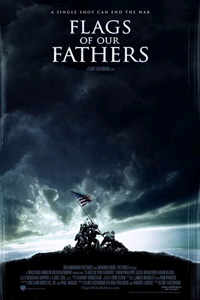
  • REVIEW: “Flags of Our Fathers” (***)

    Paramount Pictures\' Flags of Our FathersClint Eastwood is largely considered one of the most uneven directors working today.  For every probing piece of thematic greatness (“Unforgiven,” “Mystic River”) there are three or four considerable missteps, from “The Gauntlet” and “Heartbreak Ridge” to “Midnight in the Garden of Good and Evil” and “Blood Work.”

    Such inconsistency is the price a hard-working filmmaker pays, for anyone willing to crank out a new project every other year for three decades is bound to miss the bull’s-eye frequently.

    At the same time, amidst these lesser efforts, Eastwood has always shown a process of honing his artistry, remaining a singular talent and every once in a while experiencing the serendipity of matching that talent with exceptional material.  Indeed, more often than not, a failing Clint Eastwood film is doomed on the page before principle photography even begins.

    “Flags of Our Fathers” is certainly a singular figment of the war film oeuvre, fit with promising themes rather unrepresented in the genre’s history that speak eloquently to today’s environment of deception of the masses for the gain of the establishment.

    But it is also an exercise ultimately hampered by an unfocused and erratic narrative, one that constantly seems to be searching for itself and feels hastily lifted from the pages of James Bradley’s best selling book of the same name by William Broyles, Jr. and last year’s Oscar-winning scribe Paul Haggis.

    Bradley’s book was a personal endeavor for the author.  The son of John Bradley, one of the six infamous Iwo Jima flag-raisers immortalized by Associated Press photographer Joe Rosenthal in March of 1945, James Bradley crafted a human account of the lives of unassuming heroes captured in time.  Only three of them survived the war to see the image’s impact on the western world, and within the pages of “Flags of Our Fathers,” their stories are told with painstaking clarity and at times sluggish accuracy.

    The task in adapting the book as a film was to amplify the central theme of manipulation and marketing for the greater good.  Broyles and Haggis succeed in doing this to a point, but as the yarn unfolds, the depth of potential seems to thin out in the mix.

    The three survivors in the photo were John “Doc” Bradley (Ryan Phillippe), a medic who certainly saw his share of carnage on Iwo Jima; Rene Gagnon (Jesse Bradford), a man portrayed as intent on becoming a “hero”; and Ira Hayes (Adam Beach), a Pima Native American paradoxically proud to serve a country that had relegated his people to the confines of reservations.

    Upon their return to the United States, the flag-raisers find themselves ensnared in a publicity tour that represents the core of what Haggis is trying to get across.  Behind the scenes, the aim is for Rosenthal’s lasting image to spearhead a wave of hope and patriotism that will inspire citizens to purchase bonds as the country suffers financial asphyxiation four years into the war.
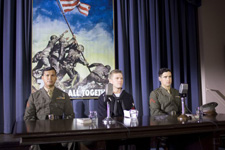
    (from left) Adam Beach, Ryan Phillippe and Jesse Bradford in Flags of Our FathersThe ubiquity of the photo puts Gagnon in the appreciated place he had sought to be, Hayes in the hesitant position he feels he doesn’t deserve, and Bradley as an awkward observer of it all, strangely passive as a character, given the book’s origins.

    This repetitive sense of exhaustive handling is intercut with the infamous battle that claimed the lives of over 27,000 human beings – three quarters of them Japanese.  More congressional medals of honor were awarded for the Battle of Iwo Jima than any other battle in American history.

    A large chunk of this military excursion is presented in the first act – a good ten or fifteen minutes of solid chaos.  Had Haggis chosen to tell the story in a more linear fashion, keeping the battle at the top and using its memory as a haunting element throughout the rest of the film, the pieces might have come together more organically.

    But the stink of manipulation and even amateurism emanates from the decision to continuously go back to Iwo Jima when it feels thematically relevant.

    Eastwood and his technical crew, not the least of which being cinematographer Tom Stern and film editor Joel Cox, do a marvelous job of conveying an unnerving and multi-faceted battle sequence that will draw comparisons to Steven Spielberg’s “Saving Private Ryan.”

    Eastwood is working with much more than land infantry here, however, mixing in air battalions, battleship artillery and the symbiosis of it all as it pertains to the taking of Mount Suribachi on the east side of the island.  Exceptional visual effects mix seamlessly with Stern’s washed out photography for a truly gripping and visceral experience.

    However, where Spielberg successfully utilized the Battle of Normandy to visually tell his story, Eastwood seems to get lost in the elements, sacrificing thematics for admittedly surprising capabilities in the trenches.

    All of this might have made for a much more tolerable, even above average war film had the third act not dived so gratuitously into the binding structure of the rest of the film.  Multiple perspectives and narrations carry the tale here and there through fleeting scenes depicting James Bradley (portrayed by Tom McCarthy) interviewing subjects and preparing his book.

    It was laid out from the start, and a return ought to have been expected, but regardless, once the final act commences, the screenwriters make the unwise decision to concentrate on this aspect of the story for purposes much more sentimental than thematic.  And each unrelenting cue of a typically repetitive Eastwood score amplifies this perception of the final leg of the film.

    The performances throughout represent a true ensemble, but the focal points are surely Phillippe, Beach and Bradford.  Phillippe handles an under-written leading role as well as can be expected (that’s really all that can be said), while Bradford puts forth a stock, self-serving and rather uncomplicated character that hedges its bets in an obvious attempt by the screenwriter to steer clear of disrespect.
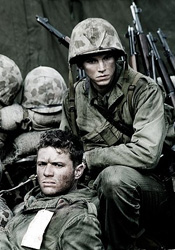
    Ryan Phillippe in Flags of Our FathersElsewhere, John Slattery offers a great supporting turn as the point man on this public relations whirlwind.  Barry Pepper, in the role of flag-raiser Mike Strank, comfortably stifles the urge to take a tough-as-nails character to the same places he has taken numerous similar characters numerous times before.

    Neal McDonough and Robert Patrick fill out the higher military ranks accordingly, while Jamie Bell, Joseph Cross, Benjamin Walker and a thankfully muted Paul Walker (as mistaken flag-raiser Hank Hansen) seem to blend together in the surrounding scenery.

    The real find of the film, however, is Adam Beach, already a 16 year veteran in the business and on the cusp of a defining moment in his career.  Portraying an alcoholic Native American in Ira Hayes (a character that attempts to avoid cliché when it can), Beach’s role automatically exists as the most complicated of the lot.

    There are times when the viewer catches a whiff of over-reaching in his performance, but more often than not, the 33-year-old actor lands the right emotional notes in key scenes that will evoke the most heart-felt reaction from audiences.  Even amidst a continuously tepid reaction to the goings-on, this viewer felt the threat of a tear when Hayes visibly breaks down and hugs the mother of one of his fallen comrades with all the meaning in the world.

    As war films go, “Flags of Our Fathers” had the opportunity to speak to greater truths of the actual machine of war than any other film of its kind.  The John Ford “print the legend” quality of the story is definitely apparent, and as mentioned at the top, these notions speak volumes to the modern environment of vast manipulation, deceit and even celebrity.  But they seem to be fighting through the dense foliage of spectacle at times, and at other times, the elaborate design of unnecessary artistry.

    Much of this is ultimately forgivable, however, if somewhat hesitantly so.

    Eastwood is as surprising as he is predictable in that he never seems to fully collapse under the burden of something new or unfamiliar.  He has found himself adept at conveying epic stories through the intimate brushstrokes of character in the past, the truest examples being his early westerns “High Plains Drifter” and especially “The Outlaw Josey Wales.”

    “Flags of Our Fathers” feels like his third or fourth war film endeavor much more than it does his first.  It was a valiant effort and a unique experience, but it ultimately isn’t enough to stretch beyond definitive flaws in the screenplay.

    During the production of “Flags of Our Fathers,” Eastwood reportedly felt as if he wasn’t conveying the full story of the Battle of Iwo Jima.  With this in mind, he set about preparing “Letters from Iwo Jima” (formerly “Red Sun, Black Sand”).  Told from the Japanese perspective and releasing February 9, 2007 from Warner Bros. Pictures, “Letters” may or may not find itself more in tune with its own thematic structure than “Flags of Our Fathers.”

    Regardless, as a duet, the films will inevitably find themselves unique in the pantheon of anti-war cinema.  It’s nice to see a seasoned filmmaker being this ambitious, and no matter how you slice it, these two films are an ambitious enterprise to say the least.