In Contention

Category: Daily

  • All over it

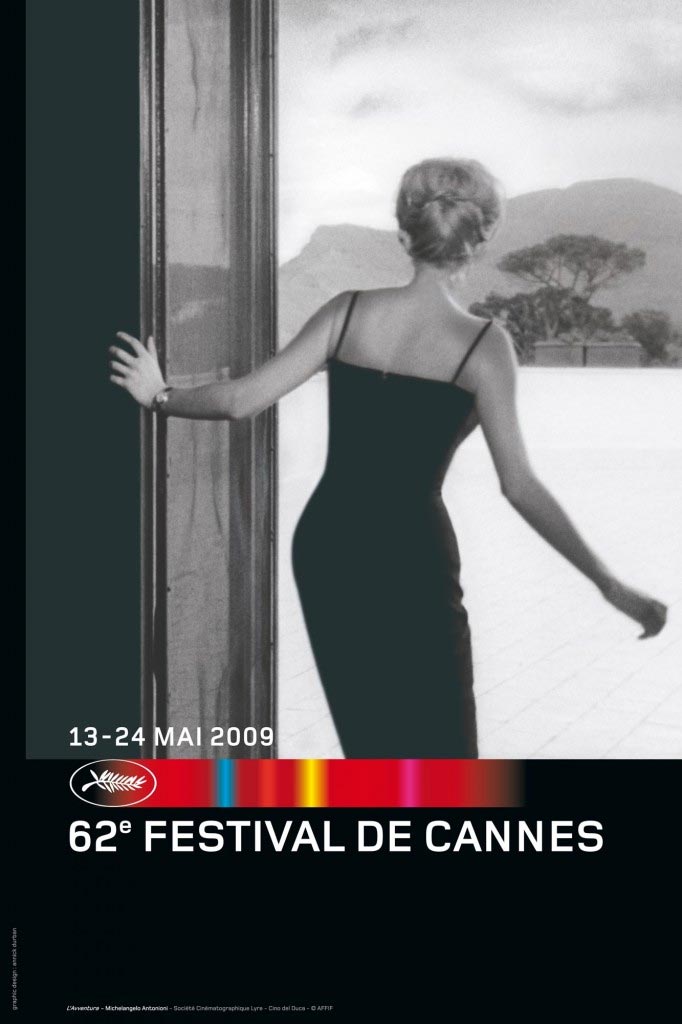
    It’s been around for a few weeks now, but since next week is going to be pretty Cannes-heavy (the fest kicks off on Wednesday), this is as good a time as any to say that I want to buy this year’s official, Antonioni-referencing festival poster, frame it, and stick it on my living room wall. Forever. Sheer perfection.

    Official Cannes 2009 poster

  • Tell us what you thought of ‘Star Trek’

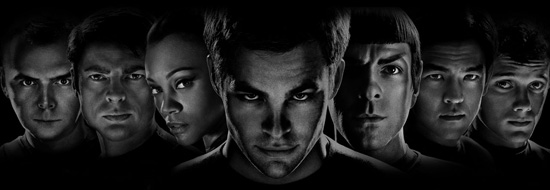
    Star Trek

    If you were disappointed last weekend, hopefully you’ll get a kick out of this weekend’s big release, which had me at hello.  Like I said in my review, try to catch it on the loudest screen possible.  Come on back here and give us your thoughts on J.J. Abrams’s reboot of the “Star Trek” mythos once you see it.

  • Those underrated gems of the 1980s

    BirdFor me, no decade was as overall weak for films as the 1980s, a 10-year span when bad movies made a fortune good ones went unnoticed. Of course there were exceptions to that rule.  “Amadeus,” “E.T.: The Extra-Terrestrial” and “Platoon” were brilliant productions that also scored at the box office, but more often than not, great films were discovered on video, sometimes years after release.

    A quick glance at the decade will show you that “Raging Bull” was not hailed as a masterpiece right away, and was by all acounts a failure at the box office, as was Warren Beatty’s masterful “Reds.” Phillip Kaufman’s extraordinary space adventure “The Right Stuff” had all the makings of a great American film (which it was and remains) and a box office smash, but sadly never found an audience, falling by the wayside in the summer of 1983. Audiences were flocking to see junk like “Flashdance,” “Footloose,” “Top Gun” and “Dirty Dancing” while many great films opened and closed without causing a ripple.

    I went back through the 1980s recently and re-visited 15 films that deserved attention when they were released, deserved Academy Award nominations (or more than they got), and certainly should have found an audience at the time of their release. Many of them were admired by critics, but I have left out the obvious — “Raging Bull,”  “Blade Runner,” etc. — to include smaller films that need a little love. Here they are, in no particular order…

    (more…)

  • WEEKLY WRAP: Loving ‘Trek,’ reading ‘Chéri,’ awaiting ‘Basterds’

    Anton Yelchin in Star Trek• In a bumper season for the sci-fi genre, Kris was thoroughly impressed by both “Star Trek” and the lower-profile “Moon.”

    • Meanwhile, we kicked off this year’s Page to Screen series with a look at the literary origins of “Chéri’.”

    • In a sad week for the business, we bade farewell to both actor Dom DeLuise and filmmaker Marc Rocco.

    • Quentin Tarantino declared “Inglourious Basterds” a masterpiece. (And Eli Roth a bastard.)

    • Following “Angels and Demons,” could cinema be the wrong medium for Dan Brown’s storytelling?

    • Continuing our new Sunday Cents feature with a breakdown of “Wolverine’s” box office performance.

    • Speaking of which, the “X-Men” franchise continues to grow new limbs. This time, a Deadpool spinoff.

    • We got a taste of Francis Ford Coppola’s “Tetro” with both a trailer and the opening minutes of the film.

    • Yours truly admitted to some reservations about Christian Bale’s recent work, and lost further cool points by fessing up to his Jennifer Garner weakness.

    • Finally, our contentious quest for the most influential films of all time continues apace.

  • ‘Whatever Works’ trailer

    Well, it certainly works for me — it’s been a while since a trailer made me laugh out loud. Larry David’s and Woody Allen’s respective brands of neurosis seem to mesh together nicely, while Evan Rachel Wood looks unexpectedly comfortable doing the guileless simpleton thing. Patricia Clarkson is obviously having a good time too. I’m in.

  • IFC nabs Sundance winner ‘Five Minutes of Heaven’

    Liam Neeson in Five Minutes of HeavenFor whatever reason, it completely slipped my mind to mention Oliver Hirschbiegel’s superb “Five Minutes of Heaven” when it premiered on UK television last month. The film, which won directing and writing honours at Sundance in January, is an exemplary return to form for the “Downfall” director, a grim but riveting account of two men seeking closure 30 years after one murdered the other’s brother in the darkest days of the Irish Troubles.

    As the reformed killer, Liam Neeson offers up his most nuanced, affecting work in several years, but it’s really British TV regular James Nesbitt who breaks the heart as a man stuck in agonised limbo between release and revenge. It’s taut, impeccably written and realised drama, comparable in many ways to Paul Greengrass’s similarly disquieting “Bloody Sunday” — between this and the “Red Riding” trilogy, it’s an odd truth that the best filmmaking of the year so far has only appeared on the small screen on this side of the pond.

    Happily, Screen International reports that the film will get the theatrical platform it deserves Stateside. IFC Films has acquired US rights to the film, and is planning a multi-format August release:

    IFC’s Arianna Bocco negotiated the deal with Pathe International and UTA and the distributor will release the film through its IFC In Theatres VOD day-and-date platform.

    Five Minutes Of Heaven, which premiered in Sundance, will also go through the company’s exclusive deal with Blockbuster in stores, by mail subscription and digital downloading at Blockbuster.com.

    Great plan. The film’s not the easiest sell in the world, so the more accessible they make it to the viewing public, the better. Keep an eye out — I can imagine this one landing on a few ten-best lists comes the year’s end.

  • Ain’t too proud to beg

    Nicky Bell and Liam Boyle in AwaydaysIt’s foolish to make any “best” claims before the year is halfway through, but if any 2009 release has a greater soundtrack than Pat Holden’s upcoming “Awaydays,” I will be very surprised indeed. A vividly atmospheric portrait of teenaged football hooligans in 1979 Liverpool, the film throbs to a propulsive playlist of post-punk gems from Joy Division, early Ultravox, The Cure, Echo and the Bunnymen, et al.

    I liked the film a great deal upon seeing it at last year’s London Film Festival (my capsule review is here). As I was watching, however, I kept wondering how such a low-budget effort had managed to afford such a top-flight soundtrack. It’s a question that the film’s writer, Kevin Sampson, answers in an entertaining piece in today’s Guardian. With a music clearance budget of just £10,000, and the average price for a single song standing at about £4,000, apparently sometimes it just pays to plead:

    Halfway through there’s a stripped-down, home-recorded demo of 10.15, Saturday Night. It features little more than Robert Smith and a guitar, and it’s one of the most devastating and heartbreaking love songs I’ve ever heard. I told (Universal Music’s) Marc Robinson as much, but knew we could never afford the Cure. He agreed, but suggested I wrote a letter to Robert Smith, which he would forward. It was worth a shot. I wrote honestly and passionately about seeing the Cure at Eric’s in May 1979, then thought nothing more of it. Robert Smith came back and said we could use the song for £500. I fainted.

    Good on them. Trailer (featuring one of the film’s key tracks, Ultravox’s “Young Savage”) after the cut.

    (more…)

  • Jeunet and Tautou reunite for Chanel ad

    In a neat (and surely not entirely coincidental) turn of events, Audrey Tautou succeeds Nicole Kidman as the face of Chanel No. 5, in the same season that she’s attracting positive notices for playing Chanel herself. Her tenure begins with this typically lush commercial, directed by Jean-Pierre Jeunet with the same burnished color palette and stylised compositions that characterised “Amelie” and “A Very Long Engagement.”

    Pure fluff, of course, but very pretty fluff, and tossing in a bit of Billie Holiday never hurts. It’s more restrained than Baz Luhrmann’s expensive Kidman-starring effort a few years back. (The one which handed the actress the cringe-worthy line, “I’m a dancer, I love to dance!”) Joe Wright also joined Chanel’s directors’ club last year — the label has taste.

  • Realization: Dan Brown is tailor made for TV

    Angels & DemonsI’m not going to review “Angels & Demons.”  Sometimes the idea of tearing a film apart just doesn’t quite appeal to me, believe it or not.  But watching the expected unfold on the Sony lot last night, it suddenly occurred to me that Dan Brown’s bloated if intriguingly researched fiction has no place on the big screen.  It might, in fact, be better suited to television.

    Think about it.  A show like “24” (which is compelling this season for the first time in three years) milks every close call for what it’s worth.  Each tick of the final episode clock mixes with the soaring brass of the score, all but announcing: “Tune in next week, same Bauer time, same Bauer channel.”  And that’s what a Brown adaptation feels like.  Except the effect is exhausting in a two-hour span of time.  The conduit of cinema simply doesn’t support it.

    One could go back and forth on the issue of quality all day long.  Those championing the thrill ride experience would be equally justified in their assessment as those who find their foreheads red from constant smacking at the amount of regurgitated exposition (which seems to be an unfortunate necessity in these films).  But the breadth of the episodic could make a story like “The Da Vinci Code” or “Angels & Demons” sing.  Brown, a masterful storyteller in that can’t-put-it-down kind of way, could make every carefully plotted (some would say contrived) set piece or dramatic beat count within the consistent ups and downs of a television series or mini-series.  And theatrical audiences worldwide would be spared the headache of trying to keep up for too brief a time in a darkened room.

    I’m certainly no studio or network head, so what do I know?  “The Da Vinci Code” pulled in bucketloads of money across the globe and made Ron Howard, Brian Grazer and the lot much richer people.  Though I don’t expect “Angels & Demons” to have the same success (not as immediately recognizable from a pop culture standpoint, regardless of the sequel factor), I also don’t expect “Digital Fortress” and “Deception Point” to go unfilmed forever.  Ditto the upcoming “The Lost Symbol” (which will probably finds its way to screens first, completing the Robert Langdon trilogy).  But I think there’s an alternative to cinema worth exploring with Brown’s work.

    It might rescue the material from being panned outright, if nothing else.

  • 5/7 Web Round-up

    X-Men Origins: Wolverine(Somehow this post disappeared earlier. No idea why. Apologies.)

    • Mother’s Day is coming, so here’s a list of the 40 (yes, 40) best movie moms. [Premiere]

    • Has “Wolverine” skewered the intelligent superhero movies? [The Guardian]

    • With Cannes around the corner, Tim Robey spotlights the best Palme d’Or winners of all time. [Daily Telegraph]

    • Stu VanAirsDale stands up for Sony Classics honchos Michael Barker and Tom Bernard against the jolly mean giant, Nikki Fikke. [Movieline]

    • Screenwriter Larry Gross attempts to take yours truly to task on a passing comment that obviously had more behind it by spewing assumption after assumption with verbiage that would bring Bill Strunk to tears. [The Hot Blog]

    • Peter Bart writes up former CBS programming head Mike Dann’s new memoir. [Peter Bart]

    • Steven Zeitchik presents the MTV Movie Awards as an Oscar cautionary tale: when populism runs rampant. [Risky Biz Blog]

    • Back to business.  Sasha Grey to follow up “The Girlfriend Experience” with “This Ain’t Star Trek XXX.” [/film]

    • Erica Abeel chats up Carlos Cuaron on his latest work. [indieWIRE]

  • Is Bale slacking?

    Christian Bale in Terminator SalvationThe first evaluations of “Terminator Salvation” are slowly creeping in (here’s AICN’s reasonably positive take if you’re interested), but I was more interested in something the Film Experience’s Nathaniel Rogers had to say about Christian Bale’s performance, which mirrors a grievance I’ve had with the actor’s work of late.

    Rogers likes the film well enough, but finds Bale’s contribution distinctly lacking:

    I am happy to report that unless Christian Bale’s eyes are particularly sensitive to bleached colors and shadowy sets, Shane Hurlbut’s lensing didn’t intrude on his thespian process at all. But Bale intruded on Bale’s thespian process.

    I liked Salvation a lot more than this next statement will imply but… John Connor was a dud. [editor’s note: Isn’t he always?] Christian Bale bored me silly. He used to be a thrilling and unpredictable actor. Now I feel like I’m seeing the same performance over and over again. It’s like he’s lipsynching to his own Arias of Intensity.

    I couldn’t agree more. Admittedly, I’ve never quite learned to love Bale — his most impressive performances (“The Machinist,” “American Psycho”) have a mannered quality that keeps me at arm’s length, while he has an unfortunate tendency to get outshone in talent-laden ensemble pieces (“Laurel Canyon,” “I’m Not There,” even “The Dark Knight”) — but he’s an undeniably accomplished and courageous actor.

    So it’s disappointing to see him applying the same shade of opaque intensity to one impenetrable hero after another recently. Here’s hoping he finds more notes to play in “Public Enemies.”

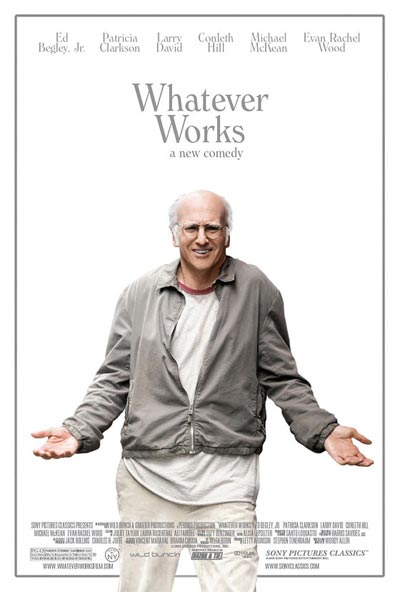
  • ‘Whatever Works’ poster

    The sexy, teasingly framed artwork for “Vicky Cristina Barcelona” was one of my favorite posters of 2008. Suffice to say I cannot offer similar approval of this dreary new one-sheet for “Whatever Works.” Just how much time did they spend on it? And at no point did anyone on the design team meekly suggest, “Hey, Evan Rachel Wood is a hot young actress, and you know, the film’s biggest talking-point is the May-December thing she has going on with Larry David. Maybe, just maybe, it might be worth sticking her on the poster too?”

    Sigh.

    Whatever Works

    [Source: Vulture]

  • Space oddity

    MoonIt’s hardly the only intriguing thing about “Moon” — the oddball sci-fi effort that Kris greatly admired earlier this week — that director Duncan Jones is in fact the rather more infamously named Zowie Bowie. Still, you must admit that an intimate space epic directed by the son of Ziggy Stardust has a certain symbolic cache to it; clearly, if the reviews are to be believed, visionary eccentricity (not to mention otherworldly interests) runs in the family.

    I must admit I wasn’t aware of this fact until I read this profile of Jones and his leading man, Sam Rockwell, in the New York Observer. It’s a fun piece, in which the two kindred spirits essentially try to outperform each other in the quirky loner stakes — loneliness being, they agree, the core theme of the film. It also offers some insight into the process behind Rockwell’s reportedly extraordinary dual performance:

    “It became part of this ingredients list of how do I make a film that Sam wants to be in? I know, I’ll make him play all the roles … and write the theme music, too,” Mr. Duncan joked.  It was indeed a challenge for Mr. Rockwell, who had to shoot each scene multiple times, either with a body double or using a Motion Control camera that can replicate body movements identically. Mr. Rockwell would act out the scene, go to hair and makeup to differentiate between the two characters, and then come back to set and do it all over again. It became what the two men described as a kind of dance, having to stick to precise moments to make the scene work—action scenes when the two Sams fight or play Ping-Pong were particularly difficult.

    (more…)

  • POLL: the most influential films of all time, round one, part four

    I decided to bump today’s poll an hour to give some extra lead time to the sad news of director Marc Rocco’s passing, but I don’t think it ultimately mattered much.  The three survivors of last week’s slate were “Casablanca,” “The Matrix” and “Star Wars.”  On to a new set of 10.

    Again, the groupings in these polls are decided at random.  So no yelling at your humble servant.  But I expect more than a few to be dismayed at having to choose three from the sterling collective you’ll find in the left sidebar.  C’est la vie.

    Choose your trio and be heard!  Two more weeks of round one after this and we’ll be moving on.  Once again, for background on this series, click here.

  • ‘Murder in the First’ director Marc Rocco found dead

    Marc RoccoIt saddens me to report that filmmaker Marc Rocco, perhaps best known for directing the 1995 film “Murder in the First,” was found dead in his Northridge home over the weekend.

    I was informed of the news earlier today by a mutual friend, so I called the Devonshire division of the Los Angeles Police Department in Northridge to get the details.  It seems Rocco was found by a friend on Friday, May 1 after he had not been seen for nearly a week.  Police say there was no foul play involved and they are still awaiting autopsy results.  It appears to be a natural death, I’m told.  Five days later, nothing at Variety, nothing at The Hollywood Reporter, nothing at the L.A. Times — nothing anywhere.  According to police, no one has even called asking questions yet.  Bizarre.

    I never saw Rocco’s earliest work, 1987’s “Scenes from a Goldmine,” the Corey Feldman/Corey Haim starrer “Dream a Little Dream” and 1992’s “Where the Day Takes You.”  “Goldmine” and “Dream” both featured Rocco’s father Alex, who starred as Moe Greene in “The Godfather.”  But I always loved “Murder in the First,” which featured first-rate performances from both Christian Slater and Kevin Bacon.

    It was one of those films that sort of came and went in the early weeks of 1995.  Fortunately the Screen Actors Guild and Broadcast Film Critics Association remembered Bacon’s work come year’s end, the former nominating his career-best leading performance, the latter awarding him for it.  Nowadays it seems most people forget the film until it pops up on TNT or the like, but it was a confident showcase that proved Rocco had some real directorial chops.

    I always wondered what happened to the director after that.  He seemed to have a few projects on the horizon, according to his IMDb page, but the last two films he worked on were 2005’s “The Jacket” (story and producer credits) and 2007’s “Take” (executive producer).  He popped up two years ago to direct the music video for Eddie Vedder’s “Guaranteed” from the “Into the Wild” soundtrack, however.  Variety reported in January of 2007 that Rocco was set to adapt Jim Thompson’s “The Killer Inside Me” and that he was “mobilizing to direct” his original script “The Winter Hill Gang,” which had been set up at Paramount several years ago with Tom Cruise and Paula Wagner producing.

    Sad news.  Rocco was 43.  He is survived by his wife, sister and younger brother.
  • An unkind cut

    Scarlett JohanssonPoor Scarlett Johansson can’t seem to catch a break these days. With her acting talents currently experiencing a bit of a fallow period (I’m being gentle, I’m a fan), the snark patrol have now seized on her burgeoning directorial ambitions too.

    The source of their glee is the news (a few days old, but I only saw it now) that the short film Johansson directed for the upcoming portmanteau movie “New York, I Love You” (a follow-up to 2006’s “Paris, je t’aime”) has been dropped from the thematically linked collection, which features contributions from such oddly matched talents as Fatih Akin, Natalie Portman and, uh, Brett Ratner.

    Unnamed “sources” (yeah, I’ll bet) claims it’s because the film is “unwatchable,” while others say the film — which stars Kevin Bacon as an obsessive-compulsive on a day out in Coney Island — simply doesn’t fit the project’s romantic brief. Producer Emmanuel Benbihy, meanwhile, offers this diplomatic explanation:

    The story did not specifically involve an interpersonal relationship, and it was conceptualised to be filmed in black and white – both of which were extreme departures from the other films. Scarlett presented me with an extremely compelling, albeit unconventional, narrative that appeared as though it would not necessarily conform to the overall approach of the entire collective.

    The Guardian’s Peter Bradshaw, citing the suffocating preciousness of the Paris instalment, thinks she’s better off out of it. I have no idea, except that I’m more curious to see another facet of Johansson’s creative personality (shoot me, I kinda liked her Tom Waits album) than Brett Ratner doing a love story. Oh well.

  • Get your votes in!

    This week’s “Most Influential” poll closes up shop at 2:00pm PST, so get your votes in if you haven’t already.  The film leading the pack should come as no surprise, but I’m surprised to see “Casablanca” so high.  “The Matrix” is just barely ahead of “Taxi Driver” for the third and final slot, while truly influential staples like “It Happened One Night” and “The Great Train Robbery” are apparently down for the count.

  • Acting out

    Meryl StreepThe Guardian’s Ryan Gilbey offers an interesting piece today about screen acting, and the narrow criteria by which many of us judge it. He is writing principally in response to a recently released British film, “Helen,” a rigidly stylised meta-film in which actors play actors participating in a police reconstruction, which has attracted divisive reviews for the deliberately stilted performances of its cast.

    Complaining that many audiences place too much stock in “realism” in acting — using the deification of intensely studied, precise performers likes of Meryl Streep (“a walking manual on acting”) as an example — Gilbey argues the following:

    David Mamet writes that “We confuse ‘I like it’ with ‘It is very realistic.’ If we like it we say, ‘Yes, that’s very true.’” So truth becomes our alibi, our defence for that which pleases us.

    Given our myriad ideas of truth, it is no wonder we turn to the awards ceremonies to clarify and ratify. But while Sean Penn, Philip Seymour Hoffman or Meryl Streep win prizes, and their acting may feel true or right, it is detrimental to the craft to hold up as ideal only those performances that work as audition pieces, or as 30-second excerpts on Oscar night. The actors in Bresson’s Mouchette or Dumont’s La Vie de Jésus are but one component of those films’ defining philosophy and meaning; removed from that context, their performances have no meaning.

    (more…)