In Contention

Tag: The Milk of Sorrow

  • Predicting the foreign-language Oscar shortlist

    Tomorrow, we get the last of the Academy’s crucial pre-nomination shortlists, as the list of 65 entries for the Best Foreign Language Film Oscar is slashed to just nine titles, from which the eventual nominees will be announced in a week’s time. Predicting these nine is a vague and mostly thankless task, but I am nothing if not vague and thankless, so let’s give it a go.

    Remember, here’s the system as it currently stands: six of the nine titles on the shortlist are voted in by the general committee of volunteer voters in the category, based on the scores given at each film’s official Academy screening. The remaining three are selected by a hand-picked executive committee, with the specific intention of “saving” significant and/or challenging titles that didn’t win the approval of the larger, more conservative body of voters.

    This curious system was set up two years ago, following the uproar that greeted the exclusion of critically beloved Palme d’Or winner “4 Months, 3 Weeks and 2 Days” in the 2007 race.

    (more…)

  • OSCAR GUIDE: Best Foreign Language Film

    The Milk of SorrowThe foreign Language film category has been marred in controversy for the last few years. When films like “4 months, 3 weeks and 2 days” and “Persepolis” were unceremoniously nixed from the field a few years ago, a special new “executive committee” was established to have final say on the fallen, hopefully saving the committee (which has to see all the titles to vote) some embarrassment.
    Still, there is an inherent bias throughout the votership here. Violence rarely plays well, and they are loathe to be accepting of non-traditional filmmaking. One need only look back one year to 2008’s “Departures” upset for evidence. For thee reasons, the category always seems ready to surprise.

    The nominees are:

    “Ajami” (Scandar Copti and Yaron Shani)
    “The Milk of Sorrow (La Teta Asustada)” (Claudia Llosa)
    “A Prophet (Un Prophète)” (Jacques Audiard)
    “The Secret in Their Eyes (El Secreto de Sus Ojos)” (Juan José Campanella)
    “The White Ribbon (Das Weisse Band)” (Michael Haneke)

    (more…)

  • Foreign notes

    The Milk of SorrowWell, as I suspected, my predictions for the Academy’s foreign film shortlist were mainly off the mark, though I maintained my 4-from-9 strike rate from last year … so, yay for consistency.

    That said, I’m not terribly surprised by the films that did make the cut. As I wrote earlier today, I knew one of the WWII-themed films in the mix would make the cut — but plumped for Norway’s “Max Manus” instead of the Netherlands’ “Winter in Wartime.” And festival hit “Samson and Delilah” was high on my radar, a film I suspected the executive committee might save (as I’m sure was the case).

    I foolishly blanked on Argentina’s “The Secret in Their Eyes,” a romantic thriller that was extremely well received at Toronto in the fall, and may yet be the spoiler in this race. I’d received word that this was one to watch, but it slipped my mind this morning.

    (more…)

  • Academy’s foreign shortlist unveiled

    Samson and DelilahWell, Guy nailed down four of them.  But you just never know what this controversial branch is going to do.  I’d love to know what the secondary committee had to re-institute (probably “A Prophet”), but nevertheless, we have our nine.

    The only films I was predicting that didn’t make the cut are “Backyard” from Mexico and “Forever Enthralled” from China.  Replace those with “Ajami” from Israel (which I JUST took out of my predictions Monday in favor of “The Milk of Sorrow”) and “The Secret in Their Eyes” from Argentina and that would be my bet.

    I’ll leave it to Guy with further thoughts later on.  I need to catch up on the rest of films now that it’s a more, shall we say, manageable list.  Check out the full list of nine, from an original list of 65 submissions, after the jump.

    (more…)

  • Waiting on Oscar’s foreign language shortlist

    Niels Arestrup and Tahar Rahim in A ProphetLast Saturday, the Academy concluded four months of screenings of the 65 films in contention for this year’s Best Foreign Language Film award. Today, that tall pile of titles will be culled to a shortlist of just nine contenders, from which the eventual five nominees will be chosen.

    Making predictions here is a pretty thankless task, given the regularity with which this branch of the Academy slights seemingly sure-fire nominees in favour of less visible, and less acclaimed, fare. Indeed, a high-profile snub, with ensuing media outcry, has virtually become an annual Oscar tradition.

    The furore over the omission of Romania’s “4 Months, 3 Weeks and 2 Days” two years ago even prompted a change in the voting system – to safeguard against such controversies, a smaller executive committee was appointed to add three titles to the six elected by the branch voters.

    It didn’t work: when last year’s critical darling “Gomorrah” failed to impress even the new committee, the Academy was raked over the coals once more. The bottom line, then, is that even the mightiest title can’t be called a shoo-in in this race.

    (More analysis, and shortlist predictions, after the cut.)

    (more…)

  • Werner Herzog named president of 2010 Berlin jury

    Werner HerzogAfter premiering two films at September’s Venice fest, perhaps the most surprising thing about Werner Herzog heading the jury at February’s Berlin Film Festival is that he won’t be inflicting another film upon the competition.
    I kid, I kid. Herzog, the first German jury president since Roland Emmerich in 2005, is inarguably deserving of the position, and should bring a welcome streak of eccentricity to the jury’s deliberations. The press release declares him “one of the most significant personalities of New German Cinema,” which is risking understatement.

    Interestingly, the 67 year-old auteur has only twice competed at the Berlinale himself, with his 1968 debut “Signs of Life” (for which he won a special award) and 1979’s “Nosferatu.”

    (more…)

  • THE LONG SHOT: Mind your language

    (from left) Niels Arestrup and Tahar Rahim in A ProphetYou might not be aware of it, but the competition is already formally under way in Oscar’s most perennially problematic category, Best Foreign Language Film.

    For almost two weeks now, official Academy screenings of the longlisted contenders in the race have been in progress, and will continue through January, until all 65 titles have been subjected to the foreign-language committee’s scrutiny.

    Pete Hammond has details of the screening schedule and voting rules, as well as some gossip on audience reaction to the screenings thus far: Mexico’s “Backyard” and Switzerland’s “Home,” starring Jimmy Smits and Isabelle Huppert respectively, have apparently gone down well; Croatia’s “Donkey,” thanks to incomprehensible subtitles, not so much. Add a pinch of salt to taste.

    Coincidentally enough, courtesy of the London Film Festival, I’ve been simultaneously working my own way down the contenders list, though my personal tally has stalled at eight titles. (It could have been 11, if scheduling and admin obstacles hadn’t kept me away from the Australian, Colombian and Serbian entries. I am but one man.) Only 57 to go, then.

    I will offer a more detailed assessment of the films in another post, but by and large it’s been a pleasure making their acquaintance. Of course, my own selection has been filtered through that of the fest’s generally thoughtful programmers, safeguarding against any real horrors – but I don’t mind saying that an unembarrassing list of nominees could theoretically be assembled from just my scant sampling of the longlist.

    (more…)

  • Counting down to the London fest

    Fantastic Mr. Fox(Apologies for the “Fantastic Mr. Fox” review that appeared prematurely here as a result of embargo confusion. It will be reposted later today.)

    There may have been silence on my end these past few days, but I assure you it hasn’t been for lack of activity. The days leading up to the London Film Festival — which officially kicks off tonight with the world premiere of Wes Anderson’s “Fantastic Mr. Fox” — have been crammed with press screenings and assorted admin duties.

    Yesterday, meanwhile, was given over to the film’s extraordinarily elaborate, and most enjoyable, press junket, staged across a range of picturesque locations in Roald Dahl’s home village of Great Missenden, an hour’s train ride from London. (More on that later.) Fox has spared no effort or expense in the launch for this unusual film, which culminates tonight with the LFF Opening Gala party at the Saatchi Gallery in Chelsea.

    (more…)

  • Foreign film watch: ‘Dogtooth’ and ‘The Milk of Sorrow’

    DogtoothAmong the films squeezing in under yesterday ‘s foreign-language submission deadline were two pretty major titles, both boasting hefty festival hardware — not that that makes them strong Oscar possibilities by any means.
    As we suspected, Greece (not nominated in the category since 1977) did indeed submit Yorgos Lanthiomos’s surreal family drama “Dogtooth,” which won the Un Certain Regard prize at Cannes, and recently played at Toronto. The film is gradually acquiring an ardent critical following, chief champion of which is James Rocchi, who suggests it is the year’s best so far:

    “Dogtooth” speaks to Greek history, to be sure, but it also works as a universal fable about the blunt mechanics — and bizarre appeal — of dictatorship … “Dogtooth” is funny and then terrifying and, somehow, both at the same time. Haunting, bold and truly cinematic in its ambitions, expressions and convictions, “Dogtooth” might be the best film I’ve seen all year — and, somehow, it got even deeper and more disturbing on the second viewing.

    (more…)

  • Berlin jury avoids the mainstream

    Perhaps it’s an indication of an unusually low-key festival, or perhaps (more likely) I’ve been too distracted by the steamrolling Oscar season, but either way, I’m a little disturbed that the Berlin Film Festival wrapped up this weekend and I am barely familiar with most of the prizewinning films.

    I had heard some positive things about “London River,” a culture-clash drama from “Day of Glory” helmer Rachid Bouchareb, set around the 2005 London bombings, that gathered some buzz for Brenda Blethyn’s performance — but ended up taking Best Actor for Sotigui Kouyate.

    And I was aware that “Sweet Rush,” which shared the Alfred Bauer Prize (which rewards “new perspectives,” apparently), is the latest from Andrzej Wajda (though word is it’s not one of his best), while I remember the Best Screenplay winner, Iraq-themed US indie “The Messenger,” gathered some notice at Sundance.

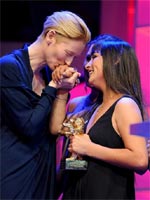
    But I must admit that the winner of the Golden Bear, “The Milk of Sorrow,” skipped my radar entirely. The sophomore film from female Peruvian director Claudia Llosa, it’s a solemn-sounding effort about the lifelong trauma inflicted on a child of rape — or, if you want the more sensationalist pitch, a woman with a potato in her nether regions. It seems to have attracted mixed notices — Variety’s review admires from a distance, but Screen International finds it “mannered” and “contrived.”

    Of course, one would expect a jury headed by avante-garde arthouse queen Tilda Swinton to favour the international and the eccentric, so none of this is really a surprise — especially given that they’d made clear their intent to reward politically charged work.

    In any case, the Golden Bear truly hasn’t been any indicator of international success of late — the last few winners include “U-Carmen eKhayelitsha” (which really deserved a higher profile), “Grbavica,” “Tuya’s Marriage” and “Elite Squad.” I have a feeling Llosa’s film isn’t going to have much more luck crossing over, but we’ll see.

    Full list of winners after the cut.

    (more…)