In Contention

Tag: Thandie Newton

  • The lost contenders of ‘For Colored Girls’

    Thanks to a crippling flu attack during the film’s blink-and-you’ll-miss-it UK release, I was late in getting round to Tyler Perry’s “For Colored Girls” — a rumored Oscar spoiler for about seven-and-a-half minutes back in the autumn, before Lionsgate got curiously tentative about publicizing it.

    A paucity of press screenings meant several key online voices missed the film entirely; they haven’t been that generous with awards screeners, either.

    Given Perry’s history, and the steamroller-subtle nature of the film, the studio can’t have been expecting a critical hit — though it found some prominent supporters anyway, chief among them Manohla Dargis. I heard from a number of people I trust that the film, a free adaptation of Ntozake Shange’s beloved 1970s “choreopoem,” was messy and misjudged, while others acknowledged that it retained an inelegant brute power.

    (more…)

  • 11/2 OSCARWEB ROUND-UP: Newton on ‘For Colored Girls,’ Godard’s Oscar revives controversy, ratings board drama

    • Jean-Luc Godard’s Honorary Oscar revives controversy over the director’s supposed anti-Semitism. [New York Times]

    • Amy Kaufman sits down with “Love & Other Drugs” director Edward Zwick. [The Envelope]

    • Edward Douglas chats up “For Colored Girls” star Thandie Newton. [Coming Soon]

    (more…)

  • Gray and Elise the pick of ‘For Colored Girls?’

    Tyler Perry’s “For Colored Girls” has been a question mark on our Oscar lists for some time, but even those pessimistic about the film itself can see potential in the film’s vast, and formidable, female ensemble — if there is to be any kind of awards play for the film, it’ll be the actors who spearhead it.

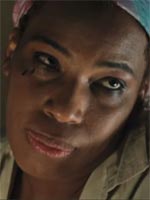
    A couple of weeks ago, word spread that Kimberly Elise looks to be the standout performer in the group, and a feasible contender in a still wide-open Best Supporting Actress race — 12 years after the actress was the subject of similar (if ultimately fruitless) talk for her work in “Beloved.” Recently, we heard that Thandie Newton could be the film’s second possibility. However, Jeff Wells quotes an inside source who has seen (and loved) the film, and names a far less expected standout: singer Macy Gray. Here’s his enthusiastic endorsement:

    [I]t’s the real deal — maybe too conceptually out there for safe, old, mainstream white Academy tastes, but the performances range from good (Janet Jackson, Loretta Devine) to great (Phylicia Rashad, Thandie Newton) to pretty much masterful (Kimberly Elise, Macy Gray).

    (more…)

  • OFF THE CARPET: Can the ladies get some support?

    A number of people wanted Anne and I to discuss the seemingly thin Best Supporting Actress category on the podcast Friday, but we didn’t get to it. So it seemed an opportune time to dedicate this space to the discussion.

    One should keep in mind that the race is still in its early days. This time last year we didn’t even know “Crazy Heart” would be in the mix, and any number of things can change. But while I have been saying for a while now that the supporting actress field is week, it does seem to be taking shape as of late.

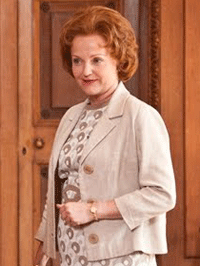
    There is no hard and fast frontrunner in the field right now. If Lesley Manville’s “Another Year” campaign were to switch gears, that would be a different story, but the only contender that feels right at the moment is Miranda Richardson as the fiery Barbara Castle in the Brit comedy “Made in Dagenham.”

    On the next tier, I feel pretty good about Dianne Wiest’s chances in “Rabbit Hole,” where the three-time nominee (and two-time winner) stars as a concerned but affable mother to Nicole Kidman’s grief-stricken housewife. Meanwhile, Helena Bonham Carter could well ride the coattails of “The King’s Speech” to a nomination for the comic relief and emotional support she maintains throughout the film.

    (more…)

  • The Great Performances: 2005

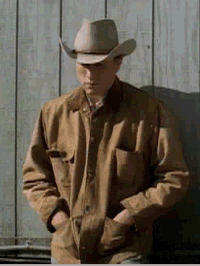
    Heath Ledger in Brokeback Mountain2005 was the year of Heath Ledger’s beautiful, moving performance in “Brokeback Mountain,” which I saw for the first time in Toronto.  It instantly became the talk of the festival, and the film became the one to beat for the Academy Award.

    Ledger was astonishing as the taciturn cowboy who is more surprised than anybody when his soulmate turns out to be another cowboy, portrayed superbly by Jake Gyllenhall. If there is a more deeply felt moment in film history than Ledger gently adjusting Gyllenhall’s shirt at the end of the film, his eyes filled with tears, I don’t know what it is. That’s loss, that is absolute heartbreak, that is one of the greatest acting performances of the decade.

    Phillip Seymour Hoffman would win the Oscar for his transformation into “Capote” and he’s very good, but just not in the same league as Ledger. I wondered from time to time if “Infamous” had been released earlier if Toby Jones might have won the Oscar instead of Hoffman. Each becomes Capote in a very different manner, and side by side it is difficult to choose the stronger portrayal. Certainly I prefer Hoffman’s as it is darker, and for me more realistic, but there can be no denying Jones.

    (more…)

  • Will BAFTA stick by their own?

    I have a bit of a love-hate relationship with the BAFTA Awards. On the one hand, they can be far more daring and playful in their choices than the American Academy — this is an organisation, after all, that has handed their Best Film award to such enduring works as “The Purple Rose of Cairo,” “GoodFellas” and “Lacombe, Lucien,” while nominating the Oscar-snubbed likes of “Eternal Sunshine of the Spotless Mind” and “The Usual Suspects.”

    Their technical awards are invariably more imaginatively awarded, too — take a look at their Best Film Editing category, for example, which in recent years has crowned “Eternal Sunshine,” “City of God” and “Mulholland Drive” as winners. And they can often be counted upon for gratifying upsets, as when Pedro Almodovar pushed past Sam Mendes for Best Director in 2000, or when “Trainspotting” blindsided “Sense and Sensibility” in the 1996 screenwriting race.

    For an awards show that fancies itself world-class, however, BAFTA can be infuriatingly parochial in their selections, stubbornly rewarding their own in the face of bigger, bolder competition. I doubt most of the voters could say with a straight face that “Four Weddings and a Funeral” was the very best film of 1994, nor “The Full Monty” of 1997, but they cleaned up nonetheless.

    For the last two years running, that kind of provincialism has ruled the voting, with this year’s awards looking particularly suspect. I think “Atonement” is a fine film, but handing it their top award seemed tokenistic at best, not least when the only other gong it took was for Best Art Direction.

    It’s a trend that Variety thinks could continue this year. In an article previewing the British contenders in the acting categories, they point out that Limeys have taken 16 acting BAFTAs in the last decade, compared to seven Oscars. Needless to say, they are frequently justified. It’s fair to say that this year, several British names will be cropping up in awards lists on either side of the Atlantic, and deservedly so — particularly in the Best Actress category, where thesps like Kristin Scott Thomas, Sally Hawkins and the ubiquitous Kate Winslet are all likely to figure.

    (more…)
  • 11/1 Oscarweb Round-up

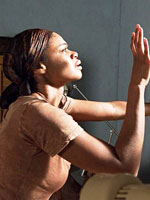
    Sally Hawkins in Happy-Go-Lucky• Mark Olsen goes deep with Soderbergh on “Che.” [The Envelope]

    • Tom O’Neil chats it up with “Happy-Go-Lucky” star Sally Hawkins. [Gold Derby]

    • Jeffrey Wells susses through conflicting running time numbers for “Australia,” which, by the way, 25 days out from release, where the hell is this movie? [Hollywood Elsewhere]

    • Anne Thompson spends some quality time with Danny Boyle. [Variety]

    • Yeah, wait until you see Newton as Condi — if you can stand it. [The Guardian]

    • Anthony Breznican reports on the twisting and turning Oscar season of 2008. [USA Today]

    • Boy…Karina Longworth really doesn’t like Angelina Jolie’s work in “Changeling.”  [Spout Blog]

  • Thandie on Condi

    Of all the bizarre calls that have been made in the process of creating “W,” the one that possibly threw me the most was the casting of Thandie Newton as Condoleezza Rice.
    I’ve admittedly always been lukewarm on Newton as actress, but nonetheless, nothing about her onscreen or off-screen personae suggested that she had it in her to channel the world’s most powerful woman.

    So it’s refreshing to read, in this lengthy Sunday Times interview with Newton, that she felt pretty much the same way:

    “Oliver woke me up,” she says. Stone had an “absolute belief that I could play this character who was absolutely nothing like me. She didn’t look like me; she’s a couple of decades older than me. And I’m English, for goodness’ sake”.

    In her favour, Newton appears to have a healthily objective stance on the character she’s playing (more so, I suspect, than her director):

    Then she began working on her mannerisms, the quirks and ticks that an impressionist might exaggerate to tell you as much about a person as the “inner truth”. She won’t tell me what they are. “Look, I do have a kind of reverence for who I am playing. This is a human being, and whatever you think, as an example of discipline, she’s unbelievable … (But) seeing her in more undone situations, there was this difference in her. You can see her posture change at certain times. It’s almost imperceptible, but it’s there. I got a sense of the human being behind the construct. And I did feel compassion for her.”

    She’s clearly an open and articulate interviewee — read the rest here. (Note to the interviewer, however: I know it’s customary to flatter your subject, but calling Newton’s turn in “Crash” the “definitive performance” of that film is a blatant lie. And I don’t even like “Crash.”)

  • REVIEW: “RocknRolla” (*1/2)

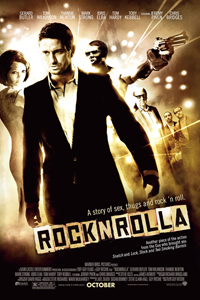
    Warner Bros. Pictures\'s RocknRollaShort of seeking or citing any legitimate critical opinion, the marketing team behind “RocknRolla,” the fifth feature from Guy Ritchie, have gone to much effort to portray it as a creative comeback for the much-maligned filmmaker.

    Here in the UK, the words “return to form” are splashed prominently across billboards for the film (set to make its North American bow at the Toronto fest): a frank admission that Ritchie’s last two efforts, “Revolver” and “Swept Away,” were across-the-board disasters. They appear to be working the angle that this is something of a back-to-basics effort, a happy reunion between Ritchie and knockabout gangland comedy.

    And indeed, for the first few minutes of “RocknRolla,” hopes are high that Ritchie has rediscovered the fleet-footed timing and lightness of touch that made his trend-setting 1998 debut “Lock, Stock and Two Smoking Barrels” such a delight, and its lesser follow-up, “Snatch,” such a guilty pleasure. The animated credit sequence, as you may have heard, is a thing of considerable beauty. More importantly, the opening scene, which employs swift, sexy cuts between multiple actors and locations to maintain a multi-voiced monologue on the fortunes of present-day London (Ritchie presumably wrote this before the recession), is something to behold.

    But then the pace settles, the actual narrative reveals itself — and the whole enterprise, shorn of these initial stylistic tics, steadily falls apart. Ritchie has dialed down his style of story construction since the incomprehensibly convoluted “Revolver,” but he may have overcompensated — the size of the ensemble notwithstanding, there is really very little storytelling motor here.

    (more…)

  • Huh?

    People are fascinating. We have a huge and complex capacity to be all kinds of things. And you look at someone like Condoleezza Rice and you see an example of just how far a person can stretch themselves. And I don’t mean that in a good or bad way, but she is an…oh God, I really want to get this right…she is an incredible example of discipline.

    Oy.  Still the worst casting decision of the film.