In Contention

Tag: Roger Deakins

  • Bennett Miller’s opening montage sees the light of day

    Apparently the following montage, which played for the audience at the Kodak Theatre Sunday night but was ultimately pulled from the televised rundown, has popped up as a Vanity Fair exclusive.  It’s directed by Bennet Miller and I have to say, it’s nice, has a good flow, but is a little film festival-esque.  Not “big enough for an opening Oscar number, I’d say.

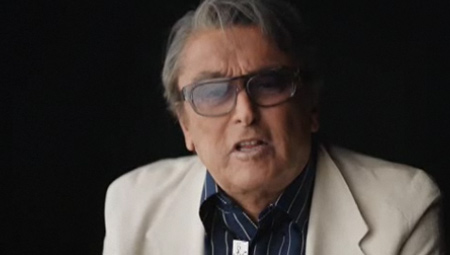
    Lots of interviews: William Friedkin, Robert Evans, Danny Boyle, I think I saw Scarlett Johansson in there, Roger Deakins, Janusz Kaminski, Flea (rocking out a Gus Van Sant T-shirt), Brett Ratner (ugh), Michael Stipe, etc.  Click on Kid Notorious below to have a look:

    Robert Evans

  • Top lensers praise ‘Slumdog’ cinematography

    Slumdog MillionaireOver at Variety, Robert Koehler has put together a survey of sorts of some of the industry’s top DPs to gauge their reaction to the year’s work behind the camera.  It could be a nice hint toward what the ASC will chose as the year’s best lensing, and judging by Koehler’s results, Anthony Dod Mantle’s “cherry on top of a career” efforts on “Slumdog Millionaire” gets the gold star.

    It’s really quite an achievement.  Even though I’ve long been on the record in favor of Wally Pfister’s innovations on “The Dark Knight,” I have to say Dogme 95 veteran Mantle broke unexpected new ground in Danny Boyle’s film.  In lieu of an Oscar win for the highly deserving Pfister, I would be very content to hear Mantle’s name called.

    Here’s a taste from Koehler’s survey:

    Mantle’s “Slumdog” was “the biggest technical achievement of the year,” says [Roger] Deakins, “because even though part of the film was shot on a 2K digital camera and part on 35mm, my eye could never detect the difference…it was quite a feat to maintain a consistent quality of image throughout.”

    Adds [Janusz] Kaminski: “I like cinematography that feels alive, and Anthony’s work felt that way for me. The shooting got the sense of the Mumbai streets, the reality of the gameshow, the nostalgia of the romance.”

    Goldblatt agrees, noting that “Slumdog” was “a very adventurous mix of media, fun and beautiful and very courageous. I’ve worked in India as a photographer and know how tough it is there, so I was quite impressed with the results.”

    McGarvey “loved how Anthony thought about how the various formats he shot in would serve each milieu in the story, so that the images never patronized the characters. It was such a ride.”

    Koehler then goes on to say Claudio Miranda’s gorgeous work on “The Curious Case of Benjamin Button” was close behind in his unscientific poll, followed by Pfister, who McGarvey says “can work on the grandest of scales but can also be terrestrial, and is able to provide an anchor to fantastical situations — a talent he shares with (director) Chris Nolan.”

    I was happy to see Maryse Alberti (“The Wrestler”) and Hoyte Van Hoytema (“Let the Right One In”) also mentioned, but hey, you’ve heard that kind of stuff out of me in this space over and over again. It’s nice to see the trades pumping up their crafts coverage, since no one seems to be willing to give them the proper attention this time of year beyond the expected outlets (American Cinematographer, Below the Line, etc.).

    For a crash course in the year’s best cinematography, have a look at our Top 10 Shots of 2008 column from last month, laced with insights from an esteemed crop of lensers.
  • SANTA BARBARA: Virtuosos on the march

    Richard JenkinsUnfortunately, “Happy-Go-Lucky” star couldn’t make it to tonight’s presentation of the Virtuoso Awards at the Lobero Theatre due to surgery recovery, but Viola Davis, Richard Jenkins, Rosemarie DeWitt, Melissa Leo and Michael Shannon were on hand to talk their roles in five of the most critically acclaimed films of the year.  James Cromwell did the honor of presentation.

    It’s a shame DeWitt was the only one on stage lacking (criminally) an Oscar nomination, but moderator Roger Durling kept the conversation away from awards as much as he could.

    A considerably amount of the discussion was spent on the nature of these actors’ careers, floating between the big screen, television and theater with a particular ease.  Many of the Virtuosos swept the comment aside with the usual “we go where the work takes us” rhetoric, which is fine, but Davis made a compelling comment regarding the state of the profession.

    “When you think about actors, you think about Brad Pitt, Angelina Jolie,” she said.  “But most of them look just like us here on stage.”  The indication, of course, is the middle class actor and how often he or she isn’t given the proper credit, be it on television, on stage or, certainly, on the screen.

    “Please, go to New York,” DeWitt said.  “See a play.  Some of the greatest actors in the world are working on stage,” but their names aren’t well-known.  It’s an interesting topic with the SAG dispute of late, which finds middle class actors at the forefront of a fight for credit.  Durling, of course, didn’t pursue that line of questioning.

    (more…)

  • TECH SUPPORT INTERVIEW: the crafts of ‘The Reader’

    Tech Support at In ContentionThe past week has been exceptionally good to Stephen Daldry’s “The Reader” on the awards circuit.  The film followed up its five Golden Globe nominations with the same number from BAFTA, not to mention Kate Winslet’s BFCA and Globe awards for her performance as Hanna Schmitz.

    I recently had the chance to speak to several of the individuals who have helped to bring the film to life from behind-the-camera: production designer Brigitte Broch, costume designer Ann Roth, makeup artist Ivana Primorac and cinematographers Chris Menges and Roger Deakins.  All five artists look back on “The Reader” fondly but they all nevertheless share a principal theme in their recollections: delay.

    Conflicts with his contractual obligations on “Doubt” meant that Deakins had to leave the production with the vast majority of the film left to shoot.  Menges says he then found himself torn upon receiving an offer to step in.

    “I first met Roger in the 1970s when he left school,” he recalls.  “He’s been to my home in Wales several times.  Roger shot 31 days of the film and I did 65.  Principally, I’ve never done it before but because I knew Roger and respect his work, it was not as difficult as it could have been.  Obviously, I do some things differently, but the principle that Roger and I adhere to is that the visual power of the film obviously comes from working closely with the director.  No D.P. has won an Academy Award without working with a director who has great visual flare.”

    (more…)

  • The top 10 shots of 2008: part one

    Slumdog MillionaireI’m hoping to make this an annual tradition here at In Contention.  It’s no secret we have a lot of respect for below-the-line talent around these parts, but it’s nice to have a visual way of showing that appreciation.  I sat down to write this piece for the first time last year, taken by the caliber of cinematography we had to bask in throughout the year and, indeed, the awards season.  The unusually high number of lensing achievements in 2007 left a slew of images to choose from and it was difficult whittling it down to 10.

    This year the challenge was of a different sort.  The field was curiously thin.  It wasn’t that the talent wasn’t on display.  God knows, a number of the greats were lining up behind the camera this year.  But the images weren’t as instantly iconic or as viscerally gripping as they were in 2007, which might have left me a bit disappointed on one hand.  Then again, it just made searching for my favorites all the more involved and interesting, and I’m happy to offer my findings to you in this space, even if it meant doubling up.

    Yes, in one instance (an undeniable one, really), a certain film found two shots popping up on the list, and nearly three.  Another film also found itself close to a second mention, but I tried to keep a balance of honesty and fairness in place as much as possible.  If a film has two of the year’s best shots, it has two of the year’s best shots, right?

    This year, things are slightly different.  Last time around, I got a few arbitrary quotes from lensers throughout the season and plugged them into the piece where they fit best.  This year, I sought out the various directors of photography to get their opinions on the specific shots in question.  Their insight, as always, makes for a better story and, indeed, more context for the reader.  I hope you enjoy reading their thoughts as much as I did collecting them.

    So, I look forward to doing this each and every year I’m cranking out copy for your reading pleasure (or displeasure).  In my view, it is one of the best ways I can commemorate the technicians that so often find themselves overlooked this time of year.

    So let’s get on with the list…

    (more…)

  • TECH SUPPORT INTERVIEW: The crafts of ‘Doubt’

    Tech Support at In ContentionThose fortunate enough to have caught John Patrick Shanley’s “Doubt” in its original Broadway run were almost unanimous in their praise for it.  When Shanley announced his intention to bring the play to the screen — starring Meryl Streep, Philip Seymour Hoffman and Viola Davis, no less — many were skeptical of his ability to transform the very theatrical piece into a cinematic work.

    Cinematographer Roger Deakins, production designer David Gropman, costume designer Ann Roth, film editor Dylan Tichenor and music composer Howard Shore all had pivotal roles in making that happen.  Shanley, despite his acclaim as a playwright and screenwriter, had only directed one previous feature film.  And “Joe Versus the Volcano” is hardly considered a masterpiece of cinema.  Deakins nonetheless recalls that the director came to the set with very concrete ideas of what he wanted, and did not come across as inexperienced at all.

    “He knew what he wanted to see and turned to me to realize it,” he says.  Tichenor adds that, despite having written the play, Shanley was “not overly precious about his work, which was good as we had to cut a lot out.”

    Gropman already had a brief history with Shanley, having worked with him on an off-Broadway play in the 1980s.  “There was never a moment where experience was an issue,” he says of the director.  And while she had not worked with Shanley before, Roth, who also cut her teeth on theatrical productions, acknowledges she could work together easily with him because of their shared background.

    “There are some film directors who just use actors as part of visual scenery,” she says, adding that, conversely, theater directors tend to start with the actor and then build the scenery from around him or her.

    (more…)

  • TECH SUPPORT INTERVIEW: The Crafts of ‘Revolutionary Road’

    Tech Support at In ContentionIn less than a decade, filmmaker Sam Mendes has established himself as one of the most intriguing directors of his generation. “Revolutionary Road,” his fourth film to date, hit theaters over last weekend. Regardless of its Oscar fate in the writing, directing and acting categories, the film seems poised to be a major player in the craft arenas, our central focus here at Tech Support.

    I recently spoke to cinematographer Roger Deakins, production designer Kristi Zea, costume designer Albert Wolsky and film editor Tariq Anwar about their work on the film, a 1950s period piece featuring the on-screen reunion of Leonardo DiCaprio and Kate Winslet. All four artists are veterans, having had long (Deakins is the youngest at age 59) and successful (each has been nominated for an Oscar at least once, with Wolsky earning two statues to date) careers.

    Each of the respective department heads commented on Mendes’s tendency to balance a well-defined vision with the necessity of cooperative discovery on the set. Deakins previously worked with Mendes on “Jarhead,” stepping into the shoes of late legend Conrad L. Hall, who lensed Mendes’s first two efforts. “He’s not happy until he gets what he wants,” he says of the director, “but he has an enormous respect for the collaborative process.”

    Zea, meanwhile, says Mendes has a great “willingness and affection for collaboration, but has a precise vision and, because of that, the movie, in its entirety, is very controlled.”

    Anwar received an Oscar nomination in 1999 for his work on Mendes’s “American Beauty.” This year marks their own reunion. He agrees with Zea’s reflection of the director’s balance of his own preparation and the input of his collaborators.

    “In spite of being so sure-footed in his approach to film production, there is never a feeling of being excluded from the creative process,” he says, “or a sense that his material is too precious not to be rearranged or even deleted.”

    (more…)

  • OFF THE CARPET: Getting to know you

    Leonardo DiCaprio and Kate Winslet in Revolutionary RoadThis is the first season I can think of, at least since I’ve been covering this crazy beat on the west coast, that studios have become so terrified by the media that guild screenings are preempting press screenings with such consistency.
    Some have whined about “The Curious Case of Benjamin Button” screening for SAG 10 days before the media at large gets a look (with the usual brand of entitlement that turns the stomach).  Others actually snuck into the screening, surely freaking out a few publicists desperate to unfold the film at their own pace (and the pace dictated by the meticulous David Fincher).  I’m just waiting.

    Plenty have taken the altered ending story behind “Australia,” not to mention the film being held from the press until two weeks before it opens, as a sign that the movie is in trouble.  I’m just waiting.

    Lots of anticipation has suddenly been blown into “The Reader”‘s previously deflated balloon.  I’m just waiting.

    But I have to say, seeing a couple of the year’s contenders last week with big industry audiences proved to be just the breath of fresh air this incredibly stifling season needed.

    (more…)

  • ‘Revolutionary’ trailer in beautiful HD

    Now we can all get a clean look at Roger Deakins’s work. Check it out at Yahoo! Movies.

  • TECH SUPPORT: Best Cinematography — Volume One

    Tech Support at In ContentionToday we begin our in-depth looks at the individual crafts categories.  I’m a sucker for starting with my favorite: Best Cinematography.

    The art of film is reliant on the motion picture camera and those men and women who lend their talents behind the lens.  The Director of Photography is in charge of charge of capturing the director’s vision on film, not only by ensuring mood through lighting, thematic comment through juxtaposition, etc.  This work has to be done in tandem with the director, which makes it not surprising that many cinematographers and directors work together frequently.

    This category tends to award “pretty” films.  Big epics and gorgeous landscapes frequent the nominated five each year, as do war films and anything generally considered a labored task in this department.  That is not to say such efforts have a monopoly on this category –- just that they are especially apt to be nominated.

    Last year it was sad to see Roger Deakins lose for the sixth and seventh times on the same evening. I cannot deny that Robert Elswit -– a longtime favorite of mine –- was an excellent choice for “There Will Be Blood,” but the great Deakins is once again searching for his first statuette!  He will be back in contention this year, lensing Sam Mendes’ “Revolutionary Road.” This film clearly has Oscar in its sights.  While I still remain skeptical on how it will be received overall, Deakins will almost certainly be in contention should the film deliver in the slightest.

    Deakins will also be lensing “Doubt” this year, which also has the potential to be a major awards player.  Though I’m doubtful (no pun intended) about its chances in this category.

    In what would be a historic nomination, Mandy Walker will likely be in contention for Baz Luhrmann’s “Australia.”  She would be the first ever woman nominated in this category.  Yes, that’s right.  No woman has ever been nominated for Best Cinematography in 80 years of Academy history.  Lurhmann’s films are always visually spectacular and this effort in particular fits in perfectly with the sorts of epics usually nominated in this category.

    (more…)

  • First look at ‘Revolutionary Road’

    Thanks to Nick Plowman for pointing out this brief taster of “Revolutionary Road,” arguably the most prestigious-on-paper of the upcoming Oscar bait.

    I found the footage too haphazardly edited to get much of a feel for the film, but we can safely say that it looks lovely, with Roger Deakins offering his trademark burnished sheen, and that DiCaprio and Winslet seem to be on form. I’ve already expressed my hopes for the film; this keeps them afloat.

    And the use of Nina Simone’s version of “Wild is the Wind” in the background is unimpeachably classy.

  • Deakins on the web

    OK, it seems to have been around for a few years, so a lot of you are probably aware of it already, but I’ve only just discovered the great Roger Deakins’ website.
    It’s a pretty bare-bones affair, but there’s some fascinating stuff on it nonetheless. I for one am gobsmacked at how this prolific man, between shooting some of the most significant films of the past few years, somehow finds time to answer so many queries in the forums section. You have to wade through a lot of drivel there, as does Deakins – there are a depressing number of people out there who see fit to ask one of the most gifted DPs alive such probing gems as, ‘How is Leo and Kate’s acting in “Revolutionary Road?”‘ (Only without the correct spelling and capitalisation.)

    Dig around, however, and there’s a wealth of technical information and insight for fans and filmmakers alike. As if that weren’t enough, he’s posted some of his lighting diagrams too, including ones for “No Country for Old Men” and “The Man Who Wasn’t There.”

    Finally, for those who can’t get enough pretty pictures, he’s put up some of his photography work too. (I’d pay good money for a print of that “Rain Begins” shot.) The man’s a true artist.

  • The top 10 shots of 2007: part two

    Today we round out the top 10 shots of the year with the final five.  Check out part one if you missed it.

    Let’s dive in:

    #5

    Michael Clayton

    “MICHAEL CLAYTON”
    Director of Photography: Robert Elswit

    We were completely ripping off New York filmmaking from the 1970s, things like “Klute” and pretty much everything Owen Roizman has ever shot.  But Tony’s sense of these things was not lots of little pieces; he loves making kind of graphic frames that play as long as possible.

    –Robert Elswit

    Robert Elswit had a hell of a year in 2007, finally getting his due from the American Society of Cinematographers who awarded his work in Paul Thomas Anderson’s “There Will Be Blood.”  There was another film featuring Elswit’s unique signature, however, that flew under the radar for its considerable attention to composition and camera movement: Tony Gilroy’s “Michael Clayton.”

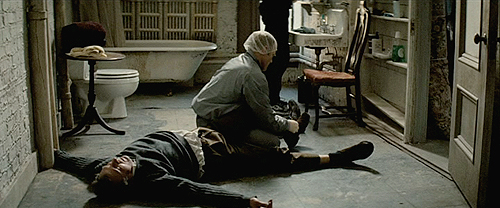
    Much is made of the film’s final sequence, a long shot focused on Clayton as he rides away from the hysteria in his life, desperate for his cab driver to “just drive.”  But a companion shot from earlier in the film was just as arresting, if not more so, as a purposeful point of transition to the second half of the endeavor.  A long tracking shot that never misses a beat, both behind and in front of the camera, the scene detailed is the expert, painfully clinical execution of Arthur Edens, played to an award-worthy T by Oscar nominee Tom Wilkinson.

    The final image is steeped in theme, and an initial tracking sequence under Edens’ opening monologue pulls the viewer into the film’s interior world, but this particular shot is so cold as to be frozen in its depiction of something at once gruesome and strangely beautiful, fluid.  I’m not privy to whether it may have been a directorial decision, though I suspect it may have been, but it is the crown jewel in a film packed with precision from Elswit.
    (more…)

  • The top 10 shots of 2007: part one

    Daniel Day-Lewis in There Will Be Blood2007 was, to my mind, the greatest year for cinematography in a long, long time.  I can’t recall the last time I was so thoroughly impressed with the visual artistry of film after film like I was last year, and I attribute that to the intriguing spark of creativity underway in the film medium as of late.  Newcomers and veterans alike were putting awe-inspiring images on film, some of the seasoned pros besting their already exceptional portfolios.
    I wanted to do something special in the way of commemorating the efforts of these individuals, and so I set out to interview a number of them as the year drew to a close.  Sadly, I was never able to piece those interviews together in a proper story like I would have wanted, but in recent weeks it has occurred to me that it may be just as beneficial to offer up something you don’t regularly see: a personal compilation of the greatest single images from the cinematic year.

    And so it goes that I offer the Top 10 Shots of 2007, a two part piece that will run down what I felt were the best of the best in a year full of exceptional cinematographic work.  Today, I’m running down shots 10 through 6, and tomorrow, we’ll wrap it up with the top 5.  Mixed in you’ll find sporadic comments from the lensers in question, as I feel it only appropriate that I give that small gateway into their process for readers and viewers alike.

    I hope you enjoy reading this as much as I did compiling it.

    (more…)

  • REVIEW: “The Assassination of Jesse James by the Coward Robert Ford” (****)

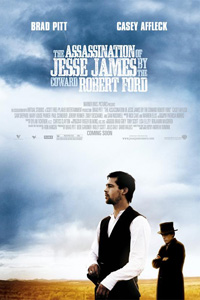
    The Assassination of Jesse James by the Coward Robert FordIn 1983, author Ron Hansen crafted a novel that ought to be considered mandatory reading for anyone fancying himself or herself attracted to the western as a genre and as a conveyor of essential truth. A Shakespearean account of betrayal in the old west, Hansen’s masterful sketches revealed deep and vibrant characters that transcended the nickel-book mythology into which they inevitably found themselves woven.

    Twenty-four years later, filmmaker Andrew Dominik has accomplished a visual telling of that story as close to cinematic perfection as you could hope for. At the risk of sensationalism, I would call “The Assassination of Jesse James by the Coward Robert Ford” the most accomplished work of moving imagery committed to film in nearly a decade. It is a staggering piece of true cinematic art.

    The tale is as simple as it is complex, a trait shared by the greatest of western storytelling. Jesse James (Brad Pitt), the infamous outlaw of old, found himself the subject of obsession, fascination and idolatry by the young and ambitious Robert Ford (Casey Affleck). A yearning to touch greatness, or even reside in similar territory, drove Ford to seek out acceptance amongst James and his gang of outlaws in the waning years of the 19th century. A lethal combination of angst, envy, hubris and government sanctioning brought Ford to a place on April 3, 1882 where firing a bullet into the back of James’ skull seemed the logical course of action. And so it was.

    Dominik and director of photography Roger Deakins have framed the legend of James in some instances by blurring the outer edges of the frame. Perhaps the intention is to convey a legend we know little about, given the cloud of mythology that surrounds actuality. But there are depths of reality here that speak to some fairly grandiose truths, and that, I think, is what Dominik is driving at.

    With all the sensationalized accounts, all of the larger-than-life depiction, there is true poetry in the life and death of the outlaw. And there is true poetry in his assassin’s regret. Myth is born out of realism, and Andrew Dominik, an Australian, seems to understand the American western better than any contemporary, and many who paved the way before him.

    (more…)