In Contention

Tag: Jamie Foxx

  • 10/8 Oscarweb Round-up

    Michael Stuhlbarg in A Serious Man• Jamie Foxx wants “Ray” director Taylor Hackford to tackle the actor’s planned Mike Tyson biopic. [MTV Movies Blog]

    • Jeffrey M. Anderson talks to “A Serious Man” star Michael Stuhlbarg. [Green Cine Daily]

    • Patrick Goldstein wants to know why Michael Moore got dolled up for Sean Hannity. [The Big Picture]

    (more…)

  • Hahahahahaha

    From this morning’s Telegraph (among other sources):

    Jamie Foxx, the African-American actor, singer and comedian, has been named as a potential contender for the role of Frank Sinatra in Martin Scorsese’s biopic of the entertainer.

    Foxx, who won a Best Actor Oscar for his portrayal of Ray Charles in the 2004 film Ray, reportedly considered to be “perfect” for the role. If he is chosen for the part, it will be one of the most prominent examples of “colour-blind” casting in Hollywood history. Also in the running are George Clooney, Leonardo di Caprio, Harry Connick Jnr and Justin Timberlake.

    They forgot to mention Dakota Fanning.

  • SUNDAY CENTS: ‘Obsessed’ impressed

    ObsessedAmerica liked it and they put a ring on it.

    Beyonce’s new thriller “Obsessed” topped the domestic box office this weekend with $28.5 million, adding another impressive performance to the budding actress’s career. Impressive box office performance that is.

    Whether or not Beyonce truly and gracefully inhabits the character of a woman forced to kick ass when some other crazy bitch starts stalking her man, I can’t be certain. This should easily make $70 million+ from a $20 million budget so all involved have just gotten a nice bonus.

    Despite gunning for the same target audience, Universal’s “Fighting” also performed admirably and earned $11.4 million for third place. You can’t accuse them of not being straight to the point and enough males or teens must have thought that a movie called “Fighting” had to be bad ass and worth their $10. Channing Tatum’s career lives to fight another day.

    Actual star power enters the fray at number four with “The Soloist.” Joe Wright’s once-Oscar hopeful earned $9.7 million, which is okay but not enough to justify moving out of the 2008 season. Even though audience reaction is bound to be positive, I just don’t see the legs being great here and a sub-$30 million finish won’t have anybody remembering these folks when ballots are due next year.

    (more…)

  • Was it worth the wait?

    Jamie Foxx in The SoloistWhen Joe Wright’s “The Soloist” was shifted from prime Oscar territory last autumn to a considerably more low-profile 2009 slot, many presumed that the film was something of an artistic disappointment. However, word also went round that the move was a sympathetic one, aimed to place less pressure on a film that, despite the talent involved, was more crowdpleaser than prestige item.

    Meanwhile, two diametrically opposed trade reviews do very little to clear up the picture ahead of the film’s release next week. (They appeared a few days ago, but escaped my notice until now.) Todd McCarthy’s Variety pan confirms the suspicions of the sceptics, actually suggesting that the film appears uncomfortably caught between awards-baiting and more populist urges:

    Neither rarefied art film nor widely accessible inspirational drama, “The Soloist” falls between the cracks both creatively and commercially … Joe Wright’s first American feature has moments of power and imagination, but the overworked style and heavy socially conscious bent exude an off-putting sense of self-importance, making for a picture that’s more of a chore than a pleasure to sit through.

    Charismatic and dynamic as they’ve been on any number of previous occasions, both Foxx and Downey seem to labor here as they grapple with roles viewers will find difficulty warming to. Downey, in particular, fails to find either outer charm or inner soul in Steve Lopez.

    The Hollywood Reporter’s Kirk Honeycutt, however, sings a very different tune, describing the film as “excellent, if flawed.” His disagreement is most pronounced on the matter of the film’s lead performances, going so far as to suggest that they remain strong awards contenders:

    Robert Downey Jr. and Jamie Foxx are on fire in the lead roles: They’re both charismatic as hell without sacrificing any of the emotional honesty necessary for you to believe that these movie stars are a scruffy reporter and a mentally ill musician … True, Academy members tend to remember only the last three months of a year when voting, but these performances are extraordinary enough that the memory should not fade by fall.

    (more…)

  • OFF THE CARPET: Handicapping 2009 a year in advance!?

    Ewan McGregor and Hilary Swank in AmeliaAhh.  The dust is settling.  And on the horizon, just visible through the mist and waiting to drive us all up the wall once again: the 2009 Oscar season.

    I’ve been writing this year-in-advance column for probably six years now, and I always look forward to gazing ahead.  No one dives in so pathetically deep this far out as yours truly, but in exchange for not having a life for the past few months, I get to unload this burden the day after our annual season’s peak and forget about little gold men entirely for a few months.

    It’s quite liberating.

    The most interesting thing about the season to come, from my vantage point, is the lack of a dreaded “frontrunner status” for any of the contenders.  Some might say Clint Eastwood’s Nelson Mandela project (which is not called “The Human Factor,” mind you — the director says the film is currently untitled and is based on John Carlin’s book “Playing the Enemy”).

    Others might say Rob Marshall’s “Nine” (coming from a money-tight company hoping to avoid echoes of “Memoirs of a Geisha”).  But I don’t see a “Geisha” from here, or a “Charlie Wilson’s War,” expected heavies waiting to miss the mark.  The field is curiously flat, and as a result, excitingly broad.

    Let’s get to it, shall we?

    (more…)

  • Who should host the Oscars?

    Kevin SpaceyThis morning I linked to our friend John Campea at The Movie Blog who offered up a list of 15 possibilities for host of this year’s Oscar festivities.  Producers Bill Condon and Larry Mark are hard at work putting the show’s particulars together (when Condon has a few moments away from that Richard Pryor biopic he’s been writing), and sooner or later, an announcement will be made.

    I agree with a few of Campea’s suggestions.  George Clooney, for instance, is an inspired pick, the charmer of Hollywood without an enmy in the world — well, except for McCain supporters, I guess.  I also like the choice of Robert Downey Jr., though in 2008, it’s almost TOO on the nose.  Rounding out the big names that make sense, I’d be on board for Tom Hanks as well, always adept at working a crowd.  But Steve Carrell seems to lack the right prestigious “umph,” while Denzel Washington would prove to be too cardboard-stiff, I’d wager.

    We’ve been there and done that with Steve Martin, Ellen Degeneres and Jon Stewart — new blood would be preferable.  And Steven Colbert would be a false echo of Stewart’s attempts.  Will Ferrell and Ben Stiller — too silly.  Tina Fey — too one-note.  Jerry Seinfeld — too snooty.  And Ricky Gervais was a manifested pipe-dream from the start.  But I’d absolutely be on board if Condon and Mark want to hand over emcee duties to Uwe Boll.  Who wouldn’t??  But you might as well toss in Kelsey Grammer in full-blown Beast make-up as a co-host at that point.

    So the question remains: Who should be the host?  Who has the right amount of showmanship to off-set his dramatic faculties and keep the even keel a show like this needs?  Who has the right comedic reserve to tap into when necessary and who would absolutely light up the stage with his consistent determination to perform?

    (more…)

  • 9/30 Oscarweb Round-up

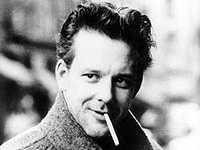
    Mickey Rourke• Mark Olsen reports on the first U.S. screening of German foreign film Oscar entry “The Baader-Meinhof Complex.” [The Big Picture]

    • Jeffrey Wells passes along a note from an exhibitor acquaintance who thinks “Milk” is a home run, but “Frost/Nixon” is a bit stale. [Hollywood Elsewhere]

    • Then he picks the five likely Best Picture nominees, based on the criteria of stories involving journey and redemption. [Hollywood Elsewhere]

    • In a truly tasteless display, Elizabeth Snead makes wise cracks alongside 28 photos of Mickey Rourke’s more bizarre fashion decisions through the years. [The Envelope]

    • David Poland responds to the manipulation of Nikki Finke. [The Hot Blog]

    • Nathaniel Rogers doesn’t think any of the “Reader” hub-bub is a big deal at all. [The Film Experience]

    • Anne Thompson runs down the stacked Best Actor category with the potential Downey vs. Foxx “Soloist” showdown in mind. [Thompson on Hollywood]

    • Tom O’Neil corrals seven pundits for his own predictions chart to light a fire under the collective rear of the Buzzmeter techs. [Gold Derby]

    • James Rocchi chats it up with “Religulous” maestro Bill Maher. [Cinematical]

    • Karina Longworth reviews “Che” and reports from the NYFF Soderbergh press conference. [Spout Blog]

    • Adam Moss corners Woody Allen in the Big Apple. [New York Magazine]

  • Robert Downey Jr. to join the lead actor race in ‘The Soloist?’

    Robert Downey Jr. in The SoloistI’m hearing (not altogether surprising) rumblings that Robert Downey Jr.’s role in Joe Wright’s “The Soloist” is larger than Jamie Foxx’s homeless violinist Nathaniel Ayers and that he’ll be pushed as a leading actor contender by the good folks at Paramount Pictures and DreamWorks SKG.  Apparently this is coming from a place of beaming confidence from the studio and Downey Jr. is said to be fantastic in the film.

    “The Soloist” is, of course, largely Steve Lopez’s story.  It is told from his perspective and is about, as the title of the book lets us know, “the redemptive power of music.”  That would be Lopez’s redemption as much as Ayers’, seeing as the LA Times columnist has picked up his guitar again as a result of his relationship with the man.  (Listen to Lopez discuss his interaction with Ayers and the process of committing that story to print here).

    Of course, actors with star power have a say in these things.  I can’t imagine Paramount would want to put both of these guys in the same category, but I’m starting to get more of a “Resurrecting the Champ” vibe out of Foxx’s role than before.  Perhaps he’d be better suited in the supporting arena, but again, these are decisions that have yet to be finalized.

    It goes without saying that Downey Jr. is having a hell of a come-back year.  I’m still having conversations with industry folks that think he has a shot at Oscar gold for his work in “Iron Man,” but perhaps Paramount can spin that goodwill into the Best Actor group think for “The Soloist.”

    Downey Jr., DiCaprio, Rourke, Jenkins, Langella, Penn, Mortensen, Eastwood, Pitt, Sheen……it’s gettin’ crowded in here.  And Heath Ledger may have just seized the supporting prize.

    More as it develops…

  • Beyond the biopic

    Halfway through watching the recently uncovered trailer for Ron Howard’s “Frost/Nixon,” I felt my stomach sinking with involuntary dread, and it took me a beat or two to figure out why.

    The problem didn’t appear to be the film itself; in fact, the relatively zippy trailer promises something somewhat tighter and wittier than I’ve been expecting from the odd (to my eyes) pairing of Ron Howard and Peter Morgan.

    No, what had me grimacing in anticipation of things to come were the glimpses we are offered of Frank Langella as Tricky Dick – a showcase that, in the space of two minutes, manages to tick so many Academy boxes that Langella could probably nab a nomination for the trailer alone.

    The studied gait, the mannered vocal cadences, the escalating, booming rage in his confrontations with Michael Sheen’s David Frost (anyone want to lay bets on the “when the president does it, it is not illegal” clip being used in the Best Actor presentation on Oscar night?) … all the elements appear to be in place for the kind of superficially impressive inhabitation of celebrity that has lately dazzled the voters on a yearly basis.

    Let it be said, I’m not dismissing Langella’s performance – he may be very good indeed. (Though now that The Guardian has pointed out the vocal similarities between Langella’s Nixon and Sean Connery, that discordant parallel will remain firmly lodged in my brain.) And after a long career with two recent near-misses at an Oscar nomination (“Good Night, and Good Luck” and the wonderful “Starting Out in the Evening”), I could hardly begrudge the man some recognition.

    But at the same time, if someone were to issue a moratorium on rewarding biopic performances for the next decade or so, I would be right on board. For the last ten years running, at least one of the four winning performances each year has been a portrayal of a real-life figure. Daniel Day-Lewis just broke a three-year biopic run in Best Actor category; over in Best Actress, a mere two of the last nine victors played fictitious characters.

    I’m not so contrary as to assert that none of them were deserving, but I don’t mind admitting that I’m a little fatigued. More than that, I’m exasperated at how easily, and consistently, impressed the Academy has been by this particular trick.

    (more…)

  • Best actor contenders join an eclectic list of recent winners

    Sean Penn, Benicio Del Toro and Frank Langella seem to be the names bandied about for Oscar consideration this year, which would place them in some impressive company of nominees and winners these last 20 years. Of course, that said, there have also been some bizarre choices for the Best Actor award, which has often left me shaking my head in disgust and wondering what these voters were actually seeing.

    Since 1988, there have been 10 winners that perhaps should not have been, the award arguably deserved by another of the nominees, or worse, an actor not nominated! Consider Dustin Hoffman in “Rain Man,” a widely acclaimed performance that asked that he not connect with anyone in the film, never make eye contact, rock back and forth and speak in a nasally voice.

    Stop what you are doing right now and try what he did in the film, and trust me it is very easy to do. Now do you deserve an Oscar for doing what Hoffman did in that film? The real perfortmance in “Rain Man” was that of Tom Cruise, who we watched evolve over the course of the film, and of course the best performance of that year was Gene Hackman as the tough investigator in “Mississippi Burning.” Hackman was nominated, but he stood no chance in the wake of the juggernaut of support for Hoffman, who in fact should have won years before for his miraculous work in “Tootsie!”

    (more…)

  • Bringing the truths of Skid Row to the masses

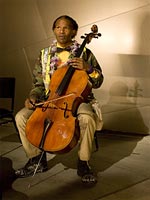
    The LA Times’ Steve Lopez is enjoying plenty of publicity this month for his latest book release, “The Soloist: A Lost Dream, an Unlikely Friendship and the Redemptive Power of Music.” The book was drawn from a series of articles Lopez published three years ago in his “Points West” column in the Times about a Juliard-trained, homeless musician: Nathaniel Ayers.

    The story was cleverly recounted with amusing detail by Lopez at a book reading in Pasadena last month, which was when I first discovered that the film adaptation (releasing later this year and starring Jamie Foxx and Robert Downey Jr.) might actually do some good in forwarding the issue of mental disorder in the U.S., a stigmatized subject that deserves more focus.

    Lopez and “The Soloist” are featured on newsstands this week as Dana Goodyear writes the story and the issue up as a “Letter from Los Angeles” in the pages of The New Yorker. And I’m happy to see that the film may actually take these issues seriously, rather than setting them aside in favor of what would obviously be a heart-warming story.

    Here’s a look at the abstract (I wish the full article was online, but it’s the May 5 issue for those interested):

    Since the nineteen-eighties, L.A. has been known as the country’s homeless capital. Skid Row, a fifty-block area covering less than a square mile between the L.A. River and the office towers of downtown, has the city’s highest concentration of homeless people. A January, 2007, street count showed that there were just over five thousand homeless people living in the area, thirty-three hundred of them in shelters and nearly eighteen hundred on the street. Many suffer from mental illnesses, drug addiction, or both. Thousands are in recovery.

    Joe Wright, the British director of the new Ayers film, decided to take the job on one condition: that the film be made with real people from Skid Row…Open casting calls for extras in the movie were held on San Julian Street, and hundreds of people turned up. Two miles east of the real San Julian Street, a set was built. The Skid Row cast members were asked to play recognizable street types. Some days there were four hundred extras on the set, the vast majority of them from Skid Row.

    “The humanness of the story has given people a rooting interest in Nathaniel’s life, and to that extent it has destigmatized homelessness,” Lopez said. “But Nathaniel pays a heavier price. He has to deal with the attention.”

  • On Robert Downey Jr.

    It was only a few years ago that the inimitable Robert Downey Jr. was in our living rooms as a result of repeated drug arrests. I recall several instances where I felt as if he’d never recover. Fortunately, he did, and on May 2 Mr. Downey will appear as a comic book hero in “Iron Man.” Advance buzz for the film has been strong, and David Carr of The New York Times filed this profile in today’s paper of the actor once labeled “the best of his generation.”

    “Iron Man,” I suspect, will be an enjoyable film. Jeff Bridges, Gwyneth Paltrow and Terrence Howard also star. Based on what I’ve seen thus far, it has some technical appeal that may catch voters come awards season. It’s this film – and the remaining work on Mr. Downey’s schedule in 2008 – that should finally complete his remarkable comeback.

    Later this summer, he stars as Kirk Lazarus in the film “Tropic Thunder” from Ben Stiller. Downey’s character, a method actor who undergoes a pigment alteration, has many people curious. And this fall he appears in Joe Wright’s latest film “The Soloist” opposite Jamie Foxx.

    Mr. Downey has only been nominated once for an Academy Award, in 1993, for his role as Charlie Chaplin in Richard Attenborough’s film “Chaplin.” He did not win. Since then, he’s appeared in more than thirty five films — some quite memorable (“Wonder Boys,” “A Guide to Recognizing Your Saints,” “Kiss Kiss Bang Bang” and “Zodiac,” especially). But none of these roles caught the attention of the awards community.

    Seven years ago this month, Mr. Downey was fired from his recurring guest role on “Ally McBeal.” This year, he’ll release three films, one of which, “The Soloist,” may earn him a second Oscar nomination. And his past seems to be well behind him. As he remarked to Mr. Carr, “I’m not in that sphere of activity anymore, and I don’t understand it any more than I understood 10 or 20 years ago that somehow everything was going to turn out O.K. from this lousy, exotic and dark triple chapter of my life. I swear to God I don’t even really understand that planet anymore.”

    I’m certainly grateful for that.

  • Steve Lopez and ‘The Soloist’

    I stopped by Vroman’s Bookstore in Pasadena yesterday evening to hear Steve Lopez read from his new book “The Soloist: A Lost Dream, an Unlikely Friendship and the Redemptive Power of Music,” fully expecting a run-of-the-mill book release PR thing. As it turns out, Lopez is a quick-on-his-heels delight of a public speaker, engaging, never tedious and insightful when it really counts.

    And actually, there was no book reading, since Lopez had “lost his glasses for the third day in a row.” Instead, the LA Times columnist simply recounted, in maybe an hour’s time, his relationship with Nathaniel Ayers, a homeless resident of downtown Los Angeles and Skid Row — and a Juliard-trained musician all the same, whose story might be hard to believe, but can be captivating to the most cynical.

    L.A. residents are quite familiar with Lopez’s “Points West” column that runs daily in the Times. One of the few living, breathing journalistic spirits of considerable heft at the paper, it seems, Lopez turns a phrase and transforms the mundane into the captivating with a truly gifted sense of the English language. He has introduced readers to members of an entire scale of notoriety, always with equal aplomb, and his articles about Ayers lit a spark for many Angelenos.

    The articles, of course, have been adapted by screenwriter Susannah Grant into a film to be released later in the fall by DreamWorks. And Lopez’s book release this week is the beginning of a long road for Ayers’ story, one that will bubble to the surface on a much larger scale when the film lands in November. But what I learned listening to Lopez speak yesterday was how much of a concerted effort the book was for forwarding the issue of mental disorder in the United States, ailments that leave the public stigmatized, a dirty secret, of sorts, that the country seems unwilling to deal with in any up-front manner.

    There are those, I’m sure of it, who feel this project seems a grating experience on the horizon of the film awards season. I, too, had my doubts as to something this potentially schmaltz-laden hitting the screens. But my view has shifted somewhat after hearing Lopez tell it. However opportunistic it might seem to the jaded for the film industry to seize upon a story like this, I have to say, I believe a lot of good could come of it in the end. I look forward to Joe Wright’s work even more so with this added context.

    In the film, Lopez will be portrayed by Robert Downey Jr., while Jamie Foxx will portray Ayers. Oscar nominee Catherine Keener also stars.

    I recorded Lopez’s talk, which runs right at an hour. I thought it would be a great way to initiate a new multimedia aspect of In Contention, and so, I offer it to you now. It’s a funny and insightful 60 minutes from one of the industry’s best columnists.

    Have a listen:

    [display_podcast]

  • OFF THE CARPET: 2008, a year in advance

    Another year, another set of wins…and another look ahead at what’s in store NEXT year.

    It’s never too late to take a long gander at what we might see dominating the film awards landscape in 365 days, and with that in mind, I’ve been doing my usual mulling over the possibilities for a few weeks to put together the sadly thorough examination of the 2008-09 award season that follows. Let’s get into it. There are some major considerations to take into account. right off the top.

    Like Leonardo DiCaprio, for instance, who is set to be the entertainer of the year. With performances in “Body of Lies” (Ridley Scott) and “Revolutionary Road” (Sam Mendes), DiCaprio is working with a duo of awards-proven talent this year. Perhaps that will work against him, much like it did in 2006, and no major Oscar success will come knocking. But we’ll wait until we see the performances. Each of them could be enticing.

    This year’s Best Picture Oscar victor Scott Rudin is back again, by the way, with “Revolutionary Road,” recently inherited by Paramount Vantage and probably one of the true “frontrunners” this far out that we could put our finger on. The only other film in Vantage’s arsenal is Edward Zwick’s “Defiance,” which could simply be a commercial success, but might find its way to multiple nods like “The Last Samurai” and “Blood Diamond” in recent years.

    (more…)

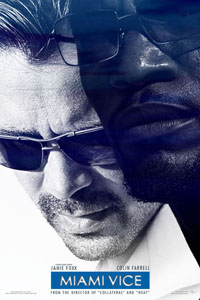
  • REVIEW: “Miami Vice” (**1/2)

    Universal Pictures\' Miami ViceMichael Mann’s “Miami Vice” is a terribly anxious piece of filmmaking.  By its own erratic and rote design, the film marks, at once, a substantial step down for the writer/director, and merely a lateral move in the realm of stylistic representation.

    Boasting a curious mish-mash of caricatures and equally original representations, it is certainly the most uneven work he has offered to date, and most assuredly the worst film he has produced since the horror of 1983’s “The Keep.”  Then again, the “worst” of Michael Mann would usually be a point of envy for most of today’s working filmmakers.

    Based on the Anthony Yerkovich-created television series of the same name, “Miami Vice” is a meditation on deception and trust.  The film wears its themes on its sleeve, though forgivably so, as, if anything is spread evenly and accomplished absolutely throughout, it is that very concept.

    But Mann’s film has an eagerness to it, a misplaced ardency, that leaves the impression of a movie with something to prove.  Its chest seems puffed outward from the moment the Universal Pictures logo disappears (immediately bursting into the sounds of Jay Z and Linkin Park at a Miami nightclub), to the slow fade of the closing title screen (a tonally ironic deep, cool blue).

    In the adaptation, Colin Farrell and Jamie Foxx fill the classic roles of Sonny Crockett and Ricardo Tubbs respectively.  As partners, this aspect of the story provides at least a basis for further exploring the notions of trust and deceit at the film’s core.  When Tubbs says to Crockett “I would never doubt you,” it represents the reality of their lives, the only tangible aspect of their profession.  It is a point, however, glossed over somewhat and certainly not capitalized upon as it could have been.

    A thorough examination of their relationship is not needed, but an understanding of consequence of that relationship is certainly a must, and it is really nowhere to be found, even within the confines of subtext (something at which Mann has proven himself an expert time and again).

    The nuts-and-bolts plot of the film plays itself out seemingly as an expansion of one of the series’ various faceless scenarios.  After a former informant compromises an FBI undercover operation, Crockett and Tubbs, being a part of the Miami-Dade Police Force and existing outside the confines of any possible leak, are recruited by the Bureau to investigate further – and deep undercover.

    Gong Li and Colin Farrell in Miami ViceThere is then an assortment of expected character types, from the introverted, consistently pondering drug kingpin (Lois Tosar), to the weasel-ish middle man who smells something fishy (a rather diabolically entertaining John Ortiz), to, of course, the tough-as-nails businesswoman-slash-kingpin girlfriend (Gong Li).  This triumvirate of typicality is painfully derivative from the get-go, but we’ve seen Mann take the cliché and turn it into stylistic substance before in “Collateral,” so assuredly one could expect as much once more.  Sadly, no such turn of events is in store.

    The film is truly owned by Colin Farrell, regardless of whose name appears first on the poster and which Oscar-winning actor whined for more prominent status on the film’s payroll.  Farrell in fact acts Foxx off the screen for the most part, though Tubbs is admittedly an awkwardly designed character.

    He boasts a quasi-romance that is ill-defined with fellow teammate Trudy Joplin (Naomie Harris), and he turns to comedic sensibilities a bit too often in his “undercover” guise, so much so that, were I Crockett, I’d demand a less obvious partner for fear of being gutted by a suspicious drug lord.  No matter how rewarding the one-liners might be on one hand, on the other, they simply represent one more wrinkled aspect of the piece that could have used some ironing.

    Farrell, however, lives and breathes inside Crockett in perhaps his best performance yet – though his accent does slip at times from the Bronx to the south, oddly enough.  He gives us the complexities of the character that are not found on the page (unlike Foxx), and even when the forced romance with Gong Li’s Isabella rears its trying head, we believe the loneliness and the despair that drives Crockett to seek out that connection.

    At the very same time, we can sense him reciting the words of Neil McCauley in his head: “Don’t let yourself get attached to anything you are not willing to walk out on in thirty seconds flat if you feel the heat around the corner.”  Even still, it is a different idea at work here, one about longing and necessity more so than discipline and detachment.
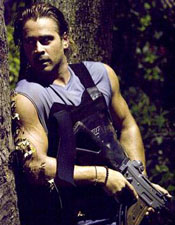
    Colin Farrell in Miami ViceLi, however, seems forever uncomfortable in a position we are meant to believe is some saving grace for her.  She shares the solitude of Crockett, the loneliness.  That is their common denominator, and the single thread with which we are to buy this romance.  But she does not sell that notion in the slightest.  She seems almost lost in her character’s dialogue and motives.  Who is this woman?  Beyond a random anecdote about her mother – a lone wolf in her own right, it seems – from whence does Isabella come?  We do not know.

    Nor do we know much about Crockett.  However, even when he is given the interesting task of peering longingly out of a window in the film’s first act, we know there is something there.  But even then, why?  What – even possibly – haunts this man?  Did his career create a rift between himself and another lover?  Various other lovers?  Does he pursue a life of lies and deception undercover to escape the realities of his own anonymity?  What are the realities of his anonymity?

    These themes never even threaten exploration, and the sound of air rapidly filling the space vacated by such dearly departed intricacies of character is all we can hear indeed.

    Elsewhere in the cast, John Ortiz weaves a truly villainous serpent, fit with hypnotic syntax and devilish grins.  Though his character is painfully ordinary, Ortiz makes him eminently watchable – as does Tom Towles as a despicable and somewhat terrifying man who chews gum as if it were his sole purpose on earth.  Furthermore, Barry Shabaka Henley, always a delight, provides a steadfast Lieutenant, a serious and driven man to trust.  Even when his dialogue seems forced, we still believe every syllable.

    The rest of the cast is somewhat anonymous by Michael Mann’s standards.  Here is a director who has always been adept at filling the frame with a variety of characters, but however minute their bearing on the story, there was always dimension to be found.

    Domenick Lombardozzi (you’ll recognize him from a cameo performance in this season of “Entourage”), Elizabeth Rodriguez (“ER”), Harris (“28 Days Later”), Tosar (“Los Lunes al Sol”) and Ciarán Hinds (“Munich”) fill their positions by the book.  However, the loss of substance in the peripheral cast is felt most painfully in the fact that Justin Theroux (“Mulholland Drive”) is just there, taking up space.

    Theroux is one of the most striking and interesting actors of the underrated lot today –- potential movie star material.  A Michael Mann film should be his playground, yet there he is, forever an afterthought.

    All of that said, John Hawkes’s oh-so-brief work in the film’s opening scenes soaks up the role of Alonzo for all it is worth.  It is rare to understand a character so thoroughly in such a brief amount of time, and with such a consistency of emotion and complexity.  You’ll recognize Hawkes from last year’s “Me and You and Everyone We Know” and television’s “Deadwood.”
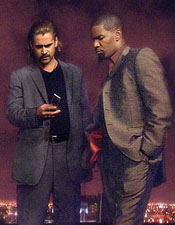
    Colin Farrell and Jamie Foxx in Miami ViceAll this talk of the varied cast (however clichéd) has left me little time to fully discuss the technical aspects of the film, all a step down from the vibrant “Collateral,” yet still a move in the right direction for digital cinema.

    Dion Beebe’s lensing still lacks the thematic composition of Mann’s work with Dante Spinotti in years past, and even of Emmanuel Lubezki on the underrated “Ali.”  However, the juxtaposition of the imagery by way of William Goldenberg’s and Paul Rubell’s film editing keeps the pacing relentless and creative, as always.

    Additionally, it seems as if Mann has found a new musical muse in Audioslave, the remnants of a singerless Rage Against the Machine with Soundgarden’s Chris Cornell at the mic.  Mann has always been a fan of Moby (and seemingly still is, given the inclusion of “Anthem” and “One of These Mornings”), but this is the second time Audioslave has been featured so prominently in one of his films (following the potent usage of “Shadow on the Sun” in “Collateral”).  The band contributes two new and appealing songs to the film’s soundtrack, but sadly, said soundtrack feels like a mix CD, a new track every other minute.

    Mann is a master of aural atmospherics, and the sparse score even recalls the majesty of Elliot Goldenthal’s work on “Heat” at times.  However, such things seem entirely rushed and thoughtless in his latest effort.

    The question with which one is left after viewing “Miami Vice” is “Why did Michael Mann want to make this film?”  Was it the desire to dig into the theme of lies through the world of undercover policing, as has been reported?  Likely.  But if so, where is the passion we’ve come to expect of his work when he is so focused, so driven?  Where is the touch of humanity that seems almost organic?  Why does this script feel as if Syd Field deserves a credit?  Why such typicality?

    These all become rhetorical questions in the final analysis, but as filmgoers, we will be quite the lucky when Mann decides to leave the desire for romp behind and tackles much more personal and engaging fare once again.

    “Miami Vice” is anything but personal.  It is a – sometimes – gratuitously violent (Verhoeven-level), generally by the numbers actioner with elements of depth and promises of texture that are more often teased than explored.  It is vacant and even elementary on as many levels as it hopes to be poignant and thematically authoritative, and though it concludes with the emotional tinge that recalls Michael Mann cinema, it fails to reach the bar he has set for himself.

    It is a high bar indeed.  Perhaps he is doomed to chase it forever.