 So many of today’s youth have not seen films made before the year they were born and they are missing so much. I remember being 18 and spending some time with my girlfriend at the time at her job, which allowed for me to get a lot of reading done. One of her co-workers expressed some surprise that I was reading Charlie Chaplin’s autobiography. “Do you have to know everything about movies John?” Without hesitation I answered, “yes,” and still feel that way. The great directors of cinema past and present knew as much as they could ABOUT cinema past and present. Aspiring filmmakers should certainly take their cue.
Once, while showing “Psycho” in my film history class, a student suddenly shouted, “Marcellus Wallace and Butch…man Tarantino lifted this,” and he was right. There is a scene in the film where Marion Crane encounters her boss crossing a street in much the same manner Butch encounters Marcellus in “Pulp Fiction.” It’s small but I’m so happy someone in that class picked it up. You have to know where you’ve been to understand where you are and, certainly, where you’re going.
There is a retro-interest in Elia Kazan, the great director of the 1950s, that I find quite thrilling. Known as a bi-coastal director, Kazan enjoyed great success in film as well as stage, helming some of the first productions of the greatest plays of the 20th century, including “All My Sons,” “Death of a Salesman,” “A Streetcar Named Desire” and “Cat on a Hot Tin Roof.” He would direct the film version of “A Streetcar Named Desire” in 1951 to great acclaim.
No other director before Kazan so understood the art of acting and was able to work with actors in the manner he did. He was among the first directors to make the actor part of the creative team, listening to his or her ideas and admitting when he had actually been wrong. It was unheard of for directors such as John Ford, William Wyler, Chaplin or Orson Welles to admit being wrong — they never were in their minds — but Kazan had no fear, believing the creative process allowed for error.
Having been trained as an actor befor he became a documentary filmmaker, Kazan understood the actor’s process, but as a director he wanted to be more than just the sort of director who blocked talent; he wanted to work with actors to create something as realistic as possible. Though he started his career as a director with Method Acting guru Lee Strasberg, the two parted ways when Kazan began evolving the style. Kazan went off to direct with his new ideas about the Method and found great success, winning two Academy Awards, Tony Awards and in 1999, under the cloud of controversey, an Academy Award for Lifetime Achievement.
 Michael Cieply, writing at
 Like a number of film music composers, Jeff Beal makes his home north of Los Angeles in the rocky, canyoned city of Agoura Hills. One feels a sense of the old west before even seeing the ranch-style houses in his neighborhood and the tail-flipping horses tied out back. Questions about his work on “Appaloosa,” Ed Harris’s latest entry in the western genre, seem to manifest out of thin, dusty air by the time we make it downstairs to his efficient but Spartan studio.
 Philip Roth is author of 25 novels and other works of non-fiction. Revered in America, he has won every major American literature prize, including the National Book Foundation’s Award for Distinguished Contribution to American Letters in 2002. Despite his literary success, his films have had a difficult journey to the silver screen.
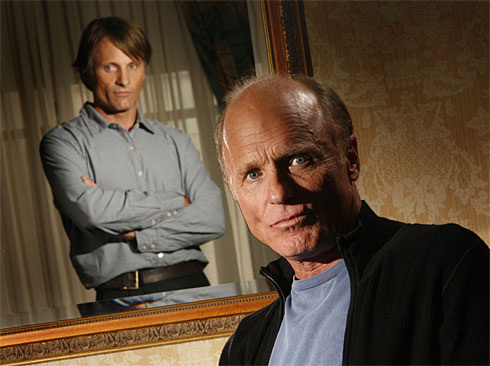



 Walking into to interview with any actor/director can be a tad intimidating, even after 20 years of doing it. They have a tendency to be…difficult. But 30 minutes into my interview with Ed Harris, he pays me a compliment that could keep wind in my sails for the duration of the fest: “Thank you for your integrity, intelligence and dedication to your job. This has been a pleasure.” He smiled as we shook hands and he walked me to the door

 Rough day on the legs yesterday, a lot of walking. Five films. One of them I will watch on DVD in the luxury of my room tonight, so four that I am running to, but hey, these are films I want to see, which always helps, right?
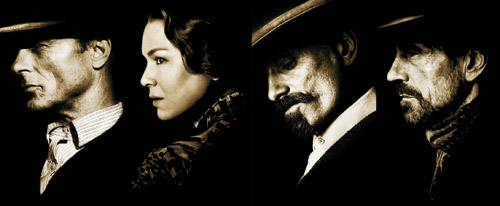
 I don’t think it’s much of a secret around these parts that I really wanted to be on board for “Appaloosa.” I’m in love with the new resurgence of the western genre, even if I get irritated when people refer to “No Country for Old Men” and “There Will Be Blood” as evidence of it.
 Before I head out today on a whirlwind of pre-Toronto screenings that will take me away from the work at hand, I wanted to follow up last week’s

