In Contention

Tag: Cannes

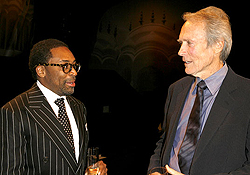
  • Spike Lee = the Jesse Jackson of film?

    Roger Simon seems to think so:

    Why would Lee pick this fight?

    Unfortunately, it couldn’t be more obvious. Like Jesse Jackson and Al Sharpton, time has been passing Spike Lee by. His worldview comes from another era and he has never really sought to revise it, to open his eyes. Proof of that is that for more than a decade Spike has barely made a film any of us can remember. Compare that to Eastwood, who, although some twenty-seven years Lee’s senior, is at the top of his career, having scored big in 2003-2004 with Mystic River and Million Dollar Baby.

    No wonder Spike’s jealous. So what does he do? He reaches back to an era when he was more successful. He plays the old identity/race card. Now we could all laugh and say this is just another case of an (prematurely) aging artist grasping for attention, but these times are more complex than that. We don’t know which way we are going – toward a post-racial future or back to a racist past.

    His argument is interesting because it is equal parts over-simplified and shrewd. The Lee/Eastwood dispute has been talked to death…and again…and again, but the overriding feeling I had following the initial Cannes fracas was sadness — sadness that Lee has shown yet again that he is unable to prove his (at times justified) contradictory opinions without the stench of clichéd rhetoric and steadily outdated reason.

    (more…)

  • Sight & Sound weighs in on Cannes

    OK, so Cannes is old news, but for me it’s never really over until Sight & Sound prints its annual Cannes review – for my money, the British magazine offers the most expansive and thoughtful coverage of the festival around. It’s not available online, but it’s worth grabbing a copy if you can. Meanwhile, I’ve picked out a few highlights from editor Nick James’ commentary on the key festival films.

    Interestingly, James agrees by and large with the jury’s selections. He names “The Class” as his favourite film of the festival, declaring it “so electrifying, satisfying and inspiring that it’s hard to believe it isn’t the work of professional fiction weavers at the top of their trade.” He also joins the chorus of approval for “Gomorra:” “So compelling is the detail that there’s no need for thriller conventions … Garrone’s direction makes incredible use of desolate locations and the acting is impeccable.” I must admit I am getting more excited about this film with every notice I read.

    (more…)

  • The June Oscar update

    EDIT: Broken link now functioning. Apologies.

    I’ve done some chart management this month in the wake of the Cannes International Film Festival. Also, we’ve added pages for each of our contributors to offer up his predictions in various races. You’ll find them linked in the bios section.

    I’ll likely keep Oscar updates to a monthly basis until we sink our teeth into the season in September. For now, there isn’t a whole lot to discuss. So…enjoy.

  • New poll

    In lieu of a decent talking point surrounding this year’s somewhat underwhelming Cannes fest, I thought I’d keep it simple this week and grab an assessment on this weekend’s blockbuster. Tell us where you stand in the new poll.

  • No surprises as Cannes jury surprises

    Well, I missed that one badly. As is so often the case, the Cannes jury threw a curveball, handing their top prize to a late-breaking film that had generated very few column inches. Admittedly, I should have paid more attention to “The Class,” French auteur Laurent Cantet’s school-based docudrama.

    I was a huge fan of Cantet’s 2001 film “Time Out,” an ingeniously constructed character study, and while his 2005 follow-up “Heading South” was a major disappointment, Cantet’s name on the competition list should have rung more bells – not least when the very warm reviews started rolling in yesterday. Variety called it “one of the most substantive and purely entertaining movies in competition at Cannes this year.”

    Congratulations to Cantet then, and to France, scoring their first home victory at Cannes since “Under Satan’s Sun” triumphed in 1987. The other awards threw up fewer surprises, with Benicio Del Toro taking Best Actor as I, and many others, predicted. Meanwhile, “Three Monkeys” and the Italian one-two punch of “Gomorra” and “Il Divo” all took home major silverware, if not necessarily in the categories that I anticipated.

    I must admit to being shocked that the widely beloved “Waltz With Bashir” went home empty-handed; an omission for which Sean Penn and fellow juror Natalie Portman seemed almost apologetic. No matter: Ari Folman’s animated war documentary leaves the festival with a dedicated following, and I’m certainly putting it on my Best Animated Feature shortlist.

    The full list of competition winners follows:

    Palme d’Or: “The Class”

    Grand Jury Prize: “Gomorra”

    (more…)

  • Cannes: uneducated guesses

    Well, it’s almost over. The competition films have all been screened, picked over and digested by the world’s critics, and now all that’s left to do is that finicky business of handing out some prizes. Sean Penn and his formidable jury (Marjane Satrapi, Alfonso Cuaron and Natalie Portman are just some of those involved) will be deliberating over a crop of films that has generally been deemed a solid selection, with few outright “Brown Bunny”-style disasters.

    (more…)

  • Which film will take the Palme d’Or?

    Wells is already speculating and Foote is ready to move on, but let’s think it out here. In a festival that has been a bit underwhelming to most, both artistically for the critics and fiscally for the buyers, someone’s still gotta win best in show.

    Matteo Garrone’s “Gomorra” and Nuri Bilge Ceylan’s “Three Monkeys” might be the safe guesses, as both were quite well-received. But the Palme has made a habit of being elusive to the films one would expect to claim it.

    Clint Eastwood’s “Changeling” enjoyed a pleasant love-fest for a time, before the director was roughed up by a colleague and then hit a wall of sorts with The New York Times.

    Then there are the fringe possibilities of Steven Soderbergh’s “Che” — mixed on receipt, but that hasn’t stopped efforts in the past — and “Synecdoche, New York” from Charlie Kaufman, which has the benefit of being the last film out of the gate.

    What’s it going to be?

    If I had to bet, I’d say “Three Monkeys.” If I ventured a guess in the midst of rampant unpredictability (which is Cannes in a nutshell), I’d say “Synecdoche, New York.”

    We’ll see how it pans out over the weekend.

  • A.O. Scott on ‘Che’ and ‘Synecdoche’

    Thankfully SOMEONE took some time to properly respond to Steven Soderbergh’s one-two punch of “The Argentine” and “Guerrilla” — “Che,” for the Cannes world premiere. I respect as much as anyone the need to get the reaction out there fast, but more than a few critics were a bit hasty in rounding up extended thoughts hours after the 6:30 screening Wednesday night.

    After all, the film’s first reaction came from Jeffrey Wells, who has paced himself yet and refrained from offering a full-blown review until the dust has at least settled somewhat.

    A.O. Scott’s piece in The New York Times is part-review, part-Cannes immersion study, and he ties his thoughts to a partial reaction to Charlie Kaufman’s “Synecdoche, New York.” He doesn’t venture solid opinions on either effort, though he does note that the filmmakers have perhaps raised the bar too high with their previous work to judge these films as anything other than a little disappointing.

    It is regardless an intriguing think piece presenting his American perspective on the global cinema 7-11 that is Cannes:

    This is one of the frustrations of Cannes, for American critics at least. We see lots of fascinating movies — not all good, but very few completely worthless — and then wonder if we, or our readers, will ever see them again. I’m not in the movie business (a mutually beneficial arrangement, believe me), and not inclined to speculate with someone else’s money. I do hope, however, that sometime in the near future I can take part in the long and contentious conversation that “Che” deserves, and also see how my own initial ambivalence about the film resolves itself.

    (Pull-quotes on “Che” and “Synecdoche, New York” after the jump.)

    (more…)

  • As Cannes winds down, TIFF looms…

    With Cannes on the downswing, it becomes time to to start making preparations for the annual Toronto International Film Festival, for which screening announcements begin next month. I have been covering Toronto for more than 15 years and can safely say it is Christmas to a film critic.

    Each September I move into the Delta Chelsea Hotel for the duration of the festival — it makes no sense to make the 90 minute drive home each night as the days begin at dawn and often tie into the following morning. My wife and girls make the drive into the the city for the weekend and swim while I screen. And if time permits, I take Sherri to a Gala screening at Roty Thomson Hall.

    Over the course of each festival I see between 30 and 50 films (50 being my personal high, in fact) and though it sounds like tons of fun, and I would not miss it for the world, it is exhausting to say the least.

    (more…)

  • Festival-goers file out of ‘Synecdoche’

    UPDATE (5:38 a.m.): Allan Hunter of Screen International has written the first full review out of the fest I’ve come across. He raves the effort as follows:

    Synecdoche is about one man’s lifelong struggle to understand the meaning of his existence. Unadventurous audiences may feel the film is a two hour struggle to understand the meaning of its intentions but as the story appears to move in ever decreasing circles, it remains incredibly engaging and ultimately very moving. Hoffman gives a bravura performance that provides the film with all the focus it requires, capturing everything about Caden that makes him immensely sympathetic and instantly recognizable as a symbol of everyone on planet earth who is…struggling with the challenges of being human.

    EARLIER: We should be hearing word in the next few hours on Charlie Kaufman’s directorial debut, “Synecdoche, New York,” starring Philip Seymour Hoffman and Samantha Morton — and one my most anticipated flicks of the Cannes fest this year.

    Here is Jeff Wells’ one-off, on his way to the post-screening goings-on:

    I’ve just emerged from the semi-nourishing, semi-tortured Fellini-esque Chinese box mindfuck-dreamscape that is Charlie Kaufman’s Synecdoche, New York…and the press conference is just starting. [Ten minutes later] Kaufman has just explained the title’s pronunciation: Syn-ECK-duh-kee. At least that’s settled.

    Mike Jones at Variety, meanwhile, had some fun yesterday with Croisette-goers about said pronunciation.

    More to come, I’m sure.

  • The story so far

    The Times of London has a very handy roundup of the highlights of the Cannes Film Festival thus far, echoing the widespread acclaim for such titles as “Gomorra,” “Vicky Cristina Barcelona,” “Waltz With Bashir,” and the long-awaited new film from Terence Davies, “Of Time and the City” – which, while out of competition, has probably been the festival’s most universally adored film so far. They also share my suspicion that Nuri Bilge Ceylan’s “Three Monkeys” may nab the Palme d’Or over the more extravagantly hyped contenders.

  • First ‘Che’ reactions land

    UPDATED (4:15 PM): Not so fast, there.  It seems Anne Thompson has chimed in and sort of doused the flames of passion a bit with a sobering perspective on these two efforts.  The next few hours ought to be interesting as more opinions trickle in.

    Here’s what Anne had to say:

    “A folly.” “A mess.” “Great.” These words came from some of the critics coming out of Steven Soderbergh’s four-hour 18 minute Spanish-language Che Wednesday night. At the end there was slight applause; no boos. My own description: noble failure.

    EARLIER: Jeff Wells is on the ball with quick (probably too quick) reactions to Steven Soderbergh’s “Che” twofer of “The Argentine” and “Guerrilla.” If you ask me, this is the center piece of this year’s Cannes fest and the one I’ve been waiting with bated breath to hear about.

    On “The Argentine” (is it still called this?) Wells had the following to say:

    I know I predicted this based on a reading of Peter Buchman’s script, buy the first half of Steven Soderbergh’s 268-minute Che Guevara epic is, for me, incandescent — a piece of full-on realism about the making of the Cuban revolution that I found utterly believable and politically vibrant and searing.

    It’s what I’d hoped for and more. The tale is the tale, and it’s told straight and true. Benicio Del Toro’s Guevara portrayal is, as expected, a flat-immersion that can’t be a “performance” as much as…I don’t know, some kind of knock-down ass-kick inhabiting. Being, not “acting.”

    And on “Guerrilla,” what will likely be the less awards-ish of the flicks:

    The second half of Che, also known as Guerilla, just got out about a half-hour ago, and equally delighted although it’s a different kind of film — tighter, darker (naturally, given the story). But I’ve been arguing with some colleagues who don’t like either film at all, or don’t think it’s commercial.

    Wells mentions Variety’s Anne Thompson, Cinematical’s Kim Voyner and Glenn Kenny, formerly of Premiere. Each of them attended the screening, so keep an eye on their respective outlets to gauge further reaction.

  • Cannes update: Italy’s ‘Gomorra’ wows ’em

    (EDITOR’S NOTE: New Cannes poll in the sidebar as of this morning, FYI.)

    We’re at the halfway point now, and this year’s Cannes Festival seems to have been a pretty staid affair so far. With the dust settled, “Blindness” appears to have been labelled an honourable disappointment. Meanwhile, some of the big arthouse names in the competition are widely agreed to be treading water.

    Walter Salles’ “Linha de Passe” appears to be worthwhile, but hasn’t generated the critical heat of “Central Station” or “The Motorcycle Diaries.” “Lorna’s Silence,” the latest from Belgium’s hitherto unimpeachable Dardenne brothers, here aiming for a record third Palme d’Or, has garnered respectable notices (and an outright pan from Jeff Wells), but doesn’t seem to be up to the standard of “Rosetta” or “The Son.”

    There have been some international successes. “Three Monkeys,” the latest from Turkey’s great Nuri Bilge Ceylan, has gathered predictably excellent reviews, of which The Hollywood Reporter’s take (a “brilliant, gorgeously visual film”) is typical. If I were to bet on a Palme d’Or winner (always a silly thing to do), this would be it – though I fear this will have as much trouble crossing over to the US and UK markets as Ceylan’s previous work.

    One of the real breakout films of the festival so far, however, appears to be Italian director Matteo Garrone’s “Gomorra,” an intricate documentary-style look at the Camorra crime empire of Naples, based on a bestselling expose by Roberto Saviano. Amid generally enthusiastic reviews, The Hollywood Reporter states:

    Powerful, stripped to its very essence and featuring a spectacular cast (of mostly non-professionals), Matteo Garrone’s sixth feature film “Gomorra” goes beyond Tarantino’s gratuitous violence and even Scorsese’s Hollywood sensibility in depicting the everyday reality of organized crime’s foot soldiers.

    In his always-worthwhile Cannes roundup, The Guardian’s Peter Bradshaw concurs:

    The competition films have been more than a little upstaged by Matteo Garrone’s Gomorra, a gut-wrenchingly brutal film about notorious Naples gangsters, the Camorra. The title’s twist implies the whole area is sunk in a kind of self-created hell, almost literally, since the mobsters are responsible for unsafe nuclear dumping. Perhaps it tells us nothing we don’t already know about gangsters, but there’s no denying the film’s power.

    I confess I am not very familiar with Garrone’s work, but I, for one, am intrigued by this. It will be interesting to see how this one plays out. From the sounds of things, if the film finds the right buyer, there could be “City of God”-style crossover potential here. Or nothing. You never can tell at Cannes.

  • Whew…

    I’m sure I’m not the only one who heaved a sigh of relief after reading some of the reviews of Woody Allen’s latest, “Vicky Cristina Barcelona,” which recently premiered out of competition at Cannes. The consensus appears to be that the film, while unlikely to enter the canon of his greatest, is an attractive, frothy entertainment.

    In his Variety review, Todd McCarthy puts it thus:

    “Vicky Cristina Barcelona” is a sexy, funny divertissement that passes as enjoyably as an idle summer’s afternoon in the titular Spanish city … pic offers potent romantic fantasy elements for men and women and a cast that should produce the best commercial returns for a Woody Allen film since “Match Point.”

    McCarthy is particularly enamoured of Penelope Cruz’s performance, deeming her to be “dynamite” in the film, and extending the Anna Magnani comparisons that we first started hearing when “Volver” emerged two years ago.

    Happily, The Hollywood Reporter’s Kirk Honeycutt is equally enthusiastic about the film, and is most impressed by its Spanish stars:

    The film belongs to Bardem and Cruz. This is a Spanish version of “Private Lives,” a couple that cannot live apart or together, whose love will always burst into fiery combat. Their scenes are some of the funniest Allen has ever put on film, and the culmination of this love/hate tango is not to be missed.

    I had a good feeling about this project from the get-go, but then I admit I’m one of those die-hard Allen supporters who maintains that “Melinda and Melinda” is a misunderstood almost-great, and tried his damnedest to find something – anything – to like about “Hollywood Ending.” So I’m thrilled to learn that this is likely to be one of those Allen treats I can enjoy guilt-free, without having to construct a defence case for it afterwards.

    As for awards prospects, after those notices, I’m going to go ahead and put Cruz on the lower rungs of my ladder of Best Supporting Actress contenders. Woody’s films have long been good to women in this category, and while the competition looks crowded this year, a slight but appealing performance from a well-liked star is often the one left standing when the bigger guns misfire. As for Allen himself, any film of his that is generally given at least a B+ by the critics is a contender for a Best Original Screenplay nomination, so I’m going to plunge in and put him on my list. What can I say? The sun’s out (at last) in London, one of my favourite auteurs appears to be back on track, and I’m in a generous mood.

  • Oscarweb Round-up (Week of 5/12)

    Reintroducing the Oscarweb Round-ups you probably caught at Red Carpet District last season, I thought it might be worth it to try it on a weekly basis here at In Contention — until the daily onslaught hits us again in a few months.

    –Peter Debruge writes up the Student Academy Award winners. [Thompson on Hollywood]

    –BAFTA/LA spotlights British comedy with new awards ceremony. [Variety]

    –Sasha Stone wonders about the apparently randy nature of Woody Allen’s upcoming “Vicky Cristina Barcelona.” [Awards Daily]

    –Pete Hammond writes up an Oscar preview via this year’s Cannes International Film Festival. [The Envelope]

    –Guy Lodge responds. [In Contention]

    –Blake Rutherford previews the Little Rock Film Festival and takes the opportunity to ponder what the festival circuit means to films looking for traction. [In Contention]

    –Noah Forrest thinks Oliver Stone’s upcoming “W” is a “bad idea.” Meeee tooooo. [Movie City News]

  • ‘Blindness’ misses the bullseye, say critics

    Well, in my last post, I said that “Blindness,” with its immaculate credentials, could hardly miss – which of course was issuing an invitation for it to do just that. The latest from red-hot director Fernando Meirelles opened this year’s Cannes Film Festival a few hours ago, to frustratingly mixed reviews.

    In his review, Kirk Honeycutt of The Hollywood Reporter calls the film both “provocative” and “predictable cinema,” and while he does admire Meirelles’ craft, he ultimately finds the film emotionally lacking:

    This philosophical coolness is what most undermines the emotional response to Meirelles’ film. His fictional calculations are all so precise and a tone of deadly seriousness swamps the grim action … Removing a fable from the comfort of the printed page to the photo-reality of film can sometimes lead to its own kind of blindness.

    Variety’s Justin Chang is similarly lukewarm on the film, bemoaning its “diminished impact and excess of stylish tics,” and is less impressed than Honeycutt is by the film’s technical qualities:

    Meirelles adopts a cooler but, in its own way, no less fussy aesthetic. He often floods the screen in luminous white to mimic the sensation of blindness, at other times bathing his characters in the stuff so they appear to be, in one’s words, “swimming in milk.” This deliberately artificial effect gives the film a stagy, self-conscious air.

    However, it’s not all doom and gloom by any means. On the other side of the Atlantic, Peter Bradshaw of The Guardian offers an unqualified rave of the film:

    Blindness is a drum-tight drama, with superb, hallucinatory images of urban collapse. It has a real coil of horror at its centre, yet lightened with finely judged touches of gentleness and even humour. It reminded me of George A Romero’s Night of the Living Dead, John Wyndham’s Day of the Triffids and Peter Shaffer’s absurdist stage-play Black Comedy, showing humanity groping in the darkness. This is bold and masterly film-making from Meirelles: popular entertainment with challenging ideas.

    (more…)

  • Will Francis Ford Coppola ever see an Oscar again?

    The first time I saw “Apocalypse Now” I staggered out of the theater stunned by what I had seen on screen. I remember sitting on Bloor Street with this burning need to tell people what I just witnessed, what I had seen and how profoundly it had galvanized my soul. At that moment I began writing about film, giving up the dream of being an actor and becoming a critic-historian. Francis Ford Coppola altered the course of my life, and his films have changed the way I see and think about movies.

    (more…)

  • The buried

    Okay, I think we’re done cleaning out all the kinks here for the night. I wanted to mention, however, that the old site is still out there in cyberspace for you to peruse. Check it out here. It’s a little buggy over there in the wake of the move, but I’ll iron all that out in due time. But now that the new design is out and about, I wanted to link back to a few posts from the last month by both myself and a few contributors, lest they be lost in the shuffle of today’s goings-on:

    1) Guy Lodge previews the Cannes line-up. (4/22)
    2) John Foote takes a look at Brad Pitt’s Oscar hopes this year. (4/21)
    3) Steve Lopez talks about his new book, “The Soloist,” in Pasadena. (4/19)
    4) The “Valkyrie” pile-on knows no bounds. (4/8) and (4/22)
    5) Anticipating the summer movie season. (4/8)
    6) Very brief notes on the “W” screenplay. (4/1)
    7) Remembering Anthony Minghella. (3/23)
    8) And of course, the year-in-advance Oscar column. (2/26)

    That should cover it.