 As long as humanity has been recording history, music has been immensely important in society. Not only can it be joyous and entertaining, but it can capture the mood and feel of a time and a place. Cinema has been no exception in this regard.
The creation of original music for a film is awarded by the Academy in the Best Original Score category. The composer has one of the most difficult and lonely jobs in filmmaking. Almost always arriving at the end of the editing stage, he or she has to fashion music appropriate to the mood of a film. But when a composer does a magnificent job, the result can be iconic.
This category tends to awards its favorites. It is notoriously one of AMPAS’s most insular branches (though it has warmed up to newbies slightly in recent years). It also tends to award music that features prominently in the films. From this vantage point, however, it is always hard to guess which films will find themselves in contention, largely because we have not heard the scores.
An exception in this regard is Michael Giacchino’s work on Pixar’s “Up.” Giacchino, who was nominated two years ago for “Ratatouille,” has once again composed a soundtrack which can be sad, joyous and suspenseful. The film is likely headed towards a Best Picture nomination, and I suspect a citation here will follow.
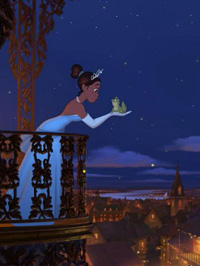
Another animated film which may very well end up in contention is “The Princess and the Frog.” The music is being handled by Randy Newman, clearly beloved by the music branch. I remain skeptical of how this film will be received and, in any event, think that Best Original Song may be the more likely spot to consider for this film. However, Newman’s name means a lot and there are few other favorites in the running this year.
 I haven’t seen James Mottern’s “Trucker,” which had a world premiere at the Tribeca Film Festival and was praised in many quarters, most agreeing that Michelle Monaghan’s lead performance was awards caliber.
 Sets and props can create a time period, an era or simply the feel of a scene. And the individuals involved in this process are awarded by the Academy in the category of Best Art Direction.
 Best Achievement in Film Editing. It’s a difficult phrase to define. To a large extent, excellence in film editing can be editing which blends into the film, allowing the director’s vision, screenwriter’s story and actors’ performances to shine without interference. But equally, a film that stands out as a showcase for flashy but motivated construction deserves recognition as well.

 Another month, another step closer to the awards season. As the summer winds down and the industry slowly begins to square itself with the off-season’s
 Movie stars are often given much attention for the fashion that they sport off-screen. Seldom does the on-screen attire garner as much publicity.
 LIGHTS…CAMERA…you were probably waiting for the word “action,” no? Action is, after all, what many individuals go to a film to see. But the “lights” and the “camera” in this classic phrase bring a film beyond a book or a radio show…and capture the “action.”
 Only the greenest of awards-watchers needs reminding of the following statistic: a mere three women have been nominated for Best Director in the 81-year history of the Academy Awards. It’s long been an embarrassing state of affairs — never more so than in the late 80s and early 90s, when in three out of six consecutive years, the Best Picture nominee denied a directing nod happened to be made by a woman.
 Ahh. The dust is settling. And on the horizon, just visible through the mist and waiting to drive us all up the wall once again: the 2009 Oscar season.