This faux “Thundercats” trailer landed in my inbox early this morning, but I’ve been tied up with a last minute rush of Christmas shopping. You’ve probably seen it in multiple outlets by now, but how many fi,ms can you name in the mix?
Category: Daily
-
‘Slumdog’ dominates the critics awards circuit
 It looks like the critics groups are slowly winding down this season, the annual influx finally settling in for a post-glut nap. I believe the only organizations left to announce are the Kansas City, Vancouver and Central Ohio crowds, as well as the National Society of Film Critics, all of whom should reveal their winners in the new year.
With that in mind, I’ve gone ahead and compiled a list of links to the various groups to announce so far and their lists of winners and/or nominees. In some cases, there are still only nominees (like the BFCA and HFPA), with awards shows still to come. But for the most part, I think we’ve got a clear consensus winner from the critics this season: Danny Boyle’s “Slumdog Millionaire,” with a striking 10 wins to its credit so far. I think it’s safe to say the London critics will hand the film their Best British Film of the Year award, bringing the tally to 11, and frankly, I feel like it’s signed, sealed and delivered from the BFCA. So if we feel safe assuming, we’re talking 12 big wins all told before the final four groups chime in at the top of 2009.
Of course, it’s not the consensus we had last year or in 2005, but it’s a pretty clear indication that the year’s critical champ is Boyle’s explosive and dynamic endeavor. Does this put it on a course for an Oscar? Maybe. But we still have a long way to go.
So far there are seven films with the designation “best of the year,” some in the way of ties. Those films are “Slumdog,” of course, then “The Dark Knight” (3), “Milk” (3), “WALL-E” (3), “The Curious Case of Benjamin Button” (2), “Frost/Nixon” (1), “Happy-Go-Lucky” (1) and “Wendy and Lucy” (1). Nothing so far for Best Picture hopefuls “Doubt” or “Revolutionary Road.”
I’ll revisit this post in a few weeks with the grand total. But for now, the critics awards so far, with links to our own coverage where applicable:
African American Film Critics Association — “The Dark Knight”
Alliance of Women Film Journalists — “Slumdog Millionaire”
Austin Film Critics Association — “The Dark Knight”
Boston Society of Film Critics (IC coverage) — “Slumdog Millionaire,” “WALL-E”
Broadcast Film Critics Association (IC coverage) — winners announced Jan. 8
Chicago Film Critics Association (nominees, winners) — “WALL-E”
Dallas-Fort Worth Film Critics Association — “Slumdog Millionaire”
Detroit Film Critics Society (IC coverage: nominees, winners) — “Slumdog Millionaire”
Florida Film Critics Circle — “Slumdog Millionaire”
Houston Film Critics Society — “The Curious Case of Benjamin Button”
Hollywood Foreign Press Association (IC coverage) — winners announced Jan. 11
International Press Academy (IC coverage: nominees, winners) — “Slumdog Millionaire,” “Happy-Go-Lucky”
Las Vegas Film Critics Society — “Frost/Nixon”
London Film Critics Circle (IC coverage) — winners announced Feb. 4
Los Angeles Film Critics Association (IC coverage) — “WALL-E”
New York Film Critics Circle (IC coverage) — “Milk”
New York Film Critics Online — “Slumdog Millionaire”
Phoenix Film Critics Society — “Slumdog Millionaire”
San Diego Film Critics Society (IC coverage) — “Slumdog Millionaire”
San Francisco Film Critics Circle (IC coverage) — “Milk”
Southeastern Film Critics Association — “Milk”
St. Louis Gateway Film Critics Association — “The Curious Case of Benjamin Button”
Toronto Film Critics Association (IC coverage) — “Wendy and Lucy”
Utah Film Critics Association — “The Dark Knight”
Washington, D.C. Area Film Critics Association — “Slumdog Millionaire” -
Dickens for today… ‘Slumdog’ meets the zeitgeist
 New York Times op-ed columnist Frank Rich has turned his focus toward Danny Boyle’s “Slumdog Millionaire” in a recent column detailing capitalistic corruption in America today and the hopelessness it breeds. This is the kind of thing Best Picture winners tap into, folks
Here are the opening graphs and the closer::
During the Great Depression, American moviegoers seeking escape could ogle platoons of glamorous chorus girls in “Gold Diggers of 1933.” Our feel-good movie of the year is “Slumdog Millionaire,” a Dickensian tale in which we root for an impoverished orphan from Mumbai’s slums to hit the jackpot on the Indian edition of “Who Wants to Be a Millionaire.”
It’s a virtuoso feast of filmmaking by Danny Boyle, but it’s also the perfect fairy tale for our hard times. The hero labors as a serf in the toilet of globalization: one of those mammoth call centers Westerners reach when ringing an 800 number to, say, check on credit card debt. When he gets his unlikely crack at instant wealth, the whole system is stacked against him, including the corrupt back office of a slick game show too good to be true.
We cheer the young man on screen even if we’ve lost the hope to root for ourselves. The vicarious victory of a third world protagonist must be this year’s stocking stuffer. The trouble with “Slumdog Millionaire” is that it, like all classic movie fables, comes to an end — as it happens, with an elaborately choreographed Bollywood musical number redolent of “Gold Diggers of 1933.” Then we are delivered back to the inescapable and chilling reality outside the theater’s doors…
We’ll keep believing, not without reason, that the whole game is as corrupt as the game show in “Slumdog Millionaire” — only without the Hollywood/Bollywood ending. We’ll keep wondering how so many at the top keep avoiding responsibility and reaping taxpayers’ billions while relief for those at the bottom remains as elusive as straight answers from those Mumbai call centers fielding American debtors.
Check out the rest here.
-
Just because I don’t get it, doesn’t mean it’s not good
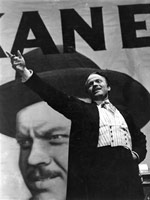 Kris is taking some heat in some quarters for his comments on “WALL-E,” and while he has never said it was a bad film, he didn’t fall over himself seeking superlatives for it either. In fact, the movie did not do much for Kris, which is an unpopular sentiment, given the critics awards and rave reviews for the film.
Why is this not okay with some people? Similarly, why is not okay to say that one does not feel “Citizen Kane” is the greatest film of all time? I don’t think it is and you have no idea the heat I take for that. Kris made a bold decision, one he believed in, one he felt was right, one that was honest.
When will people realize that at the end of the day we are all critics with an opinion, but some of us are fortunate enough to do it for a living? Does that set us apart? Not really.
Watching a film is connected to the oldest of rituals, similar to the ancient Greeks filing in to see a play and watching with rapt attention the players on stage. They then left the play and discussed it, just as we do today with cinema. Maybe we like the film, maybe we don’t…it is all opinion-based and at the end of the day, no one is really wrong.
-
12/22 Oscarweb Round-up
 • The “Seven Pounds” dogpile continues. [/Film]
• Ditto Baz Luhrmann and “Australia.” [Hollywood Elsewhere]
• Regarding Luhrmann, Peter Bart warns the director away from F. Scott Fitzgerald’s “The Great Gasby.” [Peter Bart]
• David Gritten talks to Danny Boyle and Simon Beaufoy about critics’ favorite “Slumdog Millionaire.” [Daily Telegraph]
• Donna Freydkin spends some time with Marisa Tomei, makes this site’s editor insanely jealous. [USA Today]
• Reed Tucker looks into Brad Pitt’s love affair…with David Fincher. [New York Post]
• Mark Olsen spends some time with the Laurent Cantet regarding French Oscar entrant “The Class.” [Los Angeles Times]
• On the “disturbing tendency” to portray Nazis in a sympathetic light on the big screen as of late. [The Times]
-
“Agonized and beautiful”
At the risk of sounding stoned on hope, I offer the following heresy: The movies are fine. Sometimes they’re great; occasionally they’re magnificent.
The twelfth-graph opener in Manohla Dargis’s recent year-end wrap-up. The sentiment would be a nice reference to Charlie Kaufman’s “Synecdoche, New York,” which Dargis calls “a grievously underloved film about life and death and every agonized and beautiful thing in between.” Curiously, she’s the only critic in the New York Times triumverate who found a place for the film on her list.
-
Coulda been a countenda
It’s on AMC, so I figured I’d go hunting down that original teaser for Michael Bay’s “Pearl Harbor,” featuring excerpts from Hans Zimmer’s “The Thin Red Line” score. Remember when this was one of the coolest trailers ever? Then the movie…dear lord, the movie. I should really change the channel. Anyway…
-
Robot dissension

[T]he film actually makes some pretty problematic political arguments…the point of discussion and debate is not all adulation and praise: there are real ethical talks worth having over this film, and if there wasn’t room for any dissenting opinions, I would say it failed. So, no kids gloves: it can play with the big kids, so let it.
The whole conceit of Wall-E’s second half is fat-bashing at its most pernicious and damaging. The robots are terrific, the Axiom is despicable. This is not a film I would want to see nominated for Best Picture. Just compare it to Milk, which unmasks prejudice rather than encouraging it.
Apathy is constructed here as a refusal to cultivate the body properly. And there is an ethical imperative in any suggestion of what is and is not a proper use of the body. My concern is: what does this insistence that the body can and thus ought to be beaten into shape, and that everyone really ought to do real physical work rather than just floating around, say to people who cannot beat their bodies into shape and cannot do normal work?
A trio of smart, against-the-grain “WALL-E” reactions from Awards Daily posters in the face of blind and offensive support for the film from commenters who have little to offer beyond quips like “you are too stupid to live” and “[I]t seriously pisses me off when I’m walking through a hallway, or down an escalator and I can’t get through because of a fat piece of shit.” (To be fair, there are some level-headed counter assessments, but they get drowned out, sadly, by this vitriol.)
-
Mick Foley has a nice day with ‘The Wrestler’
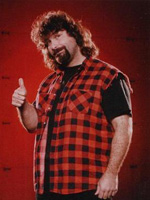 I think there are few who would disagree that the audience to sell for Darren Aronofsky’s “The Wrestler” was a guy like Mick Foley — a.k.a. “Mankind,” “Dude Love,” and “Cactus Jack” — a cross-federation staple of the professional wrestling world who’s lived through his fair share of ladder matches, barbed-wire-inflicted line-of-duty injuries and, certainly, knows the difficulties of raising a family in tandem with such a dangerous career.
It looks like Aronofsky and company had him at “hello.” Writing recently in Slate, Foley had the following say in the way of praise for the film:
The chances of seeing a great pro-wrestling movie seemed right up there with the likelihood of a Mickey Rourke career renaissance. You can see why I was pessimistic about Darren Aronofsky’s wrestling project. I received an inquiry early on about serving as a consultant but cited the need to “spend time with my family” as a reason to refrain. If I felt like having my name attached to a failure, I figured, I’d write another novel. Casting Rourke in the lead seemed like a mistake. Sure, he had been in some good films a few election cycles ago, and I’ll admit to stealing his popcorn-box trick from Diner back in ’82. But he seemed unlikely to deliver the portrait of a wrestler I wanted…
I was hooked within a minute. Within five, I had completely forgotten I was looking at Mickey Rourke. That guy on the screen simply was Randy “the Ram” Robinson, a ’80s mat icon on a two-decade-long losing streak in the game of life, searching for a way, any way, to fan the dying embers of his career…
I found great authenticity in so many aspects of Randy’s battered psyche. His constant need for acceptance—from his estranged daughter; from his possible love interest, a stripper played by Marisa Tomei (who is wonderful, if a bit shocking for any guy who ever had a crush on her in My Cousin Vinny); from a random collection of customers at the deli counter where he works; from his dwindling number of nostalgic wrestling fans—is a theme that many a wrestler will grudgingly admit to connecting with.
It’s a hell of a read. Check out the rest here.
-
Jeff Goldblum is drunk
Well, not really. It’s just a slowed-down Mac commercial, but it cracked me up. And apparently there’s more. Check it out:
(Courtesy: Cinematical)
-
12/21 Oscarweb Round-up
 • Jeff Wells is still peeved at the critical snubs of “Revolutionary Road,” aside from a few exceptions. [Hollywood Elsewhere]
• Tom O’Neil and Michael Musto debate the likely Best Picture victor. [Gold Derby]
• Another un-bylined Calendar piece. What gives? Anyway, David Fincher is talking to somebody about “The Curious case of Benjamin Button.” [Los Angeles Times]
• Alonso Duralde spotlights the year’s best, sans Oscar bait. [MSNBC]
• John Hiscock chats with “Rachel Getting Married” star Debra Winger. Anyone wondering, half-way through the season, why anyone was crazy enough to think she had an Oscar play? [Daily Telegraph]
• Jenni Miller digs into the role of a stripper with critical kudos champ Marisa Tomei. [Premiere]
• Bryan Appleyard talks “The Reader” with director Stephen Daldry. [The Times]
• “Let the Right One In” tops David Ansen’s list of the year’s best. Nice. Beware a cop-out tie at #10, though. [Newsweek]
-
So…
…are the actress categories leaving anyone else for a loss? Six to seven contenders with clear shots at a nod in each field. Flip a coin.
-
Clint Eastwood’s potential Best Actor win
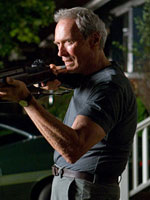 It could happen…but it shouldn’t.
My admiration and love of Clint Eastwood’s work as a director was enough to send me on an 18-month research and writing spree, piecing together a study of the man that should be in bookstores in a week’s time. In the forward, I make clear that had anyone suggested to me in the 1970s that Eastwood would one day be an Oscar-winning director and producer, one of the best directors working in modern cinema, and a two-time Best Actor nominee, I would have laughed, long and loudly in their face. Certainly there could be no question about his star power…he had that. But he was hardly a great actor.
Earlier this year his film “Changeling” was released to strong reviews, but doesn’t seem poised to do much for him come Oscar time (a shame). But there is talk of a Best Actor nomination for his performance as crusty, cranky, tough-as-nails Walt Kowalski in “Gran Torino.”
Actors have won Oscars masquerading as a career achievement in the past. Hell Al Pacino must know as do we that “Scent of a Woman” is not his best work, yet he won the Oscar for it. Henry Fonda won for “On Golden Pond,” though he should have won years before for “The Grapes of Wrath,” while James Stewart took home the gold for “The Philadelphia Story,” one of his lightest performances.
Guy put together a smart list of similar AMPAS atrocities a few weeks ago, so I won’t go into them here. Suffice it to say, the “career achievement” Oscar is a staple of a dubious Academy year in and year out.
-
Nice to be wrong: actresses who changed my mind
 Having been a film critic for more than a quarter of a century now (my God) and a film junkie for more than 40 years, I have never gotten over the joy of surprise when an actor or actress comes out of left field with a performance of such brilliance it eliminates every single bad performance or bad film they have ever been associated with.
As a critic and a journalist, I tend to call it as I see it, sometimes to a fault. I remember a stunned Al Pacino looking at me flabbergasted when I asked why the devil an all powerful evil being would have to shout so much as he did in “The Devil’s Advocate.” He eyed me up and down for a few uncomfortable seconds before answering, beginning with, “So your one of the honest guys.”
And there have been those delicious moments when I have been forced to eat my words. And you you know what? I love it. I love seeing an actor I had written off or dissed deliver a breathtaking portrayal to the point that I can scarcely believe what I’ve seen.
It happened this year for me with Kristen Scott Thomas in “I’ve Loved You So Long,” a stunning piece of acting from a thesp I had previously loathed. I remember being at press screening for “The English Patient” in the fall of 1996, after barely enduring the film. Thomas was ice cold, leaving me to wonder who could love this woman, and worse, why would they? Nothing else she has done since impressed me much until now, and frankly, her performance left me in awe.
There have been others, of course. Sally Field had been written off as “The Flying Nun” and Burt Reynolds’s latest squeeze in those goofy “Smokey and the Bandit” films in the late 1970s. She gave a remarkable performance on TV in “Sybil” as a woman with multiple personalities, but nothing prepared me for her superb performance in Martin Ritt’s beautiful little film “Norma Rae,” about a woman recognizing her potential amid textile union politics. Field was astounding, winning every major acting award there was, including the Oscar. The performance remains one of the finest ever captured on film.
-
Catching up with ‘Milk’ in the Bible belt
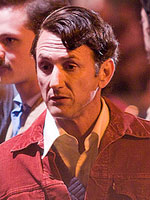 In 1977 Harvey Milk was elected to position as city supervisor in San Francisco. Milk, an openly gay man, was the first of his kind. Rather than concealing his sexual orientation, he wore it proudly, and used his influence in a largely gay section of San Francisco to do good. He became an effective advocate for gay rights across the United States until his assassination, in 1978, by Dan White. Mr. Milk and Mr. White are the subjects of the terrific new film, “Milk,” directed by Gus Van Sant.
The substantially gifted actor Sean Penn plays the lead role, and he is supported by Josh Brolin, Emile Hirsch, Diego Luna and James Franco. The film has generated a fair amount of awards buzz, and it should. It’s one of the best of the year.
In November, interestingly, the citizens of the state of California went to the polls to vote on Proposition 8, a measure that would abolish the recognition of same-sex marriage in the Golden State. In my home state of Arkansas, voters were asked to determine whether same-sex couples could adopt children or serve as foster parents. In both instances, supporters of gay rights lost.
If you have seen “Milk” or the exceptional documentary “The Times of Harvey Milk” by Rob Epstein, you know that Milk worked tirelessly to defeat Proposition 6 in 1978, just before his death. Prop. 6 was an effort to prohibit gay people from serving as public school teachers. As I watched “Milk,” after the November elections, I couldn’t help but see the parallels. Both struck at the very foundation of individual liberty.
Writing for The Huffington Post last month, Mr. Epstein observed, “Although Proposition 8 wasn’t exactly a re-make of Proposition 6, it’s the same disaster movie storyline pitch: any recognition of constitutional rights for gay and lesbian citizens will somehow destroy the natural order and as a result America’s institutions — be they schools or marriage — will crumble.”
“Milk” is on course for a Best Picture nomination at the Academy Awards early next year. It was selected as the best film by the New York Film Critics Circle and yesterday received a best ensemble nomination from the Screen Actors Guild. And no seems to be surprised by it. 2008 has been a bad one for people in same sex relationships, or who support gay rights. Still, it’s plausible that in the same state that recently approved Prop. 8 by generous margins, a film directed by an openly gay man, about a gay man, his gay friends and gay rights in California could win Best Picture. Wouldn’t that be something?
-
12/20 Oscarweb Round-up
 • Darren Aronofsky interviews Danny Boyle about the technical aspects of “Slumdog Millioniare.” [/Film]
• Erik Childress catches up with the season mid-way through the first phase. [eFilmCritic]
• David Carr takes note of the big Universal trade spend. Hey, if you’re going to decide against advertising with the lowly online types, you might as well make it count in traditional media. [The Carpetbagger]
• Tom O’Neil gets together a bunch of us Oscar bozos to talk the Best Picture chances of “WALL-E.” [Gold Derby]
• The film, meanwhile, tops Anne Thompson’s diverse list of the year’s best. Oy. [Thompson on Hollywood]
• Patrick Goldstein gives a few column inches to an under-the-radar documentary short, Leslie Iwerks’s “Downstream.” [The Big Picture]
• The hull is breached!! By the way, that’s Barry Dale JOHNSON. Fact checker needed on aisle three. [Washington Post]
• Noah Forrest podcasts it up with “Gomorrah” helmer Matteo Garrone. [Movie City News]
• Donna Freydkin catches up with increasingly Oscar-likely Amy Adams. [USA Today]
• Somehow this escaped me all week, but rest in peace Sam Bottoms. [Los Angeles Times]
• Brent Simon spends a little quality time with “Nothing But the Truth” star Kate Beckinsale. [Vulture]