In Contention

Category: Daily

  • The angel says…

    Here is a movie from a director who had gotten typed into being a success only in x-treme cinema, set in another country, often in another language, with three sets of young, inexperienced actors playing the same kids from single-digits to 20-ish, delving into the internationalism of both human aspiration and the medium of television (which might as well be movies), unafraid to deliver some of the harshest moments in mainstream cinema this year, yet emotionally kind and compelling to its core… all of this, made for a studio Dependent that has been put out of business, sold off, in part, by the parent studio to another studio’s Dependent that passed on its first opportunity to make it, sold brilliantly, surrounded by talent that is both charming and unusually generous and kind of spirit, and now in line to win The Oscar and all that comes with that honor.

    From David Poland’s recent “20 Weeks to Oscar” column at Movie City News.  Of course, he later chalks “Ordinary People” up as superior to a modern masterwork like “Revolutionary Road,” but you take what you can get (while wondering why the comparison was made int he first place).
  • No “embarrassing interruptions of impassioned speeches”

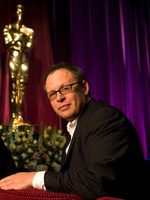
    Bill CondonThat’s the line that grabbed me in this Susan Wloszczyna feature on Oscar producers Bill Condon and Laurence Mark.  If there’s anything that drives me up the wall, it’s the musical interjection of a speech, no matter how rambling.  This is a person’s moment and ignorant, cue-happy conductors (and presumably the producers chattering into their ears) have to crank up the orchestra to send them on their way.  Meanwhile, the Academy offers up the most rank stretch of montages (however pointless) and any other number of dubious production choices.

    We’re all pretty well assured that kind of hogwash isn’t going to fly this year, but it’s nice to see Condon and Mark taking a stand for the speech thing.  Then again, he pulls his punch later in the story, so who knows?

    Here’s a bit from the piece:

    When it comes to entertaining the masses, it doesn’t really matter what is on the ballot, Mark insists. His and Condon’s primary objective is “to celebrate all the movies of 2008.” Blockbusters, sleepers, art-house fare, you name it. Attention will be paid to movie history, too, “but no clips of Gone With the Wind.”

    In other words, these fellows aren’t losing sleep over how the voters went for the low-profile Holocaust-themed drama The Reader over superhero sensation The Dark Knight in the top contest.

    “We have enough great material to attract a crowd,” Condon says. “It’s the academy’s job to honor the best movies, not what will provide the highest ratings. We both feel they show great integrity in what they do.”

    Even though I choked on Condon’s — let’s say — diplomatic quote at the end there.

    The rest is the same old, same old you’ve read on the dup elsewhere, though I remain excited by nuggets like this:

    (more…)

  • POLL: Who deserves it? — BEST SOUND MIXING

    I’ll be doubling up on these to make sure we get them all in, so be sure to vote quickly!

  • 1/30 Oscarweb Round-up

    Ahney Her• Good riddance. [Crain’s New York]

    • Bob Thompson talks to “Gran Torino” star Ahney Her. [National Post]

    • Pete Hammond digs into the hounding of “Slumdog.” [Notes on a Season]

    • Amy Adams makes a splash across the pond. [The Independent]

    • Jeff Wells is suspicious of the “Milk” come-from-behind talk. [Hollywood Elsewhere]

    • David Poland is suspicious about something…not really sure what. [The Hot Blog]

    • Helen Pidd spends some quality time with Penelope Cruz.  Envy her. [The Guardian]

  • The Bagger finds the meaning

    There are few journalists with as sharp an understanding of the tunnel vision that affects award-season coverage as David Carr.  So it’s with a guard of irony that, in yesterday’s ruminative NYT piece, he describes this year’s race as “somehow less frivolous than it has (been) in recent years.”

    While he acknowledges the comparative slightness of the Oscars against such events as Obama’s inauguration and the global financial crisis, he feels that the awards, and more particularly, the films being awarded, have a clearer collective sense of purpose — and resonance — this year:

    Consumers who are motivated by the laurels heaped on these films to plunk down increasingly scarce disposable income will leave the movie house with the message that circumstance is just that, and no match for the indomitability of human will. The films are built on individual successes — kids from the slums who better themselves, a television celebrity who finds his inner newsman, a newborn who overcomes old age and the midlife closeted man who steps into the light — that accrue to the greater good. That message, that darkness can be overcome by individuals working for the common good, is not so distant from the current collective impulse.

    I think it’s an intelligent point, but a flawed one. Carr may refer to this year’s nominees as “the filmed stories that have captured the public’s attention,” but the fact is that, in at least two cases, they haven’t. Carr already marks “The Reader,” the gloomiest and lowest-grossing of the Best Picture nominees, as an exception to his argument, but “Frost/Nixon” hasn’t fared much better commercially. In his recent chat with Charlie Rose, David Denby astutely pointed out that Ron Howard’s film rather overstates the relevance of an event that amounts to little more than an interesting historical footnote — and its $12 million gross so far suggests the public agrees.

    (more…)

  • SANTA BARBARA: Clint Eastwood hailed as a Modern Master

    Clint EastwoodSo Clint Eastwood arrived in town tonight without all the pizazz you might have expected, as I reported from this evening’s Arlington Theatre event.  But inside the place was bananas.  Every single seat in the theater was filled, many of the locals vocalizing their shock on the way down the aisles.  “I’ve never seen it this packed before,” many of them said as they found a place to settle in and behold the career the festival was honoring.

    Moderator Leonard Maltin seemed to bite off a little bit more than he could chew.  Seriously, an hour and a half in and we were just getting to 1971.  I figured the 1980s would be a blur and indeed they were — Who wants to remember “Heartbreak Ridge” and “Firefox?” — but I would have liked some discussion on “Bird,” maybe, or “Pale Rider.”  But Maltin warned at the top that if he didn’t get to your favorite film, please understand.  We’re talking about six decades here.

    Early in the discussion Maltin spent a lot of time picking Eastwood’s brain on his early career — a contract player at Universal, roaming around the lot soaking up what information he could, getting the gig on television’s “Rawhide” and, of course, Sergio Leone’s spaghetti Westerns that didn’t find release in the states until rights were cleared up regarding Akira Kurosawa’s “Yojimbo.”  On the whole it was one of those kiss, kiss sessions, but the crowd was pumped.

    Every film that might be mentioned briefly in passing seemed to find this pocket of applause or that.  The “Dirty Harry” stuff was an obvious favorite (of course we were treated to the infamous “I gots ta know” sequence), but “Gran Torino” really brought the house down, especially the old guy vs. the homies scene that might have been Eastwood’s Oscar clip had the performance been nominated a week ago.

    (more…)

  • Reasons Clint Eastwood is cool, #246

    He drives himself to his own tribute, eschews the big to do of a red carpet arrival, hops the metal barricade and slides into the fray minutes before anyone notices. Classic Eastwood.

  • What, no one wants to circulate this story, too?

    Slumdog MillionaireEveryone was so quick to pounce on the “Slumdog Millionaire” smear pieces of the week, yet this Sandy Cohen AP piece as been sitting there, waiting for similar obsessive circulation for 31 whole minutes.
    Here’s a taste:

    The makers of “Slumdog Millionaire” have done more for the film’s child stars than their parents ever could, the father of one young actress said.

    Rafiq Qureshi, whose 7-year-old daughter, Rubina, appears in the film, said that the filmmakers enrolled his daughter in school and “are taking complete care of my child.”

    “Whatever a parent could have done, they have done much more than that,” he said during an interview with AP Television in Mumbai, India on Wednesday.

    The rest here. Let’s move on, shall we? Whoever did the whispering, it was a valiant effort.

  • Is ‘Slumdog’ score too pop?

    Thanks to Nat Rogers at The Film Experience for pointing out a really worthwhile article in the Wall Street Journal, in which music critic Jim Fusilli takes a close look at this year’s nominees for Best Original Score. It’s not a category which tends to inspire much intelligent coverage in mainstream outlets, so it’s great to see someone giving the race the attention it deserves.

    Fusilli starts by commending the Academy for dodging the iffy qualification issues that have plagued previous races — principally the weirdly flexible criteria that allowed “Babel” in, but not “There Will Be Blood” — though I would still venture that “The Dark Knight”‘s initial disqualification scuppered its chances in the category. In any case, this year’s five nominated scores are all clearly original works, and Fusilli is generally impressed by the calibre of the competition. He is, however, not entirely convinced by frontrunner A.R. Rahman’s work on “Slumdog Millionaire”:

    This year, voters will have to decide whether to recognize music that’s most memorable as catchy pop or symphonic music that illuminates story and character. Mr. Rahman’s ebullient work for “Slumdog Millionaire,” a film about a poor boy who may win a fortune on a game show, is likely the early favorite — last week, I stopped in a theater in Boston to see it again and members of the audience cheered when his name appeared in the end credits. That may not be what a film-score composer is looking for. As Mr. Elfman told me last week, “If I’m going for any reaction, the best I could possibly hope for is that they see my name and go, ‘Oh really?’ Writing a score that gets people to jump out of the chairs is a whole other ballgame.”

    (more…)

  • Brit critics follow the script

    It seems we really have reached consensus here. The Richard Attenborough Film Awards, a relatively new set of awards voted on by regional UK critics, haved chimed in with nearly everyone else, handing their Film of the Year and Director of the Year honours to Danny Boyle’s “Slumdog Millionaire.”

    They stuck with the well-awarded in the acting categories too, crowning Mickey Rourke and Kate Winslet (for “The Reader”) as Actor and Actress of the Year, respectively, while Dev Patel took the Breakthrough Star award.

    Meanwhile, I’m pleased to see Screenwriter of the Year went to Martin McDonagh for “In Bruges.” That might have been a less expected choice a month ago, before the nearly year-old release achieved a remarkable awards-season turnaround in the last few weeks.

    Four People’s Choice awards were spread between “The Dark Knight,” “Mamma Mia!” and “Slumdog,” completing a very British-leaning set of winners — hardly surprising, given that last year, the Attenboroughs were all about “Atonement.” I expect the BAFTA winners list will look somewhat similar.

    List of winners after the cut.

    (more…)

  • 1/29 Oscarweb Round-up

    Joaquin Phoenix• Looks like Mickey Rourke isn’t going to get into the ring after all. [Associated Press]

    • Perhaps in response to snarky items like this? [Vulture]

    • Kim Voynar deconstructs the Oscar nominations a week later. [Movie City News]

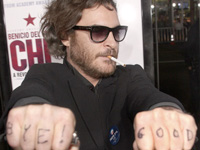
    • In case it wasn’t obvious from the start, Joaquin Phoenix has been punkin’ y’all. [Entertainment Weekly]

    • Anne Thompson wonders if “Milk” is coming up on the outside.  I’ve heard some people here in Santa Barbara call it the #2 film in the mix, which it certainly might be.  Very interesting… [Thompson on Hollywood]

    • An opportune time for a story like this.  (If we really, REALLY want to get all conspiracy theorist about it, The Times is the Telegraph’s conservative competition.  And who owns The Times?) [Daily Telegraph]

    • Rather than post the emailed producers’ statement myself, I’ll just point you to Sasha Stone’s post with the full release. [Awards Daily]

    • Following that awesome Newsweek actors round table, Patrick Goldstein worships at the altar of Frank Langella (who, I just discovered today, is friggin’ 71 — now THAT’s aging well). [The Big Pucture]

  • SANTA BARBARA: Virtuosos on the march

    Richard JenkinsUnfortunately, “Happy-Go-Lucky” star couldn’t make it to tonight’s presentation of the Virtuoso Awards at the Lobero Theatre due to surgery recovery, but Viola Davis, Richard Jenkins, Rosemarie DeWitt, Melissa Leo and Michael Shannon were on hand to talk their roles in five of the most critically acclaimed films of the year.  James Cromwell did the honor of presentation.

    It’s a shame DeWitt was the only one on stage lacking (criminally) an Oscar nomination, but moderator Roger Durling kept the conversation away from awards as much as he could.

    A considerably amount of the discussion was spent on the nature of these actors’ careers, floating between the big screen, television and theater with a particular ease.  Many of the Virtuosos swept the comment aside with the usual “we go where the work takes us” rhetoric, which is fine, but Davis made a compelling comment regarding the state of the profession.

    “When you think about actors, you think about Brad Pitt, Angelina Jolie,” she said.  “But most of them look just like us here on stage.”  The indication, of course, is the middle class actor and how often he or she isn’t given the proper credit, be it on television, on stage or, certainly, on the screen.

    “Please, go to New York,” DeWitt said.  “See a play.  Some of the greatest actors in the world are working on stage,” but their names aren’t well-known.  It’s an interesting topic with the SAG dispute of late, which finds middle class actors at the forefront of a fight for credit.  Durling, of course, didn’t pursue that line of questioning.

    (more…)

  • ‘Two Lovers’

    This US trailer for James Gray’s wispy throwback romance has been knocking around for a little while, but it only came to my attention now. It’s a minor-key work that admittedly isn’t flattered by the rather prosaic trailer, though it’s been lauded (like all Gray’s films) in France, and I was rather charmed by it at the London Film Festival back in October.

    Whether this really will be the last we see of Phoenix on screen is still open to question, but it’s a vivid, award-level turn that galvanises the otherwise slight enterprise; Gwyneth Paltrow, meanwhile, contributes her most engaging work in a decade. Look out for it.

  • Class act

    Jeff Wells has captured some of last night’s Kristin Scott Thomas Q&A at the Santa Barbara festival, and it’s well worth a look — as I found when I interviewed her back in December, she’s immensely forthright, considered and witty in her discussion of her craft. Truly one of the best in the game.

    Wells also offers some tidbits from an informal chat he enjoyed with Scott Thomas afterwards, the most intriguing of which is that “plans are afoot to shoot a film version of ‘The Seagull’ with the same Broadway cast.”

    If you caught the Royal Court revival of Chekhov’s play in either of its London or New York incarnations, chances are you’re as excited by that news as I am. If you didn’t, you should be excited anyway.

    Scott Thomas’ interpretation of Arkadina was possibly the greatest stage performance I have ever seen, and the prospect of it being immortalised on film, with the likes of Carey Mulligan (who killed as Nina in the same production) and Peter Sarsgaard strutting their stuff too, is tantalising indeed. (The production I saw had Chiwetel Ejiofor in place of Sarsgaard — hardly a bad tradeoff.)

    If it gets done, and done right, on screen, Scott Thomas could just nab the second Oscar nomination that so unfairly eluded her this year for her staggering work in “I’ve Loved You So Long.” Here’s hoping. Check out the interview here.

  • The Bagger gets it

    As if we needed any more reasons to love David Carr, he has come out in full support of Matteo Garrone’s superb “Gomorrah,” citing its Oscar snub as “criminal”:

    (The Bagger) can’t get the movie out of his mind. There is a kind of moral certainty to the film – deeply corrupt, remarkably brutal – that makes everything make sense within the four corners of the movie. It’s full of likable, familiar types, but they just happen to have the habit of blowing people’s brains out. What does it say about culture when primordial evil expresses itself in a kid who might live right down the block?

    Indeed. The Academy may believe that this masterpiece doesn’t ‘deliver’ as effectively as, say, the thoroughly average “The Baader Meinhof Complex,” but he (and we) ain’t fooled. The film opens Stateside next month; don’t let the lack of a puny Oscar nod stop you from seeing it.

  • Did Harvey Weinstein cost Kate the Oscar?

    Harvey WeinsteinFor all his marketing and campaigning genius, Harvey Weinstein’s tactics have become — well, have been — a bit thuggish. In Peter Biskind’s extraordinary book “Down and Dirty Pictures,” a stunning look at the independent film world in the late 1980s and all through the 1990s, we are made privy to many of Harvey’s tantrums, eyewitness accounts of his bullying behavior, and crazy belief that because he is rich, he can do whatever he wants.  He can always buy his way out.

    Is there anyone left out there who truly believes that “Shakespeare in Love,” a lovely film, was actually better than “Saving Private Ryan?” Somehow Weinstein convinced the Academy it was, so the best directed, best edited, best shot and best sounding film, lost to a beautifully written work that will be forgotten in time, if it has not been forgotten already.

    Weinstein is a genius at getting his films Academy Award nominations, and some have said he will promise the artists as much when he buys the film or agrees to finance the work. He took Billy Bob Thornton from relative obscurity to an Oscar win for writing “Sling Blade.”  Who did Thornton defeat that year?  No less than the great Arthur Miller for “The Crucible!”

    I had hoped that when Disney dismissed Weinstein and brother Bob from Miramax (a company they founded) that perhaps he had learned something. It seems The Weinstein Company will continue the legacy of Miramax during the Oscar season, however.

    (more…)

  • “Alan Parker had a boner…”

    Sorry — just now getting this up on the site.  Brilliant stuff:

    More here.

  • Elevating Ebert

    Roger Ebert has yet to weigh in with his formal Oscar predictions, but for now, he’s trying something a little different — selecting winners purely on the basis of “elevation,” which is to say the nominees that have had the most profound emotional impact on him. (He offers an in-depth explanation of this rationale here.)

    He has run through three categories so far, and using his criteria, I am hard-pressed to disagree with any of them. Melissa Leo — whose performance is, I think, in a different league to those of her fellow nominees — is Ebert’s personal favourite in the Best Actress category; he aptly describes her work as “close to the bone, closer to the soul.”

    Meanwhile, he celebrates “Milk” in the Best Picture category, with Gus Van Sant skilful use of existing footage of the candlelit Castro Street parade in Harvey Milk’s honour the clear emotional tipping point for him. I must concur here, even if “Milk” as a whole isn’t my favourite of the nominees. (I can’t say I was as moved by “Slumdog Millionaire” as I was grandly entertained.)

    However, I particularly love Ebert’s verdict in the Best Actor race, as he offers a point-on appreciation of what makes Mickey Rourke’s performance such a singular achievement:

    (“The Wrestler”) is his comeback on his own terms, as a full-force, heedless, passionate physical actor, with strong undercurrents of tenderness, loneliness, and need. He did a lot of his own wrestling in the film, including a scene where he deliberately cuts himself, and he was painfully honest in the scenes with women. What you see is a man with what he knows is the role of his lifetime, and willing (I am convinced) to die for it.

    Bingo. I’ve been struggling for a while to put my finger on exactly why I am that much more affected by Rourke’s performance than I am by Sean Penn’s impeccable inhabitation of Harvey Milk, but Ebert nails it. There is so much visibly at stake in the former; it’s about as autobiographical as an ostensibly fictitious performance can be.