In Contention

Tag: Vera Farmiga

  • OSCAR TALK: Ep. 2 — ‘Up in the Air,’ disagreeing on ‘The Road’ and Toronto looms

    Oscar TalkWelcome to the second installment of Oscar Talk with yours truly and indieWIRE‘s Anne Thompson.  We tried to set aside some time in Telluride to do one of these, but time never seemed to permit.

    Anne is in Toronto this week, and, at the time of this recording (yesterday, so all “todays” and “tomorrows” should be re-purposed accordingly), was gearing up for a screening of Jon Amiel’s “Creation.”

    We tightened things up slightly this time, clocking in at just over 25 minutes.  Here are a few of the topics we discussed:

    • Which films are going to be tested by their exposure in Toronto (John’s coverage begins this weekend)?

    • The story out of Telluride, “Up in the Air,” and the awards prospects for the film across the board.

    • The dueling Best Supporting Actress hopefuls from the film, Anna Kendrick and Vera Farmiga.

    • The cool reception Jane Campion’s “Bright Star” is receiving in some quarters and how that could work against its major Oscar potential, despite exquisite craftwork.

    • By popular demand, Anne and I disagree on something: John Hillcoat’s “The Road.”

    • The “schizophrenic” marketing of the film, moving from genre/suspense to the love/warmth at its center.

    Have a listen below.  And by the way, these should be filtering in through iTunes now, so you can subscribe to the podcast here.

    [display_podcast]

  • REVIEW: “Up in the Air” (****)

    Up in the AirTelluride Film Festival

    Jason Reitman began adapting Walter Kirn’s novel “Up in the Air” five or six years ago (in the wake of an earlier draft by Sheldon Turner).  The country was on better economic turf, he wasn’t married, he didn’t have a child.  He was drawn to a book jacket with a quote from his friend, “Thank You for Smoking” author Christopher Buckley, enchanted by a lead character obsessed with collecting frequent flyer miles who lives a single-serving lifestyle from airport to airport.

    Today, unemployment rates are skyrocketing, tangible human connectivity is becoming a relic of another century, Reitman has settled down with a wife and daughter and futures all around are uncertain.  But in some ways, there is hope, a sense of turning an all important corner.  By the end of “Up in the Air,” that is just where Reitman has left his protagonist.

    Meanwhile, Kirn’s novel has been transformed from an otherwise unremarkable example of corporate comedy into a piece at once deeply personal and serendipitously relevant.  This is one of the year’s finest films.

    George Clooney stars in perhaps the role of his career (one certainly drawing parallels to his own lifestyle) as Ryan Bingham, a career transition counselor who zips from hub to hub 270 days a year.  In a nutshell, he is part of a third party firm hired out to corporations for the purposes of firing discontinued clientele.   He lives a life of isolation, a stranger to his Midwest family, who sees him rarely and kills his commitment-less buzz anytime they call with an update.

    He has airport check-in down to a science, stereotypically zeroing in on those who are quickest to follow behind at security, Moonwalking out of his shoes as he does so, his luggage immaculately packed, his system a work of streamlined art.  When he isn’t letting people go in the name of other companies, he gives motivational addresses meant to steer attendees clear of the extra baggage in their life, their commitments, extraneous relationships, anything that keeps them from living a life as he believes it is meant to be lived: in motion.

    (more…)

  • PAGE TO SCREEN: “Up in the Air” by Walter Kirn

    Cover of Up in the Air by Walter Kirn“Airworld” is novelist Walter Kirn’s term for the impermanent realm of regional American air travel, a sleek network of bland local airports and adjacent beige hotel rooms, linked by the plush grey trails of business-class flights. It forms the scattered but otherwise constant home to thousands of American corporate drones, and is the simultaneously alien and mundane setting for “Up in the Air” – soon reaching your screens courtesy of writer-director Jason Reitman and star George Clooney.

    Droll, dry and ultimately rather heartless, it’s clear that Kirn (“Thumbsucker”) positioned his novel as a kind of “Bonfire of the Vanities” for post-millennial readers, a work that diagnoses the ills of corporate America and chimes in with a wider sense of social malaise.

    The novel, however, had the misfortune of hitting the shelves shortly before the events of 9/11 forever shifted the rules of his own Airworld. By the time it appeared in paperback, not only had Kirn’s milieu rapidly dated, but few readers were keen to enter that territory, and “Up in the Air” never took off as was perhaps intended.

    Whether by accident or design, Reitman’s adaptation of the novel also comes along at a time when the material couldn’t be more touchily topical, albeit for different reasons. Its anti-hero of sorts is Ryan Bingham, a 35 year-old human resources exec and first-class Airworld citizen, whose field of expertise is “Career Transition Counseling” – in other words, someone brought in by companies to tactfully fire employees, a self-proclaimed Grim Reaper to white-collar America.

    It’s a nervy subject for a feature film in the midst of a global economic recession that is providing plenty of business for men like Bingham, if few others; but whether audiences will be any more willing to embrace this than they were Kirn’s novel remains to be seen, and will largely depend on the warmth and lightness of touch Reitman and his universally liked leading man can bring to the material.

    (more…)

  • Getting around to the BFCAs

    Kate Beckinsale in Nothing But the TruthA late night premiere and after party kept me in bed most of the morning.  It happens.  So I’m just now coming around to today’s BFCA announcement.  First, some reactions (full disclosure, I am a member of the organization).

    First and foremost, the group subtracted one category (Best Family Film) and added another (Best Action Film).  I think we all know where the latter is headed.  Speaking of which, “The Dark Knight” actually had a hell of a showing, popping up in the expected areas but also grabbing a nomination for director Christopher Nolan and composers James Newton Howard and Hans Zimmer (who find themselves back in the Oscar hunt as of yesterday).

    The group also combined the Best Young Actor and Best Young Actress categories to reflect both sexes in the same arena.  A good call, since I’m sure I’m not the only one who has felt like I was grasping at straws to list six names some years.

    The startling omission: “Revolutionary Road.”  I’m sure there are more than a few broken hearts at Paramount Vantage this morning, but chin up.  “Into the Wild” landed the most nominations with the BFCA last year and only managed two Oscar nominations.  So it all goes to show you these things aren’t set in stone.  That having been said, the BFCA is simply the best Oscar predictor around and I’m thinking it will prove itself a nice tip sheet going into January 22.

    A few quasi-surprises were in store.  I’m sure not too many people were expecting Kate Beckinsale and Vera Farmiga’s names to pop up for Rod Lurie’s “Nothing But the Truth.”  Lurie, it should be said, is a founding member of the BFCA, though in fairness, that was 15 years ago and he was in the group for two years.  He has friends in the organization, sure, but they represent a fraction of the 200-strong membership.  Regardless, I truthfully think both actresses deserve a spot at the table so it’s nice they could push their way through.

    But getting back to “Revolutionary Road,” this is an out-and-out shut-out, and that really hurts the film’s buzz potential.  It’s one thing to miss this category or that, but nothing for Leo (with six shots at it), nothing for Kate (ditto), not even a nod for Michael Shannon, who damn well deserves a mention.  I’m truthfully surprised.  I think our Best Picture line-up will be taken from the top 10 list, and like I said, it can’t be happy times for that hard-working crew.  Scott Rudin is still sitting pretty, though, as his “Doubt” popped up in a number of areas.  But “Button,” “Dark Knight,” “Frost,” “Milk,” “Slumdog” — you might as well take it to the bank.

    Oh, and one final note.  I’m actually quite happy to see Clint Eastwood’s name pop up in the composer category for “Changeling.”  I think the jazzy soundtrack is his best work as a film musician to date and, if the Academy’s music branch ever saw past their bias, would make a fine Oscar nominee.  Nice to see him show up here.

    The top 10 list, with a full list of nominations after the jump:

    Best Picture
    “Changeling”
    “The Curious Case of Benjamin Button”
    “The Dark Knight”
    “Doubt”
    “Frost/Nixon”
    “Milk”
    “The Reader”
    “Slumdog Millionaire”
    “WALL-E”
    “The Wrestler”

    (more…)

  • Hell of a thesp

    (from left) Kate Beckinsale and Vera Farmiga in Nothing But the TruthI mostly enjoyed this by-the-numbers Adam Liptak New York Times piece concerning Rod Lurie’s upcoming “Nothing But the Truth.”  I’d say this little anecdote about Vera Farmiga’s acting prowess is probably the best part of an otherwise ho-hum article, though:

    But the film’s most striking performance comes from Vera Farmiga, who plays the C.I.A. operative, here called Erica Van Doren. In one scene Van Doren, suspected of leaking her own identity, is given a lie detector test. “We brought in a real polygraphist to polygraph her,” Mr. Lurie said. “He actually connects her up to the machine and asks her, ‘Is your name Erica Van Doren?’ and so on.”

    Mr. Lurie thought that would be good for verisimilitude. But it turned out the machine had something to say about the power of Ms. Farmiga’s acting. The polygraph operator, Mr. Lurie recalled, pulled him aside afterward: “He says: ‘You’re not going to believe this. The machine says she’s telling the truth.’”

    Farmiga is solid in the film, as is, really, the entire cast, from Kate Beckinsale on down.  I also agree with Jeff Wells that the film is not getting the attention it deserves, but that’s directly attributable to a) the amount of money Yari Film Group/David has to toss at an awards campaign versus the pocket books of major studios/Goliath, and b) the late-year, November/December glut of Oscar contenders, many of which have fallen out and will continue to do so, but for the time being, are ruling the conversation.

    My thoughts, published during the film’s Toronto run, can be found here.

  • ‘Slumdog’ scores at BIFA Awards

    Thanks to bright-eyed, bushy-tailed commenter Silrone for pointing out that the winners of the British Independent Film Awards were announced while I was mired in technical problems.

    “Slumdog Millionaire” emerged as the evening’s big winner, taking Best British Film, Best Director and Best Newcomer for Dev Patel, though “Hunger” ran it close, also taking three prizes, including Best Actor for Michael Fassbender. I’m simultaneously surprised and unsurprised: “Slumdog” was certainly the obvious frontrunner, but the BIFAs have a history of not following the script.

    Such was the case in the Best Actress category, where “Happy-Go-Lucky”‘s seemingly unbeatable Sally Hawkins lost out to Vera Farmiga for “The Boy in Striped Pyjamas.” I’m disappointed for Hawkins, though she will have other opportunities this season. In any case, I’m quite pleased to see some credit for Farmiga, my admiration for whom I recently expressed on these pages.

    Meanwhile, “Happy-Go-Lucky” was rewarded with well-deserved victories for supporting stars Eddie Marsan and Alexis Zegerman, while my fellow “In Bruges” fans will be pleased to see Martin McDonagh took home some hardware for his writing.

    Incidentally, I scored 7/13 in my predictions. Poor form — hopefully it’s all up from here. Full list of winners below the cut.

    (more…)

  • Is Vera Farmiga about to go big?

    I love Vera Farmiga.

    I realize that means nothing to you, and I should remain more analytical and level-headed on this site. But we all have our favorites, and Ms. Farmiga is one of mine. Whether cheekily stealing scenes in “Breaking and Entering” or fearlessly carrying the searing “Down to the Bone,” she has an unusual onscreen empathy and intelligence that has long reminded me of pre-stardom Cate Blanchett, which is about the highest compliment I can pay.

    Since surprising virtually everyone by taking the 2005 LA Critics’ Best Actress award for “Down to the Bone,” she has seemed on the cusp of big things, but things haven’t quite clicked into place. She should have been an Oscar contender the next year for her precise, sexually calibrated turn in “The Departed,” but she somehow slipped by unnoticed amid the testosterone-charged ensemble. Oscar rumblings have been heard again this year for “Nothing But the Truth,” but the film doesn’t seem to be generating much heat.

    So I was excited to learn today that she’s landed her most mainstream lead role to date: a romantic comedy opposite George Clooney, no less. “Up in the Air” will be the third feature from this year’s surprise Best Director nominee, Jason Reitman, which makes for an intriguing match-up of talent all round. Variety reports as follows:

    Story centers on a human resources exec whose only joy in life comes from the prospect of notching his millionth frequent-flyer mile, a goal he pursues with zeal as the rest of his life falls apart because he is constantly on the road.

    Farmiga will play a businesswoman who develops a romantic relationship with Clooney’s character through meetings in airports and hotels around the country. Reitman adapted the screenplay from Walter Kirn’s novel of the same name.

    (more…)

  • Release date for ‘Nothing But the Truth’

    Yari Film Group has locked in the release date of December 19th for Rod Lurie’s “Nothing But the Truth,” hoping to cash in on the awards season on the heels of mainly positive reaction at this year’s Toronto International Film Festival.  My thoughts are here.

    In my opinion, the film’s best chances at nominations are Kate Beckinsale for lead actress and Vera Farmiga for supporting.  The former will have to duke it out in a tight category while the latter has the luxury of an empty one.  But hopes are also high for Alan Alda’s prospects, who delivers the heart of the film in a quality monologue in the third act.

  • SHORT TAKE: “Nothing But the Truth” (***)

    (from left) Vera Farmiga and Kate Beckinsale in Nothing But the TruthI gave a brief reaction to Rod Lurie’s “Nothing But the Truth” a few weeks ago, but I thought now would be a good time to fully explore what the film has to offer.  Debuting tonight at the Toronto International Film Festival, “Truth” holds up on multiple viewings and, given the particulars of the narrative, one might be inclined to recommend a second look.

    Lurie has built a modest career efficiently telling stories on the screen.  He hasn’t knocked a critically acclaimed success out of the park, nor has he cranked out a considerably popular film that attracted the masses, but it is difficult to argue against even his lesser efforts.  The guy has a confident hand and knows how to put a solid film together.

    “Nothing But the Truth” isn’t quite the best film in his stable (stellar acting chops place “The Contender” in that position for me), but it is certainly close and will likely find a core of champions that appreciate how Lurie can work so assuredly in difficult terrain, tackling subject matter not easily simplified for the screen in a way that entertains and, above all, actually says something.

    Kate Beckinsale stars as Rachel Armstrong, a D.C. columnist who outs CIA agent Erica Van Doren (Vera Farmiga) in a piece that raises questions about a covert operation in retaliation for an attempted presdential assassination.  (The attempt, by the way, provides a gripping opening sequence for the film.)

    A shit-storm ensues for both women.  Van Doren can’t drop her kids off at school without the media hounding her every move, while Armstrong is ushered by federal agents to meet with a special counsel assigned as prosecuting attorney (played with slick southern panache by Matt Dillon).  The government wants the source of the information, of course, and being a good journalist, Rachel gladly tells them to screw off.  But with no shield laws to protect her decision, a swift court schedule ultimately finds her behind bars.

    (more…)

  • OFF THE CARPET: Indies on the march

    (from left) Evan Rachel Wood and Mickey Rourke in The WrestlerMaybe mid-way through the Toronto Film Festival, two things are strikingly clear: Darren Aronofsky has the goods with “The Wrestler” and Danny Boyle’s streak of successful versatility at the helm continues with “Slumdog Millionaire.”

    Both films, which enjoy pre-Toronto success at Venice and Telluride respectfully, are also evidence that surprises will happen this time of year.  And with an uncharacteriztically level playing field in Toronto this year, we should be thankful they are getting a fair shake.

    One of them is set for distribution, however, while the other is waiting out a buyer.  But will “The Wrestler” find a home and see a release in 2008 or will an awards-heavy distributor pick it up and save it for a rainy day in 2009’s awards season?

    Both options are on the table, it’s just a matter of who bites first, and what they bring to the table.

    On the horizon, everyone is awaiting their post-Toronto peeks at films like “Australia,” “Revolutionary Road,” “Milk” (landing a trailer this week) and “The Soloist.”  David Fincher’s 20 minutes of footage from “The Curious Case of Benjamin Button” may have been caught off guard by over-zealous bloggers in Telluride, but the damage may not have been as considerable as some may have thought.

    Speaking of “The Soloist,” chatter is making its way out of the Paramount camp that Robert Downey Jr. is outstanding as LA Times columnist Steve Lopez and hopes are high for a Best Actor nomination.  And as far as “Milk” is concerned, prognosticators may have the wrong idea going in as to which supporting performance has the awards-worthy chops.  More on that at a later date.

    (more…)

  • Audiences to handle ‘Nothing But the Truth’ in Toronto

    Kate Beckinsale in Nothing But the TruthThe final announcements for this year’s Toronto International Film Festival will land tomorrow morning, and one of the films that will be on the list is Rod Lurie’s “Nothing But the Truth.”

    The festival organizers have been hopeful that they could show the flick as a Gala and now they’ll be doing just that. ‘Truth’ won’t release until December, leaving quite a gap between the festival bow and the domestic unveiling. But this is a good move if early buzz is going to start building for actors Vera Farmiga, Kate Beckinsale, Alan Alda and, to a lesser extent, Matt Dillon.

    I suppose now is as good a time as any to mention that I saw an early cut of the film a few weeks back. And to be sure, I think Beckinsale is going to turn a few heads with her work as a reporter caught on the fence between the security of a source and the demands of the federal government. It’s a de-glam role but not in the typical sense. She is still beautiful throughout, of course, but seems capable of wearing that tired look of a downtrodden warrior.

    Alan Alda is, as usual, a perfect fit as Beckinsale’s attorney. He rolls the dialogue off his tongue in just the right ways and when he’s off screen, I was left wanting more of him. That can go a long way in a supporting campaign. Speaking of which, Vera Farmiga is an absolute firecracker every moment she’s on the screen as the Valerie Plame-like outed CIA operative Erica Van Doren.

    In the film, Lurie is taking what we learned from the Plame affair and spinning it into the realm of (not-so-unthinkable) fiction. He explores the vague nature of shield laws and the perfect track record “national security” enjoys over the First Amendment in this regard, and he does so in typical Lurie fashion.

    Lurie has always been a filmmaker willing to face down tough issues in his films, displaying a knack for boiling them down to a serviceable and entertaining essence. He’s also proven to be more than capable of drawing stellar performances out of his actors (Jeff Bridges, Gary Oldman, Joan Allen, Samuel L. Jackson). I think we could be looking at his next dance with the awards season with this effort.

    Anyway, now is not the time for an in-depth review of “Nothing But the Truth.” Something along those lines will drop closer to the festival, but for now, I’d wager it is a film that will have some support. Hopefully it’ll get the same from a studio with nothing else on the slate this year.

    (Also playing at the fest, by the way, is the Lurie-produced “What Doesn’t Kill You.” That film will be looking to make a splash in an already indie-heavy TIFF slate with Mark Ruffalo and Ethan Hawke starring.)

  • ‘Batman 3’ (and beyond) casting call

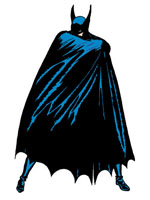
    BatmanOnce again…allow me to geek out for a bit…

    (SPOILERS FOR “THE DARK KNIGHT” IN THE BODY OF THIS POST — NO WORRIES AFTER THE JUMP.)

    Now that the record-breaking hysteria has (somewhat) subsided regarding “The Dark Knight,” I thought I’d take a moment to forecast the third installment (and perhaps future installments) of Christopher Nolan’s franchise.

    First thing’s first. What to call the next film? Ideas bounced around by fans have included tips of the hat to other aspects of the universe (“Batman Beyond,” “The Dark Knight Returns,” etc.). My personal hope was always that the Dark Knight moniker would somehow be a part of the franchise, and thankfully, they went there with the second installment.

    I kind of think taking Frank Miller’s title for part three would be brilliant (especially considering the nature of the final moments of “The Dark Knight”). But the answer here would, of course, have everything to do with the content of the film.

    At this point, we don’t have a clear idea of what to expect from the next film. “Batman Begins” scribe David Goyer (who shares a story credit on “Knight”) formulated the blueprints for a trilogy with Nolan at the outset, and we’re pretty sure Two-Face was supposed to play a considerable role in the next phase. Despite all the chatter that would have you believe Harvey Dent is dead at the end of “Knight,” that early talk of Aaron Eckhart’s contract being for two films couldn’t have been coming from thin air.

    Beyond that, the wonderful thing about the Batman mythos is that there is an array — a “rogues gallery” — of villains to choose from. And certainly, there are seven decades of story development to glean for a solid denouement to the trilogy.

    The Riddler is staring everyone in the face as the most likely possibility. And I really like the idea of handing it over to the character of Coleman Reese (as mentioned by one of our readers last week). Christopher Nolan is supposedly not a fan of the Penguin, and we all want Catwoman to pop up somehow. But that’s a whole other can of worms.

    If I had my druthers, I’d introduce the Riddler and the Penguin (as a mafia figure…nothing major), with Two-Face running rampant as the most dangerous aspect of the trio. But as I said (and we all know), any combination is possible.

    So with that, below you’ll find my personal casting call for the potential rogues we could see in a third film or even future installments of a franchise that could go from here to eternity. Of course, we won’t be seeing all of these cats pop up, but the sky is the limit with this universe.

    Here’s my perspective…

    (more…)

  • Sigourney Weaver + who in ‘Alien 5?’

    Sigourney Weaver and Carrie Henn in AliensMeredith Woerner at io9 is wondering this week whether sci-fi/action writers will finally bone up and produce a sidekick to our modern cinema heroes and heroines worth the price of a ticket.

    She’s rightly spotlighting recent examples in “Live Free or Die Hard” and “Indiana Jones and the Kingdom of the Crystal Skull” as reason to change the tide in the wimpy second fiddle circuit.

    Woerner brings the scuttlebutt regarding Sigourney Weaver supposedly being game for a fifth “Alien” installment in to fuel the fire even more, adding that Newt (from “Aliens”) and Winona Ryder’s Annalee Call (“Alien: Resurrection”) didn’t exactly pan out as they should have for badass, woah-man E.T. brawler Ellen Ripley in the past.

    Personally — I liked Newt — but I dig this topic, so let’s discuss.

    Weaver managed the impossible in 1986 when she actually landed an Oscar nomiantion for her role in James Cameron’s “Aliens.”  Sure, people are talking up Heath Ledger for a supporting actor mention in this year’s “The Dark Knight,” but Weaver was banging alien heads and walking away with a LEAD actress nod over two decades prior (giving ammunition to many who had hoped for a similar trick to be turned by Uma Thurman in 2003’s “Kill Bill: Vol. 1”).

    We must protect the Ripley legacy!  And I actually think giving her one fiesty, ferocious co-star would do just that.  And if Ridley Scott is indeed “enthusiastic” about going there again, it could be (could be) something special.

    Anyway, I say put Ripley up there with someone able to take the throne.  Like Vera Farmiga.  Anything but another “AVP” massacre.  ANYTHING.

  • REVIEW: “The Departed” (****)

    Warner Bros. Pictures\' The DepartedOne of the most artistically ruthless films to be produced in decades, “The Departed” is a spike of adrenaline straight to the heart of an audience desperately in need of such rambunctious filmmaking.  A loose but paradoxically loyal remake of the Hong Kong thriller “Infernal Affairs,” the film is doused with a cast of familiar faces, each performer offering portrayals unique to anything in their respective repertoires.

    The script, tuned down to deafening perfection by screenwriter William Monahan, is as frenetic as director Martin Scorsese’s visual vernacular.  And the atmosphere, molded by Scorsese as if he were twenty years younger, is as saturating and penetrating as one could hope for out of a freewheeling, balls-to-the-wall entry in the cops and robbers genre.

    This is truly one of the best films of the year.

    Scorsese fell off his throne in the eyes of many when he began tackling epics like “Gangs of New York” and “The Aviator” in recent years.  Some felt the fixture of 1970s cinema was chasing awards glory in earnest and therefore watering down his artistic capabilities.

    Still, those films have much more to offer than most viewers allow, affording dense portraits of 19th century America and the unraveling world of Howard Hughes respectively.  But it admittedly goes without saying the director hasn’t been near the top of his game in well over a decade, and the worry was he might be slowing down.  With “The Departed,” that line of thinking flies right out the window.

    The story is one of deception and lies, the hardships of undercover life and the effect such particulars have on a human being.  The heights Michael Mann was aiming for in “Miami Vice” in this regard are cleared with considerable comfort by Scorsese’s effort.

    Leonardo DiCaprio stars as William Costigan, a good kid from a working class family who hopes to make a difference in the Massachusetts State Police.  But his superiors, Queenan (Martin Sheen) and Dignam (Mark Wahlberg), see through him immediately as just a kid playing the role of cop more so than living it.

    Undercover work in the Irish mafia, however, might be something up his alley.  After all, deception seems to be one of his outstanding qualities.

    Colin Sullivan (Matt Damon), meanwhile, is a young buck who was introduced to organized crime at an early age.  Presented as a surrogate son to Irish crime lord Frank Costello (Jack Nicholson), Sullivan also rises quickly through the ranks of the Boston Police Academy.  He is soon positioned as Costello’s mole on the inside, greasing the rails for the mob boss to live his evil and criminal life as he sees fit, without recourse or precaution.

    Leonardo DiCaprio in The DepartedAs the film pushes forward at an unforgivable pace, each respective mole becomes cognizant of the other’s existence.  The drama therefore introduces itself in the form of a race against odds (and in the most hair-raising of environments) for each to discover the other before their rapidly evaporating time expires.

    These are roles most actors spend a lifetime hoping to nail, but in “The Departed,” even the supporting elements are tough enough to chew and find significant flavor.

    Alec Baldwin, for instance, continues to tap into a post-Kim Basinger era of confident, sleazy, yet somehow appealing portrayals as Ellerby, an officer in charge of the building case against Costello.  Martin Sheen commands a father figure for DiCaprio’s Costigan with relative ease, while Mark Wahlberg sparks a curious foil to Sheen’s Queenan as a sharp-tongued Sergeant overseeing undercover operatives.

    Vera Farmiga adds another delicate and layered performance this year (along with work in Anthony Minghella’s “Breaking and Entering”) as Madolyn, a department psychiatrist who becomes involved with both Costigan and Sullivan.  And Ray Winstone fits comfortably into the mold as Costello’s right-hand man Mr. French.

    But DiCaprio and Damon’s front-and-center portrayals are what the film hinges on.

    Damon’s is a specific and moderately callous turn, one less merely villainous than it is antagonistic by necessity.  DiCaprio’s performance as Costigan, meanwhile, might be his most accomplished to date, or at least closely rivaling his work in “The Aviator” two years ago.

    An actor consistently relegated to the “pretty boy” column, DiCaprio proves time and again that he is a performer capable of reaching certain emotional depths that others in his generation can’t quite claim for themselves.  And though both of these performances are showcases for each actor, it’s still not enough to steal the show.

    If there is one thing audiences will be talking about regarding “The Departed” for years to come, it will be Jack Nicholson’s flagrant bloodlust and vicious insanity as Frank Costello.

    Costello is the vilest of human occurrences, a truly despicable creature whose sole purpose in the world is to rail against the status quo and push his own boundaries as far as he can to get the maximum stretch out of life.  As the character admits later on, “I haven’t needed the money since I took Archie’s milk money in the third grade.  I haven’t needed p***y either, but I like it.”

    Jack Nicholson in The DepartedIndeed, Costello is one of the true villains of the modern cinema, as morally filthy as he is fascinating.  And Nicholson wallows in the role like he was born to wear it, savoring every feral gaze and relishing every blood-splattered grin.  It might be his best work since “The Shining” 26 years ago, and a performance Academy voters are likely to eat right up like Ben Kingsely’s Don Logan in 2001’s “Sexy Beast.”

    William Monahan’s erratic screenplay is enough to give anyone an anxiety attack, but Scorsese plays the thing like a fiddle.  Utilizing a crew of usual suspects, the filmmaker finds the pulse of the tale in a hurry and never relents.

    Thelma Schoonmaker deserves awards consideration for piecing together parallel narratives while still implementing the greatest of techniques scene after scene.  Michael Ballhaus’s camera glides through each sequence and constructs time and space in a manner reminiscent of his work on “Goodfellas,” and most recently, Janusz Kaminski’s underappreciated efforts on Steven Spielberg’s “Munich.”

    And I can only hope theaters across the globe crank the volume up to the level it was at in the screening room on the Warner Bros. lot, because the soundscape of the film is as much a character in the tale as Costigan, Sullivan or Costello.

    But the real story of “The Departed” has to be Scorsese’s reclamation of his former relentless ways.  This is an effort that fills out a trilogy of sorts with “Mean Streets” and “Goodfellas,” further securing the director’s status as the greatest of urban film artists.

    What makes the accomplishment all the more appealing is the sense that Scorsese is a beast awakened, done with a slumber that appealed to some and still puzzled others.  “The Departed” is crafted like he just recently discovered the medium of cinema and all its wondrous possibilities, fresh out of film school and desperate to express himself.

    It’s energizing just thinking about it.

    And, like the best of Scorsese cinema, I expect “The Departed” could be largely ignored by the awards season outside of performance respect and potential craft consideration.  But it really doesn’t matter what happens to the film in the approaching Oscar derby, does it?

    This is as hard boiled as filmmaking can get, and it proves a talented director still has more finesse and spirited determination than half the industry around him.  So take note.  An old dog can teach as many new tricks as he can learn.

  • REVIEW: “Breaking and Entering” (***1/2)

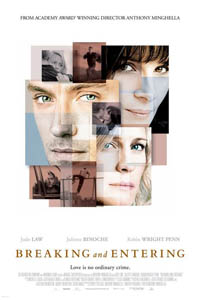
    The Weinstein Company\'s Breaking and EnteringAnthony Minghella’s “Breaking and Entering” is one of the most sincerely penetrating films of the year.  It’s most unique quality is the sense of legroom it provides, a healthy stretch of a film with deep breaths and drawn out considerations, as opposed to the typical anxiety of temperamental manipulation (which all film tends to be by nature).
    The film cannot be approached by the director’s past offerings, most of them over-reaching in their intentions and ultimately short of greatness as a result.  “Breaking and Entering” is not a masterpiece, but it certainly treads such waters as an honest and tangible portrayal of mid-life confusion and crisis.

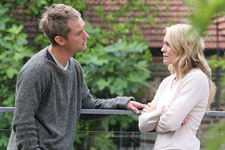
    In the film, Jude Law stars as Will, a London architect and head of a somewhat unorthodox household.  He lives with his girlfriend of ten years, Liv (Robin Wright Penn), yet they remain unmarried.  The two are at that point in a relationship when the boredom of familiarity have finally given way to something else, something utterly lacking and altogether confusing.

    Together, Will and Liv have raised Liv’s daughter, Beatrice (Poppy Rogers), a behaviorally dysfunctional teenager very representative of the trauma Will and Liv’s emotional schism has imposed on the family.

    Will’s company has recently set up new office space in a seedy district of London.  After receiving a large shipment of computer components, the office is burglarized one night by a team of acrobatic youngsters.  One such child is Miro (Rafi Gavron), a Bosnian refugee living with his mother, Amira (Juliette Binoche).

    Miro lost his father before fleeing his homeland, and his own story is not an unfamiliar one, one of longing and despair manifested in his getting himself into frequent trouble with the authorities.  He now thieves for his dead father’s brother, perhaps to keep some sort of touch with his former, all but forgotten life.

    Amira, meanwhile, is as sick with worry as one can imagine.  Making ends meet as a seamstress, she frequently expresses disgust with Miro’s extracurricular choices, but overshadowing that disappointment is an unwavering love for her child.

    Binoche’s more playful scenes with Gavron are the emotional center of the film, representative of a spirited devotion and affection that seems missing from Will’s life, and a sham if ever apparent therein.

    Jude Law and Robin Wright Penn in Breaking and EnteringAfter a series of such robberies, Will begins staking out the building with partner Sandy (Martin Freeman) and an inquisitive prostitute, Oana (a humorous and insightful Vera Farmiga).  He finally catches Miro in the act one night, and in chasing him he follows the boy to his home.  There Will encounters, from a distance, Amira and her concern for her son.
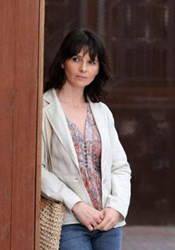
    The moment is the beginning of an emotional whirlwind that will become increasingly confusing before clarity will be restored.  Will ultimately engages in an affair with Amira, perhaps searching for love as he later will claim to Liv, but more likely discovering a void to fill, one he cannot seem to fill at home.

    “Breaking and Entering” is an awakening experience.  At its core, the film is about honesty.  It is about being truthful to yourself, your needs, your desires, your love, your family and your impulses.

    Will is a man turned around and without direction.  His confusion is not his fault, nor is it his family’s.  It is our very nature to search out our boundaries and our limitations.  It is also our very nature to seek assurance in where we find ourselves.

    In that light, “Breaking and Entering” has much in common with Todd Field’s “Little Children.”  Both films speak to mid-life indecision and discomfort, and both films weave tales of lost souls finding their way back to their life roles.

    Jude Law’s performance as Will might be the greatest performance of the year.  It is a textured and nuanced turn that has a blistering emotional veracity.

    I would perhaps go so far as to call it his best work to date, but his is still a resume bursting with diverse portrayals throughout.  In “Breaking and Entering,” however, Law has tapped into the leading man potential he has only threatened in efforts such as “Cold Mountain” and the phenomenal “Closer.”

    Juliette Binoche in Breaking and EnteringJuliette Binoche is appropriately self-aware and headstrong in her performance as Amira.  Driven yet still full of the youth she had ripped from her through tragedy, Amira is an extremely interesting creation and a vibrantly unique character.

    No one has carried across beautiful and tired so capably since Meryl Streep in “The Bridges of Madison County.”  She also works quite beautifully off of the balanced anxiety and mother-love of Rafi Gavron’s performance.

    Elsewhere, Ray Winstone turns in a cheeky performance as investigating CID officer Bruno, while Martin Freeman’s brief stint as Sandy is further proof he deserves more roles with meat on them.  Poppy Rogers has some integral scenes as Beatrice, but if there is a weak link in the cast, it pains me to say it might be Robin Wright Penn.

    Some may find her emotional recoil fitting and appropriate, but something about the performance feels as though the actress doesn’t fully understand her character.  The work recalls Patrick Wilson’s ambivalence in “Little Children.”

    The technical aspects of the film deserve accreditation of the highest order, most especially Gabriel Yared’s piano-infused original score and Benoît Delhomme’s subdued cinematography.  Each element goes toward making the piece a truly unique experience, and certainly a unique Minghella experience.

    “Breaking and Entering” really feels like Anthony Minghella’s most personal and convincingly sincere film yet.  It boasts a lived-in quality making it feel like a story the writer/director has been playing over and over again in his head, perfecting every glance and sigh, tuning every emotional pitch to tonal superiority.

    From an opening shot bleeding subtext and sporting an initial narration more enlightening than most, it is a film and, more importantly, a screenplay, that commands respect and appreciation.  In a year exploding with accomplished filmmaking, “Breaking and Entering” fits right in.