In Contention

Tag: Andrew Stanton

  • ‘John Carter’ teaser trailer

    Tons of trailers in the lead-up to Comic-Con this week. Today, it’s Andrew Stanton’s live-action debut, “John Carter” (which won’t have a presence at Comic-Con because Disney wants to be competitive with its D23 event). I’m not too sure about this one, and I think the reasoning for diminishing the brand appeal by shortening the title from “John Carter of Mars” is flimsy at best. But this will certainly be unique against the fray next year. Check out the new teaser trailer, via Apple, by clicking the image below, or watch an embed after the jump.

    (more…)

  • OSCAR GUIDE: Best Writing (Adapted Screenplay)

    This year’s race for Best Adapted Screenplay has seemingly been the most predictable of the year. One script has dominated the precursor circuit and the name behind that script is as worthy as ever given his contributions to the medium over the years.

    I’m not particularly a fan of this slate. One script is an interesting experiment that doesn’t fully land as a piece of screenwriting, another is a near word-for-word adaptation of a novel (which is fine, but credit where it’s due) and another, frankly, made for the most overrated film of the year. But the two that seem to be duking it out for the win are worthy and deserve to be here, in my opinion, so I have little room to complain.

    The nominees are:

    “127 Hours” (Screenplay by Danny Boyle & Simon Beaufoy)
    “The Social Network” (Screenplay by Aaron Sorkin)
    “Toy Story 3” (Screenplay by Michael Arndt; Story by John Lasseter, Andrew Stanton and Lee Unkrich)
    “True Grit” (Written for the screen by Joel Coen & Ethan Coen)
    “Winter’s Bone” (Adapted for the screen by Debra Granik & Anne Rosellini)

    (more…)

  • I’m a big crybaby

    Pixar’s “Toy Story 3” reduced me to mush, just like it has untold numbers of critics across the nation.  I’m so excited to see that 2010 has already seen two top-notch animated features, and a few of those still to come look intriguing to say the least.  But this one took a formula, injected it with more profound meaning than its two predecessors could have dreamed of, had the balls to keep its edge when push came to shove with the story’s antagonist, and at the end of the day, put a big, bright, beautiful bow on one of the most beloved franchises in — I think we can say this now — cinema history.

    The story was cooked up by Lee Unkrich, Andrew Stanton and Pixar Don, John Lasseter, but Michael Arndt was tasked with actual scripting duties.  His work is a lean vision of purpose, four years of hard work shining through.  The voice work is every bit as effective as it ever was, but all the toys in Andy’s toy box seem to be even more distinguished in their own rights this time out.

    Of course, this makes it all the more sad that we can’t hear Jim Varney’s Slinky Dog chime in, but Blake Clark gives it a decent go.  On the whole, though, we’re looking at one of the best films of the year, easily.  And a studio that knows how to do the franchise thing well.

    (more…)

  • Lasseter on his Disney ups and downs

    John LasseterTotal Film has done a notably thorough interview with John Lasseter, which takes the form of a chronological tour through the animation maven and “Toy Story” director’s career. It’s a fascinating read, particularly if you, like me, are not entirely au fait with the early history of Pixar and computer animation. I hadn’t realized how the dots all joined between Lasseter and such diverse figures as Steve Jobs, Tim Burton, George Lucas and Chris Wedge. Small world, and all that.

    The overarching narrative that emerges from the interview is Lasseter’s complicated history with Disney Animation Studios. He may run the place now, but getting fired by them decades ago has clearly left its mark. He’s too genial a guy to remain bitter, but he’s still frank about how unpleasant his early Disney days were:

    When I got there I found it was led by people who felt threatened by young talent. I kept suggesting stuff but I remember being told by one of them, ‘Look we don’t want to hear your ideas, just do what you’re told. There are plenty of guys who’d be happy to take your place.’

    In two sentences some guy made me not care about the studio; he made me not care about the project I was working on. And I thought to myself, ‘One day if ever I’m in charge I’m never going to say to a young person what that guy just said to me’. But it didn’t stop me, I just kept trying to push and make things better.

    When we showed the test and gave a pitch (for “The Brave Little Toaster”), the head of the film studio just said, ‘The only reason to produce this by computer is if it makes it cheaper and faster.’And he walked out. Within five minutes I get a call: ‘Your project is incomplete and your employment with the Disney Animation Studios is now terminated.’

    (more…)

  • Writing the silences

    Hard as it may be to believe, it seems there are a lot of people in and around the industry who don’t fully understand what a screenplay is — who think that ‘writing’ equals ‘dialogue.’ This makes it all the more laudable that the Academy’s writing branch recognised “WALL-E,” a film that hinges, of course, on extended stretches of dialogue-free storytelling.

    As I’ve written before, it’s a significant challenge to build empathetic characters, credible relationships and narrative immediacy with a minimum of on-screen words. And yet, one still hears occasional murmurings questioning the validity of the film as a feat of screenwriting. (Presumably they imagine the animators made up the story as they drew, or that all silent cinema was entirely improvised.)

    So I was pleased to read Andrew Stanton thoroughly address this issue in a chat with Pete Hammond, wherein he states that of all “WALL-E”‘s 6 nominations, he takes the most pride in the screenplay nod:

    “I am prouder to be in writing more than anything else. At Pixar we say ‘story, story, story.’ It’s the root of everything,” he says. “It’s the biggest pat on the back I can think of. We put ourselves fully into every aspect but it’s all in service of the story.”

    It could be a tough sell to the overall academy (every branch votes on the final screenplay award) as a lot of members just don’t understand how a virtually silent movie, in which the main characters speak their own language, could possibly have been “written.”  But Stanton says it’s no different than the process any other writer would go through.

    “How you tell a story is just as important as what the story is. In my mind these characters were gonna speak. They just weren’t gonna speak in a language you and I knew. When they spoke and why they spoke was just as important as if you could understand their language,” he says.

    Well said. Got it, voters?

  • 2/12 Oscarweb Round-up

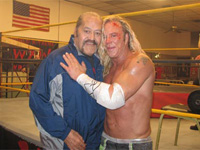
    (from left) Afa the Wild Samoan and Mickey Rourke on the set of The Wrestler(Kind of quiet out there…)

    • David Carr addresses the “some stars won’t walk the red carpet” talk, slams fashionistas as being “pilot fish on a big whale.”  Ooooooohhhhh. [The Carpetbagger]

    • Rebecca Ascher-Walsh talks to double nominee Kate Winslet. [The Envelope]

    • Dave Karger says it’s Harvey vs. Miramax in the ladies’ acting fields. [Entertainment Weekly]

    • Sasha Stone goes deep with “WALL-E” helmer Andrew Stanton. [Awards Daily]

    • David S. Cohen writes up “The Wrestler”‘s unsung hero: trainer Afa “the Wild Samoan.” [Variety]

    • Patrick Goldstein responds to the week’s “Reader” slams. [The Big Picture]

  • 2/7 Oscarweb Round-up

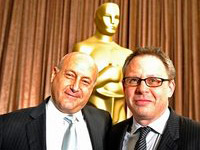
    (from left) Laurence Mark and Bill Condon• Rochona Majumdar and Satyam Khanna discuss the “Slumdog Millionaire” controversy. [NPR]

    • Kim Voynar spotlights the Best Director category. [Movie City News]

    • David Poland spends 30 minutes with “WALL-E” writer and director Andrew Stanton. [The Hot Blog]

    • Five Oscar night surprises Mark Lisanti would like to see. [Little Gold Men]

    • Searchlight may be making a wise business decision, but they’re still abandoning the best of the nominated songs in the process. [Gold Derby]

    • Yet another “meet the Oscarcast producers” piece. [Associated Press]

  • Best Original Screenplay: The case for ‘WALL-E’

    I think it was some smart person on Nat Rogers’ most recent podcast who remarked that if you really want to get a picture of what was going on cinematically in any given year, you’d be better off bypassing Oscar’s Best Picture category and heading straight for the Best Original Screenplay nominees – a category that has a far higher tolerance for eccentricity, controversy and the occasional foreign tongue than any other.

    Case in point: 2002. When the top categories were splintered between the respectable but less-than-relevant likes of “Chicago” and “The Pianist,” Original Screenplay afforded voters the luxury of choosing between Pedro Almodovar, Todd Haynes and Alfonso Cuaron. Two years later, the category gave recognition to the otherwise shamefully sidelined “Eternal Sunshine of the Spotless Mind,” just as, a decade earlier, “Pulp Fiction” fans sought refuge there from a merciless shower of Gump. As I’ve said before, from “Citizen Kane” to “The Crying Game,” Best Original Screenplay tends to be the connoisseur’s favourite Oscar category.

    And so it is this year, when the writers’ branch really demonstrated admirable ingenuity and adventurousness in their selections, in the face of some otherwise uninspired voting. For me, it’s by far the most exciting of this year’s major Oscar categories, both for the calibre its competition and the unpredictability of its outcome. It’s one category where the Guild award is of little to no use to prognosticators, as only one title (“Milk”) features on both the Oscar and WGA lists.

    Like Kris, I’m placing my money on Andrew Stanton, Jim Reardon and “WALL-E” emerging triumphant here, and thus becoming the first animated film in Oscar history to win a major category. This morning, meanwhile, I was interested to see that the majority of the Gurus of Gold are thinking the same way. It’s a healthy vote of confidence for a prediction that, let’s face it, would represent a significant leap for Academy voters. Just last year, the Reel Geezers (AMPAS members both) immediately discounted “Ratatouille” from consideration in the category because it was a “cartoon.” How do we know that most of the notoriously conservative Academy voters won’t feel the same way?

    (more…)

  • SANTA BARBARA: Writers talk writing, Cruz walks the red carpet

    Penelope Cruz talks to festival director Roger Durling at the Santa Barbara International Film FestivalYesterday was another busy event day for the Santa Barbara fest.  It was a shame the Director’s Panel was canceled, but participant Andrew Stanton switched gears to join Robert Knott (“Appaloosa”), Tom McCarthy (“The Visitor”) and Dustin Lance Black (“Milk”) for an Anne Thompson-moderated discussion on their work at the keyboard this year.

    It was a good discussion, though I couldn’t help a double take at Black’s prepubescent appearance as he waltzed casually on stage.  I mean it as a compliment.  I was also intrigued by his noting one of the things that really interested him when working on the spec “Milk” script was the famed politician’s not-so-heroic side.  “Sometimes he’d be in the bath house when he should have been home with his boyfriend,” Black said.  I say intrigued because one of the key criticisms of the film has been its overly haloed depiction of the man, a criticism that, frankly, hasn’t been properly defended by even the film’s legion of supporters (and I count myself in their ranks).

    Stanton, meanwhile, was perhaps the most thought-provoking member of the panel, finding a nice place amid Black’s low-key veneer, McCarthy’s wit and Knoll’s hilarious interjections.  And thankfully, Jeffrey Wells martyred himself by asking why Stanton continued to be “oblique” when addressing the overweight “teletubbies” of “WALL-E.”  This has been a bone of contention for me on the film for some time, not so much because I feel it undermines the film, but because I believed it to be an easy opportunity for mean-spirited “fat” jokes, so to speak.

    (more…)

  • Santa Barbara heats up

    The Arlington Theatre in Santa BarbaraThe air smells cleaner.  The sound of waves crashing outside the hotel room is soothing.  The hippies are dancing in the streets.

    It’s nice to get away from the mess of this morning and the frustration of Oscar season in general for eight days.  But the awards circuit isn’t out of sight by any means.  Kate Winslet, Michael Shannon, Penelope Cruz, Mickey Rourke, Viola Davis, Melissa Leo, all of them set to be feted over the course of the week.  Panels will include Andrew Stanton, Dustin Lance Black and Eric Roth, among others, are set for panels, while festival guest director David Fincher will be the toast of the town throughout, leading to his big to-do on Friday, Jan. 30.

    And yet, it doesn’t feel as stifling as it might.  Sometimes a couple hours drive out of the heart of the beast does a body good.

    With that, one of the season’s casualties drops this evening, Rod Lurie’s “Nothing But the Truth,” which was all but buried when Yari Film Group went under last month.  As festival director Roger Durling has said, the film deserves to be seen and it’s a hell of a gesture on Durling’s part to give the pic some limelight.

    So with that, I’m throwing on the suit and heading out for the evening.  I’ll be here all week catching a number of films I’ve missed over the last couple of months and even a few I’d like to enjoy once more.

    What Oscar nominations?

  • Guessing the DGA

    Directors Guild of AmericaSo, with SAG, PGA and ASC out of the way, and with WGA still to come in a matter of hours, I guess it’s worth mentioning that the big daddy guild is announcing tomorrow: the Directors Guild of America (DGA).  Now’s as good a time as any to take a stab at guessing the nominees…

    The DGA has been one hell of an Oscar Best Picture barometer for the last decade or so.  Last year was the first real hiccup as the guild only nailed three of the eventual five nominees with their director choices.  2006 saw one misfire (but we all still figured “Dreamgirls” was in around this time two years ago).  Then it was four years in a row five-for-five until we have another hiccup, Ridley Scott making it in for “Black Hawk Down” and Christopher Nolan (in the mix again this year) for “Memento.”

    After that, the general trend was four-for-five with some 100 percents thrown in here and there, but you get the picture.  This is, more often than not, quite the prognosticative (that’s so not a word) guild.  With the PGA clearly establishing a consensus of sorts (not that those five films haven’t been the obvious contenders for weeks upon weeks), I see no real reason to get creative right now, so I’m going with the following:

    David Fincher, “The Curious Case of Benjamin Button”
    Christopher Nolan, “The Dark Knight”
    Ron Howard, “Frost/Nixon”
    Gus Van Sant, “Milk”
    Danny Boyle, “Slumdog Millionaire”

    There are only two filmmakers that I think have a shot of cracking this quintet: Woody Allen for “Vicky Cristina Barcelona” and, perhaps more so, Darren Aronofsky for “The Wrestler.”  John Patrick Shanley and “Doubt” showing up would truly shock me and Andrew Stanton is not eligible for “WALL-E,” so the field is rather thin.

    What are you thinking?

  • In the round

    I don’t know why exactly, but the “roundtable” format of interviews that crops up a lot during awards season often strikes me as rather less fascinating than it’s meant to be. Unless the panel is very smartly chosen, I find the discussion tends to veer towards back-patting and faintly smug in-jokery, rather than stimulating argument between widely differing creative forces.

    Maybe I’m just blasé. But on reading the Hollywood Reporter’s two recent “Oscar Roundtables” with six screenwriters and six producers that THR thinks are likely to figure in the Oscar race, I couldn’t help being disappointed that, despite the level of talent involved, they didn’t have that many interesting things to say between them. (I’d go so far as to say that the best soundbite is quoted from the not-present Charlie Kaufman.)

    The selected writers are Jenny Lumet (“Rachel Getting Married”), Dustin Lance Black (“Milk”), Thomas McCarthy (“The Visitor”), John Patrick Shanley (“Doubt”), Andrew Stanton (“WALL-E”) and J. Michael Straczynski (“Changeling”). I have a hard time imagining the latter two will score writing nominations, but the race is young, I suppose.

    Writers can be pretty insufferable when talking about their “process” — I know, I am one. So there’s the usual semi-serious comparing of hours spent at the computer, feverish notebook scribbling and messy first drafts, but there isn’t much discussion of the specific screenplays and films at hand. McCarthy seems to be the most reticent of the group, only entering the discussion halfway through. A shame, really, as I’d venture that he’s possibly the best writer of the lot.

    (more…)

  • Best Original Screenplay: beyond the obvious

    Everyone has a favourite Oscar category, and Best Original Screenplay is mine. It’s partly because I’m a screenwriter myself, so I feel a little more invested in the outcome. My evaluation of the category often comes down to the question: “Which screenplay do I most wish I’d written first?”

    More importantly, however, it’s the category where the Academy takes its greatest artistic risks. With the Best Picture category generally weighted towards adaptations, they often use Best Original Screenplay as a way to acknowledge the edgier, more adventurous work that voters can see the greatness of, but don’t yet have the guts to honour with their biggest prize. Hell, once in a blue moon they even give it to (gasp) a foreign-language film.

    It’s this convenient ghettoising mentality that ensures the likes of “Citizen Kane,” “The Red Balloon,” “Chinatown,” “Pulp Fiction,” “Talk to Her” and “Eternal Sunshine of the Spotless Mind” don’t go empty-handed. Sure, it sucks that they couldn’t win more. And, being the Academy, they make more than their share of screw-ups. (Let’s try and forget that, in 1960, “Pillow Talk” beat — wait for it — “Wild Strawberries,” “North by Northwest” and “The 400 Blows,” shall we?) But they occasionally hit on an otherwise-snubbed masterpiece, and for that we should be grateful.

    This year’s Best Picture slate appears to be heavy on prestige adaptations, allowing for a more idiosyncratic ragbag of contenders on the Original Screenplay front, mixing familiar Academy-anointed favourites with some exciting new voices.

    There is, of course, a chance this could be a year when the paths of the Best Picture and Best Original Screenplay races converge, principally in the shape of “Milk” scribe Dustin Lance Black. Already high hopes for “Milk” were amplified by an excellent trailer, and a number of Oscar clairvoyants are labelling it the front-runner in the top race. If this turns out to be the case, Black will likely benefit.

    (more…)
  • Breakthrough for Hawkins and Franco

    As regular readers may know, I’ve been yammering on about a Best Actress nomination for “Happy-Go-Lucky”‘s delightful Sally Hawkins since I reviewed the film back in April. So I’m pleased to see that Hawkins will receive the Breakthrough Actress award at next month’s Hollywood Film Awards.

    As I said when they named their crafts honorees earlier this month, I’m a bit mystified by these awards, which appear to honour as-yet-unseen films rather frequently. Still, it’s difficult to argue with this selection: in a crowded field of Best Actress contenders, Hawkins is the freshest face out there. It’s a good omen for her Oscar chances — last year’s honoree was Ellen Page.

    “Happy-Go-Lucky” didn’t emerge from the festival circuit with quite the amount of heat I hoped it might, but Hawkins remains a solid contender for awards consideration. As we know now, the performance has a major Marmite factor — people either love or hate Hawkins’ character — but it’s sure to stick in people’s minds.

    Elsewhere, the Breakthrough Actor award went to James Franco — another obvious choice, and a move that gives credence to the Best Supporting Actor buzz for his performance in “Milk,” something Kris just discussed.

    “Milk” scored twice with the awards, with newbie (not that you’d know it from the marketing) scripter Dustin Lance Black named Breakthrough Screenwriter. Meanwhile, “Doubt” helmer John Patrick Shanley picked up Breakthrough Director. The latter strikes me as something of a safe choice in a year that has given us stellar debuts from such talents as Martin McDonagh and Philippe Claudel, but we only have the trailer to go on.

    Finally, pointing to two Oscar inevitabilities, the Animation award will go to Andrew Stanton for “WALL-E” (well, duh), while “Iron Man” will be recognised for its visual effects.

  • Loving from a distance

    Well, “WALL-E” finally lands in the UK today, and this weekend I’ll be able to evaluate it for myself at last. (But hey, at least we got “Mamma Mia!” first. Score!)
    I am always a bit nervous about approaching something that’s been praised to the skies so far in advance of my own interpretation – but today’s very interesting Guardian review gave me some pause. I’d ignore it if it were by that wily contrarian Peter Bradshaw, but Xan Brooks is a genuinely thoughtful writer whose views I value more than most:

    What a rich, strange and intriguing picture this is; a wintry Cassandra in the guise of a pearl-bright summer blockbuster. There is something giddyingly impressive in the way in which its makers have cherry-picked a crop of antique ingredients and then forged them into something new. The plot is a meld of Silent Running, Metropolis and Robinson Crusoe. At times it is possible to catch the ghost of Charlie Chaplin behind Wall-E’s silent, stoic pursuit of his social better. At others the film’s central romance plays like the Genesis story with Woody Allen and Diane Keaton cast in the roles of Adam and Eve. That narrow neck and blinking binocular specs are a dead giveaway.

    For all that, faint doubts remain. Wall-E (the character) is eminently lovable, by far the film’s most human inhabitant. And yet Wall-E (the movie) actually has more in common with EVE. It is an exquisitely rendered piece of work; beautiful, flawless, serious in its intent and hermetically sealed. You can admire it to the skies and back. You can even learn to love it from a distance. But does Andrew Stanton’s film amount to much more than a brilliant aesthetic exercise? I’m not convinced it does.

    I understand that there are more than a few people who have been intensely moved by the film, and who would therefore not identify with this perspective at all. But in an environment where Metacritic scores are bandied about as if they’re some irrefutable artistic Solomon, it’s always healthy to read an alternative individual voice. I can’t wait to find my own on this film.

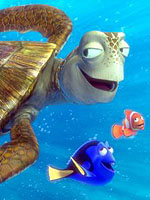
  • Revisiting ‘Nemo’

    Pixar\'s Finding NemoI still haven’t made it out to see “WALL-E” since returning to the States, but today I thought I’d pop “Finding Nemo” into the player and soak up some of that old Andrew Stanton goodness in the meantime.  And it really does stand-up as the most sensational entry in Pixar’s steadily increasing portfolio.

    Back in 2003 the film landed in my top three for the year, and I’ve only given it two or three looks since.  But every time I do, the reward is considerable.  This is a sincerely affecting study, one packed with vivid and dynamic characters, the most gorgeous animation of the genre and applicable, resilient themes that work on various levels.  It fires on all cylinders.

    Not to mention, the film contains the only vocal performance I’ve personally ever deemed worthy of major awards consideration.  “When I look at you I remember.  When I look at you I’m home.  I don’t want to lose that.  I don’t want to forget.”  Absolutely beautiful.

    It also looks damn spectacular on an HDTV.  I don’t have a Blu-ray copy of the flick, but on a simple upconvert the image is crystal clear, sparkling.  Especially with the new 120Hz technology (which is dodgy with live action films).

    So with that, I’ll probably stumble into the El Capitan over the weekend and finally take in Stanton’s latest.  His is a creative mind and I’m truly happy he’s out there generating content such as this.  Few compare.