In Contention

Blog

  • Actor/movie star — who walks the line the best?

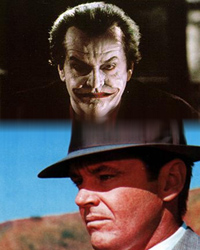
    Continuing the conversation from a few days ago on actors that are more than icons, only one name comes to mind: JACK.

    For more than 40 years Jack Nicholson has been one of the most dominat acting forces in movies, with an impressive array of performances that both challenge him as an artist and also please audiences from time to time with his wild man portrayals.

    In fact, after “Batman,” in which he stole the film from under the nose of Michael Keaton, Nicholson was often accused of playing “Nicholson.” It’s a claim I find absurd considering his performances in subsequent films such as “Hoffa,” “A Few Good Men,” and “The Crossing Guard,” one of his most daring performances ever. Recently the actor has given at least two of his most courageous performances, in “The Pledge” for director Sean Penn, and going totally against type in “About Schmidt,” reminding audiences of the great thespian lurking within the body of the movie star they know so well.

    (more…)

  • Soderbergh puts himself in the company of Salles

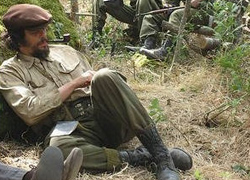
    I stumbled across this zinger today at Anne Thompson’s blog. Obviously I haven’t seen “Che” yet, and want to love it when I do, but this?

    Walter’s movie is really an Act One. With these, now it’s a trilogy.

    Strong words.

  • Hmmm…

    “Che” = “Medellín?”

  • The story so far

    The Times of London has a very handy roundup of the highlights of the Cannes Film Festival thus far, echoing the widespread acclaim for such titles as “Gomorra,” “Vicky Cristina Barcelona,” “Waltz With Bashir,” and the long-awaited new film from Terence Davies, “Of Time and the City” – which, while out of competition, has probably been the festival’s most universally adored film so far. They also share my suspicion that Nuri Bilge Ceylan’s “Three Monkeys” may nab the Palme d’Or over the more extravagantly hyped contenders.

  • First ‘Che’ reactions land

    UPDATED (4:15 PM): Not so fast, there.  It seems Anne Thompson has chimed in and sort of doused the flames of passion a bit with a sobering perspective on these two efforts.  The next few hours ought to be interesting as more opinions trickle in.

    Here’s what Anne had to say:

    “A folly.” “A mess.” “Great.” These words came from some of the critics coming out of Steven Soderbergh’s four-hour 18 minute Spanish-language Che Wednesday night. At the end there was slight applause; no boos. My own description: noble failure.

    EARLIER: Jeff Wells is on the ball with quick (probably too quick) reactions to Steven Soderbergh’s “Che” twofer of “The Argentine” and “Guerrilla.” If you ask me, this is the center piece of this year’s Cannes fest and the one I’ve been waiting with bated breath to hear about.

    On “The Argentine” (is it still called this?) Wells had the following to say:

    I know I predicted this based on a reading of Peter Buchman’s script, buy the first half of Steven Soderbergh’s 268-minute Che Guevara epic is, for me, incandescent — a piece of full-on realism about the making of the Cuban revolution that I found utterly believable and politically vibrant and searing.

    It’s what I’d hoped for and more. The tale is the tale, and it’s told straight and true. Benicio Del Toro’s Guevara portrayal is, as expected, a flat-immersion that can’t be a “performance” as much as…I don’t know, some kind of knock-down ass-kick inhabiting. Being, not “acting.”

    And on “Guerrilla,” what will likely be the less awards-ish of the flicks:

    The second half of Che, also known as Guerilla, just got out about a half-hour ago, and equally delighted although it’s a different kind of film — tighter, darker (naturally, given the story). But I’ve been arguing with some colleagues who don’t like either film at all, or don’t think it’s commercial.

    Wells mentions Variety’s Anne Thompson, Cinematical’s Kim Voyner and Glenn Kenny, formerly of Premiere. Each of them attended the screening, so keep an eye on their respective outlets to gauge further reaction.

  • A bit of perspective

    A day after its Cannes premiere, more “Changeling” reviews are coming through, and while the general feeling towards the film is still positive, some high-profile dissenters are emerging. The inestimable Manohla Dargis at The New York Times, usually an Eastwood die-hard, is surprisingly agnostic on the film, particularly with regard to Jolie’s performance:

    Despite Ms. Jolie’s hard work and Mr. Eastwood’s scrupulous attention, the difficult, fairly one-dimensional character fails to take hold. For much of the film, Christine weeps and pleads, begging the police for help and fending off disbelievers. She clings to hope, the problem being that Ms. Jolie, whose off-screen role as Angelina Jolie is so much more vivid and all-consuming than the parts she now plays on screen, this one included, does not come across as a clinger or a whiner or a pleader or even much of a waterworks. Like Joan Crawford, Ms. Jolie seems capable now of only playing variations on herself, which is why she was more persuasive holding back her tears as a steely Mariane Pearl in “A Mighty Heart.”

    On this side of the ocean, meanwhile, The Guardian’s Peter Bradshaw is distinctly underwhelmed, declaring the film “long, self-conscious and cumbersome.” He goes on to say:

    The film’s heart is very obviously in the right place, but it is trying to be so many things at once: family drama, cop-corruption thriller, child-snatcher nightmare – and, for Jolie, another flight over the cuckoo’s nest, only this time with far more queenly dignity than in Girl, Interrupted. Accompanied with a syrupy musical score to cushion the dramatic blows (and to ensure that the audience isn’t too horrified or upset too early on) this over-long film fails to convey – is in fact afraid of conveying – the real horror of child loss.

    Finally, Jeff Wells has posted his verdict, and while he joins the yea-sayers, he ultimately deems it “not a great film, but a very fine one.”

    Make no mistake, “Changeling” still sounds like a helluva contender, but it’s useful to get some balance of opinion. The industry adores Eastwood, which explains the trade papers’ lyrical reviews; but that doesn’t always make for critical consensus. With another 2008 release still on the cards for Clint, it anyone’s guess how the man’s awards season will play out. He sure keeps the game interesting.    

    As for the whole title issue, there still appears to be confusion – even Eastwood doesn’t know what it’s called. I say they should take a cue from Awards Daily, retitle it “The Changelina,” and stick with it.

  • Heavy

    Asked twice by The Times to respond to Lee’s criticism, Eastwood stared out into the audience as the compere refused to accept a question that did not relate to L’Échange.

    LINK

  • Ouch

    I have lots of respect for the guys at indieWIRE, but they kinda deserve this.

    At least it’s funny. I love the caption under Kohn’s photo.

  • More than just an icon

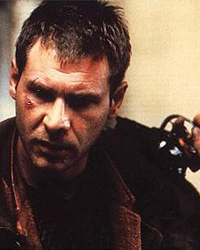
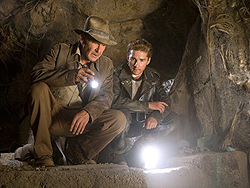
    Though best known as the fedora-wearing, bull whip-cracking hero of the Indiana Jones films, Harrison Ford has forged a strong career as an actor, with an impressive filmography that has, in many quarters, gone sadly unnoticed.

    One of the downsides to being a movie star — or an actor best known for work in blockbusters, even — is that your skill as an actor is often unappreciated or ignored. In some cases with Ford, that is precisely what has happened. I remember the great Burt Lancaster stating what a great challenge the role of Indiana Jones was, and that it took a great actor to make it work. Lancaster, like Ford, had grown into a fine actor by then, but lest we forget he began his career in swashbuckling B-movies before evolving into the Oscar winner of “Elmer Gantry,” and his finest work, “Atlantic City.”

    I first took note of Ford as a true actor in a scary little role he had in the otherwise terrible film “Heroes.”  The actor portrayed a Vietnam vet who loved his time over there, and like buddy Henry Winkler, wanted to go back. Though he had just a few minutes of screen time, he was quietly terrifying, bringing to the part all that was frightening about that war. While the rest of the film was devoted to the mugging of Winkler, it was Ford who left the audience unsettled.

    (more…)

  • Cannes update: Eastwood scores…again

    Well, I’m pleased to report that my initial doubts about Clint Eastwood’s latest, “Changeling,” were obviously unfounded.

    His Angelina Jolie-starrer, based on a true story about a child’s kidnapping in 1920s Los Angeles, premiered this morning at Cannes, and, judging from the reviews so far, the man’s impeccable recent run of form hasn’t hit a snag yet. (Incidentally, both Jeff Wells and Screen Daily report that the film has been retitled “The Exchange,” a far less intriguing title, in my opinion. However, some trade papers are still going by the original title in the reviews, so I’m sticking with that for now.)

    Clearly, however, the film’s a stunner by any name. Todd McCarthy’s rave for Variety puts it thus:

    A thematic companion piece to “Mystic River,” but more complex and far-reaching, “Changeling” impressively continues Clint Eastwood’s great run of ambitious late-career pictures … Graced by a top-notch performance from Angelina Jolie, the Universal release looks poised to do some serious business upon tentatively scheduled opening late in the year.

    McCarthy also puts to rest the rumours that film was a foray into hysterical genre territory, which I admit had me concerned for its awards prospects:

    Fears that the story is now destined to veer off into “The Snake Pit” or, given Jolie’s presence, “Girl, Interrupted” looney-bin horrors prove largely unfounded, despite a couple of brief electroshock scenes. Rather, this is where the picture really spreads its wings, as ramifications of this tragic but unexceptional case seep through the police department, the legal system, the medical establishment and City Hall in entirely unexpected ways.

    The word on the other side of the Atlantic is just as hot. In his Screen Daily review, Mike Goodridge minces no words abouts the film’s quality or its prospects:

    Beautifully produced and guided by Eastwood’s elegant, unostentatious hand, it also boasts a career-best performance by Angelina Jolie who has never been this compelling. Like “Mystic River” in 2003, it should go all the way from the Palais to the Academy Awards next March.

    (more…)

  • Cannes update: Italy’s ‘Gomorra’ wows ’em

    (EDITOR’S NOTE: New Cannes poll in the sidebar as of this morning, FYI.)

    We’re at the halfway point now, and this year’s Cannes Festival seems to have been a pretty staid affair so far. With the dust settled, “Blindness” appears to have been labelled an honourable disappointment. Meanwhile, some of the big arthouse names in the competition are widely agreed to be treading water.

    Walter Salles’ “Linha de Passe” appears to be worthwhile, but hasn’t generated the critical heat of “Central Station” or “The Motorcycle Diaries.” “Lorna’s Silence,” the latest from Belgium’s hitherto unimpeachable Dardenne brothers, here aiming for a record third Palme d’Or, has garnered respectable notices (and an outright pan from Jeff Wells), but doesn’t seem to be up to the standard of “Rosetta” or “The Son.”

    There have been some international successes. “Three Monkeys,” the latest from Turkey’s great Nuri Bilge Ceylan, has gathered predictably excellent reviews, of which The Hollywood Reporter’s take (a “brilliant, gorgeously visual film”) is typical. If I were to bet on a Palme d’Or winner (always a silly thing to do), this would be it – though I fear this will have as much trouble crossing over to the US and UK markets as Ceylan’s previous work.

    One of the real breakout films of the festival so far, however, appears to be Italian director Matteo Garrone’s “Gomorra,” an intricate documentary-style look at the Camorra crime empire of Naples, based on a bestselling expose by Roberto Saviano. Amid generally enthusiastic reviews, The Hollywood Reporter states:

    Powerful, stripped to its very essence and featuring a spectacular cast (of mostly non-professionals), Matteo Garrone’s sixth feature film “Gomorra” goes beyond Tarantino’s gratuitous violence and even Scorsese’s Hollywood sensibility in depicting the everyday reality of organized crime’s foot soldiers.

    In his always-worthwhile Cannes roundup, The Guardian’s Peter Bradshaw concurs:

    The competition films have been more than a little upstaged by Matteo Garrone’s Gomorra, a gut-wrenchingly brutal film about notorious Naples gangsters, the Camorra. The title’s twist implies the whole area is sunk in a kind of self-created hell, almost literally, since the mobsters are responsible for unsafe nuclear dumping. Perhaps it tells us nothing we don’t already know about gangsters, but there’s no denying the film’s power.

    I confess I am not very familiar with Garrone’s work, but I, for one, am intrigued by this. It will be interesting to see how this one plays out. From the sounds of things, if the film finds the right buyer, there could be “City of God”-style crossover potential here. Or nothing. You never can tell at Cannes.
  • Not that you haven’t seen it yet…

    …but the “Tropic Thunder” red band trailer has arrived:

    httpv://www.youtube.com/watch?v=4VdDoy3LC_4

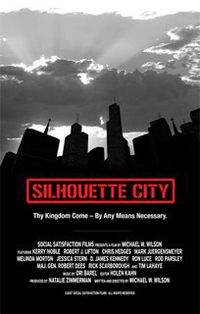
  • Is ‘Silhouette City’ this year’s ‘Jesus Camp?’

    Clive James, in his review of “American Movie Critics” for the New York Times Book Review in 2006 wrote, “…it’s the movie itself that tells you it means business. It does that by telling a story. No story, no movie.”
    “Silhouette City,” a new film by Michael Wilson, is a documentary about the rapid rise of religious extremism in America. It’s a haunting account of where the Christian evangelical movement has been and where it’s going, and it is impeccably researched.

    The film begins by covering an obscure Christian survivalist group called The Covent, The Sword and the Arm of the Lord. The CSA created a survival camp near Bull Shoals, Arkansas where they trained, stockpiled weapons and preached an apocalyptic end to the world. “We’re storing food,” one of the young girls in the film says. “We can’t tell you where or how much. We’re preparing.”

    (more…)

  • More Indy reviews hit

    First, this item from Jeff Wells is a long, drawn out way of saying the film is just, well — okay. I wonder if this is going to be the norm, a lot of passable opinions but nothing really in the way of a rave.

    Next up, Todd McCarthy offers insight, I’d say a little too quickly after the screening for a publication of Variety’s stature. And Eric Kohn (Corrected — Apologies to Eugene Hernandez.) of indieWIRE actually live blogged the screening, which is quite silly and unfortunate, I’d say.

    By the way, having not seen one frame and likely irritated by that fact, David Poland takes a piss out of both publications, in addition to badgering the Times of London for its uber-early review. Just so I’m covering all the bases here.

  • First review of ‘Crystal Skull’ lands in the Sunday Times

    It seems John Harlow of the Times of London has managed a screening of “Indiana Jones and the Kingdom of the Crystal Skull” at some point in the last week, sure to rub a number of self-perceived entitled journalists the wrong way. What’s more, he’s gone ahead with a full review, a totally positive assessment of the flick.

    Here’s a look:

    The good news for Ford fans is that Indy may be older and greyer, but there’s still a spark to his repartee, and he still gets the girl in the end (the girl in question being Marion Ravenwood, played by Karen Allen, who was the love interest in the first Indiana movie, Raiders of the Lost Ark).

    Whether Ford’s charm will be enough to earn the film the $400m it is estimated to need to recoup Paramount Pictures’ investment remains to be seen. However, a preview attended by The Sunday Times last week suggested that the internet gossips who have doubted the film’s drawing power may be proved wrong.

    And about “it” boy Shia LaBeouf:

    Much has been made in internet chatrooms about LaBeouf’s potential impact on the film, and fears that he is merely a sop to lure teen viewers. Yet LaBeouf, who made a striking impact against computerised villains in Transformers, matches Ford quip for quip and leather jacket for leather jacket.

    Rounding it out:

    The real pleasure for series fans may lie not so much in the madcap action, the carnivorous bugs and the familiar perils of quicksand, but the restored romance between Ford and Allen, and the fatherly relationship that develops between Ford and LaBeouf, who is clearly the new pretender to his whip.

    Indy treats Mutt with the same sarcastic disdain that his own father, played by Sean Connery, lavished on him during the Last Crusade. You can probably guess how it all works out.

  • Whew…

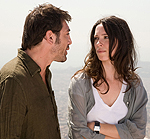
    I’m sure I’m not the only one who heaved a sigh of relief after reading some of the reviews of Woody Allen’s latest, “Vicky Cristina Barcelona,” which recently premiered out of competition at Cannes. The consensus appears to be that the film, while unlikely to enter the canon of his greatest, is an attractive, frothy entertainment.
    In his Variety review, Todd McCarthy puts it thus:

    “Vicky Cristina Barcelona” is a sexy, funny divertissement that passes as enjoyably as an idle summer’s afternoon in the titular Spanish city … pic offers potent romantic fantasy elements for men and women and a cast that should produce the best commercial returns for a Woody Allen film since “Match Point.”

    McCarthy is particularly enamoured of Penelope Cruz’s performance, deeming her to be “dynamite” in the film, and extending the Anna Magnani comparisons that we first started hearing when “Volver” emerged two years ago.

    Happily, The Hollywood Reporter’s Kirk Honeycutt is equally enthusiastic about the film, and is most impressed by its Spanish stars:

    The film belongs to Bardem and Cruz. This is a Spanish version of “Private Lives,” a couple that cannot live apart or together, whose love will always burst into fiery combat. Their scenes are some of the funniest Allen has ever put on film, and the culmination of this love/hate tango is not to be missed.

    I had a good feeling about this project from the get-go, but then I admit I’m one of those die-hard Allen supporters who maintains that “Melinda and Melinda” is a misunderstood almost-great, and tried his damnedest to find something – anything – to like about “Hollywood Ending.” So I’m thrilled to learn that this is likely to be one of those Allen treats I can enjoy guilt-free, without having to construct a defence case for it afterwards.

    As for awards prospects, after those notices, I’m going to go ahead and put Cruz on the lower rungs of my ladder of Best Supporting Actress contenders. Woody’s films have long been good to women in this category, and while the competition looks crowded this year, a slight but appealing performance from a well-liked star is often the one left standing when the bigger guns misfire. As for Allen himself, any film of his that is generally given at least a B+ by the critics is a contender for a Best Original Screenplay nomination, so I’m going to plunge in and put him on my list. What can I say? The sun’s out (at last) in London, one of my favourite auteurs appears to be back on track, and I’m in a generous mood.

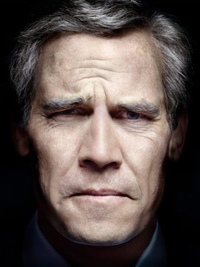
  • Stone’s ‘W’ could be his ticket back to Oscar

    I like the films of Oliver Stone, though I am acutely aware he tends to pound us over the head to get his message across, is known to bully his actors and audiences, and from time to time has bent history to suit himself and the film he is making.

    That said, it cannot be denied Stone creates powerful, visceral films, beginning with the vastly under appreciated “Salvador” back in 1986 that was somewhat overshadowed by his Vietnam drama “Platoon” which won the Oscar for best film and director making Stone a household name. Aside from being the most realistic film about the war in Vietnam, “Platoon” obliterated those terrible comic book style films like “Rambo: First Blood Part II” and “Missing in Action” in which the war had been reduced to a comic book and a single American could go back and win it!!

    Three years later he won his second Academy Award and Directors Guild Award for “Born on the Fourth of July” a film he had wanted to make for years, at one point in the 70s with Al Pacino as Ron Kovic. Both Vietnam films were powerful and deeply moving, populated with strong performances that drew the viewer into the story. In between those pictures he made “Wall Street,” now horribly dated, and “Talk Radio,” an underrated little film based on the hit play.

    (more…)