In Contention

Blog

  • Sticking to the music

    Way back in April, in my very first post for InContention as it happens, I reported that Marketa Irglova — the delightful star of “Once” and the woman responsible for the best speech of this year’s Oscar ceremony — was in talks to further her acting career by appearing in “Darkness,” a new horror film from Czech veteran Juraj Herz.

    Sadly, it’s not to be. Irglova has backed out of the project in order to tour with her personal and professional partner (and, of course, “Once” co-star) Glen Hansard. I shouldn’t complain, since I can’t wait to see them in concert, but it would’ve been interesting to see her on screen again. Here’s hoping something else comes up.

  • LONDON: Filling in the gaps

    Whew. A fortnight and 60-odd films later, I have reached the end of the London Film Festival. It came to a rousing close today with “Slumdog Millionaire,” a film for which I can only echo the enthusiasm that has been expressed nearly everywhere else — a fresh, thrilling, beautiful marriage of classical (even fairytale-style) storytelling and edgy stylistic verve. Plenty will be written about this beguiling work in the months to come, but for now, I’ll just say that it satisfies and surprises on just about every level.

    I’ve tried to keep up with the pace with my review roundups, but inevitably, I’ve wound up with a backlog of films I haven’t mentioned yet. So what follows is a quick catch-up effort, looking over some of the lower-profile hits and misses in 100 words or less.

    I will get into some bigger films in due course — Steve McQueen’s harrowing “Hunger” and Rian Johnson’s undervalued if occasionally precious “The Brothers Bloom” are two titles that merit more detailed discussion. And, as I’ve said before, there’s no need for me to discuss films that are already old news in the US (though I will say I finally caught up with “Frozen River” and was impressed by its tight construction and Melissa Leo’s deeply felt lead turn), or have already been covered on these pages. (I have similar sentiments to Kris on Ari Folman’s exquisite but overly distancing “Waltz With Bashir.”)

    So here’s a rundown of the littler guys, ranging from (to filch from the title of one of my favourite festival pics) the good to the bad to the weird:

    SUGAR (***1/2): One of the strongest American entries in the festival, Ryan Fleck and Anna Boden’s worthy follow-up to “Half Nelson” shares that film’s lyricism and humanism, but paints on a broader social canvas. The story of a young baseball pitcher from the Dominican Republic embarking on his Stateside career, it adds new textures to the sports-movie genre — no other baseball film has conveyed the knife-edge stakes of league politics more effectively. A rare portrait of the American Dream that skirts sentimentality, it benefits from the brooding, vulnerable presence of lead actor Algenis Perez Soto, and the hazy, summery tones of Michael Brooks’s cinematography.

    (more…)

  • AFI is here

    AFI Fest launches tonight with an opening gala of John Patrick Shanley’s “Doubt,” which as you’ve probably heard, we can’t write about for a week or so.  It’s understandable that producer Scott Rudin would prefer critical opinion flow out of the best case exhibiting scenario, so it’s all good.

    Nothing more from me for now as the fest (and festivities) will have me predisposed.  I’ll be stopping by the studio to fill in with John Campea at The Movie Blog: Uncut again in a few hours, so check that out around 5:00 PST.  Until tomorrow…

  • ‘Slumdog Millionaire’ trailer

    …has dropped at Yahoo! Movies.  I’m not overly impressed with it and I actually don’t think it totally represents the film’s emotion, but you gotta sell it.  Regardless, the further I spin away from the film, the more I’m becoming convinced that Dev Patel will land a nomination for Best Supporting Actor.

    Have a look:

  • TECH SUPPORT: Best Sound Editing — Volume One

    Tech Support at In Contention Swoosh.  Bang.  Grunt.  Clink.  Crash.

    These sorts of sounds can add a lot to a film’s mood and plot even though they are not recorded during filming and have to be created and mixed in later on.

    The individuals who create these effects are rewarded for their efforts in the category of Best Sound Editing.  The category used to be called Best Sound Effects Editing, which, in my opinion, is a better name.  Supervising sound editors and their teams are generally the individuals rewarded here.

    This category used to only have three nominees but was expanded to five two years ago.  This makes the category somewhat more difficult to predict, though there are five films this year that really strike me as frontrunners.

    Ever since “Monsters, Inc.” scored here in 2001, animated films, particularly those of Pixar, have fared very well.  I’d be very surprised if Andrew Stanton’s “WALL-E” failed to continue that trend.  Sound effects are key to any animated film so many of the sounds have to be created.  There is nothing to be captured while filming because, well…there is no filming!  For Stanton’s effort in particular, the sound effects were especially pivotal given the minimal dialogue.

    Jon Favreau’s “Iron Man” was another summer film where the sound effects were crucial to the film.  The explosions, clanks of armour and numerous experiments of Downey all required sound manifestation.  A huge hit and critically respected, the film in really depended on its sound editing and it flowed perfectly into the visual sights.  I’d be quite surprised if it didn’t get nominated here.

    (more…)

  • Caught it again last night

    Awesome flick for the season.  And still a classic:

  • Ebert hearts Hawkins

    I happened upon this a week late, so apologies for that, but I still think it bears mentioning. It’s no secret that Roger Ebert is probably one of the few critics who means anything to Academy voters. Whether it’s true or not that his backing of such underdog contenders as “Crash” played into their victories, people thinking you wield that kind of influence is an influence in itself.

    What I’m saying, in a long-winded fashion, is that when Ebert gets truly excited about a film or a performer, the sun often shines a little brighter on their Oscar campaign. And someone whose publicist must be smiling is Sally Hawkins, a well-liked but comparatively low-profile contender who needs passionate support to come through in a crowded Best Actress race. And, in his glowing four-star review of “Happy-Go-Lucky,” passionate support is precisely what Ebert offers:

    Poppy is one of the most difficult roles any actress could be assigned. She must smile and be peppy and optimistic at (almost) all times, and do it naturally and convincingly, as if the sunshine comes from inside. That’s harder than playing Lady Macbeth. Sally Hawkins been in movies before, including Leigh’s “Vera Drake” and Woody Allen’s “Cassandra’s Dream,” but this is her star-making role. She was named best actress at Berlin 2008. I will deliberately employ a cliche: She is a joy to behold.

    (It’s) a role very few women could play. Maybe Meryl Streep could sustain that level of merriness, but then what can’t she do? And now I must ask, what can’t Hawkins do? There are countless ways she might have stepped wrong. But she breezes in on her bicycle and engages our deepest sympathy.

    That’s heady praise there. He is also deeply impressed by Hawkins’s co-star Eddie Marsan, describing his performance as “spellbinding.” I’m not saying Ebert strikes gold every time, but should he continue to champion Hawkins and the film to such an extent, some voters might just be listening.

  • Small screen query

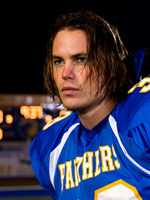
    Taylor Kitsch in Friday Night LightsOff topic, of course, but I wonder if everyone else is as disappointed with some of the fall’s mid-season series as I am.
    My DVR is generally packed with “Friday Night Lights,” “The Office,” “Heroes,” “The Shield” and yeah, “The Big Bang Theory” (I love it — it’s harmless).  But at least three of those are a total drag this season.  “Lights” hasn’t learned the soap opera lessons of its second season and is settling into another melodramatic groove, while “Heroes” is just too convuluted (as usual).  I honestly just watch it out of habit at this point, but I derive no enjoyment out of it.

    “The Shield” is properly building the tension for a Shane/Vic stand-off, but I can’t shake the feeling that it’ll be a soft landing.  “The Office” is hilarious as always, and “Big Bang” is my guilty pleasure.  Thank God for small miracles.

    I latched onto the first two episodes of “My Own Worst Enemy, glued to the set and eating it all up, only to feel a weird lull during the third episode.  Boredom set in and suddenly I got the feeling that the show doesn’t have much space to grow.  Maybe it’s just me.  And I also picked up “Supernatural” on a friend’s recommendation this season.  Very cool show.

    Mainly, I just can’t wait for “Lost” to come back.  Blew my mind last season.

    Anyway, you guys?  Thoughts on the fall TV season?  Agreements?  Disagreements?

  • The more things change, the more they stay the same

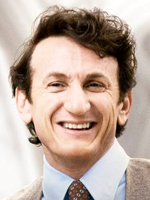
    Sean Penn in MilkI never got around to linking to Devin Faraci’s well-reasoned piece on the politics of “Milk,” but I want to take a minute to draw your attention to it this morning.  I think it’s a very sound assessment of what the film really does, which is challenge the viewer to be foolish enough to think that the country has carried Harvey Milk’s torch three decades after his assassination.

    A little from the piece:

    Thirty years later California has another anti-gay Proposition on the ballot, and it seems like the only progress we’ve made is in the numbering, since this one is Prop 8. On the surface Prop 8 doesn’t seem as draconian as Prop 6, but it’s just as cruel and evil at its heart; Prop 8 would ban same-sex marriages in California, which had been ruled constitutional by the California Supreme Court.

    Usually we go to see movies about civil rights struggles of the past and they feel like distant nagging voices to us: ‘Hey, black people used to have to sit at the back of the bus! They couldn’t use white people water fountains!’ There’s something safe about these stories, and we’re allowed to shake our head at the ghosts of bigots past or the pathetic, fringe clowns who make up the race hate establishment today. We shake our heads and feel better about ourselves because we’re so progressive and have come a long way, and we feel like we’ve done our part to keep these sorts of civil rights abuses from happening again because we saw this important movie about this important subject.

    But the gay rights movement isn’t something from the past*. We’ve made some progress – there are more gay characters on our TV shows than ever before, for example – but it feels like we’re still lagging in so many ways.

    Check out the rest here.  And if you’re a Cali resident, it goes without saying.  Vote “No” on Prop. 8 next Tuesday.  Make it clear, make it overwhelming clear that regression is a sin and that these are not the middle ages.  For God’s sake…forward already.

  • 10/29 Oscarweb Round-up

    Leonardo DiCaprio and Kate Winslet in Revolutionary Road• Steven Zeitchik thinks “Frost/Nixon” will get a pass for journalist worship. [Rizky Biz Blog]

    • Bill Horberg captures the San Francisco debut of “Milk” in pics. [William Horberg]

    • Eugene Hernandez, meanwhile, reports from the scene. [indieWIRE]

    • Ditto Brad Brevet, with some nice video interviews tossed in for good measure. [Rope of Silicon]

    • Jeffrey Wells draws a correlation between Nixon’s apology in “Frost/Nixon” and the painful knowledge that we’ll probably never get the same out of our current Commander-in-Chief. [Hollywood Elsewhere]

    • Anne Thompson gets a big thumbs up from the first long-lead screening of “Revolutionary Road.” [Thompson on Hollywood]

    • Susan King runs down the upcoming AFI Fest honorees. [The Envelope]

    • Xan Brooks runs down his six favorite Bond openings. [The Guardian]

    • Patrick Kevin Day reveals the secrets of makeup wizardry on “Synecdoche, New York.” [Los Angeles Times]

    • Mike Jones reports on “Adam Resurrected”‘s resurrection as an Oscar hopeful. [The Circuit]

    • Dave Karger and Missy Schwartz talk the year’s two remaining “mystery” films. [Entertainment Weekly]

    • Translation: “Blah, blah, blah…WHY WON’T YOU LINK TO ME?!…blah, blah, blah.” [And the Winner is]

  • LONDON: A note on ‘Che’

    Since its contentious debut at Cannes in May, Steven Soderbergh’s “Che” has attained a  reputation in certain quarters as some kind of intimidating four-hour monolith, even a grand folly. The 252-minute running time is invariably the first detail given about the film, a figure that seems to awe and repel people in equal measure.

    So it was interesting, at the London Film Festival, to watch “Che” in the format Soderbergh originally intended, and as it will eventually be distributed in wide release: as two separate films screened, in this instance, two days apart.

    I think it’s the right way to go, not from a commercial perspective (though probably that too), but an artistic one. For “Che” is no simple, single sprawl that has been bisected, miniseries-style. We’re talking about two individual, self-standing movies here, each one distinct in rhythm, tone and texture. Watching “Guerrilla” (Part Two) this afternoon, after “The Argentine” (Part One) had been knocking around in my head for 48 hours, gave me the appropriate distance to reflect on the changes that occurred in the man in the gap between the two narratives; I got the sense I was watching a life in progress.

    Both films are fine, muscular feats of storytelling, utterly compelling through their accumulation of military and domestic detail. There’s also a preoccupation with landscape here that recalls the earthy stateliness of 1970’s European art cinema — the Taviani brothers kept coming to mind for some reason, though they never made anything remotely similar. Despite the running time, barely a scene in either film feels wasted — if anyone’s life bears such intense scrutiny, after all, it’s Guevara’s.

    (more…)

  • Nolan talks Ledger and Oscar

    Heath Ledger in The Dark KnightI’ve held off on linking to Geoff Boucher’s three-part interview with “The Dark Knight” director Christopher Nolan at Hero Complex for two reasons.  First of all, it just seemed wiser to wait until it had run its course in full.  But mainly, I was waiting on the inevitable Oscar query.
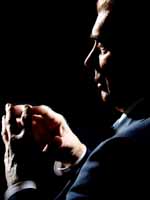
    Obviously, as Anne Thompson noted in a recent item, an interview like this is strategically placed to launch what hopes to be a successful Oscar campaign for the film.  Yes, the news peg of the Scream Awards was significant, but this kind of a deep one-on-one with a filmmaker of Nolan’s caliber serves a specific, immediate purpose: get “The Dark Knight” back on the radar in a deep, tangible way before Oscar advertising kicks in by the middle of November.

    In today’s third and final entry, Boucher finally gets to the issue of awards, specifically the potential for Heath Ledger’s instantly iconic portrayal to land a nomination for Best Supporting Actor.  In response, Nolan had this to say:

    I think the thing that has always been important to me in light of Heath’s death is the responsibility I’ve felt to his work. The responsibility of crafting the film in such a way that his performance came across the way he intended. Clearly, that has been the case. That’s one of the reasons I take such pride in the film.

    I felt a great wave of relief, really, as people first started to see the performance and it was clear that they were getting the performance. It’s easy to forget with everything that’s happened what an enormous challenge it was for Heath to take on this iconic role. He rose to that challenge so admirably that any expression of people being excited or moved by his performance is a wonderful thing. Whatever form that takes. People coming to see his performance and getting it. It’s been extremely satisfying for all of us already. Anything that adds to that would be wonderful.

    Do yourself a huge favor and read this series: Part One, Part Two and Part Three.  Whether you’re a Bat geek, a recent convert or simply an admirer of Nolan’s work, there is something for everyone.  A fine interview and, as I’ve noted before, a fine outlet for geekdom in Traditional Media.

  • ‘Milk’ing it further

    Not to spend too much time today on “Milk” stuff, but I absolutely adored WNYC writer Nathan Lee’s closing graph of a piece written largely in response to yesterday’s unfounded media flurry over the studio strategy of publicizing the film:

    Of course no one is feeling very chill at the moment, and “Milk” is no ordinary prestige picture. Here is, after all, a movie about an intensely charismatic, rhetorically gifted community organizer who rose to power with a burden of minority status. Sound familiar? Indeed, it’s impossible to watch “Milk” and not see the Obama narrative reflected in ways that are both stirring and unnerving. Were “Milk” already in theaters and chewed over by the media, it would have been sucked into the election discourse like everything else – and likely raised the subject of political assassination in ways that no one much wants to contemplate.

    Read the rest here.  Also, Focus honcho James Schamus has written a defense against the Zeitchik piece that is certainly worth a look:

    …today has been proclaimed “Focus Features Day” by the Mayor – who clearly didn’t get The Hollywood Reporter in time to understand our underhanded, apolitical approach to marketing the film.

  • Just because I’m paranoid doesn’t mean people aren’t trying to kill the movie

    Frank Langella in Frost/NixonFor the most part, I really enjoyed Sasha Stone’s recent “State of the Race” column at Awards Daily.  Stone’s been kicking around this beat for longer than she’d probably care to remember and she has a gift for thinking deeply about the insanity of an Oscar race.  But I think she takes the issue of “tension” this season slightly over the top by leaning a bit too heavily on the eagerly posted sentiments of a new-to-L.A. blogger trying to make his mark.

    She starts like so:

    Over at Hollywood-Elsewhere, Jeff Wells reports that both Milk and Frost/Nixon are pretty good, in his estimations.  He gives them both about an 8.5 on a scale of one to ten but says he doesn’t understand what the early impressions of Frost/Nixon were about and the so-called bad buzz he heard about Milk was also unfounded.

    She then quotes Scott Feinberg, an Oscar blogger who seemed to think people with a measured response to “Milk” had somehow lost their credibility because they didn’t leap at the hero worship of the tale and felt the film didn’t resonate as deeply as it might have.

    To begin with, it’s clear Feinberg made the comment to elevate his status a bit.  “Look, people send me tips.”  That kind of thing.  But beyond that, we’re not at the stage of rival publicists killing this film…yet.  And while I’m sure Wells understands that, I’m not sure that Feinberg does.

    Long lead press and trade features staffers made up the majority of those who’d seen “Milk” prior to yesterday’s trio of screenings in California (two for the press here in L.A. and a premiere/benefit in San Francisco).  There’s no agenda for them to convey lukewarm sentiments to the film, so to blow their reactions and their motives into something false is very irresponsible.

    (more…)

  • SHORT TAKE: “The Baader Meinhof Complex” (***)

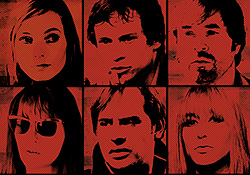
    The Baader Meinhof ComplexGermany has hit something of a sweet spot with the Academy of late, having won Best Foreign Language Film twice in seven years, and scoring two additional nominations — all with somber, rock-solid takes on aspects of the country’s fascinating 20th-century history. (Last year’s winner, “The Counterfeiters,” may have been from Germany’s neighbor Austria, but it was a clear continuation of the trend.)

    So I’m not at all surprised to hear whispers that this year’s German entry, “The Baader Meinhof Complex,” is going down well at Academy screenings. A weighty, expansive and absorbing study of the war of terror waged against the state by the radical Red Army Faction in 1970s Germany, as well as the personal conflicts raging between its three leaders, it ticks any number of Academy boxes: it feels ‘important’ yet accessible, exotic in subject but familiar in form. Intelligently structured and immaculately crafted, its initially daunting 150-minute running time fairly zips by.

    Yet it isn’t quite a great film. Where Florian Henckel von Donnersmarcks’s stunning “The Lives of Others” managed to filter volumes of political context through a finely wrought personal narrative, “The Baader Meinhof Complex” — admittedly working within the bounds of non-fiction — occasionally struggles to locate the human complexity within the history.

    The three protagonists speechify to rousing effect, but their psychological motivations and vulnerabilities remain frustratingly opaque to the end. Fine actors like Martina Gedeck and Moritz Bleibtreu consequently can’t find enough notes to play in the portrayals of the title characters; more compelling is Johanna Wokalek, who, as Baader’s wife Gudrun, colors her political passions with a fierce sexuality.

    Uli Edel directs with a sure, selfless hand, placing story before style, which makes sense with story material this rich. While his approach borders on the prosaic at points (I could do without such literal music cues as “Blowin’ in the Wind”), this is still robust meat-and-potatoes filmmaking: not as innovative or as challenging as other fare on offer, but nutritious nonetheless. The density of incident and detail crammed into the film’s frame is impressive, but it’s hard not to come away wishing one knew the people at its centre a little better.