It looks like “Secretariat” and “The Social Network” slipped out of the top 10 this week. The former finally had a drop over 40%. Did you guys see any of the dreck that opened this weekend?
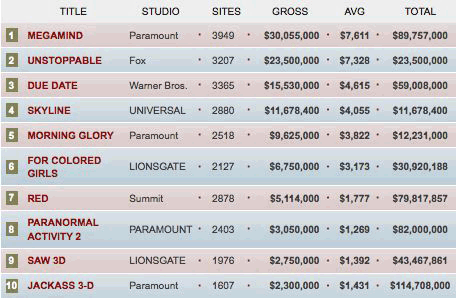
(Courtesy: Exhibitor Relations)
It looks like “Secretariat” and “The Social Network” slipped out of the top 10 this week. The former finally had a drop over 40%. Did you guys see any of the dreck that opened this weekend?
(Courtesy: Exhibitor Relations)
 A great score can take a film from memorable to unforgettable. Whether it be Vangelis’s synthesizer on the beach in “Chariots of Fire,” Nino Rota’s haunting waltz from “The Godfather” or John Williams’s blaring, adventurous march from “Raiders of the Lost Ark,” scores can elevate amazing images to bring the director’s vision to even greater fruition.
The last time I discussed this category, I noted how it is very hard to predict in advance without having heard the scores. Synopses and stills give clues in other categories to an extent frequently not seen here. That said, most contenders have screened, if not opened, now, so we can make safe assumptions.
But I still think this can be one of the most difficult categories to predict. But in the way of patterns, films that feature noticeable, loud, memorable and often exotic music are usually contenders. And being in a Best Picture frontrunner never hurts matters, as always.
This branch certainly has its favorites, and I expect to see past nominees and winners prominent in the race this year. The composers don’t frequently embrace new nominees. Usually only one newcomer is welcomed per year.
 • Anthony D’Alessandro on how box office impacts Oscar players. [Thompson on Hollywood]
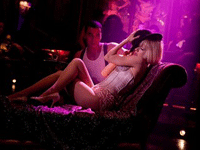
• Kim Masters writes up the juicy story of on-set fighting that marked the production of “Burlesque.” [Hollywood Reporter]
• Christy Grosz on awards season buzz momentum built on the festival circuit. [The Envelope]
 (From here on out, my nomination predictions will be updated weekly to coincide with this column. Check them out here.)
Tweed-coated and steam-breathed, winter formally arrived in my corner of the world this week, and with it the slightly grim realization that just over seven weeks remain of this year.
I say “grim” not so much because I’m unprepared for the rigors of Christmas shopping or because 90% of my year’s to-do list remains undone—though neither of those truths are helping—but because, from a film perspective, 2010 feels to me like it needs at least another couple of months to find itself.
Yesterday, I found myself battling with two lists of 10 films: the first, my own provisional best-of-year collective, the second, my revised predictions for the Best Picture Oscar nominees. Neither list, in my experience, has ever had much to do with the other (of course, I’ll take that back should the Academy reveal hidden depths of enthusiasm for, say, “White Material” on nomination morning), but both the rough drafts I wound up with had one thing in common: they’re badly in need of a late-breaking great film or two.
 • Sasha Stone on the season’s screenwriting contenders. [Awards Daily]
• “The King’s Speech” director Tom Hooper also hates the poster everyone has been knocking. [Movieline]
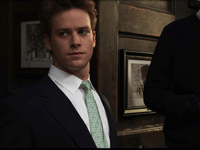
• David Poland split screens “The Social Network” star Armie Hammer. [The Hot Blog]
 A reader comment got me thinking on box office and Oscar as the usual blockbuster and genre fare led the way in ticket sales this weekend. It dawned on me that pickins might be extra slim when it comes to representing populist filmmaking in 2010’s Best Picture crop.
Box office and finding room for ratings-friendly titles have long been assumed considerations in the decision to expand the Best Picture category to 10 nominations last year. One year after Christopher Nolan’s “The Dark Knight” nearly reached “Titanic”-level numbers and was snubbed of a Best Picture nomination, there were suddenly five more spots to be filled, widening the net.
Academy members had seven films to choose from the $100 million-plus club in 2009 that had any legitimate excuse for being in the conversation. They were: “Avatar,” “The Blind Side,” “District 9,” “The Hangover,” “Inglourious Basterds,” “Star Trek” and “Up.” And some would consider “The Hangover” and “Star Trek” to be a stretch. As such, they missed, and the other five made it.
 It’s fair to say that there aren’t many movies in 2010 — much less in the awards race — that have earned the distinguished attention of The New York Review of Books, let alone a 5000-word essay by a superstar of contemporary literature. But such is the curious magnetism of “The Social Network,” whose queasy social currency has now been nailed, better than any film critic has managed thus far, by New York-based British writer Zadie Smith.
I’ve always thought Smith a better essayist than a novelist, and her quasi-review of David Fincher’s film is a tour-de-force, using Aaron Sorkin’s script (the verbality of which she likens to “His Girl Friday”-era comedy) as the starting point for a stinging but compassionate address to ‘Generation Facebook,’ its communicative lapses and its identity insecurities. She likes the film quite a bit, but that’s almost beside the point: it’s more of a compliment that she felt it merited this level of scrutiny in a publication dedicated to another medium entirely.
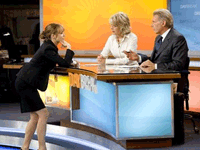 • Pete Hammond talks “I Am Love” with dark horse Best Actress contender Tilda Swinton. [Deadline]
• How DreamWorks Animation is using social gaming to boost “Megamind.” [Hollywood Reporter]
• Meet the characters of “Morning Glory.” [MakingOf]
 • Across the pond, Deborah Orr on a 15 rating due to harmless swearing weighing down an uplifting film like “Made in Dagenham.” [The Guardian]
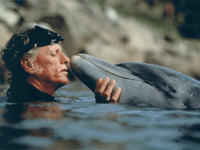
• A feature biopic is in the works about “The Cove” activist Ric O’Barry. [Deadline]
• The deadline for animated feature submission nears. [Oscars.org]
 So important but so hard to notice. That’s how I would describe the work of our best film editors – those cutting artists who blend and juxtapose frames together to make films coherent, establish a flow and also set the mood in a manner that suits the screenwriter’s words and the director’s vision.
The Academy Award for Best Film Editing is, more than any other category, very much tied to the Best Picture race. Despite a blip from 2005-2007, this category always has at least three – usually four, sometimes all five – of its nominees also nominated in the big category. Now that there are 10 nominees, however, one cannot help but wonder if we are ever going to again see a nominee here also not cited in Best Picture.
Apart from Best Picture contention, being a war film, action film or musical never hurts here. I must say, however, that since I last previewed this category in August, I continue to believe that the three titles I had leading the way then are still out in front.
 About a year ago I took to examining the 2009 Best Actor race. The frontrunners for five slots seemed to be, in order, George Clooney, Colin Firth, Jeremy Renner, Morgan Freeman, Daniel Day-Lewis, Viggo Mortensen and Robert De Niro.
A day later press members received their first invites to “Crazy Heart” screenings and were notified that the film would be released in 2009. Jeff Bridges hit the ground running and never let off the gas until he was past the finish line.
A year earlier we were looking at a pair of politico-biopic portrayals, either one of which would make a handsome winner: Frank Langella and Sean Penn. But we were fairly sure the latter would be on his way to the podium one more time.
But soon after, Mickey Rourke’s festival buzz caught serious fire and forged an atmosphere of doubt. The season’s narrative seemed to be changing, and yet the early buzz carried through and brought Penn his Oscar.
So that’s two drastically different directions – in as many years – that a lead actor race can take. Given the mid-October fulcrum shared here, let’s consider our perspective on the Best Actor category right now.
 • Jeffrey Wells calls “Love & Other Drugs” Edward Zwick’s best film yet. [Hollywood Elsewhere]
• Peter Knegt assesses the Gotham Award nominations. [indieWIRE]
• Nathaniel Rogers hearts Sam Rockwell in “Conviction.” [Tribeca Film]
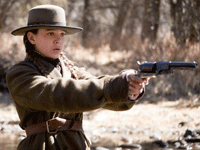 • Anthony Breznican chats briefly with “True Grit” star Hailee Steinfeld. [USA Today]
• Sasha Stone on seat-seeking and saving in the grand theater of Oscar season. [Awards Daily]
• Mark Zuckberg says the framing device for “The Social Network” is inaccurate. He just likes building things, okay? [Thompson on Hollywood]
 • Jeffrey Wells posts a reader review of James L. Brooks’s “How Do You Know” that claims Paul Rudd is a sure-fire Best Supporting Actor nominee, but I’d expect a lead campaign for him and buzz for Jack Nicholson in support. [Hollywood Elsewhere]
• Steve Rose on the secret of the Winkelvi from David Fincher’s “The Social Network.” [The Guardian]
• Roger Ebert still high on “Secretariat,” sits down with the source material’s author, Bill Nack. [Chicago Sun-Times]
 • Off the Carpet picked out the likeliest runners in a highly malleable Best Supporting Actress race.
• We checked in on the Best Animated Feature race, where it seems we may be looking at a three-nominee field after all.
• Away from the awards beat, the week’s big news was the casting of Tom Hardy in Christopher Nolan’s next Batman venture.
• The Academy formally revealed the list of 65 contenders for Best Foreign Language Film.
 You know Eduardo Saverin, the Facebook co-founder played by Andrew Garfield in “The Social Network” who won an undisclosed sum of money when he sued Mark Zuckerberg and still kept his name on the masthead of the site, yet we haven’t really heard from him on the matter? Well, he finally broke his silence in — where else — a blog.
Serving as a guest blogger for CNBC, Saverin took the opportunity to shine a light on what the film says about forward momentum in an entrepreneur-driven society rather than nitpick factual accuracies and inaccuracies. In so doing, he may have made the most convincing case for considering David Fincher’s work “the film of a generation,” to toss out Peter Travers’s quote one more time.
What is a generational film, anyway? It was a question posed by Bill Cody at Rope of Silicon earlier this week. I wonder. Sometimes such classifications feel like little more than hyperbole, but it seems a lot of people really want to believe it when it comes to “The Social Network.”
 Today we take a look a second look at, well, certainly the most “cinematic” of categories: Best Cinematography. As I like to say, cinema is born out of the camera and those who wield these devices enrich our films more than a few words written here could possibly say. From capturing mood, lighting and atmosphere to telling the story visually and creatively, our cinematographers truly are artists in every sense of the word.
Naturally, “pretty” films, war films and Best Picture nominees all have a knack for doing particularly well in this category.
Now that the trailer for “True Grit” has reached the internet, I surely cannot be the only person asking…is this the film that will finally bring Roger Deakins his Oscar? He has eight nominations (four for Coen brothers films), tragically winning zero times. The photography looks amazing, and the film is exactly the sort that would seem to excel in this category. That the film also looks like a bigger Oscar player across the board (more than I was originally expecting) is merely icing on the cake.
 • Melissa Silverstein on female dominance in the documentary shorts field. [Women and Hollywood]
• Turns out Clint Eastwood filmed an early, unpolished draft of Peter Morgan’s “Hereafter.” Well…it shows. [Vulture]
• Speaking of which, David Cohen spotlights the impact of digital wizardry on that story-driven film as well as Darren Aronofsky’s “Black Swan.” [Variety]