In Contention

Tag: RocknRolla

  • Why the public should never be allowed to vote for anything

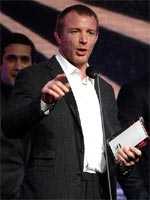
    Guy Ritchie at the Empire AwardsExcept maybe the occasional president. And, okay, a reality-TV contest or two. But film awards — no. As spectacularly wrong as organizations like the Academy, and the odd critics’ groups, can get it sometimes, nobody can rival the collective movie-going public for sheer cluelessness when it comes to determining the best of the art form.

    Case in point: the Empire Awards, voted for by readers of the eponymous film magazine, which took place in London on Sunday. Of course, it’s a fluffy, meaningless ceremony — a good excuse for a party more than anything else — but their choices are, nonetheless, a worrying barometer of just how low independent and/or adult-oriented cinema lies on the radar of most cinemagoers.

    Exhibit A, and the real groaner of the night: the public’s choice for Best British Film. While the rest of us have been singing the praises of, say, “Hunger” or “In Bruges” (both nominated, rather miraculously in the case of the former), the Empire readership apparently lives in some parallel universe where the best that British cinema had to offer in 2008 was, er, “RocknRolla.”

    You’d hardly expect a film as challenging and specialized as “Hunger” to take a public award, but “In Bruges” occupies precisely the same genre territory as Guy Ritchie’s dismal last effort, with the crucial difference that it does so with wit, intelligence and a modicum of originality. It’s hardly news that the public doesn’t place much stock in such virtues, but it’s depressing all the same.

    (more…)

  • Small pleasures: Guy’s best (and worst) of 2008

    It’s a lovely thing when you realize, at least part of the way through adulthood, that we still possess the ability to surprise ourselves. When left to graze at leisure, the mind can stumble upon some unexpected notions, frequently overriding the conclusions we thought we had reached after twelve months of watching, writing and (occasionally over-) thinking. And more often than not, it knows best.

    This is what I discovered when I sat myself down on a poolside lounger in the remote hills of Portugal’s Algarve region and set about finalizing this list, which had been eating away at me for the better part of the last six weeks. After various tortured drafts drawn from my scrappy 2008 diaries, notebooks and In Contention entries — none of which looked sufficiently reflective or, frankly, right to me — I decided to dispense with notes entirely and start from scratch, using my memory as my sole resource.

    And so it was that when I asked myself, “What’s the best film you saw in 2008,” the answer that came was not only amazingly swift, immediately satisfying and ultimately inarguable, but it was not the answer I expected to receive. Of course, I knew the film would crop up somewhere prominent in the list — the mind is a filter, after all, not a magician’s hat — but it was one of several films this year (and indeed, on this list) that I would call “growers.”  You see them, you like them, but it takes a few weeks, months even, of rumination and interpretation before you realize just how much you love them.

    It’s something that should be borne in mind when it comes to awards voting, which work on a “survival of the fittest” basis: some films simply take longer than others to make a collective (or selective) impact. This may rule them out of competition time frames, but it doesn’t make them lesser achievements. Similarly, certain films that seem like huge, important deals at the time can leave us scratching our heads when removed from the flurry of the season. In a perfect world, Oscar voting would take place a year or two (or 10) after the release of the year-end glut — but it was ever thus.

    One perception of mine that hasn’t changed through the compilation of this list, however, is that it’s been a year of bijou pleasures. As one talked-up Hollywood title after the other disappointed, dissipated or dared to be merely “good,” the films left standing for me were mostly on the intimate side: small but beautifully formed works bound by character rather than concept, often asking penetrating questions about society, family and the nature of the individual. As the Americans, by and large, treaded water, European cinema soared, with France enjoying a particularly golden streak — the likes of which we haven’t seen in well over a decade.

    I may have complained often in these pages that it’s been a “bad year” for film, but as I look down the list of 20 titles that I finally arrived at, covering as it does a pretty rich variety of moods and forms, it now seems graceless to say so. When Hollywood flickers, different voices emerge, and for that we should be grateful. Perhaps it hasn’t been a bad year…just a smaller one.

    (more…)
  • Will BAFTA stick by their own?

    I have a bit of a love-hate relationship with the BAFTA Awards. On the one hand, they can be far more daring and playful in their choices than the American Academy — this is an organisation, after all, that has handed their Best Film award to such enduring works as “The Purple Rose of Cairo,” “GoodFellas” and “Lacombe, Lucien,” while nominating the Oscar-snubbed likes of “Eternal Sunshine of the Spotless Mind” and “The Usual Suspects.”

    Their technical awards are invariably more imaginatively awarded, too — take a look at their Best Film Editing category, for example, which in recent years has crowned “Eternal Sunshine,” “City of God” and “Mulholland Drive” as winners. And they can often be counted upon for gratifying upsets, as when Pedro Almodovar pushed past Sam Mendes for Best Director in 2000, or when “Trainspotting” blindsided “Sense and Sensibility” in the 1996 screenwriting race.

    For an awards show that fancies itself world-class, however, BAFTA can be infuriatingly parochial in their selections, stubbornly rewarding their own in the face of bigger, bolder competition. I doubt most of the voters could say with a straight face that “Four Weddings and a Funeral” was the very best film of 1994, nor “The Full Monty” of 1997, but they cleaned up nonetheless.

    For the last two years running, that kind of provincialism has ruled the voting, with this year’s awards looking particularly suspect. I think “Atonement” is a fine film, but handing it their top award seemed tokenistic at best, not least when the only other gong it took was for Best Art Direction.

    It’s a trend that Variety thinks could continue this year. In an article previewing the British contenders in the acting categories, they point out that Limeys have taken 16 acting BAFTAs in the last decade, compared to seven Oscars. Needless to say, they are frequently justified. It’s fair to say that this year, several British names will be cropping up in awards lists on either side of the Atlantic, and deservedly so — particularly in the Best Actress category, where thesps like Kristin Scott Thomas, Sally Hawkins and the ubiquitous Kate Winslet are all likely to figure.

    (more…)

  • 9/6 Oscarweb Round-up

    Gerard Butler and Thandie Newton in RocknRolla• Nancy Kriparos keeps her Oscar diary going with looks at “Passchendaele,” “RocknRolla” and “Burn After Reading.” [Awards Daily]

    • Tom O’Neil and Jeffrey Wells talk up the Oscar prospects of Danny Boyle’s “Slumdog Millionaire.” [Gold Derby]

    • Wells, meanwhile, seems to be talking himself out of seeing Spike Lee’s “Miracle at St. Anna” as best he can. [Hollywood Elsewhere]

    • David Poland calls “Lovely, Still” the first real surprise of Toronto. [The Hot Blog]

    • Anne Thompson responds positively to Richard Linklater’s “Me and Orson Welles.” [Thompson on Hollywood]

    • The Kingdom of Jordan will leap into Oscar’s foreign language film race for the first time ever with Amin Matalqua’s “Captain Abu Raed.” [Variety]

  • Oceans apart

    One of the great things about getting to review a film before the general press has had their say is having no idea where your views will stand in the tide of critical opinion. With only gut expectations to live up (or down) to, one can respond to nothing but the work at hand.
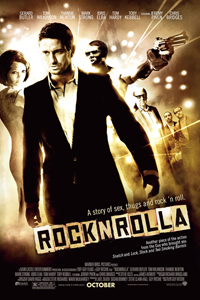
    So it was last week when I reviewed Guy Ritchie’s “RocknRolla,” which screened yesterday in Toronto and opens in the UK today. I thought it a dismal effort, but was quite prepared to be in the minority on that one. Nonetheless, the extreme split in opinion that is emerging has taken me by surprise — not least because it seems to be on geographical lines.

    The UK reception for “RocknRolla” has been decidedly frosty, with the tabloids and the more highbrow broadsheets seemingly united in their contempt for the film. The Daily Mail deems it an “embarrassing turkey,” and The Guardian — in a one-star review that’s not as funny as Peter Bradshaw thinks it is — is right with them, calling it a “shocker.” (Or “shocka,” to use Bradshaw Mockney-aping spelling.)

    The Times is moderately kinder, acknowledging its entertainment value, but complaining that “it brings back too many jaundiced memories and fails to lay any fresh tracks.” The drubbing continues at The Independent, who blame the “inexcusable banality” of Ritchie’s script, while The Telegraph complains the film is “loud and brash but goes nowhere.”

    Cross the pond, however, and the US trade papers seem to have seen an entirely different film at Toronto. Variety loves “RocknRolla,” declaring it “cleverly constructed, sensationally stylish and darkly hilarious,” and predicting strong Stateside business. The Hollywood Reporter seconds that emotion, calling it Ritchie’s “most accessible and enjoyable film yet.” (Have they seen “Lock, Stock and Two Smoking Barrels?”)

    (more…)

  • REVIEW: “RocknRolla” (*1/2)

    Warner Bros. Pictures\'s RocknRollaShort of seeking or citing any legitimate critical opinion, the marketing team behind “RocknRolla,” the fifth feature from Guy Ritchie, have gone to much effort to portray it as a creative comeback for the much-maligned filmmaker.
    Here in the UK, the words “return to form” are splashed prominently across billboards for the film (set to make its North American bow at the Toronto fest): a frank admission that Ritchie’s last two efforts, “Revolver” and “Swept Away,” were across-the-board disasters. They appear to be working the angle that this is something of a back-to-basics effort, a happy reunion between Ritchie and knockabout gangland comedy.

    And indeed, for the first few minutes of “RocknRolla,” hopes are high that Ritchie has rediscovered the fleet-footed timing and lightness of touch that made his trend-setting 1998 debut “Lock, Stock and Two Smoking Barrels” such a delight, and its lesser follow-up, “Snatch,” such a guilty pleasure. The animated credit sequence, as you may have heard, is a thing of considerable beauty. More importantly, the opening scene, which employs swift, sexy cuts between multiple actors and locations to maintain a multi-voiced monologue on the fortunes of present-day London (Ritchie presumably wrote this before the recession), is something to behold.

    But then the pace settles, the actual narrative reveals itself — and the whole enterprise, shorn of these initial stylistic tics, steadily falls apart. Ritchie has dialed down his style of story construction since the incomprehensibly convoluted “Revolver,” but he may have overcompensated — the size of the ensemble notwithstanding, there is really very little storytelling motor here.

    (more…)

  • New Toronto films announced

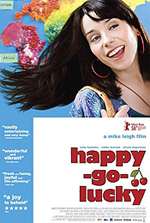
    Miramax Films\' Happy-Go-LuckyThe press office of the Toronto International Film Festival (TIFF for future purposes) announced some new titles for the line up at this year’s festival yesterday.

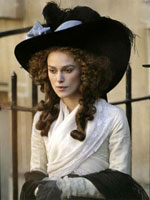
    Two Gala Presentation announcements include “The Secret Life of Bees” with Dakota Fanning, Paul Bettany, Jennifer Hudson and Queen Latifah, and “The Duchess” featuring Keira Knightley in the biographical role of a woman who brought sweeping political change to England with her progressive attitudes.

    In the Special Presentations Program we have “Every Little Step,” looking to be a fascinating documentary about the making of the Broadway sensation “A Chorus Line,” which dominated American Theatre in the late 1970s and early 1980s. It was royally screwed up as a film by the vastly over-appreciated Sir Richard Attenborough.

    From the great Wong Kar-Gai comes “Ashes of Time Redux,”  while Mike Leigh brings to us the highly anticiapted “Happy-Go-Lucky”. Guy Ritchie will unveil “RocknRolla” to audiences here with Larry Charles bringing to our fair city his new picture “Religulous”.

    “Ghost Town” sounds promising, as the story follows a man portrayed by Ricky Gervais who dies unexpectedly and is revived with the powert to see ghosts. And as expected, “Waltz with Bashir” will make its North American premiere here at TIFF.