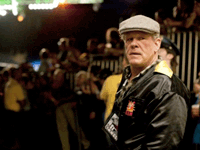
 • Nick Nolte talks “Warrior.” [Making Of]
• A little southern perspective on “The Help.” [Los Angeles Times]
• Greg Wellwood considers who got an Oscar boost at Telluride and who didn’t. [Awards Campaign]
• Nick Nolte talks “Warrior.” [Making Of]
• A little southern perspective on “The Help.” [Los Angeles Times]
• Greg Wellwood considers who got an Oscar boost at Telluride and who didn’t. [Awards Campaign]
 I have to say, even though the pieces were there and I tend to respond overwhelmingly to father/son dramas, I was really surprised at how little I felt emotionally while watching Gavin O’Connor’s “Warrior.” And O’Connor really excels at this stuff, in general, for me. But it didn’t come together this time.
I feel pretty much alone here because the film has been affecting a number of critics and press members for the past month or so now and the room I was in tonight was all energy and tears, right there with it. But I don’t know, there is something in the fabric of the writing that kept me at arm’s length.
So Nick Nolte’s Paddy Conlon character was an asshole father to sons Tommy (Tom Hardy) and Brendan (Joel Edgerton). I know this because I’m being told over and over and over again. I know it, but I don’t feel it. Being presented with a thousand-day sober man looking to make amends really shoots that in the foot and you start wondering why his kids can’t just stop being pricks. Something, anything, that would have keyed us into their perspective would have gone a long way.
 If you can believe it, it’s been since Halloween that we kicked the dust off this feature at In Contention. We made it all the way through the Oscar season without feeling compelled to go there. Odd. So, with Terrence Malick’s “The Tree of Life” opening in New York and Los Angeles this weekend, before expanding to other cities throughout June, it seemed a good time to dig back in and cook up a collective that might drive a little more interest in the discussion.
The easiest thing I could think of was a list of the best performances from Malick films, and as I sat down to revisit all five of the director’s works last week, it became clear it was as good a choice as any. There is, after all, plenty to choose from.
Malick films contain a wide-ranging array of performances, all of them proving to be singular feathers in the caps of many actors. Indeed, when an actor stars in a Malick film, he or she is met with direction unique to any other experience, and it can yield great, unexpected work. Naturalism and a sense of authenticity are hallmarks of these portrayals, as Malick likes to scrape away the dishonesty of “performance” and get to something truer, with all the imperfection that comes with it.
For my money, the following 10 represent the best of the lot. Let’s dive in…
 Doesn’t it feel like television is moving into a new golden age? Everything from hour dramas to half-hour comedies is as impressive as ever and top filmmaking talent continues to make the jump. We’ve already seen Martin Scorsese’s impact with “Boardwalk Empire” this year and if there’s one thing I’m looking forward to on the small screen, it’s the upcoming Michael Mann/David Milch horse race drama “Luck” on, where else, HBO.
This is a powerhouse partnership by anyone’s measure, and that’s before you even get to the talent in front of the camera (Dustin Hoffman and Nick Nolte will star). Both of these guys, Mann and Milch, are alphas, to quote one actor I talked to about the show at a festival last year (who has worked with both and who shall remain nameless). But they’re also creative beasts.
Geoff Boucher wrote a piece for this weekend’s LA Times and, of course, touches on that little nugget of intrigue. He gets quotes from Hoffman, Mann and Milch on the matter, as well as HBO programming president Michael Lombardo (misidentified as David Lombardo).
 In Alexander Payne’s “Sideways,” Paul Giamatti gave the best performance by an actor in 2004, so said the New York Film Critics Circle, and how right they were. So why, why, why was the actor denied an Oscar nomination? Granted, it was a strong year, but his work was at the top of that heap and that snub was one of the biggest shocks of the year.
Here was a man giving perhaps the finest performance in a comedic film since Dustin Hoffman in “Tootsie.” His co-stars go were recognized, save for the equally deserving Sandra Oh, but the leading man, around whose performance the film stands, is snubbed. All I can remember saying is: “Wow.”
Certainly Jamie Foxx deserved the attention he received for “Ray” and Leonardo DiCaprio was astonishing in “The Aviator,” even though he drew some criticism for before too youthful in the role. Rubbish, I thought. He was superb, inhabiting Howard Hughes as he must have been in those days, brash, cocky, wealthy and willing to do anything that interested him.
Clint Eastwood was terrific in “Million Dollar Baby,” while Jim Carrey gave a wonderful performance in “Eternal Sunshine of the Spotless Mind” — a marvelous piece of acting, in fact. Equally fine, and dark, was Kevin Bacon as a pedophile struggling to start anew in “The Woodsman,” which was one of the most daring American films in a long time.
 For all my bitching about Roberto Benigni winning Best Actor in 1998 for his incessant mugging in “Life is Beautiful,” I was also thrilled the Academy watched enough films and paid enough attention to realize that Edward Norton was deserving for his magnetic turn as a neo-Nazi who sees the light in “American History X.” Norton was electrifying as Derek, the charismatic leader of a group of skinheads, handpicked by the older gentleman, played with menace and sleaze by Stacey Keach, who believes in what Hitler taught and seeks to spread the word to the youth of California.
Norton gave the best performance by an actor I saw in 1998, but the Academy got caught up in the groundswell of support of Benigni’s movie, a fable set in a death camp. I’m not a fan, either of his overwrought, over the top performance, or the film itself. No rant, you all know what I think there.
That said, there was a bounty of great male performances in 1998, many of which went unnoticed by the Academy. They did their best to get it right, though. Joining Norton and Benigni for nominations were Nick Nolte in “Affliction,” Ian McKellen, superb in “Gods and Monsters,” and Tom Hanks as the weary soldier in Steven Spielberg’s magnificent “Saving Private Ryan.”
Not even nominated, however, were Warren Beatty for his brilliant turn as the truth-talking senator in “Bulworth,” Joseph Fiennes in Best Picture winner “Shakespeare in Love,” Jim Carrey in “The Truman Show,” George Clooney in “Out of Sight,” Brendan Gleason in “The General” and John Travolta in “Primary Colors” or “A Civil Action,” take your pick. And perhaps the most deserving of all: Jeff Bridges as The Dude in “The Big Lebowski,” the actor’s finest work, in my opinion.
Each of the aforemenetioned men gave stronger performances than the eventual Oscar winner, yet failed to nab a nomination. Jeez!
 So many of today’s youth have not seen films made before the year they were born and they are missing so much. I remember being 18 and spending some time with my girlfriend at the time at her job, which allowed for me to get a lot of reading done. One of her co-workers expressed some surprise that I was reading Charlie Chaplin’s autobiography. “Do you have to know everything about movies John?” Without hesitation I answered, “yes,” and still feel that way. The great directors of cinema past and present knew as much as they could ABOUT cinema past and present. Aspiring filmmakers should certainly take their cue.
Once, while showing “Psycho” in my film history class, a student suddenly shouted, “Marcellus Wallace and Butch…man Tarantino lifted this,” and he was right. There is a scene in the film where Marion Crane encounters her boss crossing a street in much the same manner Butch encounters Marcellus in “Pulp Fiction.” It’s small but I’m so happy someone in that class picked it up. You have to know where you’ve been to understand where you are and, certainly, where you’re going.
There is a retro-interest in Elia Kazan, the great director of the 1950s, that I find quite thrilling. Known as a bi-coastal director, Kazan enjoyed great success in film as well as stage, helming some of the first productions of the greatest plays of the 20th century, including “All My Sons,” “Death of a Salesman,” “A Streetcar Named Desire” and “Cat on a Hot Tin Roof.” He would direct the film version of “A Streetcar Named Desire” in 1951 to great acclaim.
No other director before Kazan so understood the art of acting and was able to work with actors in the manner he did. He was among the first directors to make the actor part of the creative team, listening to his or her ideas and admitting when he had actually been wrong. It was unheard of for directors such as John Ford, William Wyler, Chaplin or Orson Welles to admit being wrong — they never were in their minds — but Kazan had no fear, believing the creative process allowed for error.
Having been trained as an actor befor he became a documentary filmmaker, Kazan understood the actor’s process, but as a director he wanted to be more than just the sort of director who blocked talent; he wanted to work with actors to create something as realistic as possible. Though he started his career as a director with Method Acting guru Lee Strasberg, the two parted ways when Kazan began evolving the style. Kazan went off to direct with his new ideas about the Method and found great success, winning two Academy Awards, Tony Awards and in 1999, under the cloud of controversey, an Academy Award for Lifetime Achievement.