In Contention

Tag: Monster’s Ball

  • LONDON: Not so ‘Precious’

    PreciousAt this early stage in the awards race, I’ve been getting along unusually well with every major contender I’ve encountered: “The Hurt Locker,” “An Education,” “Up in the Air,” along with darker horses like “Bright Star” and “A Single Man,” have all been pleasing, giving me hope that this would be one of those rare Oscar years when I could contentedly roll with any outcome.

    Something had to break, I suppose. And it’s with not a little regret that I write this, but it broke this afternoon as I finally encountered Lee Daniels’s much-vaunted “Precious” for the first time.

    I understand and respect what has moved the critical majority so profoundly about this abrasive, eccentric film. It visits such extremities of physical and psychic pain that it does invite a kind of emotional responsibility towards its protagonist; if Daniels did have as heavy a creative hand in “Monster’s Ball” as he claims, one could draw an interesting comparison between the two films’ almost mythic excesses of female suffering.

    (more…)

  • Should Lee Daniels tread more carefully?

    Lee DanielsBased on an unexpected blanking in the Gotham Award nominations, plus the lingering resentment in some quarters over Mo’Nique’s reluctance to play the publicity game, talk has surfaced this week of a “Precious” backlash. I’m not buying it until there’s a larger press reaction to the film upon its release — if it receives further anti-consensus pans along the lines of Ed Gonzalez’s, perhaps.

    Either way, according to Patrick Goldstein, director Lee Daniels isn’t helping matters with some cocky statements that could rub some Academy voters the wrong way. His assertion that “‘Precious’ is so not Obama … so not P.C.,” in the film’s recent NYT spread, strikes me as a harmless bit of bluster, while I’m not sure why anyone but the most conservative bluehairs would be concerned by him describing himself as “a little homo … a little Euro … a little ghetto.”

    (more…)

  • Can Halle Berry turn it around with ‘Frankie & Alice?’

    Halle Berry in Monster's BallPoor Halle Berry has become something of a communal punchbag in recent years among critics seeking examples of the age-old post-Oscar curse; with every disappointing film she makes, the comments about her career (and even her winning performance) get progressively snarkier.

    Look no further than this rather odd (and somewhat out-of-nowhere) piece in today’s Guardian — in which Benjamin Lee makes the curious claim that it is color-blind casting (which others might see as progress of a sort) that has sunk Berry’s career following her Oscar win.

    Lee’s argument essentially boils down to this: non-white actresses are better off sticking to roles (such as Berry’s breakthrough parts in “Monster’s Ball” or the TV film “Introducing Dorothy Dandridge”) that are dependent on their race.

    (more…)

  • EW’s Heath Ledger appreciation

    Cover of Entertainment WeeklyEntertainment Weekly’s current cover story is a somewhat engaging retrospective on the career of Heath Ledger through the words of his friends and collaborators.  The first story of its kind to date, the piece is a nice idea given that Jan. 22 is both the anniversary of Ledger’s unfortunate death and the day he will likely nab a posthumous Oscar nomination for his work in “The Dark Knight.”

    My only beef with the story is the insistence on either writers Josh Rottenberg and Cristine Spines, or their editor (can’t be sure which), to fish out the most US Weekly-brand quotes from some of these people, splashing suspicion on the drug use about (though director Terry Gilliam refutes that at one point), leaning heavily on talk about Ledger’s insomnia and basically painting a much more morose portrait than was really necessary.  It’s a tough, sad read as a result.  But it’s solid and, like I said, unique.  Here are some highlights:

    “The Patriot” co-star Mel Gibson:

    His audition for The Patriot was rough. But he got the gig because of some kind of honest thing that was intrinsic to him. He was just authentic and sincere. I don’t think he knew the power he had already. So he’d work himself up into an angst situation, trying to get at things that were already there. You almost wanted to say, ”Dude, just calm down and be yourself. It’s good.”

    “Monster’s Ball” director Marc Forster:

    When he read the script, Heath said, ”Look, I get this character. I totally understand him. I’ll come down there and breathe in that world.” He wanted to try something different, something where the movie wasn’t resting on his shoulders. The one thing he said was, ”I’m not going to participate in the promotion of the movie. I’m just going to come in and focus on the acting.”

    “Four Feathers” co-star and friend Wes Bentley:

    Heath didn’t give himself enough credit for his talent as an actor. He didn’t know what he had so he decided to enjoy what was being offered to him. I wanted to explain to him, ”Please wake up to how great you are.” He didn’t have any classical training. He didn’t have anyone making him feel like he had credibility. The only voice he listened to was his own self critic, because it was the loudest.

    And finally, this sobering remark from Gilliam:

    I was in Vancouver, and there was a computer with a BBC website and it says, ”Heath Ledger found dead.” My immediate response was, ”It’s a f—ing Warner Bros. publicity stunt for the Joker!” We kept looking at the computer thinking it was going to change. But it wouldn’t go away…We’re cutting Parnassus now, so it’s like I work with Heath every day. He’s in fine shape, at least in the world I’m inhabiting at the moment. It just doesn’t make sense. Every day goes by and I think, He’ll be back in a second.

    Read the rest of the piece here.
  • Nice to be wrong: actresses who changed my mind

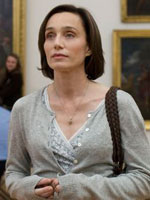
    Kristin Scott Thomas in I\'ve Loved You So LongHaving been a film critic for more than a quarter of a century now (my God) and a film junkie for more than 40 years, I have never gotten over the joy of surprise when an actor or actress comes out of left field with a performance of such brilliance it eliminates every single bad performance or bad film they have ever been associated with.

    As a critic and a journalist, I tend to call it as I see it, sometimes to a fault.  I remember a stunned Al Pacino looking at me flabbergasted when I asked why the devil an all powerful evil being would have to shout so much as he did in “The Devil’s Advocate.”  He eyed me up and down for a few uncomfortable seconds before answering, beginning with, “So your one of the honest guys.”

    And there have been those delicious moments when I have been forced to eat my words. And you you know what?  I love it.  I love seeing an actor I had written off or dissed deliver a breathtaking portrayal to the point that I can scarcely believe what I’ve seen.

    It happened this year for me with Kristen Scott Thomas in “I’ve Loved You So Long,” a stunning piece of acting from a thesp I had previously loathed. I remember being at press screening for “The English Patient” in the fall of 1996, after barely enduring the film.  Thomas was ice cold, leaving me to wonder who could love this woman, and worse, why would they?  Nothing else she has done since impressed me much until now, and frankly, her performance left me in awe.

    There have been others, of course.  Sally Field had been written off as “The Flying Nun” and Burt Reynolds’s latest squeeze in those goofy “Smokey and the Bandit” films in the late 1970s.  She gave a remarkable performance on TV in “Sybil” as a woman with multiple personalities, but nothing prepared me for her superb performance in Martin Ritt’s beautiful little film “Norma Rae,” about a woman recognizing her potential amid textile union politics. Field was astounding, winning every major acting award there was, including the Oscar.  The performance remains one of the finest ever captured on film.

    (more…)

  • Forster on Bond: It’s about character

    Odd to be linking to Time Out twice in one day, but I couldn’t let this interview with Marc Forster, director of the keenly awaited “Quantum of Solace,” go by. The interview finds Forster in London, scrabbling to complete the first edit of the latest 007 outing in a fortnight’s time.

    Many eyebrows were raised when it was revealed that the low-key director of “Monster’s Ball,” “Finding Neverland,” and “The Kite Runner” was taking on this most commercial of franchises – I always thought it rather a nice fit. For me, Forster never injected much individual flair or perspective into his otherwise workmanlike ‘serious’ pictures; I have a feeling more of his creative personality might emerge when working against the grain of his interests. Certainly, Forster doesn’t seem to be radically modifying his storytelling approach – he believes he was hired because the producers wanted a more “emotional component” to the film:

    Several times (Forster) mentions what he believes will be at the heart of the new film: character. ‘The great thing is that Daniel and I had an intense relationship, so between us we could always go back to the character … There’s this conflict going on: he’s an assassin, but he’s also lost someone he loves. We’re asking: where’s the psychological conflict in that?

    Sounds good to me. Other promising tidbits include Forster citing genius production designer Ken Adam, who worked on the first Bond films, as an influence on his creative vision, and a sneak peek at what promises to be the most exciting foe in some time for 007:

    We see a flash, too, of the new Bond villain, French actor Mathieu Amalric, who plays a character with the decidedly unvillainous name of Dominic Greene. ‘In the old Bond films, it was clear who were the good guys and who were the bad guys. Today, it’s not so clear. I feel like Mathieu looks so sympathetic and normal, the type you can’t see right away is the villain.’

    (more…)