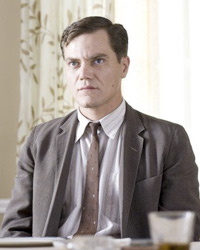
 If you’ve seen James Marsh’s “Man on Wire,” then you know of Philippe Petit’s dazzling tight-rope walk between the towers of New York’s World Trade Center on the morning of August 7, 1974. What you probably don’t know is that while Petit was criss-crossing back and forth between the towers for roughly 45 minutes, Michael Shannon was coming into the world down in Lexington, Kentucky’s Good Samaritan Hospital.
“I don’t think it means anything,” Shannon says. But it’s certainly an interesting aside to the Oscar season, drawing a connection, however meaningless, between these two contenders, one of them a thoroughbred frontrunner, the other deserving of that consideration but strangely under the radar this year.
I get a call from Shannon to kick off the morning. It seems he’s somewhat stranded at the hotel and will be late meeting me over at Hugo’s on Santa Monica Blvd. I later find out he was industrious enough to grab a cab rather than wait on a studio-provided car, probably the east-coaster in him. “Don’t worry,” he says. “I’m going to make sure we get a full hour.”
When Shannon walks into a room, his striking height seems to command at least a glance in his direction. A couple of brunching patrons stare for a bit, sure that they’ve seen him in SOMETHING before. And for a number of years, Shannon has been that kind of actor — the hard-working sort that AMPTP has certainly disavowed as SAG tries to find some sort of plan for sustaining the acting middle-class throughout the industry.
You’ve seen him in “Pearl Harbor,” “Bad Boys II,” “World Trade Center,” “Bug” and any number of bit roles that call for the unusual image he cuts. But you’ve never seen him like he is in “Revolutionary Road,” a two-scene wonder of a performance that cuts the the very core of a narrative already concerned with getting at the hardest of truths.
 Francisco and Diego, that is. Anyone else think there are a tad too many critics’ awards floating around out there? Seriously, what do they all mean? New York, Los Angeles, Boston and the National Society are the only ones that really register with me… maybe Chicago, if I’m feeling generous.

 It’s a rare achievement, but through the ups and downs the last fortnight’s precursors, one film has failed to miss a beat, landing gongs from the New York, Los Angeles and Washington critics, as well as the NBR and the British Independents, not to mention Indie Spirit and BFCA nominations.
 As I suspected, “Rachel Getting Married” and “The Wrestler” were
 The Best Picture victory for “Milk” is going to be the lede for most people as far as today’s New York Film Critics Circle awards is concerned, but the bigger story is “Happy-Go-Lucky,” which finds itself right back in the thick of the Oscar conversation.
 Whenever an awards shortlist is announced, people will inevitably spend as much time, if not more, pondering its omissions as they will its inclusions. And so it has been this week, in the wake of the Academy’s announcement of the 15 titles
 The British Independent Film Awards are an odd, under-the-radar institution that frequently like to avoid the obvious and champion the underdog. Last year, for example, they bypassed the starrier likes of “Eastern Promises” and “Notes on a Scandal” to award their top prize to Anton Corbijn’s magnificent, under-rewarded “Control.” The previous year, they were even more daring: Best Film justly went to “This Is England” over “The Queen,” while Helen Mirren and Forest Whitaker — gasp — lost to the unknown leads of Andrea Arnold’s “Red Road.”
 The Gotham Independent Film Award nominees have been announced (note the change in moniker this year), and Lance Hammer’s Mississippi drama “Ballast” leads the pack with four nominations. Six films received two nominations apiece, including Charlie Kaufman’s “Synecdoche, New York,” Jonathan Demme’s “Rachel Getting Married” and Woody Allen’s “Vicky Cristina Barcelona.”
 I must admit, the