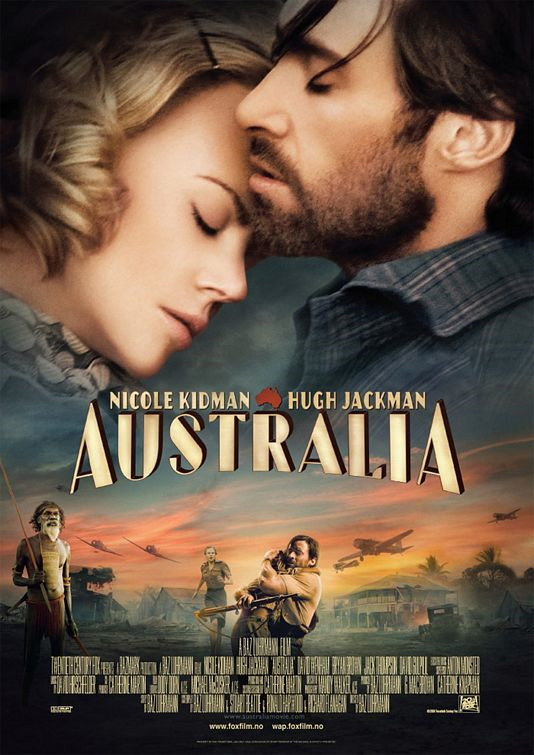
 I haven’t hidden the fact that I’m in the tank for Baz Luhrmann’s “Australia,” or at least I hope to be — when we’re eventually allowed to see it. It is, bar none, my personal most-anticipated title of the next two months, sink or swim.
I am, however, beginning to get nervous about its Oscar chances, as troublesome buzz circulates about its down-to-the-wire editing and last-minute narrative changes. The Academy tends to shy away from anything that might be perceived — deservedly or not — as a grand folly, preferring works that play the publicity game a little safer.
A part of me has thought for some time that, should “Australia” overcome the naysayers, it could be welcomed by voters as a return to the more “traditional” model of Best Picture winner — sweeping, romantic, period-set and controversy-free — after four consecutive years of honouring bleak, un-pretty and (relatively) modern-day works. It’s argument that can also be made in favour of another unseen film widely presumed to be the one to beat: “The Curious Case of Benjamin Button.”
However, over at The Film Experience, Nat Rogers makes an excellent point to the contrary, suggesting that the romantic epic is less of an Oscar ‘gimme’ genre than we tend to presume:
My initial instinct, minus any research, was that Oscar loves to be romanced by beautiful people in period finery, their love story intertwined with famed world events. But is that really true? Perhaps it’s just that early Oscar champion “Gone With the Wind” casts a really long shadow …
Oscar isn’t always in the mood for retro loving. But even when they aren’t, the films can quite often emerge with Best Actress and Costume Design nominations and a stray nomination of some other sort. “Australia”‘s chances in a wide array of categories clearly hinge on how deep audiences fall into reciprocal love with Kidman’s aristocrat and Jackman’s cattle driver.

 In a week in which there were more important things going on than the movies (an outlandish notion, I know), these were nevertheless some of the highlights:
 From a recent
 No matter how good the storyline, plot, acting, photography and other elements of a film may be, any poorly edited film will be difficult to watch, understand and enjoy. An editor has the task of not only finding the appropriate length of a film but also putting together scenes so they flow coherently, both visually and story-wise.
 Baz Luhrmann’s massive “Australia” keeps hurtling nearer, with the director apparently in an editing-room frenzy to have it ready in time. A new


 Swoosh. Bang. Grunt. Clink. Crash.

 The Academy Award for Best Art Direction is somewhat of an odd category in that the art director does not actually receive a nomination or statuette. Rather, the award is given to two individuals with unique roles in the crafting of a film’s sets. The production designer heads up the entire art department, specifically in charge of set creation and design. The award also recognizes the set decorator, responsible for filling in the sets with details and dressing to bring them to life.
 The Academy Award for Best Costume Design recognizes, shock of shocks, the clothes and accessories worn by actors in a film. Clothing can add to the story and express the nature and situation of the characters who wear them.
 As we head into the weekend, here’s a quick overview of what we (and you) have been talking about at In Contention this week: