In Contention

Tag: Alexandre Desplat

  • 8/31 Web Round-up

    Ang Lee• With “Luke and Brie are on a First Date” finding its way to an Amazon release, our own Chad Hartigan gets his film re-reviewed. [Spout Blog]

    • Stephen Zeitchik wants to know why Ang Lee can’t catch a break. [Risky Biz Blog]

    • Gregory Ellwood sees (er, hears) awards prospects in Alexandre Desplat’s “Coco Before Chanel” score. [Awards Campaign]

    (more…)

  • ‘Chéri’ website launched

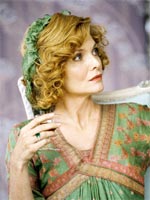
    CheriAs you know, despite a mixed critical reception over here in the UK, I was quite taken with Stephen Frears’ “Chéri,” a tarter-than-expected Belle Epoque romance that showcases the director’s best work in nine years, and Michelle Pfeiffer’s best work in … well, longer than that.

    I’m not sure how the film, a rather subtle specialty item, will play on its American release in a month’s time, but Miramax clearly has hopes for it, and have launched this rather attractive official website to make their case. (They appear to have dispensed with the accent aigu, perhaps to prevent anyone mistaking it for a foreign-language effort.)

    The site features the standard promotional bumf, but does a good job of showing off the film’s lavish technical credits, particularly Consolata Boyle’s costumes and Alexandre Desplat’s lovely score, which is actually more delicate than the selected excerpt here suggests. Both are, I think, very much in the Oscar mix, while Pfeiffer’s radiant performance may need to find more critical champions Stateside to sustain momentum.

  • REVIEW: “Chéri” (***)

    CheriMy first thought on leaving the theatre after watching Stephen Frears’ crisp, elegantly turned new effort is that it is, in many ways, a consummate Frears film. My second thought, however, ran counter to the first: it has, over the years, become increasingly difficult to define what “a Stephen Frears film” might be.

    We are talking about a filmmaker, after all, who deals in polarities, following up the broad music-hall frivolity of the ghastly “Mrs Henderson Presents” with the austere docu-realism of “The Queen,” or a glib studio bauble like “Accidental Hero” with the jagged domestic comedy of “The Snapper.”

    The uncharitable could call Frears something of a dilettante, subsuming his own long-term artistic preoccupations beneath a veneer of versatile professionalism. That, however, would be to miss the keen emotional detail and bone-dry irony that lace themselves through all of Frears’ best work.

    Whether he finds them in a Chicago record store or an 18th century French chateau, Frears dissects his characters with an amused, academic precision that inevitably reveals the Oxbridge intellectual he is – and it’s a sensibility that meshes beautifully with the prose of Colette, who in 1920, wrote “Chéri” in much the same tartly tragic register that Frears and screenwriter Christopher Hampton tell it. (I discussed the novel in greater depth here.)

    Contrary to the shrill period rom-com that the trailer appears to be pitching it as, “Chéri” remains a cutting, economic study of love thwarted by the twinned obstacles of aging and social expectation. Painstakingly mapping the end of the affair between the eponymous 25 year-old playboy (Rupert Friend) and Léa (Michelle Pfeiffer), the world-weary courtesan twice his age, it becomes something of a dual coming-of-age story, as the lovers are forced to accept the indignities of adulthood and middle age, respectively.

    (more…)

  • TECH SUPPORT: Final predictions

    Tech Support at In ContentionAfter six months of Tech Support previews and interviews, the films have arrived, the nominations have been announced and the guilds, the critics and BAFTA have all announced their preferences.  Today we take a final look at the races before the envelopes are opened on Sunday.

    BEST ART DIRECTION
    After guild and BAFTA wins, I would say “The Curious Case of Benjamin Button” has cemented its frontrunner status in this category. Spanning decades of the 20th Century, Donald Graham Burt’s production design was impossible not to notice and gave us gorgeous backdrops for its character’s predicaments.

    The other nominees all have the odds stacked against them, whether similar work has been seen before (Michael Carlin’s “The Duchess” and Kristi Zea’s “Revolutionary Road”), is just not showy enough (Nathan Crowley’s “The Dark Knight”) or the nominee is otherwise along for the ride (James Murakami’s “Changeling”).

    Will win: “The Curious Case of Benjamin Button”
    Could win: “The Duchess”
    Should win: “The Curious Case of Benjamin Button”

    (more…)

  • A promising start for ‘Chéri’

    If it isn’t quite the unanimous chorus of approval one might have hoped for, there’s still enough praise for Stephen Frears’ latest film “Chéri,” which premiered in Berlin last night, to mark it as a potential 2009 contender in several areas — among them, Best Actress for Michelle Pfeiffer’s much-anticipated return to dramatic roles. (Thanks, of course, to the ever-diligent Nat Rogers for the heads-up.)

    The Hollywood Reporter’s Kirk Honeycutt is absolutely besotted with the film, gushing that there is “no false moment or off-key note” in the entire production:

    Stephen Frears never makes the same movie twice. What he does do though is make thoroughly professional and immensely entertaining stories that pay particular attention to characters, their flaws, emotions and deepest desires. In “Cheri,” he has another dandy. Whether it will travel as far as his last film, “The Queen,” is hard to say, but with a radiant Michelle Pfeiffer as his heroine, “Cheri” could well be another breakout hit.

    The chemistry between Pfeiffer and (Rupert) Friend is positively combustible. One feels the hunger in each, the rising physical passion and emotional vulnerability in two people who, if asked, would scorn love as a human weakness. The film is in English, of course, but it can’t escape a certain Frenchness: Those who would mock love are done in by love.

    There is also, predictably, much praise lavished on the film’s scrumptious-looking tech credits, with top honours going to Alexandre Desplat’s “nostalgic, romantic, melancholy score.”

    (more…)

  • WEEKLY WRAP: ‘Slumdog’ stays happy, Bale gets angry

    A slower news week, this, but that doesn’t mean we didn’t find plenty to discuss. Here’s what was on our (and your) minds:

    • In the week’s biggest precursor news, Danny Boyle won the Directors’ Guild Award. Hollywood is still reeling from the shock.

    • Oh, and “Slumdog Millionaire” nabbed the USC Scripter award too.

    • Speaking of scripters, we say “WALL-E” is taking Best Original Screenplay. Here’s why.

    • We take a detailed look at this year’s Oscar-nominated shorts.

    • The Santa Barbara fest wrapped, with a tribute to Mickey Rourke among the highlights.

    • Two London critics’ groups acquitted themselves well this week, giving long-overdue Best Picture honours to “Hunger” and “The Wrestler” respectively.

    • Does “The Curious Case of Benjamin Button” have a prayer in the Best Picture race after all?

    • Sticking with “Button,” Tech Support interviewed composer extraordinaire Alexandre Desplat.

    • We finally laid eyes on an Oscar season institution: the Vanity Fair Hollywood issue.

    • We contemplated what constitutes a genuine ‘upset’ in the Best Picture category.

    • BAFTA is taking a long hard look at their own voting process.

    • Away from the awards beat, you probably didn’t know this, but Christian Bale said some bad words.

  • TECH SUPPORT INTERVIEW: Alexandre Desplat

    Tech Support at In ContentionOver the last several years, Alexandre Desplat has gone from being a relatively unknown (in the United States anyway) French composer to emerging as one of the most acclaimed and sought after commodities in the business today.  Receiving his second Oscar nomination this year for “The Curious Case of Benjamin Button,” Desplat has continued to cement his place at the top of his field.

    Despite the acclaim, however, he remains very close to his home in European cinema.  “I have tried to keep as much of a relationship as I can with my French directors,” he says.  “I always try to go to do two or three French movies a year.  That’s a lot but I don’t want to lose that.”

    While there are certainly exceptions, there is definitely a difference in the manner that French and American filmmakers approach their work, Desplat says.  Being forced to think differently because of different filmmaking styles helps his creative resources.  “It feeds me,” he says.

    David Fincher’s “Button” posed unique challenges for Desplat.  “It doesn’t have a linear storytelling,” he says.  “It’s a complex puzzle and I’d ask myself, ‘How do you deal with this in music and deal with the main character when he is a passive character?’  It’s not easy to capture in music.”

    Describing the film as a “sound epic,” Desplat notes that the music had to be strong without being overly dramatic or imposing.  It was a crucial demand from Fincher that Desplat says he had to struggle with.

    The composer has worked with some of the world’s top directors in recent years – Ang Lee, Stephen Frears, Jacques Audiard — but despite Fincher’s unique perspective in the wake of those talent helmers, Desplat says certain professional similarities smoothed the journey.

    “He has an amazing quality as a collaborator,” Desplat says. “He’s very demanding but so am I so that’s fine.  He’s very detailed but so am I, so that’s also fine.  He wants his people to bring their own world, talents and colors into the film.  I think that’s the sign of a great director.  All the great directors I’ve worked with know that it is crucial that your creative energy is opened and not just restrained.”

    (more…)

  • Is ‘Slumdog’ score too pop?

    Thanks to Nat Rogers at The Film Experience for pointing out a really worthwhile article in the Wall Street Journal, in which music critic Jim Fusilli takes a close look at this year’s nominees for Best Original Score. It’s not a category which tends to inspire much intelligent coverage in mainstream outlets, so it’s great to see someone giving the race the attention it deserves.

    Fusilli starts by commending the Academy for dodging the iffy qualification issues that have plagued previous races — principally the weirdly flexible criteria that allowed “Babel” in, but not “There Will Be Blood” — though I would still venture that “The Dark Knight”‘s initial disqualification scuppered its chances in the category. In any case, this year’s five nominated scores are all clearly original works, and Fusilli is generally impressed by the calibre of the competition. He is, however, not entirely convinced by frontrunner A.R. Rahman’s work on “Slumdog Millionaire”:

    This year, voters will have to decide whether to recognize music that’s most memorable as catchy pop or symphonic music that illuminates story and character. Mr. Rahman’s ebullient work for “Slumdog Millionaire,” a film about a poor boy who may win a fortune on a game show, is likely the early favorite — last week, I stopped in a theater in Boston to see it again and members of the audience cheered when his name appeared in the end credits. That may not be what a film-score composer is looking for. As Mr. Elfman told me last week, “If I’m going for any reaction, the best I could possibly hope for is that they see my name and go, ‘Oh really?’ Writing a score that gets people to jump out of the chairs is a whole other ballgame.”

    (more…)

  • The costume design of ‘Benjamin Button’

    Costume design sketch from The Curious Case of Benjamin ButtonParamount Pictures has put together a brilliant little FYC site for “The Curious Case of Benjamin Button” that I’m just now getting around to, fit with the usual bells and whistles: downloadable screenplay, score samples (God Alexandre Desplat’s work is gorgeous), clips and interviews, etc.  You can enter the site by clicking on the ad at the top of the page here.

    I always look for proper care and consideration for the crafts of this film or that each season.  It’s our mandate, as long-time readers know, that those names get the same exposure as the biggest of stars.  Paramount Vantage always does a nice job of that with its Vantage Guilds website, but more and more, other studios are following Vantage’s example.

    For instance, on the “Button” site, there is a nice little gallery of costume design sketches from Jacqueline West’s portfolio, with screen test photos to go along with the ultimate look of the apparel in the film.  It gives you a nice cross section of the work and a look at its journey from the hypothetical to the tangible.

    And indeed, West’s work on the film is quite lovely, a much more thorough and certainly more varried array of threads than you might expect.  Cate Blanchett’s red dress from a key scene in the film has popped up in at least one Q&A.  Director David Fincher used some CGI nit-picking to amp up the red and add to the experience of the scene’s emotional beats.  But that’s not to take away from what West has done, which is outfit a hell of an epic with a beautiful wardrobe that walks the line between reality and fantasy nicely and understands that dichotomy, one that lies at the heart of the film.

  • Yes, it’s true — Zimmer and Howard are back in the mix

    Patrick Goldstein’s sources are apparently right on.  I was told by a representative party at tonight’s premiere of “The Curious Case of Benjamin Button” that, indeed, James Newton Howard and Hans Zimmer’s wonderful score for “The Dark Knight” is officially back in the running for an Oscar.  I was actually told this was coming two days ago, but had nothing to go on beyond one inside source, so I didn’t want to go there yet.  Oh well.  Here’s hoping it can translate to a nomination, but that pesky two-composer thing might still stick in the branch’s craw.

    It was an interesting place to hear the news, considering the only score that tops Howard and Zimmer is Alexandre Desplat’s sublime work on “Button,” the likely (and deserving) Oscar victor.

  • Well, it sure sounds pretty

    If, like me, you’re writhing in frustration at not having seen “The Curious Case of Benjamin Button” yet, here’s some minor compensation — you can listen to it instead. The score, that is.

    As you’re surely aware, it’s by Alexandre Desplat, who happens to be my favourite modern composer. That his only Oscar nomination thus far has come for his comparatively unadventurous work on “The Queen” is a shamefully inadequate testament to the creative breadth of his oeuvre.

    His balancing of romanticism and minimalism in “Birth” made for the greatest score of the decade, in my opinion, while the snubbing of his lush, culturally expansive score for “Lust, Caution” was just one of numerous ways in which the Academy’s music branch proved themselves unfit for purpose last year. I could go into his equally gorgeous work on “The Beat That My Heart Skipped,” or “Girl With a Pearl Earring,” or “A Self-Made Hero,” or several other titles, but time is of the essence.

    Anyway, suffice to say that his “Button” score sounds as layered, intelligent and seductive as you’d expect from Desplat — I can’t imagine the music branch turning a blind eye (or ear) to him this time. I only listened to a little, as I want to experience it in its entirety for the first time in the context of the film… I’m pedantic that way. But if you’re so inclined, check it out on the film’s BAFTA For Your Consideration site.

  • ‘Button’ drops (UPDATED with audio)

    Taraji P. Henson in The Curious Case of Benjamin ButtonUPDATED (5:30 p.m.): Alright, now that I’m home and away from the shuffle, I can unfold some further thoughts on this.  Judging by the mood of the room — mostly guild members and industry types, a lot of press folks have decided on the 6:00 screening — the verdict is a big thumbs up.  Lots of positive thoughts dished about all around.

    I spoke briefly with Kathleen Kennedy, who has seen this project go up and down, back and forth for 18 years.  We talked about the visual effects in the film and how refreshing it is that this innovative work came within such a cerebral and affecting story.  “Jurassic Park” (which she also produced) has held the industry effects crown for 15 years, and now, a new leap forward.  Though director David Fincher has said from the start that he and his crew weren’t particularly sure whether they could pull it off, Kennedy took solace in her filmmaker’s professionalism.

    “When you bring in a director like Steven [Spielberg] or David [Fincher], you trust their instincts when it comes to that stuff,” she said.  “They come along with this giant tool box and they know which tool to use for this or that.”

    I also chatted with Eric Roth for a good while, screenwriter-to-screenwriter type stuff.  He really did work wonders with this story, and picking his brain for the reasons behind this decision or that can be a lot of fun.  One of the odd reactions I took away from the film, however, was that the work felt strangely cold.  I wasn’t sure whether I meant that in a good way or a bad way, and surely, people were crying their eyes out over this thing, so I might be in a minority.  Perhaps it’s my youthful cynicism, who knows, but I thought Fincher brought an arm’s length approach to the emotions in the film and I wanted Roth’s reaction to that.

    Of course, Roth doesn’t particularly agree with my take.  Indeed, he was right in the middle of telling me how the bathroom was filled with sobbers after the screening when a beautiful young lady walked up to us and told him how much the movie had affected her.  But he took my comment in stride.

    “Fincher is the kind of director that brings you right up to the point of sentiment and then brings it back,” he said.  “There’s something to be said for that I think.”

    (More, plus audio of tonight’s Q&A, after the jump.)

    (more…)

  • Paul Cantelon’s beautiful ‘W.’ score

    Cover of W. Original Motion Picture SoundtrackA huge thank you to commenter Markku who points us to emusic.com’s sampling of Paul Cantelon’s original score for Oliver Stone’s “W.”

    I have to say, it’s a beautiful piece of work on the whole.  Lots of haunting melodies, plenty of southern flavor here and there, a nice waltz thrown in to emphasize the bumbling nature of the “protagonist.”  I’m loving this stuff!

    Cantelon, by the way, is having a hell of a year way, WAY under the radar.  His work on Justin Chadwick’s “The Other Boleyn Girl” is still one of the better scores from 2008.  If he keeps this up, he’ll find himself on a fast-track to awards success just like Alexandre Desplat did after bursting onto the scene in 2004 and 2005.

    I should be seeing “W.” any day now.  The film has been screening for various journalists, I just haven’t been considered cream of that crop to date.  But we will definitely be covering all the “W.” goings on from the London International Film Festival as Guy brings us the daily latest.  So keep an eye out for that later this month.

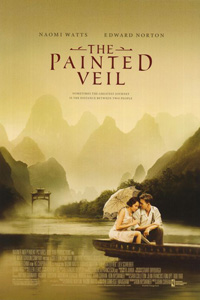
  • REVIEW: “The Painted Veil” (***1/2)

    Warner Independent Pictures\' The Painted VeilRomance seems to be the theme that sparks the most diverse reaction from the artistic community, filmmakers in particular.  There are various methods and structures utilized to tell tales of the elusiveness of love, and new, fresh takes on this binding structure of human interaction come into the cinematic arena every year.

    Some audiences prefer the restraint but equal probing of, say, “The Remains of the Day.”  Others might yearn for the creative ferocity of “Eternal Sunshine of the Spotless Mind.”

    John Curran’s “The Painted Veil” might not be as calm as the former, and certainly not as unique as the latter, but it is nonetheless a story fabulously woven and penetrating in its exhibition of a new kind of love story.  It is one of the year’s finest films.

    Based on the M. Somerset Maugham novel of the same name, “The Painted Veil” is a tale of forgiveness above all else.  It is a deconstruction of our surface frailties and a call to understanding the virtues that lie beneath, and certainly, the lessons that might be learned all too succinctly with the experience of poor decision.

    Conveyed through a creative structure and filmed with long, deep breaths of beauty and compassion, John Curran’s effort propels him from an independent background and into a stoic place of assured filmmaking competence.

    He might be a director to keep an eye on in the future.

    Naomi Watts stars in the film as Kitty, a spoiled and monetarily nurtured sort who longs to break away from her meddlesome mother and tiresome life in London.  She meets Dr. Walter Fane (Edward Norton) at a family gathering one night and the good doctor falls for her immediately.

    Inevitable courtship commences, though Kitty doesn’t seem to take a specific interest over the course of two years (which fly by in the tight structure of the first act) until Walter asks for her hand in marriage.

    Kitty agrees, if only to break free of the ties of London, and the doctor whisks her away to Shanghai, where he will be working and studying.

    All of this is told betwixt scenes depicting a very different Mr. and Mrs. Fane making an overland voyage to a Chinese village, a couple uncomfortable with one another and uninterested.

    This cross-editing comments directly upon the present in a structure recently apparent in Christopher Nolan’s “Batman Begins.”

    As the past blends with the here and now, the first act comes to a head with Walter’s discovery of Kitty’s affair with Charles Townsend (Live Schreiber), a popular diplomat in Shanghai who is also married.  Under the threat of divorce (and therefore scandal), Walter forces Kitty to accompany him to the faraway village where he will study and help treat a cholera epidemic, and in so doing, perhaps glean some sort of pleasure from Kitty’s distress at the expedition.

    Naomi Watts and Edward Norton in The Painted VeilTensions, meanwhile, are running high between nationalist Chinese and the westerners they feel are invasive to their way of life.  Held somewhat emotionally captive in this unfamiliar environment, Kitty spends her days and nights wasting away and feeling useless.

    Walter avoids her, quite clearly considering her with disgust and disdain.  But the man Kitty married, she never bothered understanding or even knowing, and so a trying excursion to the Far East, it seems, might reveal the good man she was too selfish to discover, and the life she has wasted on herself for far too long.

    “The Painted Veil” is a complicated but delicate film.  It really is a lasting sort of story, however, and credit seems to be best served to writer Ron Nyswaner.

    I personally have never read Maugham’s novel, so if the first act structure of the film is apparent therein, forgive my ignorance.  But my assumption is that is not so and it was the clever creation of Nyswaner to comment directly on the Fanes through a simple but purposeful structure from the first frame of the film.

    Whoever is responsible, the device is a brilliant one because it works on so many levels.  Nyswaner (who was nominated for an Oscar in 1993 for his original screenplay “Philadelphia”) also takes a certain care to pace the story with a sense of measure, but never at the expense of interest.  A film that might seem boring to some is in fact quite engaging throughout.

    Edward Norton and Naomi Watts have a specific chemistry that is extremely organic to the piece.  Norton in particular (who also served as one of the film’s producers) provides perhaps his best performance since “American History X,” and certainly his best since “25th Hour.”

    He trumps the quality he tends to have difficulty shaking, that tendency to be Edward Norton first, the character second.  Here, he is fully believable and lived-in as Walter.
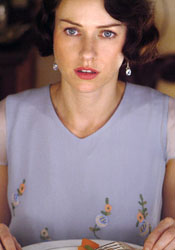
    Naomi Watts in The Painted VeilNaomi Watts shines and has the clear character arc of a woman who grieves for her past mistakes.  Kitty is extremely child-like at the film’s start.  By the end, she is a woman with a life of experience and a future that would have been uncertain otherwise.

    It is a slow revelation for the character, which in some ways makes it more poignant.  To paraphrase, a convent nun puts it to her late in the film, “When duty and love are one, then you are truly full of grace.”

    And that is the lesson Kitty learns a thousand miles from familiarity.

    Another performance worth commenting upon is Toby Jones’s portrayal of Mr. Waddington, a liaison for the Fanes who is quite the warm friend of the family, so to speak.  It’s the kind of small but meaningful turn that Harvey Weinstein would have ushered to a supporting actor nomination in the 90s, one that typically slips under the radar in today’s movie-going environment.

    The technical elements of the film are quite lovely, hinting at the works of James Ivory or Anthony Minghella in some instances.  Stuart Dryburgh’s cinematography thankfully avoids the temptation of drowning the scenery out in golden hues and tonal recreations, rather depending on putting forth beautiful imagery to tell the story first.

    The work of editor Alexandre de Franceschi is some of the most understated but clearly exemplary efforts at the AVID this year, and Alexandre Desplat’s majestic score is his finest work to date, fit with soaring themes and delicate subtlety.

    “The Painted Veil” is the crowning jewel of producer Bob Yari’s output this year.  It is also a fantastic get for Warner Independent Pictures, who might try harder with the film than a larger distributor would (though that is yet to be seen).

    It is a comforting reminder of the filmmaking medium, that stories can be told with beauty and simplicity and still evoke effective emotional impact.  A fantastic effort.